

Help with setting up a mixed flowering hedge
Hello
We are trying to plan a hedge to put on a fence line.
The fence is 160 ft long, runs north south and is on the east side of the house.
zone 8b - northwest Washington - sandy soil - partial shade - from the cedar.
The cedar tree on the north and south end of the line is about 30-40 ft off the fence - west of the fence. - I attached an image of the layout.
The red line is the fence, the brown line is where i want the hedge.
Im thinking i should plant the shrubs about 5 ft in front of the fence assuming it will grow a couple ft wide - this will leave 2-3 ft behind the shrub and fence.
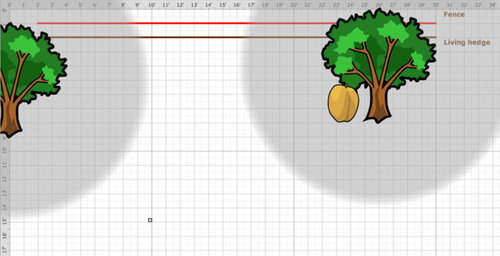
i forgot to add the house but there is a little square where the 15' and 10' line meet. the house is probably 6 squares to the right.
so from the house, you see the hedge and the hedge should hide the fence. Then there is a cedar way left and a cedar to the right
The 2 trees on the image are actually cedar trees. the soil below it is acidic and then the shadow.
I would like the shrub to be 8ft tall plus, i want it to be thick so it will keep the dog in the yard, i read that it should be a mix of evergreen and Deciduous but if this is for a privacy fence, do i really want bushes that leaves fall off every year?
I want some to flower in spring and some other stuff to flower in fall and summer
I also think i would like 2 rows of shrubs so it meshes together a little bit better.
I would then like to put smaller flowers infront of this living shrub
and then maybe some dwarf trees infront of this living shrub - i like the sugar maples with the red/orange leaves.
i have 4 sweet Viburnum (can grow to 8 ft + )and 7 viburnum sweet bouquet (5 ft) in 1 and/or 2 gallon pots waiting to be planted.
I also have a list of plants that should work from the local nursery but im
not sure how to lay it all out so it looks nice and complete 5 years from now.
Would you do a solid green hedge in the back and then the smaller more colorful plants in front (2 rows of shrubs) or would you just mix the shrubs that are full of color through out the space?
what % should be evergreen what % should be Deciduous?
should i stick to 3 or 4 types of shrubs in this space or can i put 50 different types of shrubs in this space? if i go two rows i think i would need about 80 shrubs?
can i start with one gallon pots and have a hedge that is 5 ft tall within 2-3 years? or should i start with 5 gallon pots... i have time to wait but im not sure how much time this all takes.
i have a good idea of what plants can be planted, i actually have a list from the nursery but im not sure how to lay it all out, if these plants grow well together, or if they will look well together all said and done.
By layout i mean, if a sweet viburnum goes here and will be about 8 ft wide, where should the California Wax Myrtle go, what about the Mock Orange, what about X, y, and Z?
All said and done, i do not think i will like the look of a big bush that has white flowers, next to a big bush with red flowers, next to gold flowers. i do not want a stop and start look, i want a blended look - does this even make sense?
Thanks
Signed - confused.
Comments (30)
 7 years ago
What is the list of plants the nursery gave you to choose from? And exactly how much shade and at what time of day is it present? Is there any direct sunlight? And you mention a fenceline but then go on to talk about your hedge as a privacy "fence" and to keep the dogs in.....is there an actual physical fence or is the red line just the property line?
Evergreen shrubs are just not that floriferous :-) Except for rhododendrons and azaleas, most will have just a few flowers for a short period of time. And the more shade they are growing in, the fewer flowering choices are available. That's the advantage of mixing deciduous with the evergreen :-)
Photos of the area in question would be very helpful.

100 904
Original Author7 years agoHi
Plant list that is available now..Evergreen Plants
California Wax Myrtle Myrica californica spring blooming, native
Mock Orange Choisya ternata spring blooming
Evergreen Huckleberry Vaccinium ovatum spring blooming, native
Boxleaf Honeysuckle Lonicera nitidia spring blooming
Deciduous PlantsKing Edward Flowering Currant Ribes sanguineum ‘King Edward VII’
Bloomerang Dark Purple Lilac Syringa ‘Bloomerang Dark Purple’
Dawn Viburnum Viburnum x bodnantense ‘Dawn’
Midwinter Fire Dogwood Cornus sanguinea ‘Midwinder Fire’
Oceanspray Holodisus discolor
Thimbleberry Rubus parviflorus
Wild Mock Orange Philadelphus lewisii
There is a physical fence but it is the other guys fence, and it is just an old chain link. 2 sections are falling down on itself and 3 other sections is not touching the ground and that fence is to keep the neighhbors dogs in.
but it is also see through - their dog and my dog cant be outside at the same time.
i want the shrubs to hide the fence, and i also just want one side of my house to be a living hedge - this is the easiest side and the fence just happens to already be there.
how much shade....
im actually not really sure. I just moved in. this is all on the east side of the house so it will get morning sun but most of the area will be covered by shade from the cedar on the right side of the image i provided for a couple hours a day. . The right cedar tree is south so the hedge is planted north of the tree.
im not sure what the suns path is here, i know it is not directly over head, the sun will be a little south of that south cedar (to the right) casting a shadow to the left of the right tree. From looking at google/bing/yahoo/map quest and old real estate listing pics it appears that the shadow will last 3 or 4 hours late morning and/or early afternoon. Sorry for the long explanation, i just dont know.
When i say keep the dog in, i mostly mean, hide the other dog from my dog and make it so the dog really has to try to get through it.
I will upload a video in a second.Related Professionals
Allentown Landscape Architects & Landscape Designers · Quincy Landscape Contractors · Brainerd Landscape Contractors · Coeur d'Alene Landscape Contractors · Vineland Decks, Patios & Outdoor Enclosures · Fort Dodge Decks, Patios & Outdoor Enclosures · Wausau Decks, Patios & Outdoor Enclosures · Bakersfield Landscape Architects & Landscape Designers · Fort Wayne Landscape Contractors · Bemidji Landscape Contractors · Athens Home Builders · Myrtle Beach Home Builders · Beaumont Home Builders · Charlottesville Home Builders · Charleston Home Builders100 904
Original Author7 years agoI took this video the other day so the end of it about the plants below the cedar tree and the smaller front of house flower beds are not related to this hedge question.
- 7 years ago
Hmmm....that list may or may not work very well, depending on exactly how much sunlight the area receives. Of the evergreens, neither the wax myrtle nor the boxleaf honeysuckle offer any flowers to speak of (yes, they flower but the flowers are not showy or are inconspicuous). And the oceanspray is not a plant that is typically included in a cultivated garden setting or shrub border - rather messy and unruly and better suited to a natural woodland setting. Ditto the thimbleberry.
100 904
Original Author7 years agoI think i already noticed some of the evergreens on the list prefer full sun which wont work but another evergreen was fine in shade and if that was one of the ones w/o flowers that would be fine for bushes here and there. i just dont want a 160 ft hedge that only flowers in 2 small sections.
10 ft wide of green w/o flowers would be fine i think if there was a a bush in front of it that was maybe 3 or 4 ft wide and 8 ft tall that had amazing spring flowers, then another smaller bush that was 2 ft wide and 3 ft tall that had winter flowers.
i do not want 160 feet of no flowers though.- 7 years ago
Yes, a number of those shrubs are best in much more or even full sun. The wax myrtle, for example, will struggle in much shade and be sparsely foliated at best.
- 7 years ago
How much depth to the planting area do you have to work with? If I were designing this for a client and for the reasons you state, I would opt for a pretty dense evergreen backdrop and then more showy, flowery shrubs in front. 8' is tall for most shrubs but the choisya should get close and grows rapidly. It blooms late spring and usually has a late summer or fall flush as well. And you can fill in here and there with Mahonia x media (winter flowering) or Pieris japonica Mountain Fire or Valley Valentine (spring bloomers). Also camellias. Or the boxleaf honeysuckle. IME, all grow much slower than the choisya.
For deciduous shrubs, I'd consider Hydrangea macrophylla or quercifolia (summer to fall flowers), winter hazel - Corylopsis (late winter), Deutzia (late spring), Clethra or Itea (late summer) or hardy fuchsias (late spring to late fall).
I certainly wouldn't pick them all!! I'd be a bit more miserly with the evergreen selections (limit your choices) and a bit freer with the deciduous. And to best accommodate a mixed shrub border like this I would allow at least a 10-12 foot deep planting bed.
- 7 years agolast modified: 7 years ago
If you are wanting a blended look, definitely go with the solid green hedge in the back and then the smaller, colorful perennials. Have you considered Holly bushes? They are evergreen, but provide color in spring (white), red (fall and winter). Their thorny leaves will prevent the dogs from getting to each other - effective immediately. Then put some long-blooming perennials in front of them - queen victoria lobelia (3-4' of bright red foliage for 9 months), and autumn stonecrop (pink flowers summer, fall, part of winter). You could put your 4 viburnum at intervals in front of the holly...look at the spring, summer, fall, and winter pics... the viburnum shown here is not the same species as what you have - pictured below is "roseum" ...so yours will look a little different.
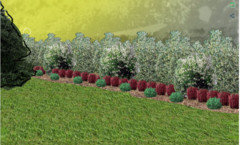
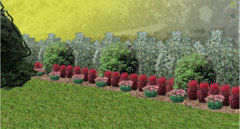
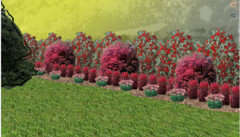
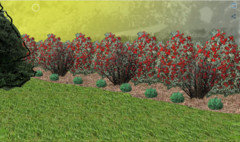
- 7 years ago
You could also just do holly in the back with your viburnum in the front. The idea with landscaping is not to do more than 4-5 types of plants in any given area. The repetition of plants is what makes the scene blend together.
- 7 years agolast modified: 7 years ago
English holly - the kind most frequently grown in the PNW - is borderline invasive here and not recommended to plant. Ditto with English or Portugese laurel.
And Lobelia cardinalis will struggle mightily through our very dry summers!! And not many flowering perennials will stand up to dog traffic very well, either.
It is difficult for those who live outside of this area to make reasonable plant suggestions just due the vagaries involved with this rather unique climate :-)
- 7 years agolast modified: 7 years ago
What county are you in? In terms of climate "Northwest WA" to me is from Marysville - where the native groves of paper birches - a cold climate indicator species - appear along I-5 - to the border. Consistent with this the Sunset Publishing climate zone mapping system shows the Puget Sound climate being limited to Island County and Fidalgo Island north of Everett, with the foothill/valley climate coming all the way to the shore east of the islands (except for a section west of Mount Vernon). And Anacortes being the last gasp of Sunset 5, with all lowland WA points north including the San Juans being in the colder belt.
This is due to the influence of the Fraser River, a pipeline for Arctic Air from the interior. If you are within this Fraser Outflow impacted zone I would not rely on the Mexican orange for instance as an architectural feature such as a hedge or screen. Plus it has other cultural limitations and just isn't the kind of thing that many would consider something making a nice backdrop or hedge in the style of traditional hedges like holly, yew or box.
Also what is the deer situation there? These tend to love "twig" dogwoods so you might have problems with the Cornus sanguinea, if you ever have deer in the yard.
For me one of the top choices for an evergreen flowering hedge plant would be Viburnum tinus but if you have Fraser winds or deer there might be problems with that. Otherwise there is Osmanthus burkwoodii. And O. heterophyllus - which stood out after the 30 year cold in 1989 and 1990 for being a broad-leaved evergreen (along with various rhododendrons and azaleas, of course) that didn't burn.
Portugal laurel is comparatively hardy and handsome as well but like English holly seeds out in our region. As do dozens of species of cotoneasters. And stranvaesia.
- 7 years agolast modified: 7 years ago
The lobelia would require frequent watering throughout the dry summers. We are in Zone 7/8, and our stonecrop does very well with the dry hot summers. Our lobelia is in a shady spot, and receives some water from the sprinklers every other day.
100 904
Original Author7 years agoCorrection... In the summer, the sun is directly above so this hedge will get more sun than i thought. some areas would be full sun while others would be more shaddy.
100 904
Original Author7 years agoHow much depth - i have a ton of room. I was thinking 2 or 3 rows think staggered layout.
I think i might have planted the 4 that are already to far from the fence - those are 8 ft from the fence. assuming a couple ft of width and i would have 5 or 6 ft behind the hedge so im thinking about moving the 4 shrubs i planted yesterday within the next couple of days so they are closer to the fence - would 3 ft of space between the hedge and fence be enough room to get in there and trip and whatnot?
I saw a couple images of a tall green hedge with additional color shrubs in front - i like this look.
So to confirm, you would plant just a couple verities of green shrubs in the back - these will form the tall privacy hedge.
then in-front of this green hedge, i would plant the colorful bushes here and there... some of these colorful bushes could be evergreen which would make the hedge fuller but i could also pick additional flowering deciduous shrubs...
and these colorful shrubs (evergreen or deciduous) you would use more verities than the green backdrop?
You said "I would allow at least a 10-12 foot deep planting bed." you mean the area is 10-12 wide right? not deep for the roots?
@Hoz-Tech - yes to the tall green in the back with a 2nd row of flowers and maybe even a 3rd row of smaller flowers...
"4-5 types of plants in any given area" THANK YOU!
I have read a little into holly but i think i read that it is invasive to my area. i could be wrong.
@gardengal48 (PNW Z8/9) - thanks for the additional comments about holly and laurel in the PNW
@Embothrium kitsap county - deer - i have not seen any nearby yet but i have only been in the house for a month. im not looking for deer resistant plants though... if a plant i get happens to be deer resistant though then that is a bonus.
What do you mean when you say "seeds out in our region"100 904
Original Author7 years ago@gardengal48 (PNW Z8/9) you said choisya for the green backdrop - would mexican orange work?
Side question - i looked up mexican orange and found https://www.monrovia.com/plant-catalog/plants/1639/sundance-mexican-orange-blossom/
is "sundance" just the cultivator or is monrovia the cultivator - this version doesnt need full sun but it doesnt get to the 8 ft mark - will keep looking.- 7 years ago
In Kitsap county - where I am located also - you are definitely in an 8b and can plant your choice of shrubs! In all my years of gardening in the central Sound area, I have never seen choisya with any winter damage!! But yes to the deer - they are a huge presence here!! (but the choisya is quite deer resistant). And Mexican orange is the common name for choisya :-) 'Sundance' is just a yellow leafed form of Mexican orange but does not get as large as the species (just Choisya ternata) and can look rather bleached out if in much sun. I am not overly fond of that cultivar.
100 904, if you go to my profile page (click on my screen name), you will see a Message tab in the upper right corner. If you click on that and message me directly, I am happy to do a little one-on-one with you. You also need to activate your Message tab - edit profile, advanced settings and click on Messaging (scroll down almost to the bottom). Then hit update. 100 904
Original Author7 years agoUpdated plan....
Choisya as the back drop i found a couple that get upto 6 ft but im sure there is a different version that gets a little bigger. if i can only get 5 or 6 ft out of them then that should work for the most part. I can just plant some dwarf trees behind the shrub or maybe in front - i like the sugar maple red in fall.
then i will use the sweet viburnums in-front - (i will call it the 2nd row) similar to what @Hoz-Tech did in the images they provided.
Question - i also have 7 viburnum spring boquets - these only get to about 5 ft tall - would you alternate spring boquet and sweet viburnum or would you just use one or the other here? I have plenty of other space that the spring boquets can go into.
I also have one Majonia Aquifolcum and one pieris flaming silver which someone said i could fill in the green back with. I got these 2 plants for the hedge already but i had planned on using these closer to the cedar trees since i was told that these can take the more acidic soil below a cedar.
Then the 3rd and 4th row would look similar to Hoz Techs image as well - i number of people have listed plants so i will go through the listed plants within this thread for rows 3 and 4 as well.
The cedar tree to the left and right (in the video i posted ) is a good distance away from the hedge but i thikn the cedar design can be tied into this hedge no? how would that be done?
And how much room do you think i need between the hedge and fence? would 2-3 ft work?100 904
Original Author7 years ago@vaporvac I missed that offer the first time around, we probably posted around the same time.
@gardengal48 (PNW Z8/9) I will message you in a bit - thanks for the offer! 7 years ago
With GG48 giving you advice, I haven’t weighed in because I am not in your area and she is a real expert, but I have done something similar. If you want to look at some of the photos of what I did, here is a thread where my comments and photos start about half way down.
https://forums2.gardenweb.com/discussions/3113384/shrubs-for-privacy-along-a-fence?n=22
I also created a bed with a backbone of one kind of evergreens and then a whole range of flowers and shrubs that stood out against the dark green backdrop, so either way works.
A few suggestions based on my experience:
Notice in the first photos how sparse my bed looks. The last photos are just 4 or 5 years in, and it is considerably fuller now having completed a full 10 seasons. If you plant too closely, the lower branches will get shaded out and you will lose some of your desired function. Be sure to check actual expected sizes somewhere like an arboretum or botanic garden in your area or use the experience of someone like GG48. Plant tags typically give shrub sizes at 5 or maybe 10 years, not actual growth expectations. I planted perennials between the shrubs initially and by now they are mostly shaded out or have been moved.
I love sugar maples (though I don’t know how they do in the PNW) but I wouldn’t include any maple in your row of plants. Give the maple its own space a distance away because they tend to have quite aggressive roots and will decrease the health of your other plants by outcompeting them.
You may need to plan on a light weight wire or fabric mesh fence on posts to keep your dog from setting up pathways through the shrub border for a year or two since the neighbor’s dog will still be somewhat apparent and your dog will want to patrol the area by the fence. Using something at planting time to prevent him/her from establishing that habit will help your shrub border be effective and let it fill in. If s/he establishes paths, they will likely remain.
I would love to see follow ups as you get going with this.
- 7 years ago
You want a green wall, but I would still put in some sort of fence;
otherwise, the two dogs will find a way to get through, possibly
damaging your plants, breaking branches and creating gaps. Don't rely on
a neighbor's fence to protect your dog! A welded wire mesh fence
(available in green or black as well as plain) stretched tightly between
t-posts would be very inexpensive and would disappear as your hedge
grows.
The evergreen huckleberry (on your list) actually prefers dense shade and would do well beneath your cedars. It is, however, rather slowing. It doesn't flower, but the leaf color is nice and the berries are delicious.
While this is not a tight-growing hedge plant, I love the various lonicera nitidas (Baggesens's Gold Honeysuckle and the silver and variegated cultivars) for an informal privacy screen. It is evergreen, grows well in shade and would contrast nicely with your cedars. I'm in NW Oregon, and here it grows quickly, roots easily from cuttings, yet has not been invasive. No flowers, but it makes a good backdrop. - 7 years agolast modified: 7 years ago
There's what looks to be the Monrovia clone (more than one cultivar is being offered under the name to the local market in later years) of Viburnum tinus Spring Bouquet = 'Compactum' about 10 ft. tall in downtown Edmonds.
- 7 years ago
Here on the Kitsap peninsula (where the OP also lives), it is only the deciduous huck (Vaccinium parvifolium) that prefers a lot of shade. Evergreen hucks tend more to open locations that receive a fair amount of sun and this plant is often grown ornamentally as a hedge in full sun. They can grow in shade but tend to be leggy and less densely foliated - in sun they are shorter and more compact plants and display bright coppery new growth in spring. And of course they do flower....otherwise, there would be no berries :-)
- 7 years ago
Lonicera nitida grows into a sprawling heap in my experience, especially in shade. I wouldn't use it in an informal hedge. It needs clipping to keep it shapely and sturdy. And although evergreen it can look very threadbare in winter. GG would Ecallonia, Hebe or Griselinia grow there?
- 7 years ago
"GG would Ecallonia, Hebe or Griselinia grow there?"
Depends on how close to the water the OP is. In my location, a bare block (if that) up from the Sound, the escallonia or hebe would be fine. Although I have never seen any hebe variety get close to 8' tall around here. Further away from the water, both can be damaged in a cold winter.....a number of escallonia hedges in this area were knocked back to ground level a few winters ago but did rebound. And I wouldn't recommend either for a planting area that received much shade. Can't comment on the griselinia, as to my knowledge, I have never seen it planted or even sold here.
I still believe the Choisya, Mexican orange, is a good choice for an informal hedge - grows pretty quickly, gets large enough and will tolerate both full sun and considerable shade although likely will not bloom as heavily in much shade. Also deer resistant and to date, I have never seen any appreciable winter cold damage, even in colder exposed locations.
I like Lonicera nitida and have planted several myself in my shady garden. But I dislike it when pruned or sheared and if left unpruned, agree it would make a poor choice for a hedge. A couple as accent plants in front of the hedge would work, however. Would make a nice textural contrast with the choisya!
- 7 years agolast modified: 7 years ago
Evergreen huckleberry has better foliage color and a more graceful habit in shade, often looks overexposed and tufted in full sun. Here in various locations near Seattle most wild examples are living in the gloom beneath second growth conifers, with only those along the edges of roads or other maintained openings getting more exposure.
Likewise red huckleberry grows in sun here, but looks stiffer and more up-swept than when it is shaded.
Griselinia gets presented to the local market off and on but I have yet to see a long established one on a local site. Whereas I have seen it as big as an apple tree at Humboldt State University in Arcata, on the northern California coast. Here in the U.S. the winter temperature regime analog to far western coastal Britain is the outer Pacific Coast from southwest Oregon south to wherever averages start to be higher than in Cornwall etc. (With plantings at Tresco Abbey having been compared to what is seen in Santa Barbara).
- 7 years ago
Perhaps it's my location (northwest Oregon in the Coast Range foothills), but all of my lonicera nitida hold their shape without flopping. Some are looser than others, but all have a pleasant form. It is most definitely not a formal hedge plant, and I wouldn't use it alone as a hedge, but even my 7-foot tall specimen in open shade has a handsome physique. I have this plant in various conditions, including dense shade, open shade, and full sun. The only difference I see is that it is gold in the sun and more of a lime green in the shade.
My evergreen huckleberries are in deep shade at the foot of Douglas Firs and cedars and are quite happy. i don't have gardengal's or Embothriam's experience, and I can only speak for my location, but according to Raintree Nursery, Vaccinium ovatum "grows best in the shade where it can reach 6-8 feet without pruning. In the sun it only grows to 3 feet tall." One Green World says "Evergreen Huckleberry likes shade or sun and moist, well-drained, acidic
soil. It will grow to 8 ft. in height in the shade and 3-4 ft. in
height in the sun." - 7 years ago
If your box honeysuckle is that color it's probably 'Baggesen's Gold'. Otherwise the species responds well to clipping, which makes it in fact quite suitable for formal effects.
- 7 years ago
My 7-footer is Baggesen's Gold and I have numerous plants from cuttings of it. I also have Silver Beauty and another variety whose name I've lost. For whatever reason, lonicera nitida grows beautifully for me with almost no effort.

Vaporvac Z6-OhioRiverValley