Software
Houzz Logo Print
joey_gordon89

6500k full spectrum vs 8500k gro-lux?

7 years ago
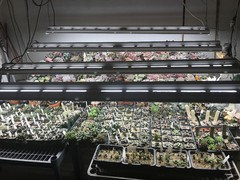
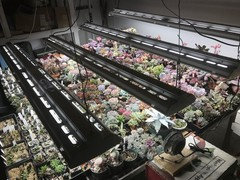
I currently have a small grow shelf set up in my basement where a single T8 light is used to supply “sunlight” to one shelf (approximately 1sqft).

It has come to my attention that the 3500k GE bulb I am using may not be enough for these plants. I am researching the purchase of new bulbs, but don’t know whether to go with a 6500k full spectrum bulb (15w) or a 8500k “gro-Lux” bulb.

What would be the better selection?

My plants sit about 6 inches below the lights and I am running them about 14 hours a day right now (with 3500k lights), but can adjust the timer to whatever.

Any advice is much appreciated!

Comments (18)

  • 7 years ago
    I’m really looking to stick with the T8 18inch bulb set up, but just don’t know which bulb is better for my succulents.
  • 7 years ago

    I just use standard fourescents, and my plants are digging it.


  • 7 years ago
    last modified: 7 years ago

    I used to use fluorescent lights quite a while back, and spent some time somewhat obsessively trying to figure out the "best" fluorescent bulb to grow plants (there are a LOT to choose from, especially if you get into the aquarium plant bulbs..) I eventually came to the conclusion that at the relatively low light intensities from fluorescent tubes, and the relatively small differences in spectral outputs among most "regular" and "plant" bulbs (keep in mind most advertised spectral graphs are rather idealized, nonspecific, and promotional in nature - don't put too much stock in them), the fancy plant bulbs really weren't worth the money. And honestly, pretty much any bulb between 2700k and 6500k that advertises "full spectrum" is going to work just fine.

    My vote is to buy the cheapest bulb. Also, if your plants really like "sunlight", it would help to lower your lights a couple inches (light intensity REALLY drops off quickly as distance increases, when using artificial light), and to increase the timer to 16+ hours. Oh - and don't use any of those diffusers (the covers that go over the bulbs/light fixtures).

  • 7 years ago
    last modified: 7 years ago

    I may be wrong, but disagree with one thing: 2700k is too low. I wouldn't use anything less than 4000k, and preferably higher than that. There is no need to keep lights on for 16hrs; get better k and lumens and keep them on for 12-14hrs. Price is consideration for most of us, but at the end, one gets what one pays for. Lights will cost something - cost of fixtures, cost of bulbs, electricity...but keeping cheep lights on for long hours will not supply what plants need most economically (I learned hard way - used to keep cheep lights on for 16hrs, but my plants were still etiolated).

    Joey

    I keep many succulents in the basement, and likely it is 6mo because of cold zone I am in. Cost of everything is a big consideration for me too, but I realize nothing is for free. I did mention that I use few different type of bulbs: many CFL (because I got almost 50 bulbs for free few yrs ago...they are all min 23W and 6500k); some T8 fluoro tubes; one T5HO. To help decrease the cost, I have done lots of work myself (bought vanity strips for CFL bulbs in resel store dirt cheep; also bought sockets for rest of them in same place and installed myself - not too pretty to look at but great for the basement :) Biggest saving is for electricity used: I switched day for night when hydro cost is considerably less. In the basement, there is literally no natural light. My lights are on timer, and come on at 7:00pm - 7:00am. I have only 1 light upstairs that is on during daytime, and keep rest of plants in unobstructed west facing windows. They are lower light plants like haws, sansevierias, and some jades. Jades could use bit more light, but they are ok. Few are blooming, and if any get etiolated, I just prune them comes Spring...

  • 7 years ago

    illsstep

    Yes, I do. In my zone, it is about 6mo indoors, 6mo outdoors. Plants that I have under lights are not etiolated, they are quite close to source (I already mentioned that on another thread). I still try to get them best light I can. 6mo is long time IMO :)

  • 7 years ago
    last modified: 7 years ago

    Sorry Rina! I didn't mean to make it look like you were responding to a "ghost" post. I wanted to reword what I wrote, but didn't have time to rewrite it.

    Rina is responding to my (deleted) comment that "making it through the winter under lights until they can go back outside" can be done with a bare minimum of light, while "trying to duplicate outdoor conditions to encourage lots of new growth" takes quite a bit of light indeed.

    Plants respond to total ("accumulated") light amounts as well as to light intensity and light duration. The first one is important, and if you're using fairly low intensity lights (such as fluorescents), all you can do to make up for it is to leave the lights on longer. That's why I suggested 16 hours or more - although if you're just trying to get your plants through the winter alive, the extra cost may not be worth the extra growth potential.

    I had also pointed out that any etiolation at all is a good indication that the plants are not getting anywhere close to optimal light levels. Looks like that was in reference to something I misread, but the point still stands!

  • 7 years ago
    At this point, I’m not sure if I will be moving them outdoors. I’m a little hesitant, with the type of gritty soil I use, that they might dry out faster than I’d like. I did go and purchase some 6500k lights to replace the 3500k I was using. They are 700 lumens and I am running them for 12 hrs a day tonight now, but plan to up that to 14-16 when spring arrives. I am curious to find out (aside from the sun) would be the best type of lights to use? I am limited on space as the lights are attached to the bottom of the shelf above the plants. Also, I want to try to stay away from lights that get too hot to avoid any safety issues.
  • 7 years ago
    last modified: 7 years ago

    Joey

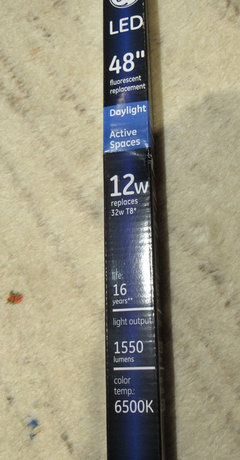
    700 lumens only? that is pretty low and I wonder what lightbulb did you purchased? Here is example of a tube that is LED - very little heat; replacement for fluoro T8. This one is GE, purchased at Lowe's:


    Most heat I get is from CFL bulbs, but even under those plants can be quite close to (I already mentioned distance of my plants in previous post). I just checked them, they are 1500lumens. Incadescent bulbs, that are not economical to use, would emit most heat (I don't think anyone uses them, or only very few).

    I am not sure if you mentioned your general location. My succulents are in a mix of just grit, perlite and little turface - very fast draining. When outdoors, they get 'watered' most often by rain. I water only if it doesn't rain for a while. What kind of mix do you use?

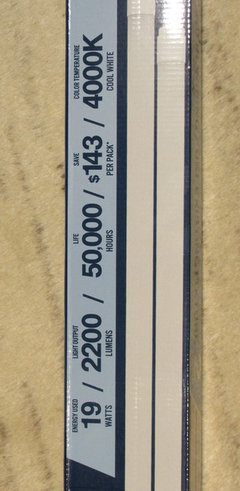
    I also have couple of LED tubes bought in Costco (2 pack), that are only 4000k but 2200 lumens:

    They also fit T8 fluoro fixture.

  • 7 years ago
    last modified: 7 years ago

    Rina - you're comparing 48" bulbs (yours) to 18" bulbs (his) - so no wonder his have a lower light output :)

    Joey - for limited overhead space, and a worry about heat, your only real options are fluorescent tubes or LED replacements for fluorescent tubes like Rina showed. In my opinion, at least. Better lights than those will all either need more overhead space, or will produce quite a bit of heat.

    As far as fluorescent lights go, high output T5's (T5HO) are the most powerful, and so have my vote for "the best". But you'd need to buy a new light fixture as well as new bulbs - you can't just put T5HO bulbs in your T8 fixture.

  • 7 years ago
    last modified: 7 years ago

    illsstep

    I didn't notice that Joey is using 18" lights...and do not know enough about length having less or more output of lumens. I considered wattage; but could be wrong...If so, I apologize to Joey for misleading him.

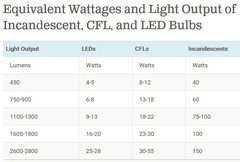
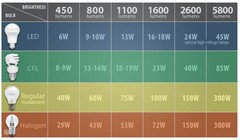
    Info below doesn't mention length, so I do not know if and how to apply it?

    ETA:

    I do not know if there is difference in lumens between tubes and 'round' bulbs. Here is another chart:

    Here’s a wattage equivalence chart but note that lumen-per-watt ratios can range mildly, even from LED to LED products, ranging across architectural lighting applications

    CFL lightbulbs I am using are 1500 lumens ea (23W) - at least that is info printed right on the socket.

  • 7 years ago
    last modified: 7 years ago

    Length of fluorescent tubes and wattage of those tubes are directly related. Longer tube = more watts = more light. I don't know exactly how CFL bulbs compare to the tubes, but the tubes are supposed to be more efficient (as long as you have a good reflector), because the coiled shape of the CFL bulbs directs a fair bit of light back at the bulb itself instead of out and away. So I don't think you can assume CFL = fluorescent tubes, in those wattage charts. You could probably make your own entry for the chart to compare the tubes though, just by Googling wattages and lumen outputs for the different lengths of the different types of fluorescent tubes.

    "Different types" is important though - all CFL bulbs are (coiled) T5 tubes. The different types of fluorescent tube lights (T12, T8, T8HO, T5, T5HO, T5VHO) will all have different watts/lumen outputs.

  • 7 years ago
    I am going to stick with the 6500k full spectrum for a while and see how it goes. I’m not looking to invest too much money into a different set up and I really think that these tubes will do just fine. Thank you guys for your help and input! I will post an update later as to how they are working.
  • 7 years ago
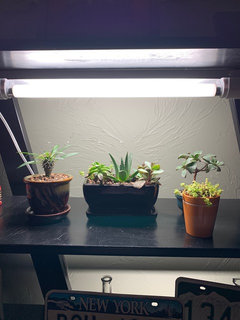
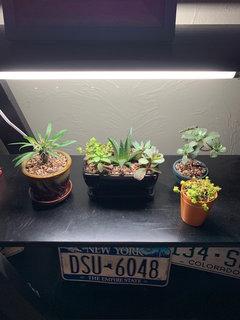
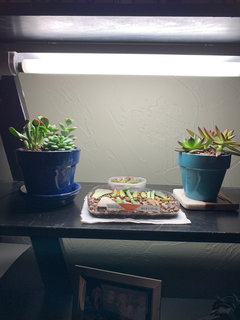
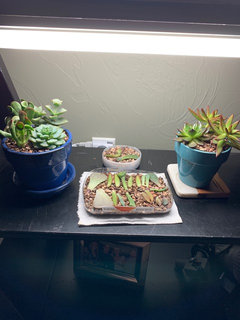
    Here is the set up with 6500k full spectrum bulbs. Do you think the plants are close enough?
  • 7 years ago
    last modified: 7 years ago

    JMO and I am often wrong, but you can judge by growth of plants, and the color. Compact growth is sign of sufficient light. Many will get great color too. Just make sure you don't burn them by sudden exposure to stronger light - you probably do not since they seem to have good color already (and were under lights before). If not sure, you can start with lights bit higher ad gradually lower them.

    Leaves you are propagating do not need very strong light (that 'premium' space is for more mature plants in my case), but ones plantlets start growing, I would make sure they are receiving enough.

  • 7 years ago
    last modified: 7 years ago

    I was using T5HO 54W 6500K tubes and spending a ton of $$$ on electricity. This year I have replaced these with retrofit "full spectrum" T5 24W 5000K 4100 lumens LED's. LED tubes cost about $6.30/tube. Plants are doing as well, if not better and my cost for electricity has decreased by 30% to 40%. I have kept plant to light distance and hours of usage the same. The lights are on for 9 hours currently and about a foot from plants.


  • 7 years ago
    last modified: 7 years ago

    illsstep

    I wasn't able to find much info abut how length of tubes affects light output. In photos I posted, wattage is either 12W or 19W and that is for 48" tubes. Yet the lumens are quite similar. I found some info according to length -HERE- for T5 and T5HO lightbulbs, for lengths of 22-58" (Table 1-2). Is there any site you could direct me to pls?

    I was going by the wattage rather than length, and considering any type of bulbs - possibly misunderstood:

    "To compare different light bulbs, you need to know about lumens. Lumens, not watts, tell you how bright a light bulb is, no matter the type of bulb. The more lumens, the brighter the light..."

  • 7 years ago
    last modified: 7 years ago

    Rina -

    Fluorescent bulbs (the tubes) have an identifying code, which is:

    F<watts>T<number><extra code>

    For instance:

    F32T8 (32 watts, T8)

    F54T5HO (54 watts, T5, high output)

    Each wattage for each type corresponds to a length of bulb. Each length of bulb is going to have a (small range of) lumen value(s).

    You can do a Google search for, say, "T8 bulbs", choose the result from a site like 1000bulbs.com to get a list of all the T8 bulb options (they will be displayed using the codes described above), and find out what length and lumen output corresponds to each wattage of bulb.

    Longer tube = more lumens because lumens are a measure of total light QUANTITY emitted by the light source. So a tube twice as long is generally going to emit around twice the lumens, although that is not a hard and fast rule.

    Note here, as I mentioned in the OP's other thread, that lumens are of limited use in figuring out how good a light is for growing plants.

Sponsored
Franklin County's Heavy Timber Specialists | Best of Houzz 2020!