Software
Houzz Logo Print
jesse_knight38

Need Help With Fiddle Leaf Fig

7 years ago
last modified: 7 years ago
Hello!

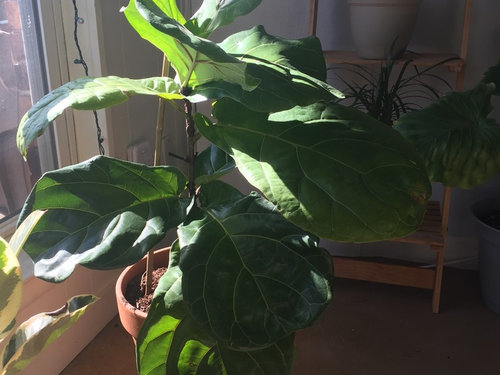
My beloved Fiddle Leaf Fig is giving me cause for concern. I'm not freaking out, but I'm fascinated by these plants and want to learn as much as I can. We haven't dropped any leaves, but the newer growth is beginning to yellow a bit. Here's the info.

I got the plant in April, and it has sent out three new growth spurts since then. It hasn't grown any since about October, which I attributed to dormancy—someone please correct me if I'm wrong.

Upon inspection over the winter period I've noticed the upper leaves are beginning to yellow a bit. Like I said, none have dropped, but the most severe leaf is taking on a rather chartreuse hue that isn't exactly standard for FLFs.

The plant has always lived in a sunny south-facing window. I did back off on watering a bit because I read they need less when dormant, but I always water upon seeing droop and testing the soil because I don't want to stress the plant out. I also went about three months without fertilizing, which may have been my mistake. I did fertilize the plant last week after reading that they need more frequent feeding.

The undersides of the leaves look perfectly normal, no spots; I meticulously check the bark, leaves, and soil for signs of pests/fungus/etc; I regularly dust the plant and wipe the leaves with a wet cloth; and when I water I do deep watering so about 10-20% of the water runs out of the pot.

Please let me know what this could be! This is my first winter with a FLF, so this may simply be normal, but if not I want to correct my habits to ensure a happy plant. Thank you in advance for the help!

-Jesse

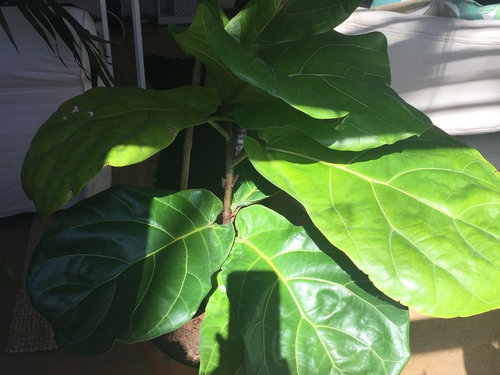
Image: The whole plant (it lives closer to the window, I pulled it away for the picture)


Image: Better view of leaves


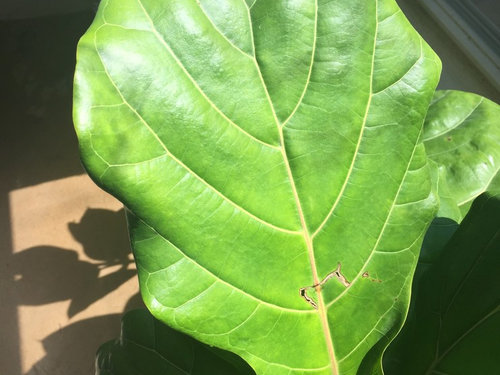
Image: Most recent leaf, grown around October, which is now yellowing (the leaf has had a small crack since it unfurled but I don't think this is a factor, as other leaves without any tears or cracks have the same yellowing)


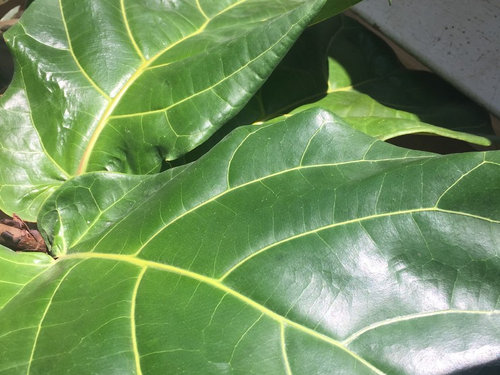
Image: Some of the lower leaves, which have the healthier dark green hue


Comments (6)

  • 7 years ago

    I'm no expert, but it looks pretty healthy to me. Just today, my FLF lost a lower leaf that had turned yellow--much more yellow that yours seem to be. And in the past week, it's sprouted 3 new leaves at the top--they seem rather yellow-ish to me but they're small yet. I find the FLF one of the hardest plants to "read," like a baby that cries but you can't figure out the reason.

    I believe you're doing everything right including the watering. They don't really go dormant in a traditional sense, but I do what I can to discourage growth in the winter, including less feeding and making sure it's fully dried out before thorough watering.

    Jesse Knight thanked Feathers11
  • 7 years ago

    Thank you! I was worried that perhaps I'd backed off on the watering too much, but I'm pretty vigilant with checking the soil and I don't typically kill plants so that's good to know. I'll stop worrying as much and chalk it up to Plant Seasonal Affective Disorder.

  • 7 years ago

    Hi, Jesse. Some of the nutrients plants absorb from the soil solution are defined as "mobile in the plant" (mainly N as nitrate, P as phosphate, potassium, magnesium, zinc), and some are "immobile" (calcium, iron, sulfur copper, boron), and some of these might be "moderately mobile" under some circumstacces . The immobile nutrients must be available in the nutrient stream at all times if the plant is to grow normally, especially calcium, because the plant can 'borrow' the nutrients from existing tissues. If one of the mobile nutrients is in short supply and the plant has enough energy to produce a new leaf, the plant will borrow the mobile nutrients from existing leaves. The most common deficiency is nitrogen, and symptoms are chlorotic (light green to yellowish) new growth, and chlorosis in the older foliage followed by shedding of older leaves if the deficiency is not corrected and becomes severe. My best guess would be that your timely application of fertilizer is just what was needed, so good job.

    If you aren't already doing so, you should flush the soil with some regularity. How often sort of depends on how you fertilize, what you fertilize with, and your watering habits. If that's something you want to discuss .......


    Al


    Jesse Knight thanked tapla (mid-Michigan, USDA z5b-6a)
  • 7 years ago

    Hi Al! Thank you so much for your help. It definitely looks like chlorosis was beginning to occur, especially given the lack of brown spots anywhere on the plant.


    Here's my fertilizing schedule, which I know is probably very incorrect...

    Up until last week I hadn't fertilized in 3 months which I believe was my mistake here, but otherwise I fertilize once a month with Miracle-Gro All Purpose Plant Food, using a ratio of 1/2 tsp. per gallon of water. My FLF is in a 13 inch pot and I flush it with the fertilizer solution until some runs out the bottom into the tray. I'm sure I could use a better product and schedule which I will absolutely implement; fertilizing is my weak point with plant care and I'm constantly learning. The ratio on this fertilizer is 24-8-16.


    I water my FLF about once a week or whenever the soil is dry to the touch around 2 inches below the surface. I check daily with my hand and a wooden bamboo skewer. I then water until the water runs out of the bottom into the tray.


    Again, thank you for your advice! I love these beautiful plants and want to make sure mine is happy.


    -Jesse

  • 7 years ago

    Thank you so much! This was extremely helpful and informative. I'm going to start using those methods from now on. My plant should be much, much happier now!