Yesterday we got sidetracked on a FB discussion that started out as a cabbage discussion because I mentioned to one of the members that you can grow brassicas under netting like Biothrips Proteknet or MicroMesh. I then added that you can then use the netting for squash the rest of the year, which got me to thinking about parthenocarpic squash. I like to grow summer squash beneath protective fabrics at least every other year because I just get tired of killing squash bugs and squishing eggs perpetually, day in and day out. It is one of those battles that you never really win, though you can keep them in check pretty well as long as you don't miss a single day of squishing the bugs and their eggs. Then, of course, there's the separate issue of Squash Vine Borers.
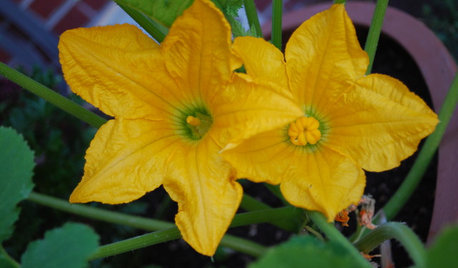
The big drawback to growing squash underneath summer-weight row covers or insect netting is that, in general, you have to lift the protective barrier long enough to hand-pollinate the flowers. This is not really time-consuming if someone is at home in the mornings and can do it, but it would be almost impossible for someone who starts their workday at 7, 8 or 9 a.m. It also adds an element of risk as both squash bugs and SVB moths may get into the squash plants during that short time period when you've pulled back the protective covering to hand-pollinate blooms. That's where parthenocarpic squash varieties come into play because you don't have to hand-pollinate them. So, yay for that, except that they tend to be zucchini varieties and I prefer yellow summer squash. Oh, well, you cannot have everything.
We know that Partenon (a traditional green zuke) and Cavilli (a pale green Middle Eastern type zuke) both are parthenocarpic and produce well under row covers or netting, but I was wondering if there was anything new in the parthenocarpic world. I did find one golden zucchini variety (actually, maybe 2, but I chose this one based on research) called Golden Glory. What I found interesting as I researched was a study that Cornell University did where they compared the yield of summer squash varieties grown underneath protective fabric. They used both parthenocarpic and regular varieties, and some of their findings surprised me. I'm going to link the study below. What you'll see as you look at it is that several varieties, some of which are not even labeled parthenocarpic, outproduced Partenon. Hmmm. So, as I looked I made a note of the top-performing varieties, and then I searched for their seeds. The five I focused on were Golden Glory, Dunja (as a bonus, it is powdery mildew resistant), Noche, Partenon and Costata Romanesco. I did notice that Cavilli is not even listed in the research study, but it has performed well for me under netting and row cover here.
So, here's the research study:
Cornell Squash Study
One thing to note is that they refer to Golden Glory as a yellow summer squash, which may be confusing. It is not a traditional yellow summer squash of the type that we grow in the south and in the central plains. It is merely a golden-colored zucchini variety. So, keep that in mind. Their highest producing yellow summer squash had a fruit set rate of only 39%, but when you consider that it is of the type considered to 'need' insect pollination or hand pollination, then 39% is a pleasant surprise. I found it really interesting that non-parthenocarpic Golden Glory, Dunja and Noche all out-produced Partenon. Hmmm. That is very interesting food for thought. Since they bagged blossoms to ensure they excluded all bees, I think it is a very good research study because without the bagged blossoms we probably would have assumed that some little tiny pollinators got underneath the coverings and were pollinating Golden Glory, Dunja and Noche. If you want to grow Costata Romanesco, it is an old O-P variety and I see it on local seed racks all the time.
I'm thinking that since I'm moving all the tomatoes to the back garden and will have plentiful space in the front garden, I can plant a whole row of squash in one of the usual tomato beds, put up hoops, put insect netting over the hoops and test these varieties, plus a couple more, head to head to see how they produce here. Experimentation of this type is fun, but I don't have room for it in years that I grow only in the front garden. I'm not going to bag blossoms because this row is for my own use and is not a university research study. I'm thinking of growing Golden Glory, Dunja, Noche, Partenon, and also Cavilli, Multipik (yellow summer squash) and Bossa Nova zukes. I already have the Noche, Partenon, Multipik, Cavilli and Bossa Nova seeds, so I'll only have to order Golden Glory, Noche and Dunja. I think I'll order all three from JSS. Some of them are available at other places, but some of those places sell seeds treated with neonics, and I won't buy from those sellers.
For netting, I have both MicroMesh and Biothrips Proteknet netting that I've used for several years now. I actually prefer MicroMesh, but the pre-cut lengths of it that are available are not as long or as wide as the pre-cut lengths of Biothrips Proteknet netting, so I'll probably sew together two pieces of the Biothrips so I can plant a long, wide double row of squash plants. If money were no object, I'd just buy a big row of the Biothrips netting in one of the wider sizes but money is an object because I try every year to avoid spending too much on gardening supplies....since we are saving retirement and that retirement date is getting closer and closer. . I don't want to spend $300 or $400 for netting to produce summer squash. It wouldn't be productive over the short term, and the fabric would have to last several years (the ones I have are going strong after 3 or 4 years of use) to have any chance of being cost-effective over the long term. I feel like the kinds of protective netting I have on hand already have paid for themselves in previous years, so no matter what yield we get this year, I'd consider it cost-effective. I do suspend our netting over low tunnel hoops (which are easy to make yourself). You also could use AG-19 floating row cover, but I'd suspend it over hoops instead of floating because our wind is pretty hard on it. Any row cover or netting a person uses in this manner must be held down firmly to the ground to keep pests from crawling underneath it. I prefer AG-19 to AG-15 because it holds up a little better in our strong Oklahoma winds.
So, that's my squash experiment. It would be so lovely if I could exclude the squash bugs to the point that they just die or go away. (That's not likely....they'll probably just move to other cucurbits.)
Oh, and woo hoo, we just made it up above freezing!
Dawn





bon
bon
Related Professionals
Montgomery Landscape Architects & Landscape Designers · Bowling Green Landscape Architects & Landscape Designers · Greenville Landscape Architects & Landscape Designers · Harrisonburg Landscape Architects & Landscape Designers · Boston Landscape Architects & Landscape Designers · Worcester Landscape Architects & Landscape Designers · London Landscape Architects & Landscape Designers · Ardmore Landscape Contractors · Miami Landscape Contractors · Elmira Landscape Contractors · Cleveland Landscape Contractors · Fresno Landscape Contractors · Honolulu Landscape Contractors · Montréal Landscape Contractors · Madison Accessory Dwelling UnitsOkiedawn OK Zone 7Original Author
bon
AmyinOwasso/zone 6b