Software
Houzz Logo Print
webuser_704931868

Identify this citrus please

7 years ago
Hi!


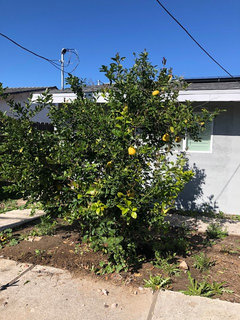
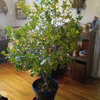
I recently transplanted a fairly large citrus tree to my house. The tree was planted in the ground. The new house owner wanted the tree gone to re-do the cement. He said it was a yuzu tree.


I asked today how he knew it was a yuzu tree. Turns out it was just his assumption from his research and he had never received this information from the previous house owners.


I'd like help in identifying this fruit / tree.


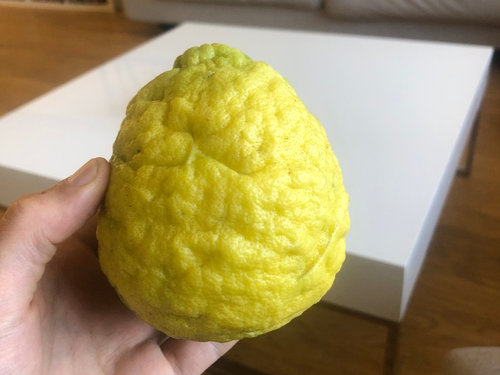
Very large fruits, heavy, very juicy, lemon flavor, quite delicious too.

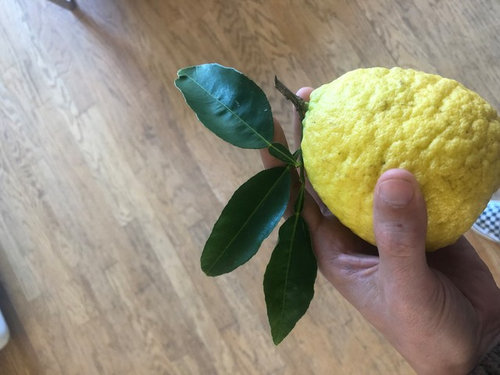
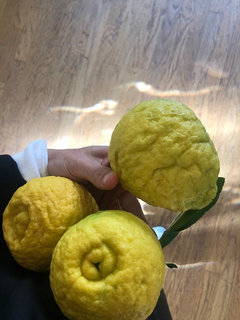
Distinctive bumpy skin all over,

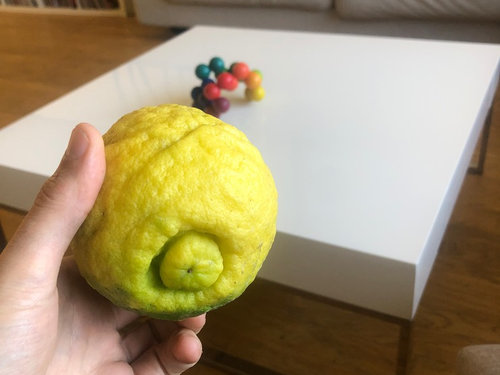
and even more specific is that every fruit has a recessed apex (see picture).


Peel is not thick, and very easy to peel off.

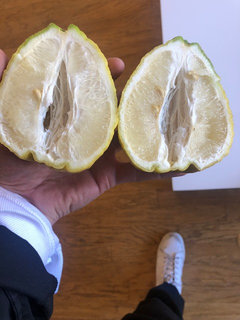
Quite a few small seeds.


Blossoms are purple tinted, new growth is also purple tinted.

Tree has many sharp thorns.


Could this be a rootstock that took over? The "citron" fruit doesn't seem to match the fruit description.


I figured it might be a ponderosa lemon but not all ponderosa lemon images I can find share this distinctive recessed apex. And I'm not familiar with a real-life ponderosa.


It seems to me it doesn't fit the description of a yuzu fruit as the previous owner assumed.


Thank you everyone for your advice! See pictures.

Best,

J.


MATURE FRUIT (notice the distinctive apex)


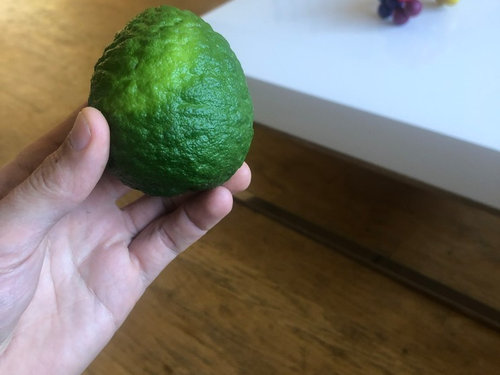
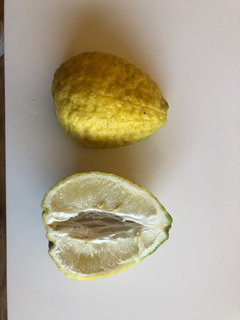
IMMATURE FRUIT


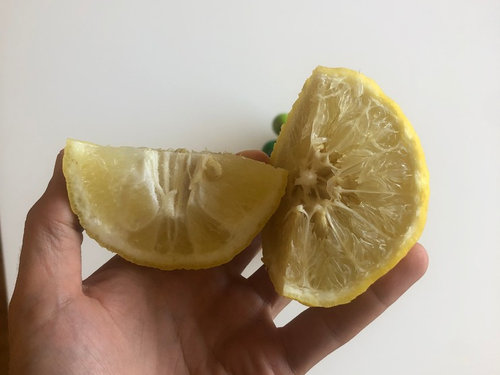
CUT FRUIT


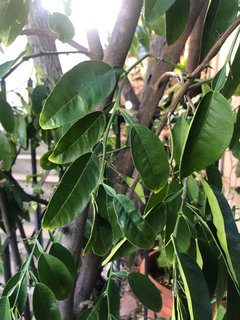
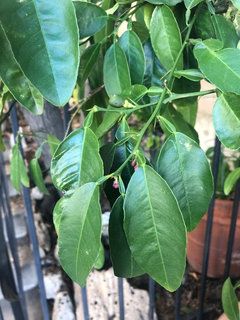
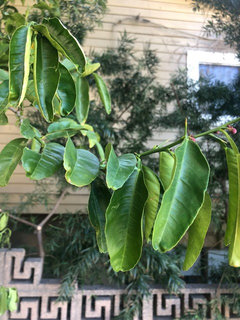
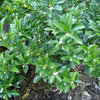
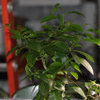
LEAVES


Comments (17)

  • 7 years ago
    last modified: 7 years ago

    Acidic and very sour like a lemon? Or does it have a sweetness to it?

    I'm no expert, but I think Yuzu leaves have winged petioles very similar to those.

    Pomona lemon and rough lemon maybe not so much. Plus Pomona lemon apparently has a sweetness to it.

    Ichang lemon has much wider petioles.

    Sudachi is a Yuzu hybrid, but I think the skin is a bit smoother and doesn't have that recessed nipple on the bottom end.

    Jay Ruso thanked Dave in NoVA • N. Virginia • zone 7A
  • 7 years ago

    Looks like it could be Swingle rootstock.

    https://citrusvariety.ucr.edu/citrus/swingle_trifoliate.html


    Jay Ruso thanked evdesert 9B Indio, CA
  • 7 years ago
    last modified: 7 years ago

    Yuzu seeds tend to be rather big. That's not really looking so much like a Yuzu.

    It could be a Swingle citrumelo but Swingle has trifoliate leaves, which this one doesn't seem to. It's also possible they grew the rootstocks from seed, and then decided to still use one of the seedlings even though it didn't show trifoliate leaves. (This can sometimes happen, where the seed of a hybrid can express different traits than its parents, but on large scale commercial citrus operations they'll usually discard any seedlings that look obviously different because of the likelihood they may not perform as well)

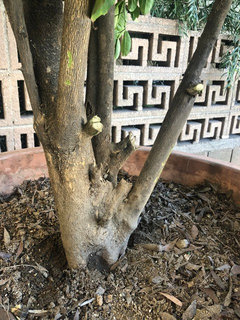
    Look carefully on your tree to see if you can spot a graft union. If not, it's very likely a rootstock. Or it means a previous owner planted it from seed.

    If it is a hybrid it obviously appears to have either yuzu, lemon, or pomelo/grapefruit in its ancestry.

    How is the flavor? If it tastes absolutely terrible and bitter, not only just very sour, than it is likely a trifoliate hybrid, meaning probably a citrumelo, which are sometimes used as rootstocks.

    Jay Ruso thanked socalnolympia
  • 7 years ago
    last modified: 7 years ago

    There's one last possibility to consider. Do you live in an area where citrus can normally be grown outside? If not, it could be some rare cold-hardy variety somebody a long time ago planted. (Realistically that's not the most likely to be the case, but it's possible)

    I plant rare cold hardy citrus varieties myself, and have sometimes wondered if many years from now somebody else won't know what they are and think they're just trash rootstock varieties and pull them out, not knowing their rare collector value to cold-hardy citrus enthusiasts. There's been a lot of old cold hardy citrus trees that got ripped up because a subsequent owner didn't know what they were and thought the fruits didn't taste that good and had too many seeds. A terrible tragedy.

    Jay Ruso thanked socalnolympia
  • 7 years ago

    The original post says the fruit is delicious.

    Jay Ruso thanked Embothrium
  • 7 years ago

    It doesn't look like a Ponderosa to me. Ponderosa peel is very thick and also very seedy. The bottom of the fruit also doesn't have that recessed circle your fruit has.

    Jay Ruso thanked John 9a
  • 7 years ago
    last modified: 7 years ago

    Would help to see more typical leaves from the tree to see if they are truly trifoliate or unifoliate. In some trifoliate hybrids, the leaves near the fruit on tip branches can sometimes go unifoliate. Closer look of a typical leaf to see shape and size of petiole.


    Also....Need a better description of the flavor of the fruit - sweet? sour? acid? How easy to peel? Any trifoliate oil taste to the peel? Juice?

    Jay Ruso thanked Dave in NoVA • N. Virginia • zone 7A
  • 7 years ago

    THANK YOU EVERYONE! for your advice and thoughts.

    I will try to give more specific information below. I'm passionate about identifying this fruit and love all the input. Here are more answers:

    -Located in Los Angeles, zone 10A.

    -From my research just now, trifoliate seems to mean leaves that come out in group of three. I don't notice any of this on the tree. I am attaching more pictures of leaves on the tree below. I'd say they're all single leaves.

    -The taste is sour and acidic, strong lemon taste, quite flavorful, delicious to me and my friends, sort of like a more pronounced lemon flavor similar to a Eureka lemon. No sweetness that I notice. I've been using it like I'd use a regular lemon, in dressings, cooking, in water etc. I'm not familiar with the taste of a rootstock trifoliate hybrid, but this fruit is definitely tasty and not horribly bitter. I'd say it's slightly better than supermarket lemons. But also very different from my Meyer lemon tree as a flavor.

    -Peel is distinctly bumpy on all the fruits. Fruits look cartoonishly large and pebbly. Peel I thin, fruit very easy to peel. I don't know the taste of trifoliate oil on the peel. The peel here releases a lovely sweet lemon aroma when squeezed, but not as oily as a Meyer lemon for example. I've yet to use it for zesting so don't know yet if the peel has a nice flavor, but the smell is nice and distinctly lemon.

    -The fruits are huge, easily twice or three times the size of a supermarket lemon.

    -I'd say about 10 to 12 small seeds per fruit. They're not big like yuzu seeds from what I see online. They're easy to remove.

    -Fruits are noticeably juicy. More than a typical lemon. It's as if I can squeeze almost one cup of juice from a single fruit. Just cutting the fruit up makes a yummy juicy mess.

    -Leaves have a winged petiole, somewhat noticeable but not hugely pronounced either. Again I don't see any groups of three leaves together.

    -Could the purple tinted blossoms and new leaf growth be a clue? That's the case on every blossom growing and every new leaf is the darker purple color, as I often see on other lemon trees.

    -And again, each fruit has a very distinct recessed apex. the bottom of the fruit is flat. it can stand on its apex easily. The top portion is more pointed.

    I think two key clues would be the distinctive bumpy peel, and the apex.

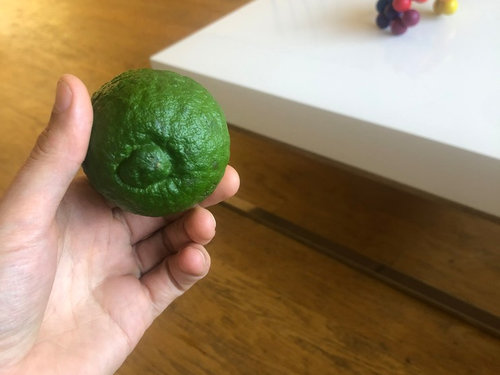
    I'm attaching more pictures: Leaves, fruit cut in half, and more pictures of the fruit seen from under with that distinct recessed circle / apex underneath.

    Also attaching a picture I found online which is listed as a ponderosa lemon, it's the closest thing I could find to this fruit online, looks quite similar to it.

    I'll welcome any other thoughts!

    Thank you again.

    J.


    TREE AT ORIGINAL LOCATION BEFORE UPROOTING

    BASE OF TRUNK. I DON'T NOTICE A GRAFT BUT NOT SURE.

    DISTINCT RECESSED APEX. the fruit can stand on its "bottom"


  • 7 years ago
    last modified: 7 years ago

    Wow! Lots of pics. So I wonder if what you have is a rootstock of rough lemon (Citrus jambhiri ) that has taken over. Although the petioles don't match it exactly. But rough lemon is a common root stock, or was. Purplish blossoms are not uncommon for lemon. Do crushed leaves smell of lemon as well?

    The petioles seem to match those of Yuzu better. But I think Yuzu has much bigger seeds.


    Ponderosa lemon leaves don't have those wide petioles I don't think.


    So, I can't help you. Hopefully someone from California will ID it.

    Jay Ruso thanked Dave in NoVA • N. Virginia • zone 7A
  • 7 years ago

    Thank you Dave! I'm struck by the massive "nipple" recessed at the bottom of every single fruit. The immature fruit starts pointy on both ends and then eventually develops this recessed flat bottom. They're quite unusual. My neighbors comment and ask what they are. And I never know what to answer them! The fruits are large so they're quite impressive on the tree.

  • 7 years ago

    Could it perhaps be a grapefruit-lemon hybrid? Maybe somebody planted a seed.

    I hate to speculate too much.

    Jay Ruso thanked socalnolympia
  • 7 years ago

    I would take the fruit to one of the ag extension offices near you and see if somebody could find a way to have it identified for you. You are near the prime growing areas of citrus so I don't think it would be too difficult. University of California Riverside would also be a good place to go as they have growing grounds and that's were all the experts are.

    Jay Ruso thanked Denise Becker
  • 7 years ago

    The 7th photo showing the "base" of the tree (looks like it is in a large container) has 1 branch towards the left that appears to be the graft (cleft-graft? i.e., the branch with some striation that looks like the bark had been scraped revealing some green). The rest of the branches around it look to be rootstock. A bunch of your fruits almost look to be this type of rough lemon - https://citrusvariety.ucr.edu/citrus/vangasay.html or this - https://citrusvariety.ucr.edu/citrus/schaub.html or even this - https://citrusvariety.ucr.edu/citrus/floridarough.html

    There was a similar id request thread on the Tropical Fruit forum almost 5 years ago with something that looks similar here - http://tropicalfruitforum.com/index.php?topic=10713.0

    As much as people have grafted over the years, I wouldn't be surprised if there is a mix on there too! :-D

    Jay Ruso thanked jenny_in_se_pa
  • 6 years ago

    My guess would be a seed grown plant from somebody back in the day. I don't see any signs of a graft and have seen some old lemons that look exactly like that. Its probably a old parent of something like a ponderosa but thats purely a guess.

  • 4 years ago

    Hi Jay,

    This is a common lemon grown in South Africa. A crossed lemon (Citrus jambhiri). It was a cross between a mandarin orange and a citron. Was used by the British navy to combat scurvy at sea because it is easier to eat than the common lemon. Also produces a lot of juice for its size. Has many long thorns. It is of course a rare hybrid for the States. Its name is Rough Lemon.

  • 4 years ago

    The fruit looks very similar to this fruit from India:

    https://m.youtube.com/watch?v=1t-OTj48vHo

    called Narthanga

    I am not sure exactly what Narthanga is, it might be some type of bitter orange, or citron, or citron-lime hybrid.

    That could be one possibility to consider. Do you know who the previous owners were or what county they came from?

Sponsored
Peabody Landscape Group
Average rating: 3.5 out of 5 stars8 Reviews
Columbus' Reliable Landscape Design & Contracting