Software
Houzz Logo Print
laurenburke314

How much did your solid white oak flooring cost?

7 years ago

We’re building a custom home and I’d like to go with a solid white oak flooring. 7-8” width and sanded and finished on site. Wondering if anyone knows how much theirs cost? Love the look of some engineered white oaks but hate the beveled groove between boards and have heard no matter what engineered is never a superior product. Any insight? TIA!!

Comments (29)

  • 7 years ago

    [I didn't like our engineered wood's 'exposed' groove either.]

    LaurenB thanked everdebz
  • 7 years ago
    last modified: 7 years ago

    I copy/pasted this from the designers - you could ask them.

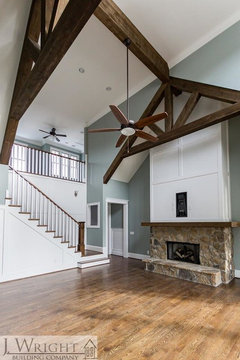
    Madson Design - floor is white oak with a natural finish, water-based (limits yellowing over time). PRO Oak & Broad: It certainly does. Water-based finishes are often called clear. It helps to avoid the golden color that comes from oil-based finishes. Another option is an oiled finish.

    https://www.houzz.com/photos/bay-area-modern-whole-house-remodel-contemporary-living-room-san-francisco-phvw-vp~2324357


    Bay Area Modern - Whole house remodel · More Info


  • 7 years ago

    Just ask a flooring company. Costs vary so greatly, that any answer you get here would be meaningless where you live.

    Call them tomorrow. Done. Simple.

    LaurenB thanked tatts
  • 7 years ago
    I wouldn't go that wide with real wood. Gonna need to be face nailed for sure. 4" will perform better as temp/moisture change. If you're committed to wide boards, it's gonna be expensive for materials and installation.
    LaurenB thanked Adam Thomas
  • PRO
    7 years ago

    I just got preliminary quotes in the mid teens per foot including installation for slightly narrower, about double that of engineered. Both are impacted by tariffs and fuel costs. Get local prices.


    LaurenB thanked Jeffrey R. Grenz, General Contractor
  • 7 years ago

    Ditto S J Mccarthy. Our Lumber Liquidators prefinished 3 1/4" white oak floors cost less than $5/sf materials only. The bevel at the joints is minuscule. We didn't go wider as we don't leave the AC on all summer and winter humidity gets to 25% now and then.

  • 7 years ago

    I got a beautiful 8" wide white oak character grade for $7.50 SF. I did the full glue down by an amazing installer. Very happy all around. Here is the place that I purchased which has amazing stuff to pick from. I believe they ship? Or at the very least get some ideas.


    https://thehudsonco.com/

    LaurenB thanked taconichills
  • 7 years ago

    About $10/foot seven years ago, rural Midwest. Solid oak planks, 3.5”, sanded and sitefinished. No discernible grooves: it’s smooth as a basketball court.

  • 7 years ago

    It's a pretty rare house that does wide planks like that in real hardwood. Risk of cupping and curling over the long term might be higher than expected. In the short term they'll sand it down and let you know "oh the house is still drying out" until the 1 year "warranty" is up. Glue + nail down + best installer maybe?

    LaurenB thanked Sam Goh
  • 7 years ago

    Oak tends to move more than some woods. I also would not put down wide solid wood boards. There will be gaps..

    LaurenB thanked NHBabs z4b-5a NH
  • 7 years ago

    If you want wood that wide. you need engineered. They do make sure finishable engineered. You still want the home hvac upgrades to keep control of the humidity. Even engineered that wide will move like a son of a gun with bad humidity control. It just won’t be 1/4” gaps.

    LaurenB thanked User
  • 7 years ago

    Thanks everyone for your input!! I really don’t think we want engineered hardwood. We live in the Midwest outside of Chicago. Will definitely be particular about humidity in the house. What would you say is a more realistic width for a wider plank solid hardwood? 5”? Thanks again for all the replies!

  • 7 years ago
    last modified: 7 years ago

    We're looking at solid white oak right now, as well. We were advised not to go wider than 4" in a solid to avoid cupping and gaping, and even that makes our contractor a bit nervous. 5" would raise install costs, as you'd want both glue and nail down. I would also go with rift and quarter sawn, which is supposed to be more dimensionally stable.

    Our tentative plan is 4" rift and quarter sawn solid site finished (pending a meeting with the installer to pin down his costs and make sure he thinks it will work). We've gotten quotes in the $5-$6 dollar range for materials alone, with the variance depending on grade (we're choosing between common #1 and select or better).

    Here's an example of a 5" solid unfinished rift and quarter sawn (this is a local supplier to me - I don't know what the internet end of their business is like).

    https://www.fantastic-floor.com/ProductID4396


    LaurenB thanked Kristin S
  • 7 years ago

    If you're open to engineered, you could look at something like one of these. They have reasonably thick wear layers and are 3/4" thick like a solid hardwood.

    https://www.fantastic-floor.com/ProductID5435

    https://www.fantastic-floor.com/ProductID7069


    LaurenB thanked Kristin S
  • 7 years ago
    last modified: 7 years ago

    What is the difference between rift and quarter sawn and the alternative? Also what’s the difference between common #1 and select and better? Sorry if these are dumb questions, I haven’t meet with our flooring lady yet!

  • 7 years ago
    5" is the absolute max I would consider for real wood. At 5" you would probably need to take most of moisture control measures outlined in this thread. It's just math really. The installer nails the edges and the more distance between nails the more expansion and contraction you'll have. The nails aren't moving so the wood flexes and bows.

    If you look at a floor that has been down for 75+ years, the boards are never wider than 3 or 4". Then engineered wood came out and doesnt have the expansion issues associated with natural wood. So people see an 8" wide "board" and try to duplicate it with a natural wood. Then have issues in no time.

    So your choice is wide boards that look close to real, or 2x to 3x installation costs to try to make wood perform outside it's normal capabilities. i.e. glue, face nailing, etc...

    Personally, I prefer all the variation you get with real wood. Having narrow boards means more boards and more variation. The best old floor I ever saw was 1" boards in a 150 year old church. Of course, I live in the deep south so the labor cost was probably quite low. (not to be offensive, just a fact
    )

    On my build site (hope to move in in June) we lost a massive oak tree in October. I had it hauled to the mill, rough cut, dried, and milled to 4" boards 16' long. Technically, it is drying now, mill work in early May. I am praying I can do my library without a horizontal seam. All boards running the length of the room. I have never seen that before! I doubt many people will notice, but I'll be sure to tell em. ;)

    God did I ramble or what...
    LaurenB thanked Adam Thomas
  • 7 years ago

    Thanks for the advice Adam! And wow I’m sure that will turn out stunning! Be sure to share a photo when it’s done!!

  • 7 years ago

    I've spent more time than I care to calculate researching hardwood floor options. Here are the key variables I'd consider:

    -Wood species: Easy, as it sounds like you're set on white oak

    -Solid Hardwood or Engineered: Sounds like you'd like solid, but wider planks are more doable with engineered. There are high quality engineered floors, but if you go with engineered you also need to look at the wear layer, overall thickness, number of layers, and composition of layers to evaluate the quality. I would not go lower than a 4mm wear layer to preserve the option to refinish.

    -Prefinished or site-finished: it sounds like you're set for site-finished. Keep in mind you can get either of these with either solid or engineered.

    -Width: Discussed in detail above. The wider the floor, the more expansion and contraction of boards you'll get, resulting in gaps when it's drier and cupping (as the boards push one another up) when it's more humid.

    -Length: Also pay attention to the length of the boards you'll be getting. You want to know both the range (i.e. 2'-10') as well as the distribution of those lengths. If the range is 2'-10', your floor will be quite different depending on whether it is an even distribution of all lengths, or 75% above 6', or 75% less than 4', for example.

    -Cut of wood: plain, rift, quarter, and live sawn are the main choices. It has to do with how the log is cut. I found this to be a good illustration. http://lacrosseflooring.com/blog-articles/plain-sawn-vs-rift-quartered/

    -Grade: Character, Common #2, Common #1, or Select and Better are the main categories I've run into in my search. It has to do with how much color variation there is across the boards and how many knotholes and such there are. Here's a good explanation: https://www.flooring-professionals.com/flooring-resources/choosing-the-right-hardwood-grade/

    Happy floor shopping!

    LaurenB thanked Kristin S
  • 7 years ago

    Thank you Kristin! That is so so helpful!!

  • 7 years ago
    last modified: 7 years ago

    In engineered the thickness of the top hardwood layer is more than just a refinishing consideration. The second layer is a softwood. A thin top layer can more easily dent.

  • PRO
    7 years ago

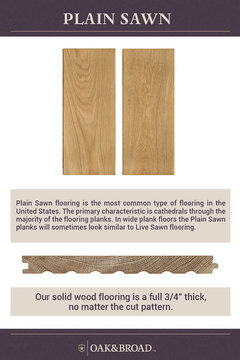
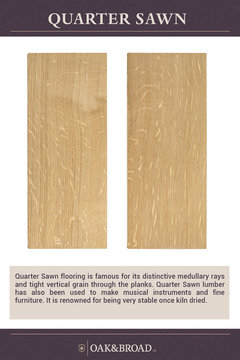
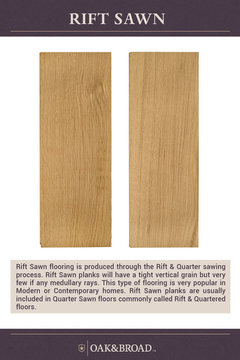
    Allow me to help here. I'll attach some helpful grain diagrams. The Rift & Quartered will certainly be more stable than the Plain Sawn. Our Unfinished 8" Rift & Quartered Solid starts at $6.50 and goes up from there. Solid Plank what wide needs to be glued and nailed for installation. That pretty typical since its a strong recommendation from the NWFA.

    Educational Plank Flooring Examples · More Info


    Educational Plank Flooring Examples · More Info


    Educational Plank Flooring Examples · More Info


    LaurenB thanked Oak & Broad
  • 7 years ago
    We have 4” rift/quarter sawn white oak, site finished, with Bona Nordic, installed and finished for $9/sq ft.
    LaurenB thanked drbevdc
  • 7 years ago

    I'm in Dallas and used real 3.5" wide white oak planks. Our flooring guy charged us $7/ft to install and sand. We did the staining/sealing ourselves. I think ours was a mix of #1 common/select. He advised us not to go wider than 4" if using real wood.

    LaurenB thanked gthigpen
  • 7 years ago

    Here's a link to the National Wood Flooring Association installation guidelines. $110. or 40 for members.

    LaurenB thanked dan1888
  • 7 years ago

    It's a tough call to make because many of the pictures out there with wider planks look good. But they tend to be engineered wood - and honestly there's nothing wrong with that. They're a bit more stable dimensionally when it comes to cupping/curling so they're preferred if you want to go that way.


    Our builder spec'd a 2.5" red oak but we upgraded to a 4" white oak with simple stain. Compromise was that in areas with a herringbone pattern we mixed both to make it look more interesting. Here's what our 4" looks like.


    LaurenB thanked Sam Goh
  • 7 years ago

    This is a GREAT thread.

    Kristen S, you provided a very good, succinct summary.
    Thanks for the links to FantasticFloors.

    To clarify, engineered hardwood floors ARE real wood. To differentiate the floor types, many people say “solid hardwood” vs. “engineered hardwood.”

  • 7 years ago

    Another big consideration is the length of each individual board: the shorter the boards the “ busier” the look.

  • 7 years ago

    I forgot about this thread! Allow me to provide an update to the massive oak tree we took to the mill. Before I picked a mill I was very specific about how I wanted the wood processed.


    Long story short, the job took twice as long as they quoted, it is the wrong length, the wrong width, and is not properly tongue and grooved. Oh, charged double what they quoted.


    Other then that, they nailed it.


    So my locally sourced flooring project turned in to a fiasco. I'll update with pictures in a few weeks.