Software
Houzz Logo Print
crushedpurple

How to thicken Thuja occidentalis/white cedars?

7 years ago
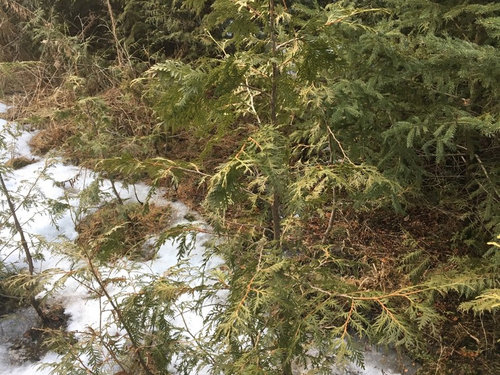
Hello all - last May I planted several Thuja occidentalis/white cedars that I got from a local farm. Unfortunately, not knowing any better the ones I got were sparse and scraggly (I don't know why but I thought that was normal and that they will fill out). The seller said that they were great for privacy hedge.


Anyway, almost a year later they almost look the same as when I first planted them except they're taller. They have not filled out at all. As you can already gather, I'm a novice and rather clueless - please, I'm not looking for all the things I did wrong- for some reason people really like to focus on that but I can't go back in time. I'm looking for help on what I can do now. How I can thicken these shrubs but I keep hearing and reading conflicting information.


Should I be cutting them back to encourage new growth? If yes, when? How much? Should I fertilize? If yes, what kind of fertilizer, how often, when? Thi: CIL shrub and hedge feeder was suggested to me.


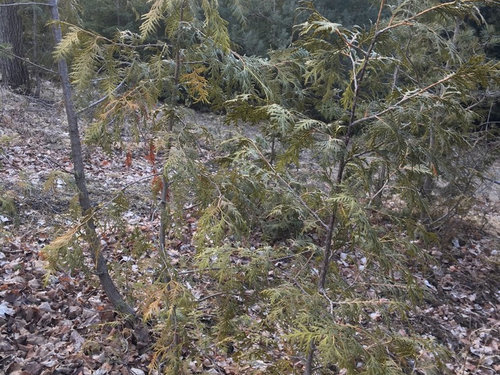
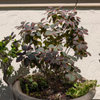
This is how they looked before I planted


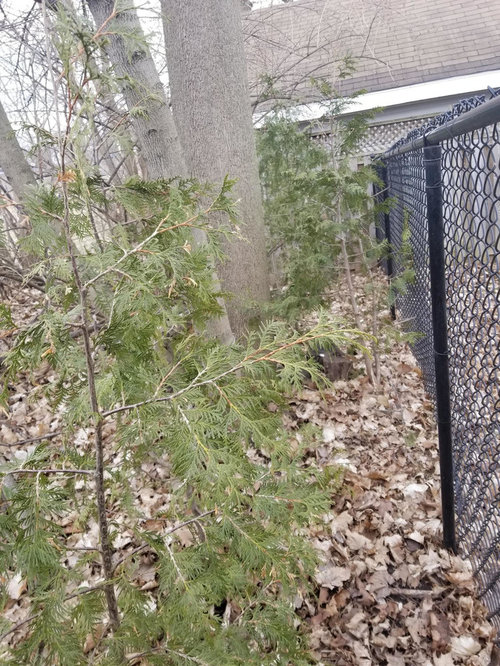
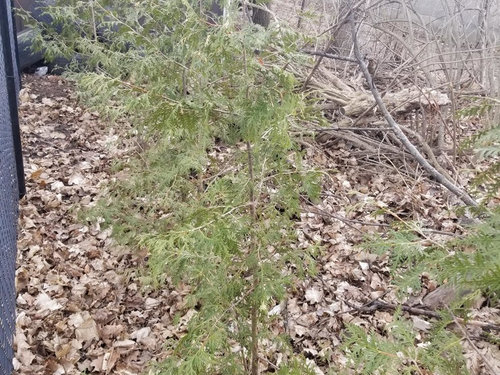
This is how they look a year later:


Comments (32)

  • 7 years ago
    last modified: 7 years ago

    Species trees will always tend to look a little sparse and ragged compared to named forms, which typically have been selected for dense, tight growth and specific mature heights. I doubt there is much of anything you can do to make these fuller or thicker.....the branching is where the branching is and neither pruning or fertilizing is going to change that.

    But they are stil very young. They might look better with a few more years under their belt but they are never going to look like a similar row of 'Smaragd's.

    crushedpurple thanked gardengal48 (PNW Z8/9)
  • 7 years ago

    ' almost a year later they almost look the same as when I first planted '

    One season is not a lot of time to expect lush, full growth for any tree. The fact that they got taller in that amount of time should be considered good progress.


    Thuja occidentalis are full sun trees. Growing as understory, is okay for the first year or two but they probably will tend to be a little 'leggy' and sparse in growth. Anything you can do to increase sun exposure will help them fill out and grow in a more robust manner.


    I wouldn't cut any off, unless it's dead or sick. Every green part on those trees will photosynthesize thus producing more food for the roots.


    But again, one season, trees can take a few years to really 'get growing'. I'd do some brushing around them and give it more time to establish the roots before I'd expect any more out of the trees.

    crushedpurple thanked User
  • 7 years ago
    last modified: 7 years ago

    Thank you to both. That 's a bit disappointing to hear that they will never be full, lush hedges but oh well.

    Should I use the fertilizer that I linked to? What about bone meal?

  • 7 years ago

    With reasonably decent soil, they do not need any fertilizer. Ever.

  • 7 years ago
    last modified: 7 years ago

    Unless there is some sort of deficiency in the soil, I wouldn't use anything at this early age.

    The fertilizer you posted to is high in nitrogen, which could cause root burn or other leaf damage if not applied sparingly. For now, what the trees need most is to establish roots and they will do that just fine on their own.

    Make sure your trees don't get real dry. With other larger trees are nearby, they can suck moisture out of the ground very quickly, so your Thuja are competing with more established trees right now. But don't over water either. Check the soil around your trees every few days or each week and water once you notice the soil is drying, the first few inches down. If you get enough rain, you might not have to water at all but later in the season when it's hot & dry, they might need some supplementary watering to help them stay healthy.

    crushedpurple thanked User
  • 7 years ago

    gardengal48 - agreed but even in my situation where the shrubs are so sparse? Would the fertilizer help to thicken?

  • 7 years ago

    Sorry, no....that's not what fertilizer does :-) Fertilizer just supplements whatever plant nutrients that may be deficient in your soil. It won't thicken things up and it doesn't even make plants grow faster unless applied in excess. Which you never want to do for any number of reasons

    To know if you have a need for any fertilzer, you need to get your soil tested.

    crushedpurple thanked gardengal48 (PNW Z8/9)
  • 7 years ago
    last modified: 7 years ago

    I agree, Thuja occidentalis has a more 'airy' form than many of the cultivars but as the tree gets taller and branches extend with needles/leaves becoming more numerous, the cumulative effect of this will provide privacy as the trees grow over time. And year round being evergreen.

    There is never 'instant gratification' when it come to privacy features of plants, unless you can write the check for huge specimens to be delivered and planted to your site. An 8 ft privacy fence would be another option.

    Your trees look very nice btw: ;0)

    crushedpurple thanked User
  • 7 years ago
    last modified: 7 years ago

    This information has been very helpful ...I don't feel so bad now about the cedars. It's incredible how much misinformation is out there ...glad I didn't open the bag of fertilizer lol

    Should I return the bone meal too?

  • 7 years ago

    Also looks like a shady spot. It's always going to be difficult to impossible to get a dense screen of Thuja in a shady area.

  • 7 years ago

    No use keeping what you aren't going to use. :-)

    Bone meal is used where phosphorus is deficient. Too much Phos. can poison the soil, locking up nutrients that plants need to prosper and increasing salt levels.

    That's why it's never a good idea to add things to the soil without first getting a soil test.


    crushedpurple thanked User
  • 7 years ago

    " Also looks like a shady spot. It's always going to be difficult to impossible to get a dense screen of Thuja in a shady area. "


    As mentioned in my first post. :^)

  • 7 years ago

    Hi, mine are in full sun and it took three years for them to get full. Don’t lose hope!

    crushedpurple thanked mazerolm_3a
  • 7 years ago

    What about compost...that amends the soil too so I shouldn't add that either unless I get my soil tested? How I do I test soil? That's not a very common thing...do most people do that?

  • 7 years ago
    last modified: 7 years ago

    A small plant can only handle so big of a volume of nutrients in a season. Juvenile plants use very little nutrients until their root system and leaves grow and can handle more.

    And remember, trees aren't like garden crops. Trees are ever extending their roots over a wide area, gleaning nutrients from the soil and doing it on a year by year basis into new/refreshed soil. And once established, they are very aggressive getting what they need.

    If these plants are native to your area, chances are they will do fine on the native soil there.

    People soil test all the time.

    You can contact your USDA extension office for your county and they can direct you on how to get your soil tested. Usually just a nominal fee. Google USDA offices and your state.

    Once you get your soil tested, you know for sure what your particular soil needs or don't need. It's nice to know. :-)

    crushedpurple thanked User
  • 7 years ago

    there is no instant gratification with trees ... they grow in tree time .. which is counted in decades ... not a season or two ...


    fertilizer will not speed tree time.. nor will it make them thicker ...


    in tree time.. in say.. to 5 to 7 years .. i would bet my wooden nickle.. that they will fill in for your purpose ... if they were in full sun ...


    i see some pretty big trees near them.. less than full sun ... will slow annual growth ....


    so.. bottom line.. patience grasshopper ... plant them.. and they will grow.. in tree time ...


    ken

    crushedpurple thanked ken_adrian Adrian MI cold Z5
  • 7 years ago

    I too agree It looks like they are heavily shaded by those mature trees. Nothing can be done unless you re plant in full sun or take those trees out.

  • 7 years ago
    last modified: 7 years ago

    Commonly repeated generalizations do not actually apply to fertilization. Any plant at any time that happens to be starved for a specific mineral nutrient will never benefit from it being withheld. As during all other times the key to fertilization at planting time is to choose a suitable product and to place it on the soil, rather than in it.

    Horticultural techniques for successful plant establishment

    https://s3.wp.wsu.edu/uploads/sites/403/2015/03/Planting-fact-sheet.pdf

    Myth of Beneficial Bone-meal

    https://s3.wp.wsu.edu/uploads/sites/403/2015/03/bonemeal.pdf

  • 7 years ago

    There are a few things you can do to help your trees. Put a few shovelfuls of compost in the spring. Not right next to the trunk but around it. Another thing that you can do is trim the branches. What you do is cut the tips of brunches, do not go into the wood. Just the green part and cut no deeper that about 1" or slightly more. This needs to be done early, but before July 1. One more thing which is also important. Water the trees deeply in the fall, before freeze up. Since evergreens don't lose leaves like trees, they continue to transpire in the winter and if they lack moisture the foliage turns brown. Also there are fertilizers available for evergreen trees. Use that but don't overdo it. If you use fertilizer spikes do not push it into the soil too close to the roots. At least two feel away. Perhaps doing a soil test will tell you what's missing.

  • 7 years ago

    Hi again - a local home improvement store has 3ft Emerald Cedars for sale for $13 each (most other stores sell for $30+). I'm wondering if I should plant a few in addition to what I already have or perhaps even replace some of what I have? Are Emerald Cedars a better option than White Cedars? Thanks ;)

  • 7 years ago

    Your problem is not the number or type of Arborvitaes you use, it's the lack of Full Sun. No tree that requires a minimum of 8-10 hours per day of direct, unfiltered sunshine, will perform to it's full potential on half of that. It's a required variable that must be supplied and no amount of added nutrients, moisture or anything else will change that.


    Emerald greens are cultivars of Arborvitae that have a narrower, denser form and would have to be planted fairly close together to form a solid screen, over time but they won't do that unless they are planted in Full Sun. Did I mention these are Full Sun Trees? :-)


    So unless you are willing to clear the trees and brush you are planting under, they will never grow into the Tall, wide lush foliage you are trying to achieve. Instead they will be erratic in height, width, fullness and form according to the variations of sun they receive in each ones location.

    crushedpurple thanked User
  • 7 years ago

    @ Bill_minn_3b I had a feeling someone was going to tell me that but I had to ask anyways because the emerald cedars look so lush and healthy unlike the white cedars I have lol ;)


    The patch of land where the shrubs/trees are is partially owned by neighbour so it's not a simple matter of me clearing everything. Plus I don't like taking down healthy mature trees unless they're diseased.


    My main reason for having hedges there is to block the view of my neighbour's backyard/property all year round. Between May-Oct it's not a problem, it's actually quite nice when there's green foliage, which blocks the view but between Nov-Apr I see all the junk in my neighbour's backyard from my living room.


    I've been trying desperately to find a reasonable resolution but doesn't seem like there's one so I just have accept this is how it will be.

  • 7 years ago

    If you want an evergreen screen in this area, then you need to plant something that will tolerate those conditons. Yews come to mind as one of the most shade tolerant of evergreen conifers. But they are slow growing, especially if in much shade, and they are appealing to deer, if that is an issue in your location. But then, so are the arbs!!

    btw, "white cedar" is just a common name for Thuja occidentalis, aka American arborvitae. So both your 'cedars' and the Emerald Greens ('Smaragd') are just different examples of the same plant :-) And neither are true cedars!

    crushedpurple thanked gardengal48 (PNW Z8/9)
  • 7 years ago

    @ gardengal48 - thank you that was very helpful!


  • 7 years ago

    @ gardengal48 do you know what rate yews grow at in part shade?

  • 7 years ago

    Slow.....maybe as much as 6" a year.

    crushedpurple thanked gardengal48 (PNW Z8/9)
  • 5 years ago

    It is difficult to be patient. I know, we have our own hedge of 1 year only planted white cedar. However, I have heard that it takes about 3 years for transplanted cedars to start really filling out.


    i know it’s true because we have other more established cedars in other areas Of our yard. Just don’t think about it anymore! Before you know it, the years will pass and they will get to your desired thickness and height without any special care ( other than mulching and watering)! Happened to us and now those cedars are lush and huge 😊

  • 5 years ago

    If I missed this then sorry to be redundant. And, this won't help get more sunlight... Mature trees can use up too much of the water that would otherwise be available to newly planted competition. When I planted Thuja occidentalis near maples and a birch (but in 8-10 hours of sun) the Thuja got thin, lost verdancy, and all the central leaders died in the second year when I didn't give them water! On the other hand, all the trees planted in our meadow survived the second year without water. Early this year (the third year) I installed drip irrigation. The trees near the maples and the birch got much thicker and greener, and started growing again...

  • 5 years ago
    last modified: 5 years ago

    Large growing species of maple and birches are notorious for forming dense mats of hungry and thirsty roots that make gardening beneath them a challenge. Whereas certain other species of trees - oaks for instance - are generally much more cooperative.

    A key point about the original topic here is that even trees and shrubs that are inherently shade tolerant still do not grow as densely in shade as they do when receiving greater light exposure. So that although arborvitaes are actually long lived climax species that come up among and beneath other kinds of trees in forest settings on a routine basis in nature the planting asked about here is never going to fill in as though it was in a sunny position.

    Unless something is done to admit considerably more light to the planting site.

  • 5 years ago

    Embothrium, yes. And, if the site is opened up, still, it may be close enough to mature species that suck up all the water (as mine are--even being outside the drip line can be too close.)

  • 5 years ago

    Maybe you should try rhododendron, ilex (holly), or pieris in this spot. They are more shade tolerant, evergreen, and probably grow more quickly. I'm not sure how tall of a screen you need but sometimes even 5 feet makes a decent privacy screen.

    :)
    Dee