Software
Houzz Logo Print
coumica

Recently purchased Burgundy Rubber Plant Issues

7 years ago
Hello!


I'll start by saying I swear I've read all I can consume about this plant. I'm new to caring for houseplants and know how quickly downhill something can go, so I'm trying to catch whatever poor behaviors/issues as soon as I can.


I recently purchased a Burgundy Rubber Plant from a local nursery (3-4 weeks ago) and the plant has looked amazing until the last week or so: 3 leaves are beginning to yellow/develop spots, and growth has seemed to halt as well (new leaf at least once a week per plant for the last little bit).


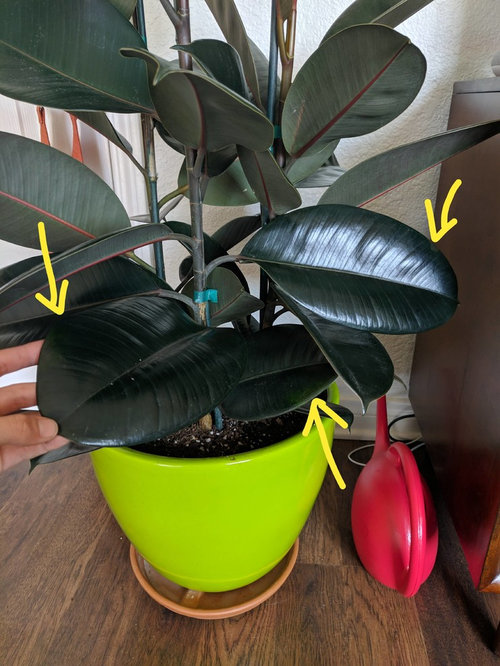
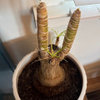
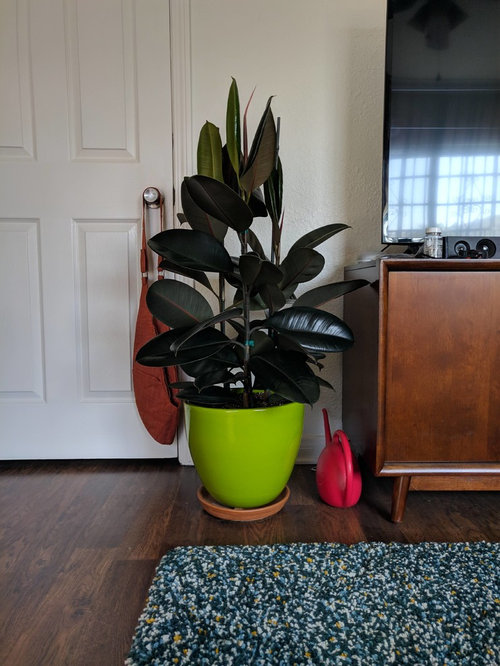
Here is the whole plant:


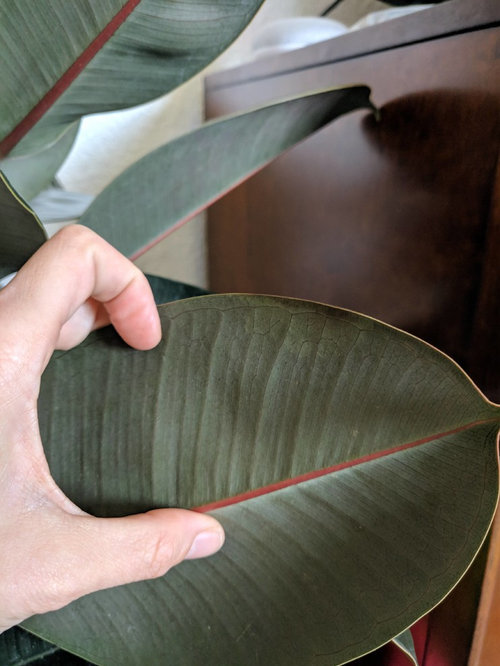
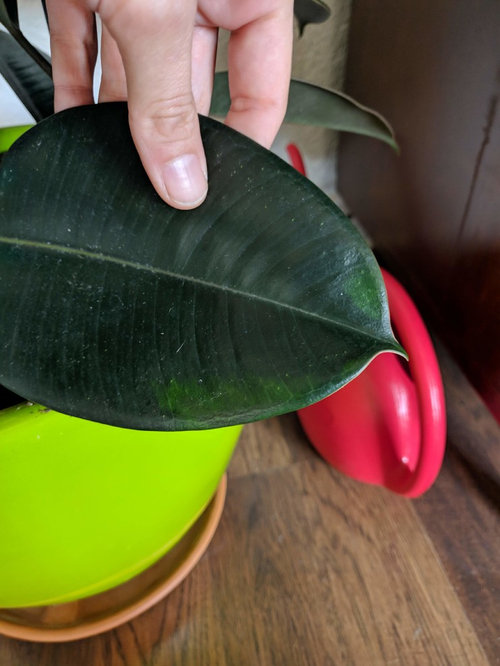
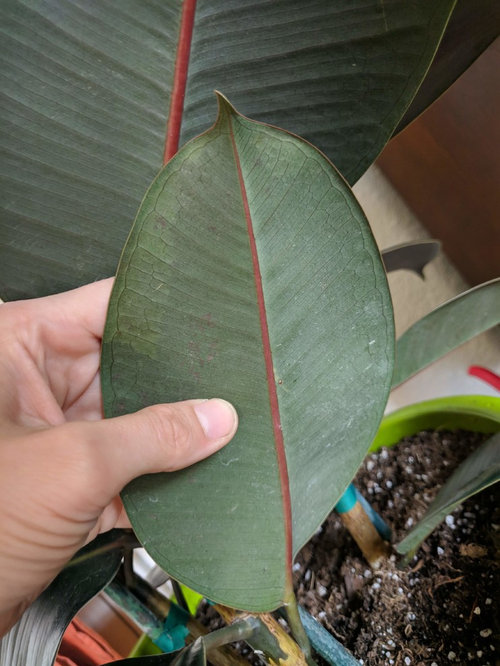
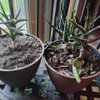
Here are the 3 problematic leaves:


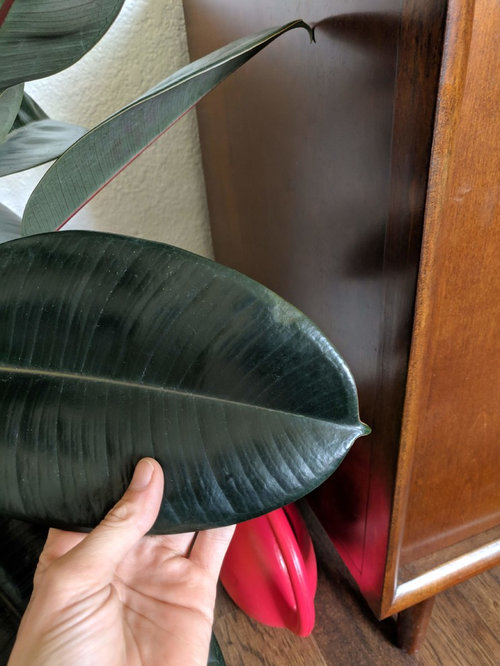
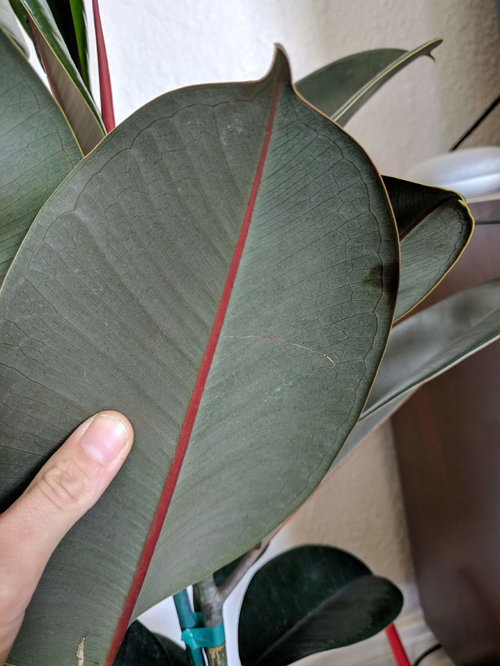
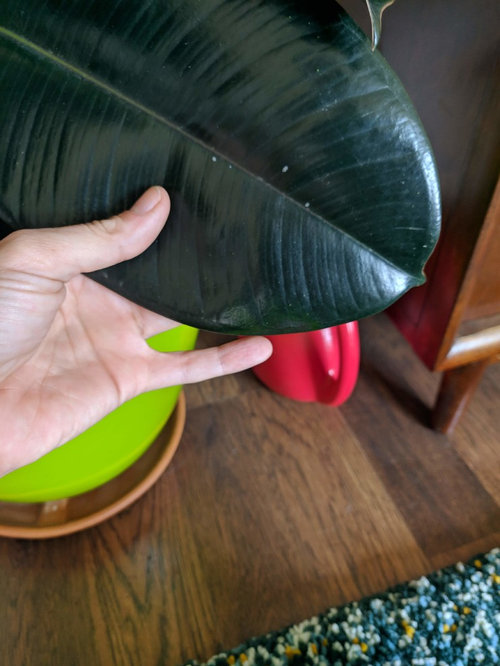
Here are the leaves (front/back of the three highlighted above):


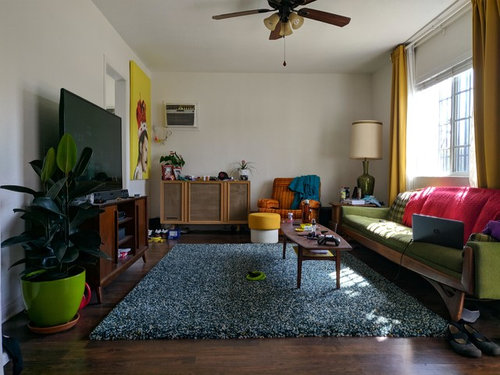
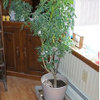
The plant is in a room with a very large SE facing window and door (usually open), picture:


This doesn't seem completely catastrophic just yet, but it's about a day of anxiety/worrying away from being the last thought in my head when I go to sleep and wake up.


Background/more details:

- This came from the nursery with 3 plants staked and planted in a single pot

- I am using Formula 420 soil (recommended by the nursery)

- Plants are potted in a glazed terracotta pot with a single large drainage hole in the bottom

- The bottom 1-2 inches of the pot are rocks/pebbles (I don't know where this came from or why I did it)

- When potting the plant from its original container, it was nearly impossible for me to loosen the roots up much at all - the whole potted area (soil/roots) was very dense and I was afraid to break it up too much in case I destroyed the roots (not large thick roots, very fine thing roots spidering EVERYWHERE)

- Deep watering is taking place once a week - or when the top 3-4 inches is dry - and the excess water in the drip pan is removed (somewhat) promptly - this is *not* a scientific method whatsoever, I'm getting a dowel to insert into the soil in about 30 mins

- Once a week (or depending on dust) I wipe each leaf down with a damp towel

- I used to mist the leaves the first couple weeks once every day or so - but I can't believe this is effective AT ALL and stopped this practice

- Overall growth on each of the plants has stopped - in fact, the plant showing issues has been the fastest grower of the 3. As mentioned earlier, I used to get about 1 new leaf per plant every week until the last week. Each plant has a visible meristem, the two on the non-affected plants are very short and haven't grown in days, the one on the affected plant has been about to open for the last few days but hasn't

- On the lower part of 2 of the plants, where the leaves attach to the trunk/stem, seems to be drooping - I'm unsure if this is a symptom or the leaves are just somewhat heavy

- There has been zero fertilization; brand new soil and only a month of time in my home seemed a little soon for the need to fertilize (to me, the dummy)


Basically - I believe I've been overwatering this buddy of mine - BUT, I'd be devastated if I corrected the watering but still had the same issues. Does this look like classic - and ONLY - overwatering, or is there anything else I should attempt to correct/rule out?


Thank you so much in advance!

Comments (4)

  • 7 years ago

    The plant isn't getting near the light it needs to stay fit. In a very high % of plants, a reduction in photo load (light levels or duration of exposure) stimulates chemical messengers to inform plant central which leaves are not pulling their weight (they are using more energy than they are producing). The plant then starts the shedding process, which initially includes harvesting mobile nutrients and other bio compounds from leaf tissues. Since magnesium (Mg) is mobile, the plant salvages it and recycles it from leaves destined to be shed. Mg is an important part of the green pigment chlorophyll because it's at the center of every molecule, so when Mg is salvaged, chlorophyll molecules are destroyed. With the primary pigment no longer expressing, other pigments that are present but masked by chlorophyll become visible. That's what you're seeing in the leaves. The necrotic areas on the leaf margins are almost certainly the result of over-watering, or a soil that's too water-retentive for how you currently water. That needs to be addressed, or you need to be resigned to the fact that a very significant measure of the plants potential will be lost as it spends energy regenerating roots killed by the prolonged periods of soil saturation. I suggest you start using a 'tell' to 'tell' you when it's time to water. Your digital device (finger) works poorly as a guide in pots deeper than a few inches. More on using a tell at the bottom of my offering.


    Background/more details:

    - I am using Formula 420 soil (recommended by the nursery). Many media that are recommended by the seller are no where near what the plant needs to maintain a healthy root system. It's good to keep in m ind that a healthy plant is only a dream if you can't keep the root system happy. A picture of it on a piece of white paper would offer a clue about where the soil belongs comparatively (poor, fair, middling, good, better, .....

    - Plants are potted in a glazed terracotta pot with a single large drainage hole in the bottom. Did you move it to that pot when you bought it, or soon after? If so, it might be over-potted.

    - The bottom 1-2 inches of the pot are rocks/pebbles (I don't know where this came from or why I did it) Not helpful as a drainage layer, but there are ways to use large items big rocks, bricks, soda bottles, over-turned pots, ...... as ballast - with very good results.

    - When potting the plant from its original container, it was nearly
    impossible for me to loosen the roots up much at all - the whole potted
    area (soil/roots) was very dense and I was afraid to break it up too
    much in case I destroyed the roots (not large thick roots, very fine
    thing roots spidering EVERYWHERE).
    If you live in the US and not in the deep south, Somewhere around Father's Day is the best time to repot. Plants that live indoors are generally at their weakest from mid-winter through early spring, so repotting during that period, except for emergencies, is best avoided until the timing better favors a fast recovery - June.

    - Deep watering is taking place once a week - or when the top 3-4
    inches is dry - and the excess water in the drip pan is removed
    (somewhat) promptly - this is *not* a scientific method whatsoever, I'm
    getting a dowel to insert into the soil in about 30 mins.
    OK - good! I covered that a bit above, and already added the info about using a tell below, so I'll just leave it in case others passing through have interest. Try to make sure there is no pathway by which the effluent can make its way back into the pot once it's exited through the drain hole. The pot should never sit in the effluent. I raise all of my pots so the bottom of the pot is ALWAYS above the maximum level the effluent can reach. Example:

    - Once a week (or depending on dust) I wipe each leaf down with a damp towel. That's fine if you're using just water. Avoid using any household cleaning supplies, and rinse residual soap or fabric softener from the cloth before you use it.

    - I used to mist the leaves the first couple weeks once every day or
    so - but I can't believe this is effective AT ALL and stopped this
    practice.
    Good - you were right.

    - Overall growth on each of the plants has stopped - in fact, the
    plant showing issues has been the fastest grower of the 3. As mentioned
    earlier, I used to get about 1 new leaf per plant every week until the
    last week. Each plant has a visible meristem, the two on the
    non-affected plants are very short and haven't grown in days, the one on
    the affected plant has been about to open for the last few days but
    hasn't.
    Plants that aren't growing are dying. I didn't coin that sentence, a guy with a PhD did in one of his books about plant production in containers. His name is Carl Whitcomb. He reasons plants that make more food/energy than it takes to keep their systems orderly create new cells with the bounty - IOW, they grow. Plants that use more energy than they are making, don't grow. In fact, as shedding organisms, they start shedding biomass, starting with leaves, then branches. Since using more energy than the plant can create is an unsustainable arrangement, if a plant is not growing, it will die unless the trend is reversed. You reverse the trend by correcting conditions that require the plant to live at, near, or beyond the limits it's genetically programmed to tolerate. That's your ONLY job as a grower - to figure out what's wrong and fix it. Learn to do that and you can grow almost anything in a pot.

    - On the lower part of 2 of the plants, where the leaves attach to
    the trunk/stem, seems to be drooping - I'm unsure if this is a symptom
    or the leaves are just somewhat heavy.
    You described what happens when plants lose turgidity (internal water pressure) - they wilt. The wilting occurs from over-watering because root function is suppressed by a lack of oxygen in the medium when the soil's pores are full of water. That's also why you're seeing necrotic lesions on leaf margins. Over-watering affects water uptake and prevents the plant fro9m effectively moving water to its most distal tissues - leaf tips/margins.

    - There has been zero fertilization; brand new soil and only a month
    of time in my home seemed a little soon for the need to fertilize (to
    me, the dummy).
    You should probably be thinking about fertilizing. It's imperative if you want healthy plants in pots. I use Foliage-Pro 9-3-6 on ALL my trees (275 - 300 of them, not counting cuttings. If you're interested, ask somewhere down the line. It's monkey easy if your soil allows you to water correctly, and very difficult to do effectively if you are forced to suffer under the influence of a water-retentive medium.


    Basically - I believe I've been overwatering this buddy of mine -
    BUT, I'd be devastated if I corrected the watering but still had the
    same issues. Does this look like classic - and ONLY - overwatering, or
    is there anything else I should attempt to correct/rule out?

    Growing well is a holistic discipline. You must provide everything the plant needs, and not too much of it if the plant is to prosper. This is surprisingly easy to do, once you understand how to recognize of make a soil that you won't have to war with for control of your plant's vitality (health). Everything is in play. Light, temperature, fertility, soil structure, (soil) moisture control, others. It's likely that too much water in the soil is currently limiting the plant; but, correcting that just makes something else the most limiting. Like driving to a distant destination. You're lost, low on gas, and have a leaky tire. Getting unlost and back on track makes being low on gas or the leaky tire the threat most likely to keep you from your destination. Plants work exactly like that. Fix the over-watering and light is probably the factor that's limiting. Fix the light issue, and temperature or nutrition, or soil pH will be next on the list of most limiting. We're always trying to fix what causes stress, and there's always something causing it. Fortunately, you can quite easily reach the level where you're entirely happy with your plants health and appearance, but that requires avoiding a helter skelter approach and sticking to a reasoned plan you can replicate at will. You'll also find that plants are very similar in what they like. They are for more different in what they won't/can't tolerate. IOW, a very high % of plants, with the right medium, can all be treated the same and thrive for it.


    Al


    Using a 'tell'

    Over-watering saps vitality and is one of the most
    common plant assassins, so learning to avoid it is worth the small
    effort. Plants make and store their own energy source –
    photosynthate - (sugar/glucose). Functioning roots need energy to
    drive their metabolic processes, and in order to get it, they use
    oxygen to burn (oxidize) their food. From this, we can see that
    terrestrial plants need air (oxygen) in the soil to drive root
    function. Many off-the-shelf soils hold too much water and not enough
    air to support good root health, which is a prerequisite to a healthy
    plant. Watering in small sips leads to a build-up of dissolved solids
    (salts) in the soil, which limits a plant's ability to absorb water –
    so watering in sips simply moves us to the other horn of a dilemma.
    It creates another problem that requires resolution. Better, would be
    to simply adopt a soil that drains well enough to allow watering to
    beyond the saturation point, so we're flushing the soil of
    accumulating dissolved solids whenever we water; this, w/o the plant
    being forced to pay a tax in the form of reduced vitality, due to
    prolong periods of soil saturation. Sometimes, though, that's not a
    course we can immediately steer, which makes controlling how often we
    water a very important factor.

    In many cases, we can judge whether or not a
    planting needs watering by hefting the pot. This is especially true
    if the pot is made from light material, like plastic, but doesn't
    work (as) well when the pot is made from heavier material, like clay,
    or when the size/weight of the pot precludes grabbing it with one
    hand to judge its weight and gauge the need for water.

    Fingers stuck an inch or two into the soil work ok
    for shallow pots, but not for deep pots. Deep pots might have 3 or
    more inches of soil that feels totally dry, while the lower several
    inches of the soil is 100% saturated. Obviously, the lack of oxygen
    in the root zone situation can wreak havoc with root health and
    cause the loss of a very notable measure of your plant's potential.
    Inexpensive watering meters don't even measure moisture levels, they
    measure electrical conductivity. Clean the tip and insert it into a
    cup of distilled water and witness the fact it reads 'DRY'.

    One of the most reliable methods of checking a
    planting's need for water is using a 'tell'. You can use a bamboo
    skewer in a pinch, but a wooden dowel rod of about 5/16” (75-85mm)
    would work better. They usually come 48” (120cm) long and can
    usually be cut in half and serve as a pair. Sharpen all 4 ends in a
    pencil sharpener and slightly blunt the tip so it's about the
    diameter of the head on a straight pin. Push the wooden tell deep
    into the soil. Don't worry, it won't harm the root system. If the
    plant is quite root-bound, you might need to try several places until
    you find one where you can push it all the way to the pot's bottom.
    Leave it a few seconds, then withdraw it and inspect the tip for
    moisture. For most plantings, withhold water until the tell comes out
    dry or nearly so. If you see signs of wilting, adjust the interval
    between waterings so drought stress isn't a recurring issue.

    Cou Mica thanked tapla (mid-Michigan, USDA z5b-6a)
  • 7 years ago
    last modified: 7 years ago

    Thank you so much - just a ton of very helpful information!


    Starting at the top...


    Light:

    Would it be sufficient to supplement natural light with HID bulb/s - assuming it's getting *anywhere* near the light it requires now? I've done some quick research around what's available (and how possibly successful) artificial sources may be. As silly as it sounds, most grow light options seem to be horribly unattractive, which is why I suggested HID bulbs since they seem to be ok to place in normal fixtures (totally might be wrong here).

    There might be one other room in my home with brighter light and it's currently a mess (just moved). If artificial light as a supplement isn't going to work, I'll carve out a space in this room (same SE large window but with an additional South-facing window). Not sure what to do if that's still enough.


    Soil:

    I'll get a photo of the soil tomorrow morning. Based on the small bit I've read as indicative of a water-retaining soil mixture... this stuff seems like it might fit the description.


    From the soil manufacturer website:

    "Recipe 420 is a blend of premium Aged Forest Products, Coir, Sphagnum Peat Moss, Pumice, Earthworm Castings, Feather Meal, Seabird Guano, Crab Meal, Fish Bone Meal, Humic Acid from Leonardite, Gypsum, Oystershell Lime (pH adjuster), Dolomite Lime (pH adjuster), Bat Guano, Kelp Meal and Wetting agent (Yucca Schidigera Saponin) enhanced with Mycorrhizal fungi and beneficial soil bacteria."


    Potting:

    I repotted into this plant after bringing it home from the nursery. It came in your run-of-the-mill cheapo black plastic container.


    RE: overpotting. I don't have the original container anymore, but it was a smaller container; not by A LOT, but maybe 25-35% smaller? The bottom of the current pot is roughly the same diameter as the one it came from but tapers outward towards the top, whereas the original was a straight cylinder. I'm still trying to figure out this whole over-potting thing; didn't know it was an issue until you mentioned it - honestly thought you meant it was re-potted too many times in its recent history before realizing overpotting is an actual term haha


    Drainage layer:

    Is this something needed with this plant - provided it's potted in the correct soil?


    Repotting in regard to plant strenght/geographic location:

    I live in Southern California (Los Angeles). I'm not sure how relevant this factoid is to the general question: this plant was housed in a container outdoors in a large covered area then repotted and placed indoors... considering the possibility of over-potting, should I have just left this in the original container? The density of the soil/roots absolutely made my plant-ignorant brain assume it was in far too small of a container.


    Watering:

    The drip tray under my pot actually does have raised portions which keep the pot out of any drained water - but not quite above maximum capacity. So far, any excess has not reached that height. That said, on the second watering I did 100% leave excess water in that pan for ~6-9 hours but I don't believe it was sitting at max capacity (definitely wasn't by the time I caught it).


    (I also forgot the dowels today, ugh)


    Leaf cleaning:

    Definitely nothing but tap water used when wiping down the leaves... taking this moment to note that I'm also attempting to let the water used for watering sit and evaporate for about a day (no water softener).


    Misting:

    *high fives self*


    Growth:

    Quite literally what I was afraid of =(


    Fertilization:

    Looking into this recommendation now - thank you!

    .

    .

    .

    .

    Considerations for the future:

    - Well, I'm definitely not watering for a bit - and getting dowels tomorrow (this time for real)

    - I'm not sure what to do about the current soil mixture besides water far less until the plant fully recovers, then change out for something better (reading up on ideal mixtures tomorrow).

    - If the plant is over-potted, is this something the plant can power through or does it need to be remedied before moving forward (after correcting watering is ensured)?


    I know I've missed something in this reply... but thank you again, nonetheless!

  • 7 years ago

    Ooooookay - so I had both my laptop and desktop experience some serious technical issues yesterday/today.


    As promised, here is the soil mixture on a white paper:


    The one plant of three experiencing leaf issues finally had the almost opened leaf open up.... doesn't seem so good =(


    Most of the new growth seems to be curling under and seems weak (?) almost? Glass half full: both the smaller, seemingly stagnated, meristems have actually grown a bit!


    Moved the plant closer to the light from the open door yesterday, until a better solution is created.

  • 7 years ago
    Leaf damage seems to have halted, and the leaves with necrotic bits have scarred over. The overall droop of the plant is reversing itself.

    ....the soil is *STILL* too wet and I swear it's been at least 2 weeks since the last water now. I've got a set of dowels used for moister metering; if there's a foot of soil in the pot, the bottom 6inches of the dowel is moist/dirty.

    This perpetual moisture seems crazy to me, and I now fully understand how I arrived in this situation. How much restablishing would anyone recommend before repotting into a much better draining mixture? I have perlite and bark amendments for the soil waiting for the appropriate time.
Sponsored
AIS Renovations
Average rating: 4.5 out of 5 stars15 Reviews
Custom Craftsmanship & Construction Solutions in Franklin County, Ohio