Software
Houzz Logo Print
webuser_156468694

Soil won't dry out!

7 years ago

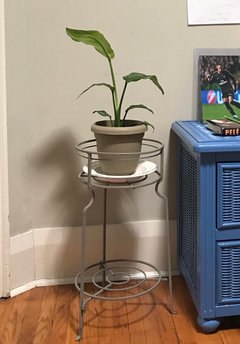
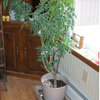
Hi - I have a small bird of paradise plant that has very moist soil even though it was last watered a month ago. The plant is two months in our possession. The first month it put out a new leaf and took weekly waterings. Its been in the same location (interior room with suntube - very bright on sunny days). Temps are fine in the house. I repotted it at the one month mark in a 1 inch bigger pot, but did not cut any roots or disturb root system very much. Used Promix premium potting soil. Are they known to be senstiive to repotting? Any ideas on what's up or suggestions for how to proceed? In retrospect, the plant didnt seem to need repotting as there was still plenty of room for root system but I went ahead and repotted it as it my custom every time I get a new plant from a store. Maybe it was a mistake.

Comments (8)

  • 7 years ago
    Here it is...
  • 7 years ago

    I've learned over the years and many mistakes to NOT re-pot a new plant for at least a year, you may not think you disturbed the roots, but now the plant will have to get accustomed to new soil and a larger pot, did you add any perlite to the soil, it's possible the roots are suffocating. Other members will have more advice for you, you should also add your location to your profile, that helps us.

  • 7 years ago

    I’m not sure that’s a bird of paradise. It looks more like a peace Lily to me. If it is a peace Lily, I don’t think it’s liking the direct sun it may be getting. Additionally, there may be too much mix in the pot for the amount of roots. Not sure of what advice to give you. Repotting back into the original size might be advisable, or just wait and see what happens but do not water. I divided one such plant several months ago, 1/2 did well and the other half pouted for months but finally perked up. I had the same situation with mix not drying. Good luck.

  • 7 years ago
    last modified: 7 years ago

    That's a Bird of Paradise, and they love sunlight. The soil doesn't look soggy, and your BoP doesn't seem to be adversely affected, so I wouldn't worry too much about it. It hasn't had much time to anchor down more roots and establish itself just yet. Given some time, it will fill in the space with new growth and be better equipped to absorb all the water it can from the soil at a much faster rate. For now, just water it sparingly as it needs it.

    I bought one of these from Wal-Mart about a month ago. I also bought a similar sized Majesty Palm as well. For the time being, they've both been sitting on my shaded front porch where I've been largely ignoring them. That's not my intention, but I've been so busy repotting old and new plants that I just haven't gotten to them just yet. I don't even think I've watered them yet, either. I'm not all that concerned, because I know it can handle it; not indefinitely, just for now.

    I'm always fascinated by the advise of others when I hear it. I'm not saying that it's wrong. Far from it. I just find it curious. There are many ways to grow plants and we each need to discover what works best for us. For my plants, I never use perlite, and I almost always repot them as soon as I buy them. However, that's not written in stone. There have been numerous times where I haven't repotted some of my plants at all. In fact, I still have several plants that have remained in their original pots and original soil. Some of them for years now. But that's why I've been so busy these past couple of months with repotting. I'm just glad that I've gotten most of it out of the way now. Now that the heat of Summer encroaches upon us. As for the perlite, I only use it in my orchid mixes. Everything else doesn't get any. Plants can grow just fine without it; provided that they're repotted correctly. It's a great additive for any soil mix, I just don't like using it for mine.

  • 7 years ago

    Hi, B - Your medium even looks like it's very water-retentive and compacted. If your medium is still wet after a month, it's a serious problem, which puts the 'potting up' in the heading of counterproductive. You can bet that, even if your plant tolerates those conditions, it does not like them, and a very large fraction of your plant's potential will be left lying on the table. You cannot impair root health or root function w/o it impacting the vitality, appearance, and growth rate of the plant; and 30-day + watering intervals are certain to have a negative impact on root health/function.

    I have 2 suggestions, the first being considerably better than the second, but the second much better than what's in place now.

    1) Get your plant into a soil that drains well. This would be a soil that supports very little or no perched water. Perched water is water that occupies the first few to several inches (6" is not uncommon) of soil above the pot's bottom, defying the force of gravity and refusing to exit the pot through the drain hole (Your pot does have a drain hole?). You should be able to water nearly at will without the plant having to pay an over-watering tax in the form of lost potential and poor vitality. Getting to that point should not only significantly increase the potential for a major increase in vitality, it will also increase your margin for grower error (unless you forget to water) and make maintaining a effective (key word) nutritional supplementation program monkey easy. If you can't water correctly, fertilizing is more like a 'this is my best guess and it will have to do' sort of approach.

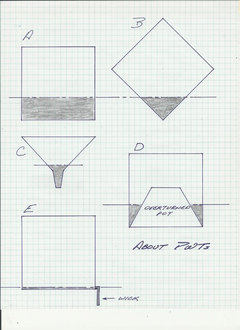
    2) I'd still change to a different medium, but use a little simple science to limit the amount of excess water your soil can hold. Tricks like using a drainage wick (see E below); simply tipping the pot at a 45* angle (see B & compare to A); or Using Ballast, which is extremely effective, can passively eliminate
    more than 95% of the excess water a soil can hold if well-planned (see D).


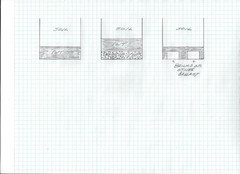
    Another ballast image:

    Did you know, if the pot is small enough and you water over the sink, you can remove all excess water by using Newton's first law of motion? Water to beyond saturation. After the pot has stopped draining (or before) hold the pot in 1 hand and move it up and down over the sink. You'll immediately see that on the reversal from downward movement to upward, the water in the pot keeps moving downward and exits the drain, and the sharper the reversal from down to up the more water exits the soil. When no more water exits the soil, you will have removed all if the excess water .... assuming you're not growing in a near neighbor of pudding. ;-)

    I wish you well. Let me know if you have any questions or input.


    Al

  • 7 years ago

    Thank you all for your comments. The pot does have drain holes. I've decided to just wait it out a little longer (and study up on tapla's advice). I'm questioning the placement of the plant now. Maybe there is something limiting about the sun tube. To me, its an incredibly bright room with lots of natural light. But maybe still not as good as an old-fashioned window...

  • 7 years ago

    Keep in mind that light diminishes by the square of the distance from its source; so, light levels 10 feet from a window are only 1/100 of what they are at 1 ft from a window. In the case of the light tube, you would measure the difference between the aperture at roof level to the leaf surface of your plant, then square the distance (multiply it by itself) to see how bright/dim the light is compared with levels on the roof. Even without measuring, you probably have a good idea what the calculation will reveal.

    I hope this is helpful.


    Al