

High humidity in new house
We moved into our newly built house her in Minnesota last fall so this is our first summer in the house. We took great care to use high quality windows and doors and have foam insulation in the exterior walls. With all the rain and high humidity levels we have been having these past weeks (above 90%) and relatively cold outside temperatures the humidity in the house has been between 52 and 65% unless I constantly run a dehumidifier that I bought last week. I turned off the Venmar air exchange system for the house (as our builder suggested) and have had to freeze us down to 67 degrees just to get the air conditioner to run and try to get the humidity down. I am worried about our engineered wood floors, cabinets etc. and we have been getting a lot of ants inside the house. Is this normal? Any suggestions?
Comments (76)
 7 years ago
sorry, I am not able to read your calculations images...if your builder installed a 120 KBTU high eff furnace with a load calc for heating in low 80s, then he made a bad mistake and did you a disservice. Getting back to the humidity, you don't say the model/brand of your furnace. I would want to know the furnace blower setting.
IMO- 7 years ago
T: American Standard. She also indicated there is hydronic heat in some areas.
cardinalminnesota thanked weedmeister Related Professionals
Daytona Beach General Contractors · Topeka General Contractors · Wichita General Contractors · Elkton General Contractors · Winston-Salem General Contractors · Fort Worth General Contractors · Duluth General Contractors · Providence General Contractors · Napa General Contractors · Bowling Green Home Remodeling · Aberdeen Home Remodeling · Duluth Home Remodeling · Redding Home Remodeling · Logan Home Remodeling · Lewiston Bathroom Remodelers- 7 years ago
thx Weed...I am unable to read the posted images. OP should have blower speed for cooling checked and possibly decreased for better humidity control.
TD - 7 years ago
I didn't appreciate the in floor heating until weedmeister pointed it out. So does this mean there is a 120K BTU furnace in addition to in floor heating?
Let's see what the builder has to say about all of this.
cardinalminnesota thanked mike_home - 7 years ago
more than likely an 80 KBTU high eff furnace would be adequate. It would be nice to get the model number of the AS furnace. I still believe there is not a slam dunk answer to the problem. Will probably have to attack around the margins unless builder is willing to help you...
IMOcardinalminnesota thanked tigerdunes - 7 years ago
It is hard to read, but I believe the furnace is model American Standard AUH2D120. I am not sure of the rest of the model number which would indicate the blower speed. If the number is correct then it is a 2-stage furnace.
cardinalminnesota thanked mike_home - 7 years ago
Thanks Mike...need the complete model number to be certain but that looks like the discontinued XV95 which is a very nice furnace. Two stage, var speed. With the correct thermostat, dehumify on demand could be set up. For the OP, what model thermostat was Installed?
IMOcardinalminnesota thanked tigerdunes cardinalminnesota
Original Author7 years agoThank you all for your continued help! With our in-floor-heat (entire basement slab, mudroom, hallway and powder room on main floor, and laundry and three upstairs bathrooms) we found that the furnace rarely started up last winter - even with the record cold temperatures we had.
The furnace and AC unit are from American Standard;
Model number UH2D120A9V5VB for the Gas-Fired, Direct Vent, 2-Stage Condensing Furnace with Variable Speed Inducer.
Model number 4A7A3048D1000N for the 4 Ton 48,000 BTU 13 SEER Residential Split System Air Conditioner.
The humidity in the basement does not seem to be higher than in other areas of the house. When we went away for 36 hours last weekend (so no one in the house taking showers etc.) and turned the dehumidifier off the RH had gone from 54% when we left to 65%. The outside temperature during the time we were gone was 65 - 70 and the humidity above 90%. I am thinking that the very humid outside air slowly seeped into the house and the AC did not kick in due to similar temps outside and inside. I would think that the tightness of the house would have helped somewhat in that case as if we had left some windows open for example (drastically reducing the tightness) I would have expected the RH to have been much higher (closer to the outside 90% plus).
The installers are coming out to see if any of the settings can be changed. I believe we have had "the perfect storm" (as Austin Air Company mentioned) with all the rain, high humidity and relatively cold temps we have been having. I have considered turning on the in floor heat in the house to whip the AC into action - seems like a lot of wasted energy but perhaps the best solution for now.cardinalminnesota
Original Author7 years agoTigerdunes,
The thermostat controller is from Honeywell - HZ322 TrueZONE (photo in my second message above). The thermostats on each floor are also Honeywell ProSeries most likely model T4.- 7 years ago
"...we found that the furnace rarely started up last winter - even with the record cold temperatures we had"
That is quite impressive for Minnesota. If you provide your approximate location I will look up the winter outdoor design temperature.
Can you explain how the floor heating works? Is there a separate system connected to a boiler?
cardinalminnesota thanked mike_home  PRO7 years agolast modified: 7 years ago
65% RH indoors with 90% outdoors is not bad in an of itself. Probably considered bad for Minnesota namely because your area is not known for such calamities. Sure it can get humid anywhere for a spell, but most areas not known for such problems it blows in and blows out without much concern.
Dehumidify on demand won't do really much of anything for high humid problems like this. It's more or less a gimmick based on a 3 degree temperature band and your AC is a single speed 13 SEER entry level unit. Which there is nothing wrong with for your climate. But with dehumidification problems you could set and reset the thing until you're blue in the face to accomplish nothing. (go for it, knock yourself out. I know better.)
The 3 degree temp band for dehumidification: Say you like 70 degree temperature. The dehumidify on demand will work down to 67 degrees and shut off. Well according to your post that's where you are at just doing what you are doing on your own.
Like I said countless times before (if not on this thread many others) you can not correct a 'design' problem by doing nothing to the design. Your system is not designed to dehumidify. Therefore it will not to any large extent. The three degree band is worthless with a single speed AC that is designed to drop temp. How long would it take an AC to drop temperature 3 degrees with out door ambient temps in the 70's or lower.
If there is no load on the structure? How could there be a load on the structure at 70 degrees?
I really doubt even a 2 speed air conditioner would help you in this situation because you're still fighting the denominator of the 3 degree band in which dehumidification is achieved with most of these systems and because the fact you are at low temps already. The equation would be different if it was 90 degrees outside. Given your climate if this 90 degree OAT was true, the humidity might not be as severe.
- 7 years ago
There are thermostats which will allow dehumidify on demand to continue more than 3 degrees below the set point.
- PRO7 years ago
Mike, why would you spend money for that when you can simply go over to the thermostat you have now and lower the temp?
Tell me how the dehumidify on demand will solve this problem given what we already know that the OP has stated as fact. "We are freezing..." - 7 years ago
Ray, this situation occurs when you have set back your thermostat 4-5 degrees on a cool damp spring day when you plan to be out of the house for a long period of time. If the humidity is high (> 60%), the system can run in the lowest stage to dehumidify the house. It is not as a good as a whole house dehumidifier, but it helps make the house more comfortable during the cooling shoulder months.
This HVAC system has not been designed properly. I agree installing a dehumidify on demand with this equipment is not going to solve the high humidity problem. I just wanted to set the record straight that the latest generation of thermostats will dehumidify if the room temperature is more than 3 degrees below the set point.
- 7 years ago
agree with Mike...dehumidify on demand just might help and relatively speaking is a cheap solution and worth a try...OP has the equipment. Just depends on the compatible thermostat. Is this just a temporary weather situation?...I have never heard of this high RH for your location...
TD cardinalminnesota
Original Author7 years agoMike,
We are located approximately 70 miles south of the Twin Cities. We have hydronic in floor heating with a separate boiler.- 7 years ago
The winter design temperature for the Minneapolis/St. Paul airport is -11F. Your location is likely to be similar. I am sure you had several days last winter that were colder than -11F. Yet you stated the furnace barely started up last winter. So what may be happening is the radiant floor heat with your well insulated house is keeping you warm. This is additional evidence the HVAC systems were not well designed.
- PRO7 years agolast modified: 7 years ago
If the humidity is high (> 60%), the system can run in the lowest stage to dehumidify the house.
This AC system is a single stage 4 ton 13 SEER AC unit. Mike please tell the world what the lowest AC stage is for the OP of this thread.
You can fasten any kind of gadget you want to this AC unit, it was never intended to dehumidify anything. It would be like going out and buying a Yugo, fastening roll bars to it, sticking in nitrous oxide into it to make it go faster all for the sake of LOSING! (money, the race, and dignity! --Go for it!)
- 7 years ago
Ray, did you read my post where I wrote:
This HVAC system has not been designed properly. I agree installing a dehumidify on demand with this equipment is not going to solve the high humidity problem.
- PRO7 years ago
Well there is so much misinformation within this thread where could I possibly start?
dehumidify on demand gimmick labeling makes it sound as though you just plug this thing in, do a few blower settings and viola all your humidity problems are over. Guess again. (Realize we're talking high humidity problems here. Climate makes all the difference as no two climates are exactly alike. I am in Katy, Texas well known for humidity problems all year long. Who better to know what a gimmick is?)
The climate in which this is installed in is not a high humid climate. So as far as design is concerned there are many things that go into design and as such there are limitations with all systems as to what they are capable of. Equipment selection is one such aspect of design. If the equipment isn't designed to dehumidify it will not accomplish that task to any degree by just lowering blower speeds. A 4 ton single speed AC will deliver 4 tons of cooling *easily* in low ambient conditions regardless of blower speed. This results in over cooling, not dehumidification.
Minnesota climate is known more for brutal winters than high humidity. So as such why would a builder focus on an aspect that *in most cases* humidity is not much of an issue for this particular climate?
Humidity for many areas Minnesota included often times start the day with high humidity and by mid to late afternoon have humidity readings much lower typically in the mid to low 50% RH area. It blows in, it blows out constantly changing just like out door temperature.
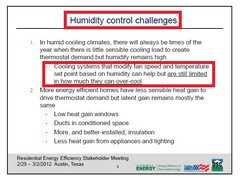
If you (for whatever reason) don't like my opinion based in fact. Look to what the department of energy says about humidity control challenges... Over cooling is not dehumidification. Never has been, never will be.cardinalminnesota thanked Austin Air Companie  7 years ago
If you have three units, and they are not running very much, that's a design problem. You might be able to demonstrate that the system(s) is over designed by turning off the unit in the middle zone and using blower fans to circulate the air to the middle from the other two. That should make the other two units stay on longer and remove more moisture. If that seems to work but not quite to your satisfaction, try turning off the two units on the ends and leave the one in the middle on. Then use the blower fans to send the cool air from the middle out to the other zones. If this approach works, then you have demonstrated that you have too many tons of AC on the project.
cardinalminnesota thanked dchall_san_antonio- PRO7 years ago
If this approach works, then you have demonstrated that you have too many tons of AC on the project.
It depends on outdoor / indoor load among other factors.
Again and hopefully for the last time you can not dehumidify with a single stage AC to any large extent. It will always over cool, long before it dehumidifies to any large extent.
Just because an AC can't dehumidify a high humid situation, doesn't ever mean it is over sized... because the single stage AC wasn't designed to dehumidify. It was designed to COOL. The AC is driven by temperature... not humidity.
cardinalminnesota thanked Austin Air Companie - 7 years ago
BUT a Single Stage unit that was oversized by any criterion would have better remove humidity if it had been of smaller capacity.
cardinalminnesota thanked User - PRO7 years agolast modified: 7 years ago
SaltiDawg,
Under these parameters posted June 24th by OP
The outside temperature is 68 degrees and the humidity 76%.
Nope, smaller capacity will still over cool. There is no load. Humidity is not considered a 'cooling' load.
Remember AC was designed to cool / drop temperature. High humidity at lower temps --- nope, you're not going to dehumidify with an air conditioner under the conditions stated by OP of this thread. You will need a dehumidifier to do that.
Right tool for the right job. You can smack a screw with a hammer all you want to no avail...
cardinalminnesota thanked Austin Air Companie - 7 years ago
Is the OPs system only ac or a heat pump? I should think a heat pump set to dry mode would alternate between the heating and cooling modes to dehumidify while maintaining comfortable temp.
cardinalminnesota thanked armoured - PRO7 years ago
There is no such thing as 'dry' mode on a central ducted forced air HVAC system.
But I read somewhere on the internet that if it's on the internet is has to be true?
On the internet you can *pretend* to be anything you want to be. So consider your sources.
What does it *really* mean to be a professional?
So not only must I do my job, I must also go around and play devil's advocate for all the misinformation in this thread and many others.
cardinalminnesota thanked Austin Air Companie  5 years agolast modified: 5 years ago
Guys. I've dealt with this humidity problem first hand. And please...listen to me when I say this.
Houses are very tight today. The AC is cutting off too fast to dehumidify. Anyone with a new construction home, with today's tight building standards, needs to get a dehumidifier in attic. Duct it with a DEDICATED return, and dump the air into the SUPPLY PLENUM! Do NOT duct it ANY other way. I've been dealing with the humidity for about 4 months on a new build, and finally....my humidity is down to 46% with this method. I also recommend with it, an ecobee thermostat. Have the ac guy wire the dehumidifier into the ecobee. You can control it from there.
This method is 100% going to work. Also, keep your ac on AUTO. And lastly, remember to have a backdraft damper installed into the discharge duct for the dehumidifier so the ac blower air doesn't feed back into the dehumidifier. Oh....and make sure that they program the relay to where the dehumidifier do NOT use the ac blower fan to "push air". You Want ONLY the dehumidifier blower to function alone. You will have slightly warm air blowing from the vents, but...1, it's not noticeable. 2, it actually makes your ac run a bit more....but, it's worth for more comfort. No more sticky skin.
Good luck!
 4 years ago
We moved into our new construction home November 30, 2021. The humidity is a steady 76%. My clean clothes become damp. It's very uncomfortable. Sounds like a dehumidifier is needed for now. We have the ecobee thermostat on the 1st and 2nd floors. I have never experienced such high indoor humidity. It's not easy to work in or sleep in. My skin is very clammy.
- 4 years ago
We moved into a new construction home November 30, 2021. The humidity always around 76%. It's extremely uncomfortable. I guess we need to purchase a dehumidifier.
 PRO4 years ago
Hi, Doris,
The performance of any residential HVAC system is affected by a number of variables including the home's size; construction details; the fresh air make-up/ventilation, if any; the particular HVAC equipment and ductwork; how and where they are installed; the outdoor conditions, and the desired indoor conditions. That's a lot of variables and I probably missed one or two.
I recommend you have someone take a comprehensive look at your home's HVAC system before making any major investments in changes.- PRO4 years ago
New builder spin via Mr. Ross & Co. to deny, deny, deny. Stall, stall, stall.
let the warranty of the home pass... 1 year? 2 years?
Doris you need to pressure the builder to fix it. - 4 years ago
Doris,
If you want help with trying to determine the cause of the high humidity, then I suggest you start a new posting. You will get more responses.
You need to provide additional information. What is your location, how large is the house, does it have a basement, what type of heating system do you have, and what temperature do set your thermostat.
The materials in a newly constructed house contain moisture. It takes time for the house to dry out. A dehumidifier will help lower the humidity. You have to determine if this is a short term or long term problem before a fix can be applied.
- PRO4 years ago
"Doris you need to pressure the builder to fix it."
There are temperature performance criteria for residential heating and cooling systems which your system would need to meet, but, to my knowledge, there is no performance criterion for indoor relative humidity; probably because if can be affected by so many variables outside the builder's control. Accordingly, pressuring your builder to "fix it" isn't likely to benefit you. A better approach would be to ask your builder for their help to investigate and remedy the problem. Collaboration typically yields better results than confrontation. - PRO4 years ago
Accordingly, pressuring your builder to "fix it" isn't likely to benefit you.
Of course... now you know why I exist, ironically enough. Straight from the builder's "contractually obligated" lips. - 4 years ago
We recently moved into a new house in the midwest humid climate. The indoor humidity ranges from 35 to 50 perent, usually between 40 and 45. If it gets over 45 I open some windows and the humidity starts dropping. Today it is 30 outside and I opened them briefly. I am not sure if this will work for others but thought I would throw it out there. The house is built on a slab and is super tight. We have three minisplits for heating and cooling. Opening the windows does not seem to impact our electric bill which averages about 80 dollars per month, less in summer and more in winter. The 80 dollars includes all the electric we use, HVAC and everthing else. The house is 1800 square feet, passive solar design.
- PRO4 years ago
If you're going to "pressure a builder to fix" something, you'll be better served if you can point to a specific shortfall with respect to a building code requirement, a contract specification, a departure from the approved plans or a failure to meet whatever quality standard is referenced in the contract documents.
While there are performance specifications in the International Residential Code with respect to temperatures which a residential HVAC system must be capable of maintaining, the code is silent, for the most part, with regard to indoor air quality measures such as relative humidity. Ventilation requirements including make-up air for range hoods and fresh air ventilation are relatively new.
Indoor relative humidity is a function of a number of variables including the outdoor temperature and specific humidity; the desired indoor temperature; the amount of fresh air make-up, if any; air infiltration; ventilation of moisture point sources such as cooktops and bathrooms, and the design capacity of the air conditioner relative to what the outdoor/indoor temperature difference requires. The OP's problem is high indoor relative humidity when no air conditioning is being called for. Without air conditioning, no dehumidification will occur unless the HVAC system is specifically designed to provide it under those conditions. When the outdoor temperature is less than the indoor set-point temperature, installation of a dedicated dehumidifier would generally be needed to control indoor relative humidity.
If you're building a custom home and have particular requirements for your home's indoor environment, incorporating those in your plans and specifications is the best way to ensure those requirements are considered in the design phase and delivered at the completion of construction. If you're purchasing a builder's spec home you may not have that option. - PRO4 years ago
So if mold developed on sheetrock would the builder be held responsible to fix that Charles? Like say in the span of less than a year from when the home was built?
- PRO4 years ago
I'm not an attorney and I don't give legal advice. That said, the conditions which give rise to mold and mildew growth are, for the most part, outside the builder's control. The builder can't, for example, ensure that bath fans are run when teenagers take hour-long showers or that the range hood is turned on when boiling a large pot of pasta or even that the HVAC system is turned on. The builder doesn't control the setpoint temperature of the air conditioner, nor whether and how much the homeowner opens the windows and doors. Nor can the builder ensure proper routine maintenance over time.
What the builder can, and is obligated to ensure, is that heating and air conditioning equipment will maintain the code-required indoor temperature (or temperature differential) for the outdoor temperature; that an appropriately sized range hood make-up air system is installed if required by code, and that ventilation is provided as specified in the applicable code. - PRO4 years ago
The builder can't, for example, ensure that bath fans are run when teenagers take hour-long showers
So you're discrediting yourself in terms of putting bath fans in showers now? Do tell.
But of course check with your attorney first, Mr. Ross. I know how builders operate so I'm sure many others outside my realm of expertise don't realize how fast things go south in new home builds gone wrong.
Of course you claim I know nothing, which does what for you "exactly". A home owner is going to have to call someone 9 times out of 10. Past two years? not going to be the builder who has done nothing but: stall, stall, stall. Deny, deny, deny. For the prior 2 years or longer.
Yeah, Builder Grade is a thing as it turns out. ;-) - PRO4 years ago
"So you're discrediting yourself in terms of putting bath fans in showers now? Do tell."
What?
I advocate installing point-source ventilation of moisture including bath vent fans over showers, and range vent hoods over ranges and cook tops. I install them in the homes that I build, but I can't make my clients use them and I can't control the consequences if they choose not to. - PRO4 years ago
I realize that this is an old thread, but folks may review it in the future and benefit from the discussion. Indeed, there is another, recent, similar thread on low indoor relative humidity in a Minnesota home in winter, so it worth correcting some of the misinformation on this thread.
"Again and hopefully for the last time you can not dehumidify with a single stage AC to any large extent. It will always over cool, long before it dehumidifies to any large extent."
A properly-sized air conditioning system-- including single-stage systems-- will dehumidify air whenever the air temperature leaving the coil is at or lower than the dewpoint temperature. In the summer in my (mixed-humid) climate zone, that's most of the time. I have a single-stage air conditioner. All of the water being drained at the end of the condensate line is ample evidence it's dehumidifying. In fact, it creates a wet spot in the lawn that I need to reseed every fall.
When my air conditioner doesn't do an adequate job of dehumidification is during so-called "shoulder seasons" when there is no real demand for cooling (you can't dehumidify if it's not operating.) We get shoulder seasons for three or so weeks each spring and fall. For shoulder seasons, I've found dehumidifiers to be the right complement to my air conditioner. I have one on each level of my home integrated into the HVAC system. They enhance comfort, and they reduce the potential for mold/mildew which is very common in our climate zone. They can also be configured to introduce fresh air into a home, which is a plus, year 'round.
"Just because an AC can't dehumidify a high humid situation, doesn't ever mean it is over sized... because the single stage AC wasn't designed to dehumidify. It was designed to COOL"
Not so fast. An air conditioner, as the name implies, is part of a system which maintains comfortable indoor conditions for the occupants. It cools, dehumidifies, and moves air throughout the home. The dehumidification part is stripping moisture from the air. Indeed, when designing an air conditioning system, we need to consider both the sensible cooling load and the latent (moisture removal) loads. A properly-sized single-stage system can dehumidify air. Its ability to do so is affected by run time under particular conditions, which is a sizing consideration. - PRO4 years ago
Charles,
a single stage air conditioner is over sized over 90% of the time. Properly sized at 60-70F even 80F outdoor is completely different than sizing conditions at 95F outdoor or warmer. The air conditioner (most of them for this climate) controlled via a temperature, not a humidity sensor.
Minnesota is a "low use" air conditioning market. So the argument about proper sizing is a poor argument when it comes to humidity concerns for a climate in which air conditioning is really only thought about at best 3 months of the year. (I use to live in Wisconsin, which is similar to Minnesota climate.) - PRO4 years ago
"Minnesota is a "low use" air conditioning market. So the argument about proper sizing is a poor argument when it comes to humidity concerns for a climate in which air conditioning is really only thought about at best 3 months of the year."
What?
HVAC systems need to be properly designed for whatever climate zone they're installed in. Would you propose that a poorly-designed HVAC system is okay in Minnesota but not in Texas? C'mon. You haven't started the New Year's Eve drinking early, have you, Ray? - PRO4 years ago
Charles,
Air conditioners are sized based on heat of the day. Sometimes the heat of the day will be hotter than design. (design is the parameter of outdoor ambient of a given location)
In the south this design parameter is 95F.
Is it 95F all the time here? No. Up in Minnesota the design parameter might be 90F. Is it 90F all the time in Minnesota? no.
If you have a heat load that says a structure needs 4.3 tons of air conditioning for a given structure? There is no manufacturer that specifically makes a 4.3 ton unit.
So your argument is to say you can specifically size appropriately? Clearly you don't do these things and so clearly you're in over your head as they say.
When is the heat of the day? Typically 3pm-7pm / heat waves typically 3pm-8pm. Unless you live in some odd place the sun is shining in the wee hours of the day.
How many hours are there in a day? If the heat is from 3-7pm thats 4 hours or 1/6 of a day. Throw in seasonal changes from there. Properly sized "specifically sized" is only achieved in modulating and Inverter based systems.
A single speed air conditioner is at best properly sized 10% of the time. There is no heat load that will get you out of that conundrum.
Trade offs? modulating and inverter based systems cost more money. So you accept the trade off for less cost in a climate that may not use air conditioning that often (3 months of the year in Minnesota) or 9-10 months of the year in Katy, Tx.
Even here in Katy, Tx a single speed air conditioner is for the most part properly sized about 10% of the time. Because of the over sizing thing mentioned above if the structure calls for 4.3 tons, that is rounded up here. Mix in all these other facts... there you go. - PRO4 years ago
"In the south this design parameter is 95F."
It's a wide, wide world out there, Ray. The "south" covers a lot of area; it includes four different IECC climate zones. A one-size-fits-all design criterion, i.e., a single temperature--isn't appropriate nor would it meet code in every southern locality.
The design temperatures for manual J calculations are provided in the International Residential Code for a variety of locations in each state. Heating systems should be designed to meet 97.5% conditions-- which means that there can be occasions where actual temperatures are less than design, and cooling systems should be designed for 2.5% conditions, which means actual temperatures may occasionally be higher than design. The code-required design temperatures include both dry bulb and wet bulb for cooling and a dry bulb temperature for heating--not a single temperature. That makes me wonder if you've ever done a manual J calculation. Incidentally, the design temperatures for Houston (which is really, really close to Katy, TX) are 94F d.b. and 79F w.b. cooling and 32F heating which aren't too different from what we design to in my coastal VA area (92F d.b. and 78F w.b. cooling and 17F heating) but different from other places in the south like Elkins, WV where the design temperatures are 84F d.b. and 72F w.b. for cooling and 6F for heating.
A one-size fits all solution is easy to prescribe, but it's not likely to be the right solution for every location nor is likely to comply with code everywhere. - 4 years ago
The design temperature for Miami Florida is 90 F degrees. The design temperature for Phoenix Arizona is 107 F degrees. You can't use one outdoor summer temperature to do the load calculations for every location in the southern states in the US.
- PRO4 years agolast modified: 4 years ago
Thanks but I'm in Texas. In Texas it's 95F.
Lets argue over semantics of areas in which I don't serve.
The fact is: temperature changes. Just because you have a design temp of 90, 107 whatever it is... it's not that temperature all the time.
Let's not talk about that though. Let's argue!
I said temperature changes where is it within that reference that says it's a one size fits all?
That's what you were saying prior... you said you could properly size a single speed air conditioner using a heat load. I said you can't because:
It's over sized 90% of the time. It doesn't matter if design temp is 95, 90, 107... the sizing you use for that design will still be over sized 90% of the time... if not more due to climate concerns.
No, lets argue some more.
I say the south... you give locations of SE as in Florida and the SW as in Arizona. I guess you all failed geography as well. Big surpise there. But no, let's argue...
The flaming ball in the sky is making a liar out of the both of you. Let's go and generate some CO2 and make some warmth? Without the flaming ball -- it won't matter how much CO2 you got. Let's ignore that argument.We must change the argument about proper sizing because? yeah an argument you won't win. So we must argue something new. It's 2022. That didn't work in 2021 either.
But lessons like these are never learned? Still not too late to form some new resolutions.
- PRO4 years ago
"Thanks but I'm in Texas. In Texas it's 95F."
Texas is a pretty big place. So big, in fact, that it includes three different IECC climate zones: zones 2, 3 and 4. Homes need to be designed for a particular climate zone in order to meet code requirements. The code required R-values for wall and ceiling insulation, for example, differ by climate zone--even in Texas. HVAC system design temperatures vary, too. Here's a few of them taken from the 2018 IRC:
Abilene: 20F heating; 99F d.b. and 74F w.b. coolingHouston: 32F heating; 94 d.b. and 79F w.b. cooling
El Paso: 24F heating; 98 d.b. and 68 w.b. cooling
You need to consider both dry bulb and wet bulb temperatures when designing HVAC systems or you'll fail to consider the latent (moisture) load.
I'm sure your local code official would be glad to help you navigate the applicable code in your area, Ray. - PRO4 years agolast modified: 4 years ago
Thanks Charles, I've been using 95F for over 20 years now for my area that I serve. That has served me well.
So the argument is still that you think you can properly size a single speed or even a two speed air conditioner when you can't even agree what outdoor ambient temp you should use to form the calculation? Makes complete sense in a builder grade world.
Let's talk in circles some more. All the more reason the load calculation is even more wrong.
So you run the numbers come up with 4.3 tons of cooling (regardless of OAT concerns) what size AC do you put in? You know so the calculation you just performed is actually used for something as important as proper sizing? Asking for a friend. LOL.
 4 years ago
FYI! I was told by my HVAC man to never have the Fan set to "ON" but always to "AUTO". When the ac not actively cooling yet fan still on, it is acting as a HUMIDIFIER, blowing moist air in from outside! I realized this when i walked in to our rental condo one day (after a week long renter) and the humidity was so high the bedsheets were moist!






mike_home