Software
Houzz Logo Print
misssherryg

So Excited - Giant Swallowtail Caterpillar!

7 years ago
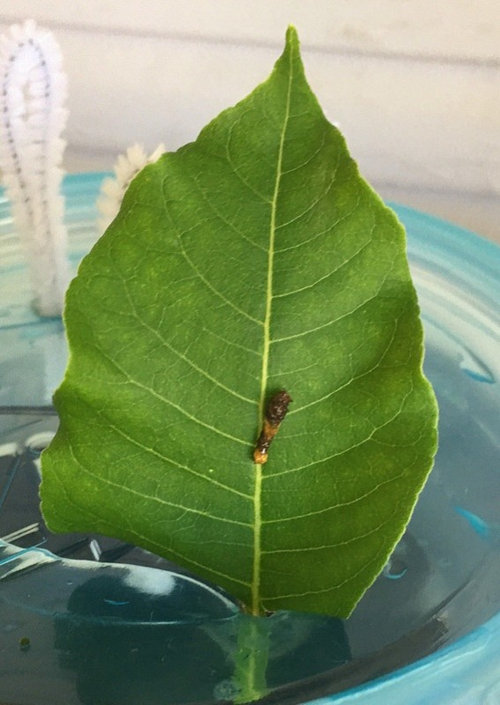
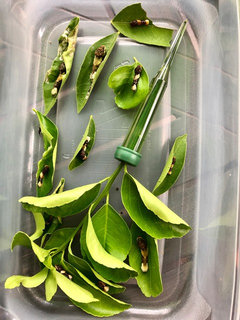
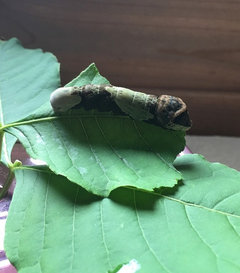
I found one solitary giant swallowtail caterpillar on my small Ptelea trifoliata! Where I used to live, I got GST eggs/cats pretty frequently, but being in this butterfly desert (near town) it's wonderful! I don't know how I failed to see it earlier - 'must have been on the underside of a leaf that looks chewed. There are plenty of wasps here, so I stuck that section of the trifoliate leaf into a left overs container with holes punched in it, filled with water and put it in a small new cage I got a while back - it's now on my shaded front porch. The top of this cage lifts off and on, don't have to deal with any zippers.

Last summer I got a single monarch, then got a lot of monarchs this past spring, so maybe as my Pteleas grow, I'll get more. I checked the others for more cats, didn't find any. The Pteleas are growing fast!


Sherry

Comments (57)

  • 7 years ago

    Anna, I think they only use the Sweet Bay magnolia to lay their eggs in Florida. The Sweet Bays like swampy conditions, which is why I think the Tigers are more prolific when there is a lot of rain. I had a Sweet Bay that got very big. There were some Tigers that used it, but not many. It finally got so big that its roots were destroying the pipes into my pool and I had to cut it down.

    I also had a few Ptelea Trifoliata. The Tigers used it, but the trees or small bushes didn't do well and eventually died. I'm not sure what I did wrong with them, but I think this growing zone might not be optimal for them.

  • 7 years ago

    Sherry, Tom, and Iris, as I said before there has been a Giant in the yard everyday for a week but no eggs or cats on my lime. But, as Sherry pointed out, my lime has no new growth right now. So I kept wondering why is the Giant here? Today when I saw it, I finally remembered my new neighbor asking what to do about an old uncared for lemon tree on their property in April. I asked them if I could look at their lemon for caterpillars and I found 12 Giant Swallowtail cats of various size!!!


    I am so EXCITED!!! I have divided them into 2 containers by size. Is that enough? Do they need less competition? Are they cannibalistic?


    Also, I trimmed some new growth branches from the tree, placed them in floral tubes and put them in the fridge for future food? Is this good or should I do something else with cuttings?


    Any suggestions would be much appreciated as I am a Giant 1st timer. :)


    Anna


  • 7 years ago

    Don't put too many leaves in the fridge, Anna, because they only stay fresh so long, even in the fridge. Ask your neighbor if you can come back for more later. Cutting leaves (like you did to get the cats) will encourage her lemon tree to make more new growth, which is good! If you trim your citrus, your tree will probably make new growth where you trimmed it, and maybe you'll get eggs there.


    The only thing I can tell you about giant cats is that they're very sluggish. The first time I raised some, I thought they might be dead! They're very different from active cats, like pipevine swallowtails or monarchs, and they eat very little relative to their large size. Pipevine swallowtails eat much more, and they make smaller butterflies.


    Congrats, congrats!! I just LOVE giant swallowtails!


    Mississippi girls really like our butterflies and caterpillars don't we? :)


    Sherry

  • 7 years ago

    Wow, such good news, Ana. Congratulations.


    Sherry is the expert here, so everything she said makes sense to me. They seem to already have some size to them, so you shouldn't have to wait for long, perhaps a week to ten days before they are going to go into their chrysalises.


    If you have another few containers it might be better to separate them more. There will be a lot of frass. Will they have something to hang from?


    If you have all of these now the probability is that there will be more eggs and small cats on the tree now. So, the good news should continue.

    MissSherry thanked Tom
  • 7 years ago
    last modified: 7 years ago


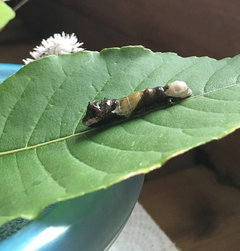
    My one and only giant is thriving -


    'Just wish I had a few more!


    Sherry

  • 7 years ago
    last modified: 7 years ago

    It's hard to tell size from pictures, and I think yours may have another instar to go, but, yes, they're close

    - they get real big before pupation. You're so lucky to have so many! And it's good that you separated the smaller ones from the bigger ones. I always did that with all my caterpillars, at least back in the days when I had a lot of each type. I don't think cats are cannibalistic, but in the process of eating a leaf, they can easily eat a much smaller cat along with the leaf!

    Sherry

  • 7 years ago

    Anna, you are doing so well raising them. You obviously know what you are doing.

  • 7 years ago

    Anna is, indeed, doing great!


    Sherry

  • 7 years ago

    Love getting the updates and seeing the pictures! Giants are still not that common for me. I had the first caterpillars 2 years ago, and there still aren’t many.

    MissSherry thanked Iris S (SC, Zone 7b)
  • 7 years ago

    Giant cat has molted again -


    Sherry

  • 7 years ago

    Hey Y'all, the transformation has started!!


    The first of the 12 is pupating!! It's so exciting!! The neighbors came down to see what their old knarly lemon tree produced. They were amazed!


    Thanks for the support and encouragement! Can't wait to see it with wings.


    Anna

  • 7 years ago

    Love the photos, Ana and Sherry. You ladies are so good at raising caterpillars.

    MissSherry thanked Tom
  • 7 years ago

    Also love the pictures! Things are moving so quickly! Miss Sherry, do they leave the skin or eat it? I thought I read somewhere that they do.

  • 7 years ago

    They usually eat it, Iris, and, in fact, mine did, plus ate the ends off two Ptelea leaves.


    Congrats, Anna!


    Sherry

  • 7 years ago
    last modified: 7 years ago

    I attribute the paucity of Tiger sightings to the fact that the Tiger uses so many kinds of hosts, thus do not need to visit us. Most butterfly genera stick to one plant family; many plant families are represented among Tiger hosts.

  • 7 years ago

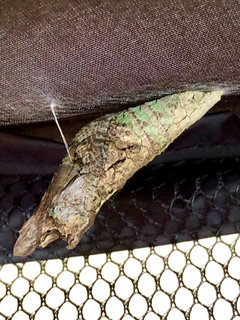
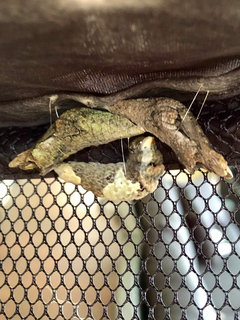
    Here is the first chrysalis of the 12 Giant Swallowtail cats!!


    AND another cat purged this evening and has moved to the top of the enclosure. So maybe 2 chrysalids in a couple of days!


    Anna


  • 7 years ago

    YAY!! GST chrysalides look like a little piece of wood, even have some turquoise colored 'mold' on them!


    Sherry


  • 7 years ago

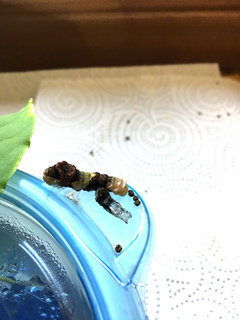
    The 2nd Giant Swallowtail has "J'd" with her silk strap and should be a chrysalis tomorrow!!


    Anna

  • 7 years ago

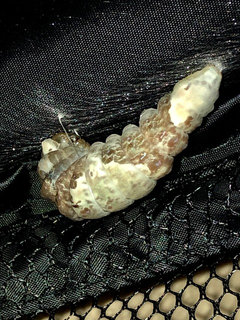
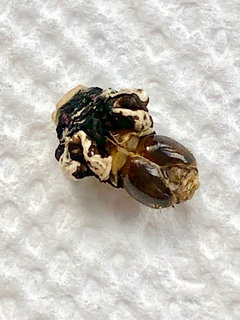
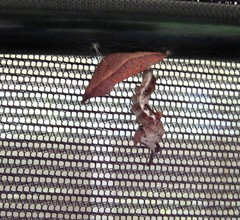
    There are now 3 Giant Swallowtail chrysalides and 4 GS "J'd" cats!! Here is a photo of the cat skin that is discarded when transforming from "J" to chrysalis. I just think it is amazing how efficient and compact is this "skinning" process.


    Anna

  • 7 years ago

    Yes, that looks very familiar. Congrats, again, on all your giants!


    Sherry

  • 7 years ago

    That’s so cool! Thank you for sharing!

  • 7 years ago
    last modified: 7 years ago

    The GST cat is getting real big, wouldn't be surprised to find it has purged in the morning. If it gets much bigger..........?


    Sherry


    Update: It's making its chrysalis now!


  • 7 years ago

    Fabulous!!!

    MissSherry thanked annabananaflzone9b
  • 7 years ago

    It's now a chrysalis! 'Can't wait to see the adult!


    Sherry

  • 7 years ago

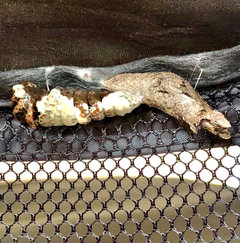
    Take a look at this! This GS cat had basically the whole enclosure ceiling on which to pupate but chose a sibling! Nothing worse than having to share a bed with your sister!! :)


    Anna


  • 7 years ago

    Now, take a look at this!! 3 in a communal pupation. :) They had the whole enclosure to choose from. This must be the "hot spot" for chrysalides.


    Anna


  • 7 years ago
    last modified: 7 years ago

    Most of my chrysalides were like that when I raised a lot of cats. It'll be interesting to see if the pipevine swallowtails I've got now (a lot!) do the same. I once had a red-spotted purple pupate on a giant swallowtail chrysalid. I might still have the picture.

    I found the picture, and it was a spicebush swallowtail the red-spotted purple pupated on -


    Sherry

  • 7 years ago

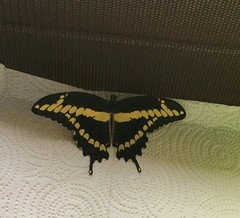
    It emerged this morning -


    Male or female?


    Sherry

  • 7 years ago

    Good question. I would say female. Only because I have seen thicker horizontal bands than that. 50/50 chance, right? :)


    Anna


    MissSherry thanked annabananaflzone9b
  • 7 years ago

    Right! I was guessing male, because his spots were so bright. I released him a few hours ago, he was so anxious to leave!


    Sherry


  • 7 years ago

    That‘s wonderful! Love hearing all your butterfly adventures.

  • 7 years ago

    Would you mind if I ask a Monarch question here? I don’t really want a new thread for it since it’s just curiosity. And the experts are right here.

  • 7 years ago

    I'm no expert, but go ahead, maybe I'll know the answer, Iris.


    Sherry

  • 7 years ago

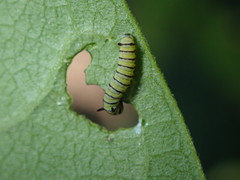
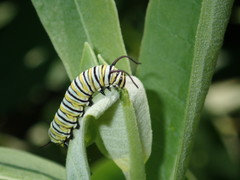
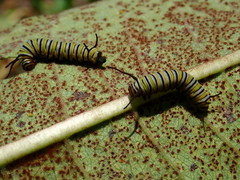
    So a week ago a Monarch stopped by. Caught me completely by surprise. It’s a month early for the Summer ones. She laid eggs on the oldest, gnarliest Common milkweed to be found in my yard. There are plenty of patches I cut down a few weeks ago that look nice and fresh now. She did have damaged wings, but flew pretty well. Stayed almost two days, but only laid eggs on this nasty patch. I thought they look for nice ones? I saw this tiny guy walking by today and put him on the fresh milkweed. He honestly seemed to appreciate it and ate this much in a little more than two hours. Should I look for the other little ones and transfer them? I am talking really old looking rusty milkweed. What was she thinking? Are you seeing Monarchs in your area now? She was the only one. None since. Wonder where she came from.


  • 7 years ago

    I often see the captive tiny Monarchs seriously eating leaves that have become quite yellow.. Small (and upwards) -sized eat only the green parts of combination yellow and green leaves. Point is that tinies can be surprisingly flexible with leaf quality.

    Of course the more that they eat, the faster /bigger that they can grow; and because tender leaves are are easier than tough leaves for tinies to eat, I give the tenderest to them. Similarly, in those times when I do not protect caterpillars via captivity, I do plenty of caterpillar relocation among plants and intraplant.

  • 7 years ago

    Iris, I would certainly move the small caterpillars to the fresher milkweed. 'Don't know why the Mama monarch laid eggs on old MW, it's unusual. I haven't seen any monarchs lately, but it's getting to be that time when they show up - late summer, early fall.


    Congrats on the babies!


    Sherry

  • 7 years ago

    Thank you! Moving it is. The Spring Monarchs arrived a month later than last year, now this one a month early.

  • 7 years ago

    I would mention one thing to consider, wasps. It is easier for them to hunt when the plants are open and leaves are small, as in plants just returning from being cut back. I don't know what your plants look like but its harder for wasps to fly into bushier leafier plants so the caterpillars are better protected. This may have influenced the butterfly.


    Or she may be old and senile and just wanting to get this done. :)


    Anna


  • 7 years ago

    Lots of Monarchs here in Central Florida. They never leave unless there is a hard freeze which hasn't happened in two years now.


    I have a somewhat different problem. I purchased five tropical milkweed plants from Lowe's. I panted them in two large pots with very good soil and some organic fertilizer. They are doing quite well, but I don't see any caterpillars on them. I'm afraid the the grower used a systemic pesticide on them. I don't know why they would do that. The only real use for these plants is for Monarchs to use as larval food.

  • 7 years ago

    Eggs?

  • 7 years ago

    Need to look for them. I haven't seen Monarchs visiting the plants, but there are small holes in the leaves. I don't see any cats yet.

  • 7 years ago

    If they are the tropical yellow flowering "butterfly weed", it may take some time. From my experience the Monarchs only use these as last resort. If your concerned about pesticides, they probably didn't use a systemic, so just water wash the plants really well and they should be ok. Also, if you've placed your pots in a new spot, it may just take time for them to find them.


    Anna


  • 7 years ago

    Tom, regarding small holes and no caterpillars : A couple of months ago I was finding a Monarch hatchling at nearly every new hole. Recently new holes without caterpillars, the change coinciding with recent heavy mortality rate of captive Monarch caterpillars. It raises the conjecture that my hatchlings have been dying, perhaps yours too.

  • 7 years ago

    I haven't seen much movement either. I see some Monarchs in my yard, but I don't see any eggs or cats. My plants are big and ready. I've seen much less Monarchs this year than pass years.


  • 7 years ago

    I am still finding some Monarch caterpillars on the old, nasty milkweed. The ones I transferred to the fresh ones are about 1.5 times bigger. So I guess they would survive on the old one, but not thrive. Well, I wouldn’t want to eat this stuff, either.


  • 7 years ago

    Great photos, Iris!


    Anna

  • 7 years ago

    Yes, excellent photos. Can you move the ones on the scruffy plant to other, healthier plants.

  • 7 years ago

    I already did. There are about 25 stalks of the nasty ones. My plan for tomorrow is to check them leaf by leaf and cut them down. There are lacewing eggs on one, so that one will have to stay. I should have gotten to this sooner, but with weeks without rain I was just watering for hours.

  • 5 years ago

    In spring, the swallowtails come to our citrus trees and lay eggs. But i never see any.

Sponsored