Software
Houzz Logo Print
chris209_gw

Pruning sour cherry tree

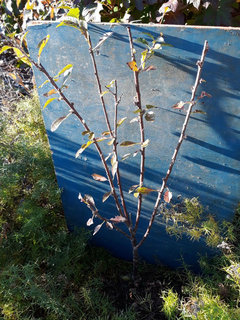
I should have asked earlier in the season, but somehow time got away from me. I purchased a North Star sour cherry this spring from One Green World. I purchased apple trees and persimmons trees in the past from them and those all came as wips. This arrived with 4 or 5 branches emanating about 1 foot up from the base. I left it as is, but not sure if that was correct. Should I have pruned it to a single branch or is this normal? It's hard for me to imagine these as part of the permanent structure originating so close to the ground.
-Chris

Comments (15)

  • 7 years ago
    last modified: 7 years ago

    For one, part of the deciding factor is whether or not it's a dwarf tree. Another is its age. Either way, if it's still pretty young, I'd say let it go for a season or two. Let the lead get up a little higher and allow some other branches to start off of it. Then, you should be safe to prune back some of the lower limbs. Just remember, like most other stone fruits, they like a lot of open space in the middle of the canopy to allow for good airflow.

  • 7 years ago

    a pic.. would really help ...


    as a tree .. i would be inclined to not be cutting off any of the canopy for the first year... and maybe the second.. just to allow as many leaves as possible.. to generate energy ... to grow the roots... to get the tree established .... i would not really be concerned about fruit production ...


    i am sure fruit peeps do things differently ...


    this fall .. after it loses its leaves.. when i could see the whole ... i would probably decide what if any pruning i MIGHT consider ... before next spring ...


    and of course.. anything broken or crossing.. would be the first pruning ... if any ...


    this fall .. after it loses its leaves.. when i could see the whole ... i would probably decide what if any pruning i MIGHT consider ... before next spring ...whats the hurry ... ????


    its easier to prune.. when you can establish a goal ... take the time to do such.. and that will guide you ...


    ken


  • 7 years ago

    While you can do some minor pruning during the growing season, you should be mindful of how much you cut. You can easily shock a tree if you take too much or leave too many open wounds - especially during the growing season. Obviously, cutting off broken branches or anything else that may negatively affect the tree should typically be done ASAP. But, if it can wait until after dormancy kicks in for the winter, that would be better - especially for heavy pruning. Pruning in late fall or late winter (I typically prune in February.) prevents you from shocking the tree in most cases. The spread of disease can also be prevented in the cold when the tree is dormant. For instance, in apple orchards, pruning in the cold weather helps prevent the spread of the bacteria that causes fire blight - which is devastating to an orchard. The sap isn't running, the bacteria can't live long in cold conditions (on your pruners or the edge of any wound your pruning just created), etc. So, like Ken said, you should save the bulk of your pruning for the dormant period.

  • 6 years ago


  • 6 years ago

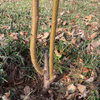
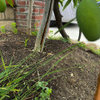
    It took me forever to get a picture of this tree and then I had trouble loading it, so I finally compressed it and now was able to upload it. Sorry for the delay. Just wanted to clarify, I never had any intentions of pruning the tree during the summer. I'm just looking for advice on how to prune it in the future. As you can see in the photo there are many branches and not sure if I should keep one and encourage height or leave them. They start branching out no more than a foot up. The whole plant right now is maybe two and a half feet tall.

  • 6 years ago

    The best advice I can give you is keep the center pretty open. Remember, stone fruit trees like an open, airy center for good airflow. That said, you can select one of the more vertical branches to be a lead but I'd wait a while. See what the tree does on its own... See what shape it begins to take...

  • 6 years ago

    Okay thank you everybody. I guess the consensus is to wait and see what happens for now.

  • 6 years ago

    i presume the board is just for the pic????


    second .... pruning becomes easy.. if you can come up with a GOAL .... what is your goal??


    only production ... or is this a lawn tree ... and you need to raise the canopy???


    if you want more of a tree shape.. so it will look pretty ... over the next few years.. tree time.. you would start removing the lower branches .... but then you will end up needing a ladder to pick your crop ...


    on the other hand.. if its all about crop ... then you really dont care about height ... and can avoid the ladder to some extent .... if you keep it low ...


    keeping the center open.. allows more sun into the middle of the plant.. where you can get more crop ... as with most trees.. the exterior of the canopy starts shading out the interior ...


    what is your goal ... ken

  • 6 years ago

    Stone fruit like cherries should only be pruned when growing. The best time is early spring, but pruning in July is better than pruning in dormancy. There is a lot of research that shows this. Pruning when dormant invites pathogens to invade the wounded tissue.

  • 6 years ago

    North Star is a very compact, dwarf sour cherry, only growing to about 10' tall. Given the mature height. low branching is to be expected and perfectly acceptable. It is essentially leaderless and should have an open, vase-shaped form, which the example in the photo does.

    I don't see that any pruning is required at this time and I'd be inclined it let it go for at least a season.

    As to the timing of pruning, sour cherries are less prone to fungal and bacterial issues than are sweet cherries, so dormant season is advised. But with virtually all fruit trees, dormant season pruning is the time for heavy pruning; summer pruning is reserved for removing water sprouts and for thinning and light shaping.

  • 6 years ago

    While I respect your considered opinion, gg, (thank you for sharing your knowledge) pruning when the tree isn't growing is very much advised against when it comes to stone fruit. No orchard owner here in the PA fruit belt prunes the stone fruit until the very last thing. A snowy winter when it's hard to get into the blocks means that in many years peaches, plums and cherries are pruned when in bloom. It is pretty, but pretty jarring too, to see the orchard floors spread with pink and white bloom.


    This from Maryland: Stone fruit trees are also very susceptible to a disease called Cystospora canker. If pruned in late winter, the tree cannot protect the pruning wounds from infection by this disease. Prune your trees from budswell through petal fall in the spring. (The bold type is from the MD Extension Service site.)


    This from Penn State: "The best time to prune is from just before bloom to 2 weeks after petal fall. Do not prune the trees from January through March, and do not prune before budswell. Stone fruit trees are very susceptible to a disease called cytospora canker. If pruned in the winter, the trees cannot protect the pruning wounds from infection by this disease. The exception is sweet cherries, which are best pruned after they have fruited or in early July.


  • 6 years ago

    With all due respect, more sweet cherries are grown here in WA state than anywhere else in the country, including California. And they are all pruned primarily during the dormant season and this practice is endorsed by both OSU and WSU.

    From Good Fruit Grower:

    1 Remove pendant and small wood. Get rid of the weak wood that won’t have enough leaves to support a crop. “Small wood is bad news on Mazzard trees, but disaster on Gisela.”

    2 Remove one-third to one-half of last year’s growth. During the dormant season, tip all branches. This will reduce the future crop but increase fruit size. He also suggests growers consider tipping of Lapins and Sweetheart when grown on ­Mazzard.

    3 Do renewal pruning, stubbing back 20 percent of all fruiting wood. During the dormant season, leave 5- to 20-inch–long stubs. Stubbing will reduce the current season’s crop and renew spurs for the following year.

    4 Thin shoots at top of tree to a single branch. This should be done during the ­dormant season, and the tree should be left in a pyramid shape to allow light ­penetration throughout.


    Maybe it is a regional thing :-) But then the PNW is known for its wet winters and springs and yet this practice is still endorsed by local orchardists and extension services.

  • 6 years ago

    Yeah, but the OP is writing about sour cherries, and WA is #4. As you wrote before, they are 2 different fruit. Also, your cherry growing area is a desert (or close to it, been there several times), so fungal problems are minimal. The climatic conditions on Long Island, NY (OP home) are similar to Cen. PA, much more similar than the Yakima-Wenatchee valley. This area (CenPenn) has few cherries. As you may know, rain when they are almost ripe ruins them, (is it too snarky to add) just like leaving big pruning scars in the winter ruins the tree.

  • 6 years ago

    Thank you all once again for your assistance with this!