Software
Houzz Logo Print
elen_gunawan

CL. Cecile Brunner,

7 years ago
last modified: 7 years ago
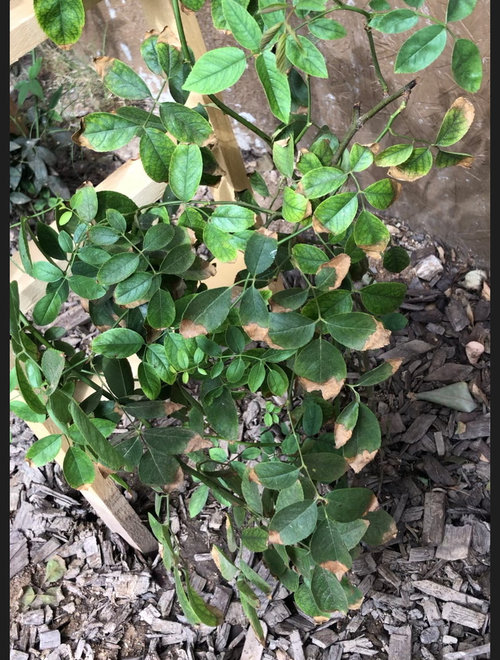
Hi all of the gardeners..

this is my first time gardening

my question Is;

is this leafs scorch or sunburn??

i did watering her.. everyday..,

got sun 5-6hours and put her in the shade

this July my weather condition very hot,

90s-106 F

i live in Victorville CA, zone 8b/9a high desert..

Btw I didn fertilize my roses when temperature still 90s up

but why I still got sunburn??

what should i do to make all of her leafs back green again??

are Cecile Brunner heat tolerant??


Comments (26)

  • 7 years ago

    Again, I see no rose in the picture.

  • 7 years ago

    There may not be a rose flower in the photo but it is definitely a rose plant :-) Brown tips to the foliage are usually a sign of environmental stress - excessive heat, inconsistant watering, a buildup of fertilizer salts.

  • 7 years ago

    @ callirhoe123


    it‘s because the heat in July my CL Cecile Brunner doesn’t have blooms or roses

  • 7 years ago

    @gardengal48

    about fertilizer salts, what does it mean?? I’m sorry I don’t understan,

    this is my first time gardening

    the last June or first June

    I fertilize all of my roses with 3in1 Bayer fertilizer

    what should I do ‍♀️

  • 7 years ago

    Fertilizers provide plants with nutrients in the form of soluble salts. If one over fertilizes or does not provide sufficient irrigation, these salts can build up and cause leaf burn. If this rose is new this season and you have not overdone the fertilization, this is probably not the issue but excessive heat or inconsistent watering certainly could be.

  • 7 years ago
    last modified: 7 years ago

    And yes, this roses is new this season


    I scared too fertilize when the temperature too high like 90s Up

    i live in california high desert

    last July temperature always 100s up

    and august will going down to 95s up

    like today 99 ‍♀️‍♀️

    Maybe be I will fertilize them the end of August or in the middle of August

    @gardengal48 thank you so much for replying it’s mean a lot for me as a beginner gardener ❤️

  • 7 years ago

    You do not want to fertilze that late in the season. Wait until early next spring (at pruning time) before you fertilize again.

  • 7 years ago

    Wow...

    thank you for a Lot of explaining

    it‘s means a LOT FOR Me


    can I fertilize them in August or Sept??

  • 7 years ago

    Clm Cecile Brunner is a China rose. The flowers are tiny and delicate. My Cecile Brunner in the PNW, does best in morning sun and full, afternoon shade, The sun will definitely burn the tiny blooms. Cecile also gets BIG. Mine is now 20 feet along a fence. It only blooms once but you will get literally LOADS of flowers all over the bush.

  • 7 years ago

    Elen, Welcome to the Rose forum! We have lots of fun discussing our roses here. Yes to what Roseseek says. He is a very experienced rosarian :-) I am always grateful for his advice.

  • 7 years ago
    last modified: 7 years ago

    It's less of a concern in a mild winter climate like yours but you never want to fertilize anything late in the season as growth slows but rather in early spring as it just begins. Typically the end of July/beginning of August triggers the end of the season for fertilizer applications. Except for lawns and containers :-)

  • 7 years ago

    thanks once again @gardengal48 ❤️❤️❤️❤️❤️❤️❤️ And I did following you and all of who comments in this post, I still need to learn from the expert

  • 7 years ago
    last modified: 7 years ago

    As mentioned above this variety produces few, if any flowers after the one big main bloom at the start of the season*, at this time of the year the main visible occurrence should be the production of new canes that will flower next year. And it needs a fair amount of space, unless a body knows how to prune it to control size without spoiling it - there used to be one near me that had grown nearly to the top of a utility pole and was working its way sideways, along the wires.

    *Except for those particular clones that do actually repeat flower in a consistent way. But these are something that would ordinarily be sought out from rose specialists, seem not to be the same as the material that is on the general market. So you probably don't have one of those

  • 7 years ago

    So I don’t have flowers in the fall ..,
    Wow I thought it’s gonna flourish at summer and fall too
    In the middle of last july she has flowers

  • 7 years ago

    I'm glad I could help and all the other helpful comments, too! Great! There are repeat flowering climbing and Spray Cecile Brunner plants available, but you won't find them at your local Home Depot, Lowe's nor nursery. You will have to buy them from on line sources.

  • 7 years ago

    Last question @roseeek

    can i fertilize them at the end of August or middle sept when my temperature get 80-85??

  • 7 years ago
    last modified: 7 years ago

    Take some of the leaves with the interveinal chlorosis (yellow between green veins) and tip burn to an independent garden center to see what they think about that. Before applying anymore chemicals.

    If you can't seem to get incisive information from a nearby retailer then try your nearest USDA Cooperative Extension Service branch office.

    You will have to be able to get to the latter during their weekday only open hours, likely to be something like M-F 9-5.


  • 7 years ago

    Bayer 3 in 1 is not recommended. You picked the right roses for your climate. Rose Tone or Plant Tone might be safer.

  • 7 years ago

    Bayer 3 in 1 contains systemic insecticide and systemic fungicide as well as fertilizer. In Victorville, I seriously doubt you are going to have many, if any, disease issues. I lived in the Santa Clarita Valley for 14 years and never saw any disease issues on Cecile Brunner. The only insects I would expect you to have would be Chili Thrips (eventually, if not already and that because of the heat there) and perhaps aphids in spring and late fall. The Chili Thrips Bayer 3 in 1 probably won't do much for from what I read. Aphids go away when it gets too hot and dry or too cold and wet. So, the suggestions for fertilizers which don't contain the other chemicals are probably much better.


    My concern would be drainage and how much of these "salts" flush from the soil. My guess is, your home is relatively newer, isn't it? Something built at least since the early 1980's or newer? That matters because of state seismic stability requirements. After the Sylmar earthquake in 1971 then the later ones, including the 1994 Northridge quake, the state enacted soil stability requirements to prevent quake damage. Soft soil slows down the shaking, making it worse and causing greater damage. Harder, more compacted soil allows them to pass quickly, with significantly less shaking and damage. Starting in the early 1980's, builders were required by the state standards to take core samples to insure the soil was uniform, stable and compacted. They must physically dig it out, mix it up and then mechanically compact it to specific density. That squeezes all the air space from the soil, leaving more like bed rock. That means the water can't percolate through it and drainage slows and eventually stops. The roots can't work their way deeply into the soil because there are no air spaces into which they can grow because the soil is squeezed solid, like rock. I dealt with that for many years in the detail gardening business I owned and operated as well as in nurseries I worked and than managed. The soil is so hard, you can't easily dig holes with a shovel and when it gets wet, it's only in the top two to three inches of "top soil" the builder or landscaper spread out over the compacted soil so you could grow sod.


    What happens is you put the plant in a hole which has slow to no drainage. Eventually that hole fills with water and the plants suffocate and rot. You apply fertilizers which are salts then water them in with water which contains more salts and the desert south west soil already contains salts because it's all ancient sea floor. Those salts build up over time like a soup which boils all day with the water evaporating and the saltiness building by the minute.


    In soil which drains well, rain and irrigation dissolve those salts and flush them deeper and deeper into the soil, out of the plant root zones. In the compaction scenario, that doesn't happen, so you really have to be aware and not continue putting salts on the ground. If you feel you MUST fertilize, and you are on compacted soil in newer construction, I would only use mild organics which will take longer to digest, break down into their salt forms. It's only the salt form which can move through the root tissues and into the plant.


    How many times have you fertilized that plant since it was planted? You MIGHT already have more salt in that soil than you want.

  • 7 years ago

    Since this is a baby rose, and you have not planted there before and so don't know your sun or soil, you could try replanting it in a peat pot in good potting soil and placing it in morning sun only. If it perks up in a couple of months and the scorch goes away, you will know you need better soil and shadier conditions. November -January is a great time to replant in the ground once you find the best sun location and have amended the soil.
    Carla in Sac

  • 7 years ago
    <?xml version="1.0" encoding="UTF-8"?><md>@roseseek

    This house built 1925, old house
  • 7 years ago

    Roseseek

    This house built 1925
    In April 2018, I bought this house and move here..

    Last time I fertilize all of my roses
    In the first of June or the end of the May

    About salts things what should I do??
    How to neutralize the salts??

    And about the fertilizer, what brand that I can use ?? Easy to use??

  • 7 years ago

    Thank you. The house is old, but you moved it, correct? If you moved the house last year, they had to, at the very minimum, compact the planting pad so when the earth shakes, the house won't fall down. That means, possibly all the area around the house is compacted hard and doesn't drain well. You can check that by digging a five gallon hole, filling it with water and seeing how long it takes to drain.


    You can't neutralize the salts. They either have to be dug up with the soil and thrown out some where and new soil brought in to replace it, or you have to flush them out with fresh water, which you can't do if the soil doesn't drain.

  • 7 years ago

    Roseseek
    Thank you so much for your advices
    Oh my my..

    Good night from Victorville Ca
    I’m so blessed to be in this forum ❤️

  • 7 years ago

    Good night, Ms. Gunawan. I hope it helps! I think we've all been blessed here, haven't we?

Sponsored
Hope Restoration & General Contracting
Average rating: 4.7 out of 5 stars35 Reviews
Columbus Design-Build, Kitchen & Bath Remodeling, Historic Renovations