Software
Houzz Logo Print
opaone

Tyvek vs HomeGuard

7 years ago
last modified: 7 years ago

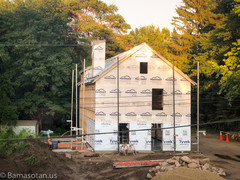
I was surprised to find that the sub who was putting WRB on our detached studio had used what little Tyvek we had remaining from our main house and then finished the bulk of it with HomeGuard.

Is anyone familiar with HomeGuard? Good? Not so good? Specific issues with it?


Thanks

Comments (21)

  • 7 years ago


  • 7 years ago

    Redo with Tyvek.

  • 7 years ago

    Thanks. Why? What issues might we have w/ HomeGuard?

  • 7 years ago
    last modified: 7 years ago

    HomeGuard house wrap is a woven polyolefin material with micro-perforations. Tyvek HomeWrap is a non-woven flashspun high-density polyethylene material with no perforations.

    I have no direct experience with HomeGuard but other woven perforated house wraps have been shown to not perform as well as Tyvek. The woven perforated membranes are cheaper and are often sold by lumberyards with the lumberyard's name all over it.

    I don't like house wrap but when I'm forced to specify it, I will only specify Tyvek.

    I hope you specified Tyvek and cap nails instead of staples.

  • 7 years ago
    last modified: 7 years ago

    Building scientists, such as Dr. Joe Lstiburek, say wraps like Homeguard are next to useless.

    "...you can’t get away with building wraps that are “perforated.” Not any more. You used to. But not any more. We have too much insulation, too many engineered wood products that are too water sensitive and too many folks have gotten real good at airtightness. This efficiency and sustainability stuff is becoming a real pain. You can’t do what you used be able to do."

    If this is your custom build, or if the contract specifies Tyvek, insist on it.

    Typar stands up better to UV exposure than Tyvek and is more surfactant resistant. And Barricade is another quality choice.

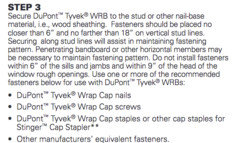
    As noted above, Tyvek installation instructions include:


  • 7 years ago
    last modified: 7 years ago

    Thanks all.

    Interestingly, Lstiburek also kind of recommends woven such as HomeGuard that have a 3D texture for engineered siding products. Almost a pick your poison with both having benefits and drawbacks.

  • 7 years ago

    HomeGuard "Titan" is a 3d (drainage mat) housewrap but its non-perforated.

    What did Lstiburek recommend?

  • PRO
    7 years ago

    Whether you can require the HomeGuard product to be removed and replaced at the contractor's expense depends on what is specified in the approved plans and specifications for the studio. If the specification is brand-specific, you should get that particular brand installed.

    I'm not sure the perforated vs. non-perforated wrap argument well, holds much water, since both are going to be nailed to the sheathing/studs and all those nails create plenty of holes in the WRB.

    The suitability of a WRB depends on both the climate and the cladding material. Both Tyvek and HomeGuard have 10-year warranties, but I have no idea what their life expectancy is. Personally, I prefer either a fluid-applied weather-resistive barrier or commercial grade 15# felt for brick cladding or a product like Benjamin Obdyke's Home Slicker plus Typar for siding.

  • 7 years ago
    last modified: 7 years ago

    Asphalt saturated felt/building paper is no longer sold as 15# and 30# (15 lbs per 100 s.f. and 30 lbs per 100 s.f.) so a commercial grade today would probably be #30 (number 30) which varies between 16 and 27 pounds per 100 s.f.

    Today #15 (number 25) varies between 7.5 and 12.5 lbs/100 s.f.

    Building paper worked well when wood windows had factory installed casing trim. I'm not sure how it would be installed with nail fin windows. A Grace rep once showed me how Vycor could be made to stick to building paper by rubbing it really hard with a piece of release tape but I couldn't rely on a contractor to do that so I gave up building paper a long time ago. However, I have never liked house wrap. The building materials industry is evolving at a snail's pace. Some day it will all be liquid applied but I've been saying that for 20 years.

  • PRO
    7 years ago

    @RES, Irrespective of the current weight/SF, I've found 15# commercial grade felt to perform well as a WRB. A couple of years ago I got delayed residing a portion of my former home and 15# felt was the only thing between the weather and the sheathing for six months. I've done remodels on 50-year old homes with 15# felt that was still intact and performing as intended. Paul Fisette at UMass likes 15# felt, too:

    https://www.finehomebuilding.com/membership/pdf/17686/021177066.pdf

  • 7 years ago

    Interesting discussion - we did felt many years ago instead of any houseware based on a consultant for "healthy homes" at the time. We have cedar siding if that makes nay difference - but we've had very good performance over the years in a mixed humid environment.


  • 7 years ago

    Belt and suspenders: Behind brick and stone, I've always used felt, then Typar or Tyvek over the sheathing. Ditto for taped XPS with or without sheathing.

  • 7 years ago

    If you install taped XPS ... not sure there will be any difference between HomeGuard or TYPAR or tyvek.?

  • PRO
    7 years ago

    I'd exercise caution if installing multiple layers of WRBs. While multiple layers of asphalt-saturated felt shouldn't pose a problem, combining it with a housewrap could trap liquid water between the two.

  • 7 years ago
    last modified: 7 years ago

    The felt retains the ability to absorb water and move it to the exterior in the rainscreen wall.

    And considering the reported shrinkage of earlier XPS and the less than perfect wrap tapes and problematic field conditions, i.e., dirt and water on the XPS, I figured it was a measure worth taking. As well, without sheathing behind the XPS, I felt a second barrier was prudent.

    Dr. Joe says tape is enough on XPS. But, somehow, my builds with the winter winds howling and snow falling never seem to look as neat, clean and precise as those used to illustrate his points!

  • 7 years ago

    I wasn't saying felt isn't a good wrb; I was wondering how it can be integrated into modern nail-fin window flashing.

  • PRO
    7 years ago

    @RES,


    Foil-faced peel-and-stick bitumen tape works great with felt. Sills can be flashed in a variety of ways using your favorite material and method. I don't use the tape on the bottom fin so any water that finds it's way behind the flashing can get out. The top fin can be flashed to the sheathing with the peel-and-stick tape and the felt installed shingle style over it. The downside to using bitumen tape is that it can be tough to handle, and once it's installed, it's virtually impossible to remove the stuff.

  • 5 years ago

    Felt can get worn down over the years with a siding Jtrim corner for example dripping. The felt can last as long as it’s not handling water flow directly, but with the way guys are installing their siding these days..... and ya not as easy to flash window corners which are your biggest issue.


    That bitumen tape I find peels apart after a while as well. I just had to pull apart a job done with home guard and foil Faced bitumen tape. The home guard used there was crap.


    5-6 year old house and literally if I stick tuck tape to it and then pull it off the wrb was pulling apart and nearly flaking...


    blueskin or equivalent high quality peel and stick (grace or titanium psu or roofnado etc) a good air/water/vapour barrier - to seal the windows in, and then tyvek around /under and over and taped on the seams.


    And ALWAYS plastic cap fasteners. And absolute must.


    This is from the guy who has to come along and tear out builders installs constantly, find the source and repair it. Penetrations. 90 deg corners.


    always a mixture of penetrations and 90 deg corners. That’s why skylights always get a bad rep. I put a 10 yr warranty on my skylight installs, never hear a peep from any of them leaking.


    the liquid applied worries me as to how moisture will escape from the wall cavity. We vent roofs/attics but not walls. I’ve seen mushrooms growing under siding from bad housewrap jobs.

  • 4 years ago

    Dont use HomeGuard as a WRB to stop bulk water. it doent stop bulk water or wind driven rain

0