Software
Houzz Logo Print
randi_holbrook

What is wrong with my Mandevilla?

7 years ago
last modified: 7 years ago
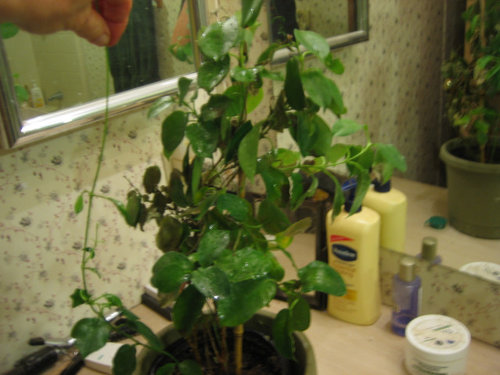
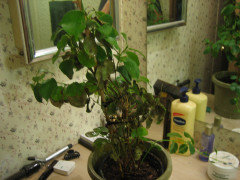
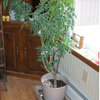
Got it about 3 weeks ago. Gets only dappled sun. The front of it looks decent, but the BACK! Attaching pics of both front and back. Some leaves dry and almost crispy, some brown, and some perfectly normal looking. I've started watering it more often, as what I read seemed to indicate it might be underwatered. But no change.


Comments (20)

  • 7 years ago
    last modified: 7 years ago


    Okay, it wouldn't insert the pic of the BACK of the plant, which looks terrible. Let me try again.

  • 7 years ago


  • 7 years ago

    The pictures are not clear enough to see any detail. Could you put your plant in a good light against a plain background and try again?

    If it lives in that corner it looks far too dark for a Mandevilla survive. They need lots of light. It already looks as if it's starting to etiolated.

  • 7 years ago

    Hi, Randi. Was it exposed to direct sunlight for more than an hour? It looks like sunburn, but sometimes the leaves coming in contact with something topically phytotoxic (damaging to leaf surfaces) can produce these symptoms. The fact that one side (the sunny side?) is more affected than the other tends to lend some additional credence to the potentiality of sunburn.

    Are you checking moisture levels with a "tell"?

    Al

  • 7 years ago

    Severe lack of loght

  • 7 years ago

    Not exposed to sunlight here, only dappled, but might have been before I got it? Although it looked fine when I bought it. Forgot to mention it was not super close, but close, to a register for the air conditioning, and that was the side that was near it.

  • 7 years ago

    It looks like a dip. It needs some sun. is this another you keep inside?

  • 7 years ago

    Yes, I keep it inside. And it was labeled Mandevilla, but we all know how accurate Lowe's is with their labels!

  • 7 years ago

    That type of damage doesn't occur from lack of light, and if it was overexposed to light prior to you acquiring it, you would have noticed the problem right away - within a day ...... and the damage would have had to happen the day or day before you acquired it for it to not be conspicuous when you purchased it. It was very likely due to the dry air from the air conditioning or chill injury, which can happen at temperatures in the 50s if the temperature change is sudden.

    Any chance you made a stop or two on the way home and left it in a hot vehicle?

    Al

  • 7 years ago

    Right, Al. I didn't notice the damage until I'd had it probably almost a week. No, I never make a stop on the way home after buying plants. They are ALWAYS the last stop. It's looking worse by the day, and I don't know how often I should water it. Some say keep moist, and others say let dry out. I didn't notice any improvement after watering it, so I'm assuming I'm not underwatering.

  • 7 years ago

    Try using a tell and withholding water until it comes out nearly dry. Something I wrote to explain:

    Using a 'tell'

    Over-watering saps vitality and is one of the most common plant assassins, so learning to avoid it is worth the small effort. Plants make and store their own energy source – photosynthate - (sugar/glucose). Functioning roots need energy to drive their metabolic processes, and in order to get it, they use oxygen to burn (oxidize) their food. From this, we can see that terrestrial plants need air (oxygen) in the soil to drive root function. Many off-the-shelf soils hold too much water and not enough air to support good root health, which is a prerequisite to a healthy plant. Watering in small sips leads to a build-up of dissolved solids (salts) in the soil, which limits a plant's ability to absorb water – so watering in sips simply moves us to the other horn of a dilemma. It creates another problem that requires resolution. Better, would be to simply adopt a soil that drains well enough to allow watering to beyond the saturation point, so we're flushing the soil of accumulating dissolved solids whenever we water; this, w/o the plant being forced to pay a tax in the form of reduced vitality, due to prolong periods of soil saturation. Sometimes, though, that's not a course we can immediately steer, which makes controlling how often we water a very important factor.

    In many cases, we can judge whether or not a planting needs watering by hefting the pot. This is especially true if the pot is made from light material, like plastic, but doesn't work (as) well when the pot is made from heavier material, like clay, or when the size/weight of the pot precludes grabbing it with one hand to judge its weight and gauge the need for water.

    Fingers stuck an inch or two into the soil work ok for shallow pots, but not for deep pots. Deep pots might have 3 or more inches of soil that feels totally dry, while the lower several inches of the soil is 100% saturated. Obviously, the lack of oxygen in the root zone situation can wreak havoc with root health and cause the loss of a very notable measure of your plant's potential. Inexpensive watering meters don't even measure moisture levels, they measure electrical conductivity. Clean the tip and insert it into a cup of distilled water and witness the fact it reads 'DRY'.

    One of the most reliable methods of checking a planting's need for water is using a 'tell'. You can use a bamboo skewer in a pinch, but a wooden dowel rod of about 5/16” (75-85mm) would work better. They usually come 48” (120cm) long and can usually be cut in half and serve as a pair. Sharpen all 4 ends in a pencil sharpener and slightly blunt the tip so it's about the diameter of the head on a straight pin. Push the wooden tell deep into the soil. Don't worry, it won't harm the root system. If the plant is quite root-bound, you might need to try several places until you find one where you can push it all the way to the pot's bottom. Leave it a few seconds, then withdraw it and inspect the tip for moisture. For most plantings, withhold water until the tell comes out dry or nearly so. If you see signs of wilting, adjust the interval between waterings so drought stress isn't a recurring issue.


    Al

  • 7 years ago

    What's weird is, half of some of the leaves are brown, the other half of the leaf being green. None of my plants have done this before. Thank you, Al, for explaining. I know the roots need oxygen, but have read about Mandevillas in the past where they said they like to be kept moist, and to never let them dry all the way out. I did that with my first one, and it was very happy. This plant is in the exact same spot (dappled sun) and I watered it the same way, with drastically different results from what I got with the first plant. Now I'm suspecting the soil. It doesn't appear light enough to me. It drains fairly fast, but doesn't look like what I normally use (cactus/perlite 50/50). I feel if I repot it now, I might kill it. It's already on very shaky ground. It's been moved further away from the air vent, and in a little more sun, but not much. Do you recommend using Pro-Tekt? How about Superthrive? I really wanted this Mandevilla, as I so enjoyed the last one's yellow blooms. They are my favorite.

  • 7 years ago

    Thank you SO MUCH, Al, for taking the time to explain things in detail. I'm not sure if the leaves affected were isolated from the collective protection. The ones I see now that are half green and half brown don't seem any more isolated than most of the rest of the plant. Most of the leaves were ALL brown near the bottom of the plant, and I removed the ones that were dry, crackly, and ready to fall off anyway. The plant is a lot more narrow and much thinner now, of course.


    I didn't know Pro-Teck was actually beneficial, so I will use it on this plant until it recovers (if it does). I had read about Superthrive being controversial, and I see now that it is really only helpful when rooting and in newly potted repots. So if I repot this one after reading the link you gave, I will use it.


    I am going to read the link about ballast now. I sure hope this plant comes around for me, and I feel like I'm at least doing SOMETHING for it's good, after reading your posts. Thank you again--you have been incredibly helpful.

  • 7 years ago

    ..... my pleasure.

    Al

  • 7 years ago

    Whatever else might be troubling it, I still think it lacks light, not because I can see brown leaves but because the new stems appear to be pale and with excess legth between nodes, even for a vine. It looks as if it is being kept on a bathroom counter which is unlikely to be in a bright enough position for this subject.

    Randi Holbrook thanked floral_uk z.8/9 SW UK
  • 7 years ago

    No, I only put it on the bathroom counter to take the pics. It stays near windowsill on a plant stand with my other plants, It gets dappled sun, but I moved it slightly today so it gets a bit more.

  • 7 years ago

    I see. That explains the gloom. I think moving it into more light will help.

    Randi Holbrook thanked floral_uk z.8/9 SW UK
  • 7 years ago

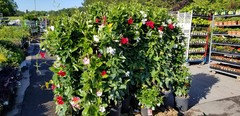
    If you want it to bloom, it needs full sun. Getting a little late this year to do that. Acclimate it to sun next year (if it survives) or you can see what you can eke out the remainder of the growing season. The big Alice DuPont mandevilla plants are usually planted on mailbox posts in full sun around here. I haven't seen them planted this way in a few years though - guess folks got tired of buying a new one each year?


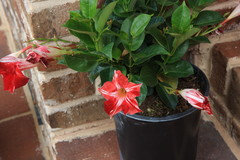
    Home Depot back in May this year


    The only one I grow now is Dipladenia (Mandevilla) 'Stars and Stripes' in its 8th year doesn't bloom like it did when new but I figure it needs even more sun year round. If only I had a greenhouse to keep it this healthy all year long.


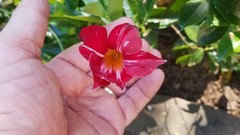
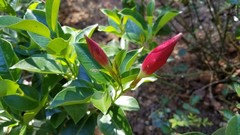
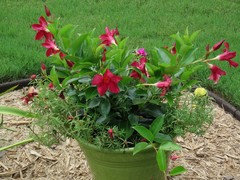
    Aug 29, 2019 - Stars and Stripes finally blooming after hot full sun all summer long.


    How it looked in 2011 when first bought, probably grown in Florida and retailed at Walmart.


    A red one I had in 2017 - full sun with moss rose planted in same container. I lost it when I left it outside too long in late fall freezes.


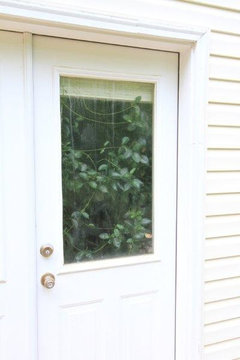
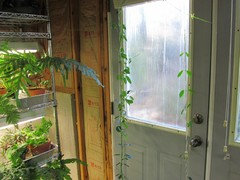
    Whatever you do, watch out for vines looking for light like it did in a small utility room for winter. The vines grew into the cords of the pulled up mini-blinds. This was May 2, 2013


    and this was in Jan 31, 2013


    You could just grow it as an annual too.

    Randi Holbrook thanked hc mcdole
  • 7 years ago

    What beautiful pics of Mandevillas! The one I had before would bloom for me, and it was in the same place this one is. I don't understand that. Things get burned here in the desert like you wouldn't believe. That is why most plants in my house have partial shade. I have to be careful, even with plants that want full sun.

Sponsored
NME Builders LLC
Average rating: 5 out of 5 stars2 Reviews
Remodeling Company in New Albany, Ohio