Software
Houzz Logo Print
harryshoe

Is Doublefile Viburnum an invasive species?

It appears on a list circulated by our association. My variety is 'Mariesii'. Occasionally it does produce "plantlets" where branches touch the ground, but I don't see that as an invasive problem as they just slightly expand the clump. Other unknown varieties of Doublefile here produce no plantlets or seedlings.


What's your experience?

Comments (22)

  • 7 years ago
    last modified: 7 years ago

    Harryshoe, here’s what I find:

    https://www.invasiveplantatlas.org/subject.html?sub=11533


    i have only had mine for a year so cannot comment on personal observations.

  • 7 years ago

    Invasive plants are very location-specific, so you need to check with local sources.

  • 6 years ago

    Mine produces a lot of seedlings in the nearby shrubbery beds. However, I haven't seen any seedlings in wilder areas, or further away from the parent plant, and this time of year they would be quite noticable. So it can seed around, but cannot outcompete the established invasive shrubs like honeysuckle.

  • 6 years ago

    here you go harryshoe, read it and weep. THIS site from my state answers your question. Although not as bad as V. dilatatum, it's just a matter of time. The birds simply cannot resist those shiny berries. Indianagardengirl's link is definitely valid.

    Anyone here remember what we were told about Bradford Pear? Pretty much verbatim what was said in the post before mine. How did that work out?

  • 6 years ago

    I've seen wild-living double-file viburnum in at least one local bottomland forest. And - unlike E North America our region has the wrong precipitation regime for E Asian species like this.


  • 6 years ago

    Point being that back there it could certainly become prevalent in the wild, if it even manages to sometimes get a foot-hold here.

  • 6 years ago

    Sam, I am not too far east of you, not too far from the Susquehanna River, and there is an endemic blight or something that kills most of the Asian Viburnums, especially V. mariesii. When the stems get about a half inch in diameter, the bark starts to peel. The disease then kills the main stems, and the result is a crappy looking, odd shaped, dying plant that persists for about 5 years before you cut it completely. This sickness affects a few native small Viburnums, especially V. nudum, but rarely does it kill the whole clump. I will try to post a pic here tomorrow if you think you could ID the problem. Whatever it is, mariesii will never be an invasive problem here. I do agree though, any imported tree that provides food for birds can invade somewhere.

  • 6 years ago

    Remember that 'Mariesii' is a cultivar of V. plicatum, and not a species V. mariesii. I had one here for years, then it started to diminish. Suspecting reduced soil quality I fertilized the shrub, and it bounced back. However a year later it was struggling again, and not having wanted to fertilize over and over I let it go, then took it out.

  • 6 years ago

    The berries produced are few and don't seem to ripen. They just wither and fall off. I've had the unnamed variety for 30 years and two Mariesii for about ten years. No seedlings. Other plants here produce a constant supply of volunteers including holly, butterfly bush, juniper, hosta, Japanese red maple and poison ivy. Its not my soil or conditions.


    Maybe not all doublefiles are created equal.

  • 6 years ago

    Please realize that "spreads in my garden" and "is invasive in my area" are not necessarily the same thing.

  • 6 years ago

    HU-435404624 wrote: something that kills most of the Asian viburnums....

    I'd like to know more about that, can you give us a link?

  • 6 years ago

    I'm guessing HU may be observing verticillium wilt

  • 6 years ago

    I will take a pic of one plant and try to post it here. It is not verticillum. The bark actually splits and it kills the branch. The underneath turns black as coal. I noticed it first in mariesii, but then lost 3 more Viburnums (carlesii, plicatum and another forgotten one) in short order. I've found the same problem in a clump of V. nudum growing wild, so I am assuming it is also a native disease.

  • 6 years ago

    Viburnums are generally untroubled by diseases......with the exception of Verticillium wilt. You can get a few foliar diseases but nothing serious enough to kill off the plant.

    One possibility that generates symptoms like you describe would be Botryosphaeria dieback and canker. And that is typically encouraged by drought or other environmental stress as well as mechanical injury.

  • 6 years ago

    Hi, gg. I am in the process of trying to up load pics. Maybe it is Botrysphaeria. (Never heard of it, but I'm not that well versed.) Maybe the pics will appear now.

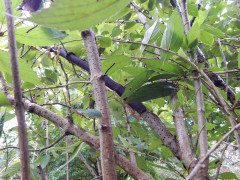
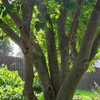
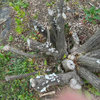
    This is the end of the process, when the branch is almost dead.


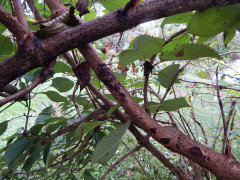
    This is how it starts. It occurs in all years here. I am in So. Cen. PA, and this particular location on my place is near a Japanese maple, a Prunus mume and a high bush blueberry.

  • 6 years ago

    It looks like it very well might be a Botrysphaeria (one of the 193 species). The bark does not show sunken areas, it peels. This seems to be a defining symptom of the blight. Thanks.

  • 6 years ago

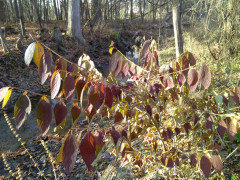
    Here's one of dozens of V. p. tomentosums invading a local wooded area near a small stream. Canopy here has thinned due to EAB and Dutch Elm disease, so there's plenty of light in the understory for invaders to become established in the moist soil.


  • 6 years ago

    Not to treat the topic of invasive species lightly, but I can think of a whole lot worse things to escape into natural settings! IMO, there are few flowering shrubs that can match a doublefile for flowering impact!!

  • 6 years ago
    last modified: 6 years ago

    gardengal - I'd probably have to agree, and it seems pretty unlikely that doublefile viburnum would ever become as problematic as some of the other invasive shrubs I observed in that same location (shrub honeysuckle, autumn olive, privet, buckthorn). Surprisingly not a lot of buckthorn there yet (common or glossy), but probably only a matter of time until they become dominant in the understory.

  • 6 years ago
    last modified: 6 years ago

    Ours is 100% a mariesii (tag was on it when we moved in) and it spreads a ton into our yard and into the woods. (Northwestern CT) I have been weeding other invasives and find the small shoots all over. One is even growing out of a mossy crag in a large rock. I find them deep in the woods too. I think here they could become an issue. but they’d have to battle the many other invasives we have!! Ugh.

  • 6 years ago

    Like harryshoe, our plicatums flower prolifically but the would-be seeds wither before maturing. I’ve never had a single seedling in the 5 years I’ve had them.