Software
Houzz Logo Print
webuser_180326071

Need Help with Backyard Orchard / Garden Plan

7 years ago
last modified: 7 years ago
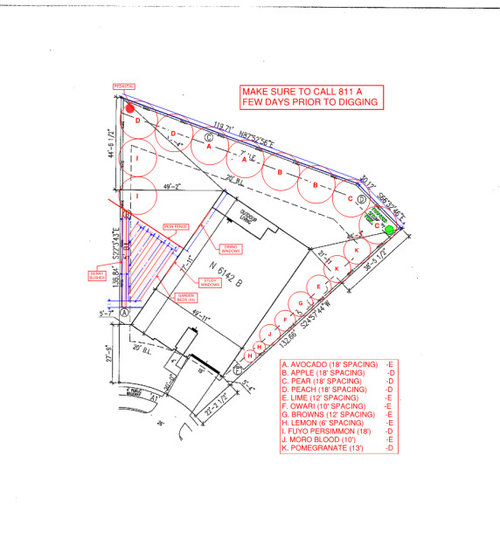
Hi,

I an building a new home on roughly 1/3 acre. Not very big i know but i have big plans.

I am attaching my plan below, but what i have is a fruit tree perimeter around my fence, and one area for a garden. My spacing for the fruit trees is just slightly less than each fruit tree requires according to the hanging card the tree came with. I intend to prune them to keep them slightly smaller.

My concern is if i'm doing something wrong with the fruit tree placement, and/or the garden placement.

I am concerned about the grading of the house and if that is going to cause concern for the garden beds. I can flatten the grading but that's not good for the house. the beds should be perpendicular to changes in elevation should it should affect each bed uniformly.

I am also concerned how i should do the irrigation. The home will come with lawn sprinklers, which i intend to re purpose. Does each fruit tree need a dedicated water drip line? Do i need drip irrigation for each bed or would a lawn sprinkler suffice?

I already have all these fruit trees in large 20 gallon pots.


I should also add the home faces the North and i live in houston, tx. I can expect the sun behind my house except in the summer when its directly overhead.

Thank you


Comments (20)

  • 7 years ago

    Thanks for your feedback. I was adding additional information such as location and sun facing a little too late for your read i guess.


    I have chosen all fruit trees that will survive in zone 9, and have accounted for citrus by protecting them on all sides from wind (i.e. fence and house) .


    I understand this will require watering which is why i am asking about sprinkler systems , and i have accounted for tree spacing relatively well (in my mind).


    Ive had fruit trees my whole life, so this aspect is not new to me, ive just never been able to plan it out before.

  • 7 years ago

    No to lawn sprinklers. They will not deliver the volume of water necessary to encourage healthy establishment and good deep root development and are seldom programmed correctly to begin with. Use a drip system or soaker hoses instead.

  • 7 years ago
    last modified: 7 years ago

    Pick a name and modify your profile. Use the idea Books.


    8b-9a isn’t zone 10b-11! Be prepared for loss, and for scrambling with big row covers, lights, and sprinklers. (Sprinklers are not for watering! Just freeze prevention.) Masonry structures that act as thermal mass for heat sinks to absorb and release heat through the night make much better walls than wood. But they also block more light. You can add to that with larger drums of water. Pissy neighbors don’t like. A PIA. But it’s worth it to some. Elevation is more critical than wind blocks. Low spots are cold spots that kill.

    Drip irrigation is a basic requirement. With the ability to adjust and expand the reach and emitters.

    Here’s a good thread for you. https://www.houzz.com/discussions/1848630/any-luck-with-citrus-outdoors-in-zone-9a

  • 7 years ago

    What are your plans for the varmint and critters that will be coming to your free buffet?


  • 7 years ago

    Ask Bear Creek Master Gardeners for lots and lots of help/suggestions. Their office is located in the Bear Creek Park between Eldridge and Hwy 6. I also suggest you purchase your fruit trees from them as they only offer those which will do well in your area.

  • 7 years ago

    Does each fruit tree need a dedicated water drip line? Do i need drip irrigation for each bed or would a lawn sprinkler suffice?

    I haul my little rear end outside, twice a week during summer and once a week every other time, to manually deliver 5- or 10- gallons of water (Home Depot bucket) to each tree I plant. I soak my shrubs and vines then, too.

    I might be doing something wrong, lol, but the drip line wasn't enough for the one tree that came with the house (new construction, builder basic), and supplementing with 10 gallons 1-2 times per week saved my "big" oak.

    If I were relying on automatic systems, I wouldn't trust the lawn sprinklers. I think they barely keep the grass alive, lol, let alone anything else!

    What are your plans for the varmint and critters that will be coming to your free buffet?

    This is a great question... If anyone has any suggestions, I'm dealing with rabbits at the moment, and they spite me by leaving their droppings 6" from where my 150 pound dog leaves his.... :-/

  • 7 years ago

    ODD, I have a shepherd mix that lives to hunt and destroy critters ... if it can get to them! Lately the tree rats have been very active on DH's tomato plants, but they jump into a nearby fruit tree when the dogs come running out. Then the dogs go crazy barking and attempting to reach the rat. DH cut some of the plants down this week so the dogs are a bit calmer!


    DH is already planning what he will plant in the next house, but new area has alligators, so I don't think it is a good idea to attract critters, that will then attract alligators. Lot will be fenced, but will probably not stop a determined alligator and from what I read, dog and cat are their favorite snacks.

  • 7 years ago
    last modified: 7 years ago

    [...] but new area has alligators [...]

    :-O

    I'll take the bunnies over the gators, despite the risk to my roses.

    !!!

    I mean, sure, bunnies attract snakes, but again, I'll take snakes (even the ones with rattles) over their much larger reptilian cousins. My kids stand a better chance of surviving a snake bite than they do being dragged into a pond by a gator. :-(

    I don't know how y'all do it, in Florida. And the Carolinas. Wow.

  • 7 years ago

    I have coyotes, rattle snakes and mountain lions now, and I'll take all those over alligators.

  • 7 years ago

    What kind of lemons? 6 ft. Spacing for a meyer is very tight. 16ft. Spacing ok for Lisbon or Eureka, while you can get away with 10ft for a v.pink Eureka.

    I made the mistake of planting duplicates. A bad idea unless you're going to open a farmstand...

    Good luck and please update with your progress

  • 7 years ago

    i believe the apple peach and pear require a pollinator if a different variety.


    I always was told you need two for better pollination and I’m in a more residential area without many pollinators you speak of so I’m trying my best to have the ideal circumstances.


    also the Meyer lemon tag on the tree says 6’wide by 10’ tall so that’s what I went with.


    the lemons on meyer

    the lime is persian

    satsumas are browns and Owari

    1 Moro blood orange


  • 7 years ago

    The peach, pomegranate, persimmon, avocado and all the citrus are self-fertile. You will only need a single tree of each to get a decent crop, provided all other growing conditions are met. The apple and pear will require a second, different cultivar for proper cross pollination to produce fruit.

    And the "two for better pollination" mantra will only apply to different clonal varieties as well. So not two Fuyu persimmons but two different Asian persimmons.

    btw, having multiple cultivars present/planted is not going to increase cross-pollination or subsequent fruit production unless the pollinators are present to begin with.

  • 7 years ago

    Two for better pollination should increase harvest even with same varieties. It only makes sense. You need male and female flowers present at the right time to have pollination. More trees mean more flowers. They visit a male flower from tree A and then a female flower from tree B. That’s my theory.

  • 7 years ago

    It doesn't exactly work like that :-) The trees you plan on growing all have perfect flowers........that means both male and female organs are within the same flower. The avocado is the only one that stands out as being different as the sex of the flower changes over a two day period.

    It is not the quantity of flowers that determines fruit set - the avocado produces flowers in abundance but very few, even when properly fertilized, will produce fruit - but the actual insect pollinators present when the tree is in flower. If you do not have them available then it doesn't matter how many trees you have.

  • 7 years ago

    you do know you will need to cover the Meyer and the lime in weather that drops down to freezing even if only fora few hours (I know from personal experience).

  • 7 years ago

    Yeah i am aware of the cold intolerance of the meyer lemon. The persian lime is a little more tolerant of cold and the satumas i dont think will have any problem.


    I have frost blankets i cover them with, and drape old incandescent style Christmas lights all over the foliage. When temps get real bad like they did a couple years ago (mid 20s), i can put out ceramic heat emitting lights inside of the frost blanket.


    I did not realize some fruit trees have perfect flowers like peppers and tomatoes. That means a decent breeze or a good limb shaking should be all it needs for pollination? That is what ive done on my peppers and tomatoes and usually helps.

  • 7 years ago

    In theory :-) But you will actually need to transfer pollen from one tree to another with those that are self-incompatible (apple and pear in your case) if no insect pollinators available.

    ALL members of the Rosaceae (rose family) have perfect flowers. And most common fruit trees - apples, pear, plum, cherry, apricot, peach, quince - are all members of that family.

  • 7 years ago

    Persian lime is more sensitive to freeze than meyer. Frost blankets will not be adequate until the 3rd or 4th year in the ground. Ultimate size depends on the rootstock. If you don't know what the rootstock is, the tag is useless for landscape estimating and plan. This is actually a really sore point with me as the existing data is very poor.... and causing me to rethink (and transplant) multiple trees' locations in my (and friend's) yards.

    Good luck!

  • 7 years ago
    last modified: 7 years ago

    Texas Extension page on growing avocadoes in Texas. Note for instance:

    Avocado varieties fall into one of two pollination types, A and B. They differ in the time of day (morning or afternoon) when the male and female flowers can reproduce:

    • Type A flowers open in the morning as receptive females and close in the afternoon. They reopen the following afternoon for pollen shed.
    • Type B avocado flowers open in the afternoon as receptive females, close overnight, and reopen the following morning to shed pollen.

    In important avocado-producing areas, orchards are inter- planted with varieties of both types to ensure good pollination. In South Texas conditions, the flower phases overlap enough that pollination and fruit set are rarely a problem.

    https://agrilifeextension.tamu.edu/library/farming/texas-fruit-and-nut-production-avocados/

Sponsored
Bella Casa LLC
Average rating: 5 out of 5 stars17 Reviews
The Leading Interior Design Studio in Franklin County