Software
Houzz Logo Print
mtvhike

Solar Panel Installation questions

6 years ago
last modified: 6 years ago
I am in the process of having a photovoltaic panel system installed on my roof. I just received a 17 page document which completely outlines what they plan to do. I need some advice from the experts here; I probably know enough to get me in trouble but I'm having trouble understanding the terminology.

The system is 12.2 KW DC STC (what does STC mean?), 11.03 KW AC CEC, and consists of 40 Trina Solar 305W modules, 40 Solar Edge P320 Power Optimizers, and 2 Solar Edge 6.0KW inverters. For some reason, they are running the power from my roof through an underground conduit to my power meter, which is 50 feet away.

Are there any issues I should be aware of? Any questions I should ask (other than price and schedule)?

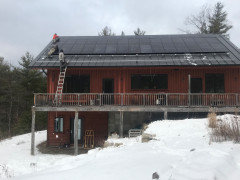
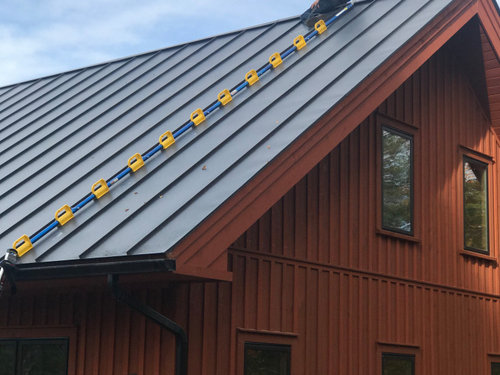
Here is a picture of their representative measuring my roof.


Comments (39)

  • 6 years ago

    Ask them how they're attaching to your metal roof. The cheap way is drilling a hole through the roof, applying caulking, then lag screws through an aluminum bracket. The better way is to attach through the vertical seams of your roof, so no holes through roof. Is this an outbuilding? They could backfeed through the panel in the building if panel and service is big enough. Even if they had to replace panel, that would be preferable to trenching through lawn and/or driveway.

  • 6 years ago

    STC means standard test conditions, an industry standard for the output under specified operating conditions. Think of it as basically the maximum nominal output value of the system (i.e. at noon on a sunny day in summer).

    https://sinovoltaics.com/learning-center/quality/standard-test-conditions-stc-definition-and-problems/

  • 6 years ago
    last modified: 6 years ago

    Seabornman, yes, that concerned me also. When I originally built the house, I specified a standing seam metal roof, because it is easy to use clips for solar panels, but they don't seem to be doing that. Maybe that's reason enough to not use this company.

    Update: I looked more carefully at their drawings, and they specify Snapnrack brackets, which I guess is for standing seam roofs. But I also noticed that they are planning for a 38° pitch roof, and mine is 45°.

  • 6 years ago

    Update: I spoke with their "project manager" and cleared up the roof pitch issue. I also noticed another problem, that they were not planning to connect to my system next to my breaker box in the basement, but to run their own line underground to my meter, which is on a post about 50 feet away from the house. The project manager didn't know why they made that decision, but it could easily be changed. One possible reason that I can think of is that when my service was run from the meter to the house about 5 years ago, they made a mistake and put a 200A line, which they thought was too small. So, a year later, they ran a second 200A line to a second breaker box. Each breaker box has a separate main 200A breaker, but since they both go to the meter (which had been changed to 400A), could that be the reason?

  • 6 years ago

    Is this an outbuilding? Is there a panel there? Ask what their plans for wiring from pv panels to the inverters. I've seen some ugly installations with exposed conduit run over the roof to the eaves and then down the wall. Best if going through metal roof (with a boot) then down through building to inverter. How are they going to get internet access for remote monitoring?

  • 6 years ago

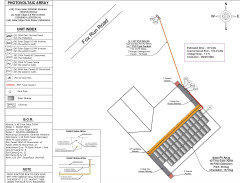
    Not an outbuilding. Our power comes overhead from the street to a single pole on our property, then underground to a short pole which has the meter panel on it. It is then split into the two 200A runs which run underground about 50 feet to our basement, where the two load centers are located. I attach a relevant page from their installation proposal. The photo above is of the NE wall.


  • 6 years ago

    This is a major, awesome investment. I suggest that you get a local construction pro and lawyer to look at the contract. At a minimum show it to your town inspectors before you sign.

  • 6 years ago

    The solar installers are getting all the permits.

  • 6 years ago

    If I'm reading this correctly all of the equipment is going to be mounted on the exterior of the house, with a conduit running up to and over the roof - not going to be pretty. Why not place equipment in garage and run conduit through attic?

  • 6 years ago

    This is still under discussion; the installer said that they can put it in the basement. There is no garage, that's a wing for the house.

  • 6 years ago

    My proposed contractor responded with a redesign, which increases the number of panels from 40 to 54 305 Watt panels. They haven't told me how much energy this will produce (it produces 14.88 kW power, but no mention how many kWh). Does anyone here know how to calculate that, taking into account orientation, latitude, historic weather, etc.?

  • 6 years ago

    My installer gave me that info. ``However you can also calculate at https://pvwatts.nrel.gov/

    mtvhike thanked seabornman
  • 6 years ago

    So using this calculator, I get 19,900 kWh/year. My usage is 22,000 kWh/ year, averaged over the last four years. Looks good!

  • 6 years ago

    Don't be surprised when you get your first reports on electricity generated. There is a 20% +/- loss from the panels to the meter. DC to AC etc.

    mtvhike thanked seabornman
  • 6 years ago

    Well, my installation is complete and inspected! Waiting for NYSEG to come and change the meter.

  • 6 years ago

    Congratulations! Hope for sunshine!

  • 6 years ago

    @mtvhike, how does your tariff work? Do you get 'reimbursed' (offset) for full amount of solar you feed into grid, i.e. paid for the price you are also buying electricity at? Or is it some different price, or the same price within some limit annually or monthly?

  • 6 years ago
    last modified: 6 years ago

    @armoured, I'm not sure about the tariff; I believe that I get credit for any power I feed into the grid. That is subtracted from the cost of the power I take from the grid, but not below zero. This is calculated on an annual basis. And, I'm pretty sure that annually I will produce somewhat less than I use. If I produce more than I use, I'll be paid only the wholesale rate, which I think is about $.01/kWh, so clearly it's not worth making the investment for more solar power production. The installing company is going to provide me with the links to monitor my system over the internet, but they haven't done that yet. The installation was only completed 1/2/20.


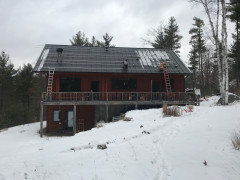
    Here are some pictures, taken 12/4 and 12/5, of the installation.

  • 6 years ago

    Thanks, that's exactly what I was wondering - so it's a net offset of your usage until you produce more than you can consume. (Relevant BTW for your question in other thread - i.e. you won't save very much money if you cut your electricity use substantially below your consumption.

  • 6 years ago

    I am concerned about the performance of my new system. The local utility replace the meter on 1/2 and some energy is being generated, but not enough (in my opinion), om 1/9 my meter registered 107 kWh generated, and on on 1/16, 1/20, and 1/22, it registered 148 kWh generated on all three days. I asked the installer if they monitor the performance, and they said No. They said that the utility is the best resource. There is another company which the installer has engaged to monitor the system and I did sign up with them but they register a total of 1 kWh. I called the installer and they said that they had "a communication problem" and are working on it.

  • 6 years ago

    My 4.96 kW system can produce 20 kWh on a good day in winter. In summer the max is 30kWh. I have a Solaredge inverter also. You really need them to get that set up, as it's a great tool.

  • 6 years ago

    I don't understand the numbers above, mtvhike. Your system is 14 or so kw? On a normal sunny day you should get some multiple of that 14kw in kwh. Perhaps 2-4 hours (full equivalent, because partial light later in day will produce some energy, but not full output, in fact in winter may never get the full 14kw.) Perhaps 4-7 hours in summer. These are location dependent (how far north) and obviously less with heavy cloud cover etc, there are sites to help you calculate this. So the 107kwh sounds like a lot for a day in winter (no way you got eight full hours of direct sun), 1kwh sounds like very little, but I don't have panels myself.

    But really perhaps check on forums where solar panels are the focus and compare to what others have there as results. There's lots of folk out posting all sorts of graphs and data.

  • 6 years ago

    As I mentioned, the installer says that there's something wrong and they'll "look into it", but their response time isn't very good. Or, should I contact SolarEdge?

  • 6 years ago
    last modified: 6 years ago

    More information: the "other company" which is doing the monitoring is Solar Edge, which is the manufacturer of the inverters. As I said, I signed up for their monitoring and got an app for my iPhone. According to that app, there are some inconsistencies. First, only two weeks are displayed, last week which is when I signed up, and this week. It says that I generated 1 Wh last week and zero this week. But, the total to date is 230.44 kWh! (That number does change daily). On the chart displayed, there are three color bars, green for Production, red for Consumption, and blue for Self Consumption (what does that mean?). Only Production has any reading, and that's 1Wh. Any Ideas?

  • 6 years ago

    All of a sudden, at about Noon today, I started getting readings on the Solar Edge site: 5.93 kW currently, 9.18 kWh today (and this month). No idea what happened!

  • 6 years ago

    It sounds like it's just a software/reporting issue. Probalby have to follow for a while and see if things settle out to numbers that make sense.

  • 6 years ago

    Good news: it seems to be working. Using the Solar Edge app, I can see how much power is being generated. It started at 7:30 AM (before sunrise) with a few watts. By about 8:30, it was up to 1 kW, and now, at 10:30, it's up to 3.75 kW, even though the sun is behind clouds. I'll check again when the sun is actually out. Remember, the maximum for this system is 14 kW. According to the utility's power meter, 163 kWh have been generated (up from 148 yesterday morning). But Solar Edge's app says the lifetime generation is 256.59 kWh; why the discrepancy? I wish Solar Edge's inverters had analog current or power meters on them!

  • 6 years ago

    Isn't the meter reading the net of total usage minus solar output?

  • 6 years ago

    The utility company said that its meter displays the amount generated and the amount used. The discrepancy I refer to is the meter's reading of the generated amount vs Solar Edge's app's reading. I assume the amount used is the net.

  • 6 years ago

    New problem: Everything seemed to be fine last month (January). On clear days, the power generated (kW), as shown on the Solar Edge app, was 14 kW, which is the installed capacity of the system. I left for a three-week visit to family and, as soon as I left, my Solar Edge app read zero kW. I know we had a lot of snow the first day of my absence (18") and I figured that the panels were covered (although they are supposed to self-clear because there is a little heat generated in the panels themselves). Well my wife got back early this week and we had a phone conversation with the installer (who was remote). He said to check the internet connection, but that seemed fine. I was concerned that the electricity generated and fed back to the grid shouldn't depend on an internet connection, so I asked her to check the meter and see what the reading for the amount used was. On Feb 2 (the day we left) it was 322 kWh, and yesterday it was 903 kWh. So in 22 days, I generated 581 kWh, or 23 kWh per day, which tells me that it's working fine (on the days in January that it was clear, I was getting 60 kWh/day, assuming it was cloudy 12 of those 22 days).

  • 5 years ago
    last modified: 5 years ago

    In such situations, it is better to find a specialist on such issues. I lost a lot of money so much when I just trusted the firm to install it. At first, when I just decided to try to install them cheaper, I trusted a company I didn't know that didn't even have a website and no data about them on the Internet. As a result, they ruined two panels for me, breaking one and breaking off one mount from the other. Then my friend advised me to contact specialists and install solar samui panels.I was satisfied with their quality of service and speed of work. They removed and disassembled the old panels in a couple of days and installed new and better ones. Now i'm very happy with what I have there are solar panels on the roof and I save money on electricity.

  • 5 years ago
    last modified: 5 years ago

    Major update a year later (from another thread):

    In December of 2019 I had a rooftop solar panel system installed - the largest one for the area of the roof! 54 305 Watt panels, grid tied. Went on line Jan 2, 2020. To date, I've generated 16,190 kWh of energy; I've consumed about 20,000 kWh, so I do use more than I generate. I was occupying the house the whole time, so the setpoint of my heater was never turned down; as an older person, I like the temperature at about 75 degrees.

  • 5 years ago

    So a quick Calc is that this is about 50 kwh per day, or an average for those eleven months of three hours of the nominal max rating of your ~16kw panels. That sounds about the expected for your relatively northern climate (as I recall).

    Do you know roughly what the proportion of your consumption is space heating and/or water heating? (Actually the two together is probably the majority). Probably easiest estimate for space heating is the winter consumption minus the summer consumption. Not that it matters much, just curious.

    mtvhike thanked armoured
  • 5 years ago

    I'm sure it's mostly space heating, since I have a 20kW (89 Amp) boiler! Regarding water heating, I was thinking about replacing my resistance-heated HW heater with a hybrid one, but haven't seriously considered it yet. Need to find out from the POCO if there are any rebates for that change.

  • 5 years ago

    When you say hybrid hot water heater, what do you mean? i hear the term used to mean different things. And I presume your heat is radiant (floor or radiators), since you have a boiler? I'm guessing you mean a heat pump water heater.

  • 5 years ago

    Yes, to both presumptions! By hybrid water heater, I mean one which has both resistance heating and a heat pump; I guess there might ones which combine a gas burner with a heat pump. My head is hydronic radiant in both the basement and main floor. I love it!

  • 5 years ago
    last modified: 5 years ago

    The issue with heat pump water heaters is they borrow heat from the house - might work really well if the room it's in can stand to be colder (like a boiler room often is), and if too humid some of the year, like in a basement in some climates. Also a factor is how long your heating season is. But if they just borrow heat that the boiler needs to compensate for, less savings - electricity rate matters too of course. I'm not saying it's not a good idea, just do some research and calcs. Also of course depends how old your current hot water heater is - good to do your research so you know what you want when it comes time to replace.

    mtvhike thanked armoured
  • 5 years ago

    Your points are well taken. Yes, in the winter, the heat taken from the house will be replaced with the resistance-heated boiler, so no benefit there. However, in the summer, then it's a win-win! And, our current heater is relatively new, but its longevity ratings aren't the best. I don't know if I mentioned it in the earlier part of this rather long thread, but I'm in northern NY where the winters are long.

Sponsored
Urban Upkeep LLC
Average rating: 5 out of 5 stars6 Reviews
Columbus High Quality Painting Expert