Software
Houzz Logo Print
anna_294404881

African violet leaves won't grow

6 years ago
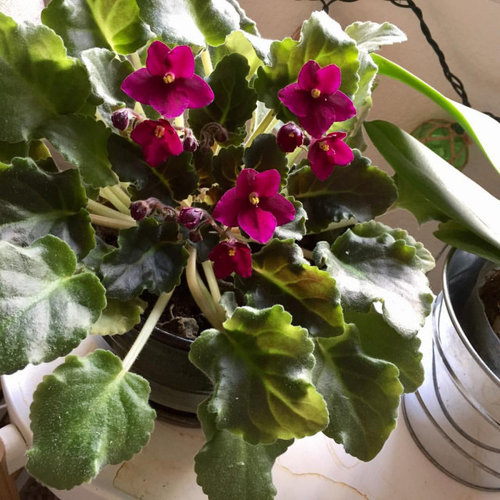
My african violet used to be very large, but slowly over the last year the outer leaves started rotting and falling off. Now they won't grow larger than a dime. I have tried repotting it, moving it out of direct sunlight, and limiting the water to once a week. Any other ideas? (Here's a before and after)


Comments (46)

  • 6 years ago

    Hi Hu, my suggestion is, if you can, take a leaf or two and set it/them up for rooting new babies. If you do not know how, just check the internet. In that way, if the original plant fails to prosper then at least you have a back-up plan.


    I think eventually the more experience and seasoned growers will chime in and will offer their own advice.


    Keep us posted on your/the plant's progress.

    Yolanda

  • 6 years ago

    Are the leaves thicker and/or more brittle than normal? If so it could be broad mites or Cyclamen mites, which can't be seen without a microscope. It's the distorted flowers (unequal petals) that makes me suspect the mites. If so, dunk the whole plant in 110 F water for 15-30 minutes (look it up). Whatever you do, quarantine them if it's broad mites or it would permanently infect other plants of all kinds and stunt growth of leaves and flowers in them. The list of plants that these mites can infest is long and remedies are limited (plus you can't see them)... I speak from experience...

  • 6 years ago
    last modified: 6 years ago

    There's no such thing as a pot being too big - this is the key part

    making sure you have the appropriate … potting soil

    and not how big the pot is. If a plant of any kind in a big pot is too wet it's because of the soil texture and/or the watering practices and not how big the pot is. Commercial growers regularly bump plants into much larger pots in one step all of the time.

    Regarding the mites suggestion I can see your plant is full of sucking pests starting with your first picture - that fine pale speckling of the leaves indicates this.

  • 6 years ago

    Following up on others' comments, the white spots are mealy bug which can't be controlled and spread rapidly. The plant has probably been infested for a long time. Discard the entire plant into a plastic bag sealed tightly. If you want to keep the pot, disinfect it thoroughly. Disinfect the entire area where the plant was. Don't bring in any new plants for a while. Might as well wait until spring when AVs are back in season.

    Regarding the comment about misshapen petals, they are fine. The flowers were pansy shape.

    When or if you get a new AV, buy it from a reputable source, such as one of the direct mail sources listed in the AVSA magazine. Not from a store where AVs are mass-produced and commonly carry thrips, another common pest. Store-bought AVs are not intended for longevity. So the mass-produced nurseries don't seem to care if they sell AVs with thrips. Joanne


  • 6 years ago

    I don't see any signs of mealy bugs but certainly spider mites.

  • 6 years ago

    you can get rid of mites by spraying ev 2nd day, repeating 3-4 times (leaves and top soil).

    you can get rid of mealies with systemic: bonide makes one for indoor use (weaker then for outdoor, but it works). systemic will not control mites though.

    I would definitely lift it out into a pot 1/3 the size of current pot, not changing the soil: the plant is too weak at this point. this will keep it drier. by all means tent it to isolate and also water it much much less. but give it a nice large dome for good air-space.

    I think it can be saved.

    my store bought 'expendables' always bloomed best and I kept them for at least 5 years before they got too huge...:)

  • 6 years ago
    last modified: 6 years ago

    just to add: judging by a few rotted leaves on the bottom it might already have a crown rot from being too damp in too large a pot . that would definitely kill it! you need to check if the stem is still firm below soil level. if you decide to lift it into a small pot : do not water, just tent it, as the soil appears to be moist already.

    in my experience when I had crown rot, I couldn't save the leaves: they all got rotted even when large and healthy looking.

  • 6 years ago
    last modified: 6 years ago

    Rhizo, the white cottony stuff. Could be mold, since it is on top. But the damage described sounds like mealy.

    By now, the plant has most likely been tossed in the trash and the poster moved on.

    I have noticed when this forum seems to go dormant, some random person will post "before and after" sad photos. But most of the time, does not return to read the answers. The random poster often has an unusual name and registered merely for the purpose of posting photos and asking a question. Some are legitimate, and many on this forum do chime in with advice.

    Petrushka, Those of us who collect know that the AVs will grow and rebloom. But many people don't know this.

    I have given many flowering AVs to friends who do not take care of them properly. They usually report to me within a month or two that the plants stopped blooming. So then they stop watering the plants. I will no longer give AVs to people who refuse to care for them properly. This is in sunny California where AVs grow easily.

    One exception is a dear family member who has a green thumb. She experimented in her environment in the wet, dark northeast. When the AVs died, she re-used the pots to grow other types of plants.

    Another exception is donations to those who attend AV club meetings. I usually prefer they not report on any donated AVs they could not keep alive.

    Also, AVs will tend to die of natural aging at some time. Joanne

  • 6 years ago
    last modified: 6 years ago

    >> wet, dark northeast

    how funny! i'm in NYC and they were growing like crazy for me...if anything, it's pacific NW that is dark and wet ….NE is quite sunny actually all things considered :).

    more funny, I never got thrips in AV's from supermarket , but at the nursery...quite often.

    anyhoo… as far as OP's plant goes: such a decline in 5 days is drastic! so, prolly it's gone by now.

    I downsized my AV's from close to 40 to barely 6...since I spend winters in super sunny FL now :)...orchids are a thing here :) and I am thrilled to get LOTS!

    another funny is although Apopka FL is AV capital, there seems to be no Av's in sight..

    like I said glorious orchids win..LOL.

  • 6 years ago

    Thank you for all the suggestions! I don't see any signs of pests on the plant. The white stuff in the first picture is just the velvet from the leaves. It came from a nearly hundred years old original plant so it's probably a pretty interesting variety. That's why I am trying so hard to save it and not throw it away. The first picture was when it was thriving and healthy, as it thrived for another 2-3 years before starting to decline this year.


    I tried taking a leaf and trying to re-root it, but the leaf instantly rotted. I did switch pots to a clean AV soil and noticed the root system is pretty rotted. I cut away the majority of the rotted part and re-potted it, and tented it.


    Any other suggestions at this point?


    Thanks!

    -Anna

  • 6 years ago

    curious, have you repotted at all in 2-3 years? the practice is to cut off the bottom third of rootball, and top up with 1/3 , removing leaves if necessary or scratching the long neck,etc.

    if you have not repotted, the soil by now must've disintegrated , as it is mostly peat. that would explain the root rot and decline.

    when you say 'I switched pots to a new soil' - did you trim the old root ball on sides? were there any good roots left? was the stem firm? did you trim the bottom of the old stem, etc

    did you premoisten lightly the new soil prior to repot? if so, no need to water for a few days.

  • 6 years ago

    No, I hadn't repotted it prior to this. How frequently are you supposed to?

    I did trim the rootball. There were only a few good roots left. It was a pretty soft stem. And I did premoisten the new soil just a tiny bit before repotting.

  • 6 years ago

    Petrushka, i lived in a wet, dark area of N.J. in a house surrounded by trees. Av would not grow there. However, my office at the time, in NJ, was in a highrise building that got light. AV did well there. At the time, I only grew Optimara's or similar store brand with limited selection.


    I don't live in the Pacific Northwest.

    I live in a suburb of San Francisco called the East Bay. It is sunny 3/4 of the year. Anything will grow and get huge.

    AV grown in mass-produced local Calif nurseries and sold in commercial retail shops like grocery stores are notorious for carrying thrips. There has been an epidemic in Calif.

    There are some wholesale Calif nurseries that are clean and sell to actual nurseries or garden center. Those are the places I shop. Their stock is inspected by someone from the Calif Dept of Ag.

    Also, many people are dealing with mites. They are harder to detect.

    Lately many people have reduced their collection. Good for you, going from 40 to 6! Happy New Year! Joanne

  • 6 years ago
    last modified: 6 years ago

    yah, I know you are in Cali; remember from other posts :).

    anyways, I don't think NE is wet and dark no matter. what IS dark is living under the trees with a house that does not have large windows. it would be dark no matter where you are. even in FL, where they have just glorious light :).

    when I was in the apt facing south with large windows in NYC I had 80F in winter in the room when outside was 32C.

    as they location, location, location..and... windows ;)

    besides, many people just grow them under lights to avoid nature interference :)...says the gardener...good mood here on NY eve :). Happy New Year to you too!

  • 6 years ago

    I do not think it is a hundred years old plant - but it can be 40. While the suggestionof parting with a sick plant and getting another one still probably the best solution, we can try to save this one - it dies - it dies - in ICU.


    Yes = the pot is way too big. 3 oz solo cup - is what it needs right now. Second - the soil looks like it needs more perlite - what I see is a commercial AV soil which mostly consists of cheapest ingredient - peat moss. Adding 20-25% perlite will be beneficial. You get it out the pot, remove the dead leaves, may be trim the root a bit if it is too long - and plant with lower leaf stalks slightly above the soil. Make sure that the soil is barely moist - and put thepot in a baggie or under a dome. Probaby putting iit under the light is better than keeping on a window with no sun and rain every day - spiral CFL bulb screwed in a office lamp will work. Keep it covered for a week - so NOT overwater - it will rot = barely barely moist, crack the baggie, let the condensate evaporate.

    Whatever happened to this plant - it is stunted now - and it takes long time before it will overcome it - or may be never. Sometimes the sickly plants do not make it even with the best care. In this case - find another red AV - and enjoy it.


    I.

  • 6 years ago
    last modified: 6 years ago

    Irina, glad you caught that (unlikely) age factor! The only plant in my possession that is 40 is an (artificial) silk violet from my grandmother I keep for sentimental reasons. Also, good observation about the peat potting mix. J

  • 6 years ago
    last modified: 6 years ago

    Petrushka, good advice on pest control, thanks.

    I am winding down my AV collection. It is now at about 40, plus leaves sprouting. I want to get down to ten and will continue to donate to club members. Now that I found a local source of locally grown, I can easily replenish. Joanne

  • 6 years ago

    I did not say that my plant was 100 years old. The mother plant was from the early 1900s when it was alive. It belonged to my great, great grandmother. My grandmother took a leaf and propagated a new plant, and I took a leaf from hers. So my plant in the picture is only about 10-15 years old.


    I have gone through all of the steps for repotting and tenting, but I think it is unlikely that it's going to survive, so I've taken two new leaves from my grandmother's plant in attempt to grow 2 new ones instead.

  • 6 years ago

    you are lucky to have access to the same plant to maintain continuity. I am just surprised you did not know about periodic repotting (min once a year). there's a lot of good info on the subject if you search this forum.

  • 6 years ago

    Thanks, I will do that! I don't have much experience with AVs. I've had this plant for about 5 years and I think I just got lucky that I had no issues with it before. I'm just now starting to learn about their maintenence and care, so this is very new for me.


  • 6 years ago
    last modified: 6 years ago

    One thing is to start multiple plants and recycle the old ones, maybe at yearly intervals. Young plants bloom better than a decade old grandma plant and that way you have at least one backup.

  • 6 years ago
    last modified: 6 years ago

    Yes. Irina gives that advice also. However, the larger the foliage, the larger the blooms.

    I find after 5 years, my older large AV have had it.

    Five years is a typical expiration date for most of my AVs. Most I do not keep that long. I usually grow them for a year or so then donate to the club for sales.

    Joanne

  • 6 years ago

    I am with Joanne... do not like to maintain aged plants, prefer to restart them for better vitality,


    Why I do not bellieve that this plant is 100 years old.. is because the first original 10 hybrid AVs were introduced in 1936, pink appeared in 1942, reds are post-war, I think the first "red" was released in 1947. So - this family heirloom can be up to 73 years old. First reds were more red purple - than the tomato reds we have now and they were very desirable at that time.

    My apologies for giving the wrong time estimate.

    While the AV without a name IMHO has mostly just a sentimental value for the family, there were not that many reds at that time and if by a miracle it would be possible to recover the name - I am sure a lot of people who collect vintage plants would love to get a leaf.


  • 6 years ago

    Thank you for the info! I don't know anything about AV history. I'm just guesstimating. I'm only keeping it for sentimental value, not for collecting. I just want to do a good job taking care of it so I can pass it on too.


    This plant actually blooms much darker purple than this picture. The lighting had beed adjusted in the picture. I wish I had kept the original picture instead of this one as it is the only picture I have of the plant.


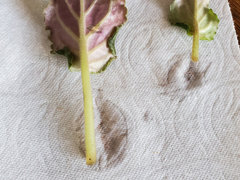
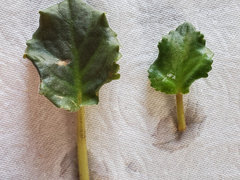
    I was wondering if you had any idea as to why the leaves on my plant are shaped so much differently? The edges are much more ruffled than most of the nice rounded leaves you see out there. They also have a purple hue underneath. I'll attach a few photos so you can see it better.

  • 6 years ago


  • 6 years ago

    If you look at the types of AV leaves... I think it is close to what they call "holly". I do nort think we have a lot of them now - because most of the hybridizers strive to create show worthy hybrids - and flat leaves make a flat rosette. Wavy leaves ... not really. Not every hybridizer insists on flat leaves - Cajun's - Belinda Tibodeaux from LA released a lot of gorgeous varieties with wavy curly leaves - it is connected with frills on the blossoms - and a lot of hers are sure frilly. (Cajun's is her nik). Pat Hancock insists on a show worthy rosette - and her leaves always lay flat (Buckeye's)

    Red back of the leaf happens quite often and just shows the presence of a red-purple pigment antocyan. A lot of dark colored AVs have red reverse on the leaves.


  • 6 years ago

    Very interesting! I did not realize there was such an extensive history and variation in AVs. You may have gotten me started on a new hobby :). I appreciate you taking the time to explain things and give me advice on caring for them!

  • 6 years ago

    There is small learning curve at the beginning with inevitable losses - and then they can easily be grown and usually take all the available surfaces - first on natural light - and then with supplemental lights. Beware. of an AV invasion.

  • 6 years ago

    Beware. of an AV invasion.
    Yeah, well, just don't install lights and they won't be able to survive in the interior of the house...it's safe. You can control those in the windows.

  • 6 years ago

    LOL...control those at the windows! mine just exploded from 12 into 40 in no time at all!

    growing and blooming so well just at the windows..and took all the shelves available...but eventually mites got most of them in the 3rd year: got too hot and crowded in april with west exposure and longer days. but I kept many for several years still.

    but I withstood getting the lights ;). so might say ..exhibited control and composure :).

  • 6 years ago

    Weirdly I have no love for them. I grow dwarf petunias the way people grow av. I have dabbled in avs. The first few died. The next few had broad/cyclamen mites that I failed to recognize. Now I am finding and suspecting broad mite infection/infestation on all my plants after it spread to my dahlias, peppers, torenias, and God knows what else....meanwhile the av blooms are nothing much to write home about IMHO. So, avs and me are done. I am just waiting to throw away/kill the only one I have that has lopsided pale pink petals with two darker than the rest (not sure that is a feature or a bug).

  • 6 years ago

    Hi Getgoing, there are no bugs in this house. We will just throw them outside. We had about six inches of snow yesterday, and it is still cold now, about 26 F. Anything would not be growing in that temperature.


    I like AVs. Some of mine are putting up pretty blossoms now, when it is still dark early.


    Enjoy your plants, whatever they are. No one plant should be for everyone.

    Yolanda

  • 6 years ago

    No no, we want mini sinningias in every house...a national houseplant (lol).

  • 6 years ago

    I am willing to try the sinningias, gloxinias, and streptocarpus. They all seem fetching...

  • 6 years ago

    Mites - you can get Forbid 4F or Avid on eBay = smallest possible amount- and spray EVERY green plant in a house. Make sure to cover a fish tank if you have it. Forbid is less toxic of 2, but Avid will work on thrips too if you have them.. Do not bother with Safer soap, Neem oil and other friendly things - they work on contact - so if you miss several hiding - they will be back. These miticides will work for a month - so if you miss some - they will be destroyed when they feed.

    Work with gloves.

    If you have plants - it is just a question of time when pests will invade - they will fly into the window in summer, they will come with a cut flower bouquet or with a new plant from Home Depot. The only thing radical - is the virus - there is no cure - so a trash is the only treatment - the rest of them - there is a way to deal with them - you do not need to chuck everything and burn the house. Just do your research.

  • 6 years ago

    I did do the research and went with the submerge in hot water method to kill the mites. In the process I managed to kill my months old adenium seedlings. The jury is still out on the mites.

    I will take your advise if I see the tell tales signs of broad mites.

  • 6 years ago

    From the photo, the pot is actually too big. AV should be potted, as with most other potted plants, one size up i.e you can put the finger round the old pot and new one. I have seen African violet thriving on a north facing window sill, in an air-conditioned room. Like Streptocarpus, they actually prefer a moist and coolish environment with fairly bright indirect light.

    For more info !

    You could also read a bit more on this as they are the authority on Gesneriads including African Violets and Streptocarpus.

  • 6 years ago

    Hot water... that seems awfully messy.

  • 6 years ago

    not if you put a paper towel over the soil and tie-up a plastic bag around the pot and close to the stems to hold it all in. somewhat messy, but doable.

  • 6 years ago

    It works well for smaller plants mostly.

  • 6 years ago

    oh, I dunk 12" ivy pots every month :). and the worst mite-magnets like smaller crotons, calatheas and African masks. besides spraying. One of these days i'll make an effort to get Forbid, swear! :) my back is complaining about all the bending :(

  • 6 years ago

    Wow. I have my eyes set on it on ebay. If I see more broad mite infestation when the growing season gets underway I am pulling the trigger.

  • 6 years ago

    I have all sorts of bugs flying in my living room. An 18 inch long yellow sticky tape is already teeming with dead bodies. Unsightedly, but needs must be.


  • 6 years ago

    Sticky yellow cards are more for monitoring than for control. When thrips - yuck - or fungus gnats - these guys are pretty much unavoidable- hatch - the first thing they do - is mate and lay eggs - after feeding - they will take a stroll - and hopefully glue themselves to the sticky card. But ... eggs are already in. So ... if you want to seriously work on it - you need to spray - 3 times week apart - to deal with all new hatchlings.


    Life is too short to spend it on once a month ivy dunking... Forbid them.


    ;-))

  • 6 years ago

    Hi All, in the '50s as I remember, there was a thing called fly paper. It came in a tube, which you rolled out to about a two foot length revealing the sticky side. It was to catch all those pesky flies and other flying insects. I remember my Mother putting up one in the kitchen at one time. When we came home after some time, the two-foot length was covered with dead insects. I think the yellow sticky cards are a version of the said fly paper.


    Just sharing.

    Yolanda