Software
Houzz Logo Print
webuser_61876759462

Solid Hardwood or Engineered and what brand

6 years ago

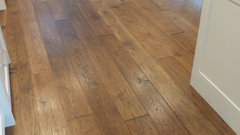
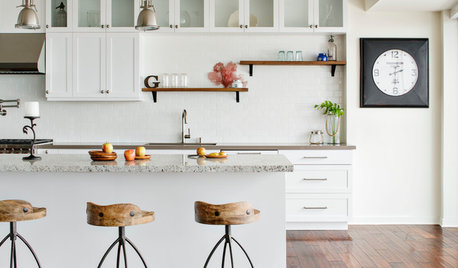
OMG please help we're making ourselves crazy trying to decide. We have 15 year old oak gunstock solid hardwood floors that are so beat up (big dogs, daughter's wheelchair & life). Remodeling and want to replace the 1200 sq ft of floors (kitchen, great room, dining and hallway) with Hickory (can't find a color we like, no red.) and can't decide between solid hardwood or engineered or even which brand. Thinking, 42" white shaker cabinets, molasses stain shakers on island, Pendle hill quartz countertops, white subway backsplash. Please help!!! Thank you.

Comments (20)

  • 6 years ago

    I prefer hardwood so that I can refinish as often as needed. My tastes do not change according to trends/fashion, though.

    P McG thanked Zalco/bring back Sophie!
  • 6 years ago

    I would lean toward site finished hardwood. Most of the prefinished and engineered floors have microbevels that catch grit (from the fur on your dog's toes) and they are a great place for the dog's nails to grab on as they try to get traction. That makes them damage prone. Good luck!

    P McG thanked Pam A
  • PRO
    6 years ago

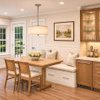
    P McG , make sure those existing floors cant be refinished to your liking prior to committing to a replacement. Something like this would look nice with white cabinets.

    Wide Plank White Oak Wood Floor in Nashville TN Modern Farmhouse · More Info


    P McG thanked Oak & Broad
  • PRO
    6 years ago

    Refinish your existing. Or replace with porcelain. It will withstand wheelchair use.

    P McG thanked User
  • 6 years ago

    Photos of the existing floors will go along way ... we can let you know if they are damaged beyond repair or if they are easily converted to a new floor with a new colour.

  • 6 years ago

    We no longer have the 80 lb husky living with us but he does visit with our son. My concern is if I keep the oak floors and refinish them and put whatever color I want I will STILL have the durability issue. I'm concerned they will just scratch up again versus Hickory being a much harder wood (no I don't think Hickory is impervious to scratching but it would more difficult to do so than oak). I realize the cost difference is a lot. Our Gunstock Bruce hardwood would need a full sand but it's not beyond being repaired by any means. I'm just looking for more durability I don't want to spend the money to refinish like I said to just end up with scratches again.

  • 6 years ago

    The wood underneath won't change anything. And to be clear, an engineered hardwood does NOT get Janka ratings. Why not? Because the hard stuff is ONLY on top. And that top is only 2mm-6mm thick. Everything else underneath is usually the softer woods like fir and pine ('cause they're cheap and plentiful).


    A solid Hickory wood floor is going to be tough to DENT (bowling ball being dropped from the top of the banister). It will still scratch. Why? Because the finish on top is just like every other finish. A janka hardness rating does NOTHING to stop scratches. A HIGH END polyurethane (2 part ceramic or Aluminum Oxide infused water based product = $190/gallon) is what stops that nonsense.


    A FINISH (the plastic/polyurethane sitting on top) is what scratches. And that's what it's supposed to do...take the scratch so the wood doesn't have to. That's what finishes do: protect the wood while accepting all the damage.


    Wood scratches. It dents. It fades. It discolours. After 20 years, you sand down the wood and do it again. That's how hardwood floors last for 60-80 years. You put a finish on it. It lasts for 20 years. You sand it off (and some of the wood) and put on more finish. It lasts for 20 years. You do it again.


    Just because a wood floor is scratched up, doesn't mean it is damaged. Yes it can LOOK bad...but it can still do it's job while looking bad. If the 'bad' part is what is bothering you, then go for the buff and coat around year 12. Get another 10 years of handsome out of it and then go for a full sand and refinish.


    If you don't like scratches (or anything finished wood normally does) then perhaps you have the wrong material. Changing out one wood floor for another wood floor is still going to leave you with a wood floor. It will scratch, etc like every other wood floor.


    Do you have photos of your floor???


  • 6 years ago

    In your situation, an engineered floor is an inferior product compared to real hardwood. Nothing is bullet-proof, so re-finish the existing floors and try to treat them more kindly. If I were in your situation, the dog would be staying outside during visits.

  • PRO
    6 years ago

    Hickory isn't that much harder than Oak. If you want something significantly harder you'd need to look into some exotic wood options. You're probably better off refinishing what you have if you can find a suitable color.

  • 6 years ago

    Thank you for your responses. So this opens up all whole other can of worms. What is the best finish to put on these floors when refinishing. I also have to consider my daughters wheels on her wheelchair could cause scratches even though we no longer have a pet living with us. What is what you feel the best way to refinish and protect these floors?

  • PRO
    6 years ago

    Looking for a good finish is time well spent. I really like the Bona Traffic finish. Its very durable.

  • PRO
    6 years ago

    Regarding the comment by my colleague @ Johnson Flooring... with all due respect, I guess durability is a relative issue, however the Janka hardness table indicates a rating of 1290 for Red Oak compared to over 1820 for Hickory... which equates to an increased factor of almost 50% in terms of "hardness".

    The considerations for the original poster would be: style (finish), of which there are several choices to choose from which offer excellent durability & wear as well as easy maintenance and periodic re-coats if/when needed. Here's an example of a Hickory Plank we recently milled & installed... Customer was extremely happy with their choice (thankfully... haha).


  • PRO
    6 years ago

    In addition... to answer the original question re: solid vs. engineered... IMHO, if the option to nail down new flooring over a raised foundation is available, SOLID is always a good choice (for wider widths, a glue & nail application might be considered)… Engineered flooring was originally designed primarily for use over concrete slab, although it too can be nailed &/or glued over plywood. As far as hardness ratings on engineered products... that also varies. The bargain basement import products may have a top (wear) layer of 1 to 2 mm thickness, which isn't much. However, the better products range from 5 to 6 mm, and are affixed to a BIRCH plywood substrate, which is better than some of the pine, fir, or other cheap variations used.

  • PRO
    6 years ago

    You're right about the near 50% difference but in my experience Hickory will still indent almost as readily as Oak. It's not like we're comparing Oak to American Cherry or Yellow Pine. Ripping out and discarding a solid Oak floor in favor of Hickory doesn't make sense just to get something harder. That said, if one was starting from scratch and considering the two woods I'd definitely give the nod to the Hickory.

  • 6 years ago

    The toughest finishes are (in no particular order other than alphabetical):


    Bona Traffic HD = 3 coats for a commercial grade floor (museum quality)

    Loba Supra AT = 3 coats for a commercial/light industrial grade finish


    Both the Traffic HD (the HD is SUPER important) and the Supra AT (the AT is SUPER important) are infused with nano-beads that TOUGHEN up the finish. They increase the scratch resistance many times over.


    The Loba Supra AT has ceramic nano-beads. These make the finish extremely tough while offering a lovely velvety feel. It also has great slip-resistance.


    I would not hesitate to use either finish (I prefer the Loba...but then again I used to sell it) with a wheelchair and/or large pets.


    Be SURE to work with an NWFA Certifed Sanding/Refinisher who has worked/been trained on either system. And make sure you get 2-3 coats of the EXPENSIVE coating. The multiple layers of the product produce the toughness you are craving.


    Do not allow a refinisher to put down two coats of cheaper product only to top-off the floor with the expensive stuff on the last coat. That isn't going to cut it. You NEED the 2-3 coats (film build up) to get what you want/need from the finish.


    Even working with the industry's toughest, most expensive, finishes you are only adding $1/sf to the $5/sf cost of sanding/refinishing your flooring.

  • 6 years ago

    Great info SJ!

    We are researching whether an aluminum oxide finish would be appropriate for the acacia flooring in our new home (still to be built) to help protect the flooring from our dog. I've read that the downside to AO is that it's super difficult (thus expensive) to sand and refinish whenever that need arises. How would AO compare to the Bona Traffic HD and Loba Supra AT?

  • 6 years ago

    Aluminum Oxide (the really tough stuff) is normally found on factory finished floors. Because of the technique needed to lay down 9 layers of urethane+aluminum oxide dust it takes a lot of effort to get the AO baked into a finish. That's why the AO finishes out of factories are so tough to get off.


    The nano-bead technology of the Bona and Loba are slightly different but still difficult to remove (in 25 years). That's the trade off. The homeowner either ACCEPTS that wood scratches and looks beaten up after 15 years (with a traditional poly finish) or they demand the floor looks perfect for 15 years (with factory finished AO).


    What makes it tough to scratch makes a floor difficult to be refinished. In essence a sand/refinish is a LOT OF SCRATCHING (sand paper swirling at high speeds for hours at a time = worst scratches EVER).


    Acacia is an exotic hardwood. These woods are traditionally hard to deal with (for the flooring installer/refinisher). Exotic hardwoods can be oily or super dense and often both. That means a site finished acacia could be a nightmare to deal with. With exotics, a factory finish is the easiest way to make a homeowner happy.


    Local hardwoods are easy to work with a site finished product. Exotic hardwoods are best left in a factory finish. In 25 years you can decide when a sand/refinish is necessary. The high-end sanding/refinishing professionals have figured out how to deal with AO. They can do it...but it costs more. A 'dude' with a sanding machine will continue to mess up the AO sand/refinish situation now and in the future.


    It all comes down to the professional you hire when the time comes.

  • PRO
    6 years ago
    last modified: 6 years ago

    Again let me recommend porcelain tile. There is a reason that wood is not used in rehab facilities or senior care homes. It will not withstand the heavy abuse of a electric wheelchair. A manual one is lighter, but still has abrasion issues. You will either have some form of VCT, or tile.

  • 6 years ago

    Thank you all for your responses. We just don't care for tile upstairs. It's cold (my house tends to be cold because of hardwood flooring and vaulted ceiling, tile would be worse) and it's even harder to walk on than wood. It's come down to which is going to be the less expensive way to go. With the remodel we're doing it may work out better to rip out the floor and replace it because of gas lines and water lines that have to be moved.