Software
Houzz Logo Print
christian_duret

Help - my new Ficus Lyrata is not doing well !

6 years ago

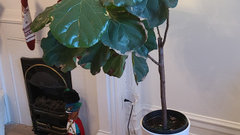
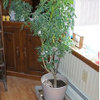
I bought a Ficus Lyrata a month ago and I am having a hard time understanding its watering needs.
- plant is just under 5'5 tall (160cm)
- I live in canada and its winter. The house is heated which makes the air pretty dry
- plant is 6m away from a big window facing east and receives quite a bit of sunlight.
Issues I am experimenting:
- i water the plant once a week. the soil dries out super fast. The store that sold me the plant said I should drain the plate after every watering. But the soil becomes super dry after 2 days.
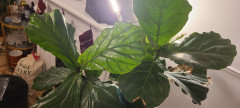
- some of the leaves started turning brown and dry on the sides and some of the natural brown stains in the middle of the leaves are increasing slowly. Some leaves are still flawless but I am afraid they might start becoming brown.
- I initially started watering with 3 cups a week and figured this wasnt enought, then increased to 4 cups a week and now started with 5 cups a week. This helped maintained the soil a bit humid for up to the next watering.
I dont know what to do. Help ! Uploading pictures in the comment section below

Comments (12)

  • 6 years ago


  • 6 years ago

    Do you have an ionic exchange water softening system?

    The spots are related to problems in the rhizosphere (root zone). The potentialities are over-watering, under-watering, and/or a high level of dissolved solids (mineral salts from tapwater and fertilizer solutions). The results of under-watering AND over-watering is the root system's inability to efficiently move water, especially the plants most distal parts, which would be leaf tips and margins. The reason over-watering causes the same drought response as under-watering is, over-watering limits air porosity in the growing medium and the lack of oxygen inhibits normal root function. It also sounds like you're watering in small sips, which ensures ALL salts from tapwater and

    To resolve the issue, you should flush the soil thoroughly to remove accumulating salts. When you water, you should be able to water to beyond the point of complete soil saturation, so 15-25% of the total volume of water applied exits the drain hole, and the effluent that exits the drain hole should have no pathway back into the pot. This means the pot should never sit in water that exits the drain hole, as that largely defeats the purpose of flushing the soil. Then, get in the habit of making sure the entire soil mass is moistened. If you think the soil will remain wet for an extended period, causing issues with root function/health, let me know and I'll help you with work-arounds. I'll leave some things for you to read about using a "tell" to "tell" you when it's time to water, and how to effectively flush the soil. I'll also leave a link at the very end that lays out a very good way to approach growing in containers. Getting to a point where you do not have to constantly battle your chosen medium for control of your plant's vitality is so important it might be considered the keystone of container culture. Undoubtedly, the right medium makes all aspects of growing in pots easier, and affords the grower a much wider margin for error.

    I received your message, so let me know your thoughts after you read what's below.


    Using a 'tell'

    Over-watering saps vitality and is one of the most common plant assassins, so learning to avoid it is worth the small effort. Plants make and store their own energy source – photosynthate - (sugar/glucose). Functioning roots need energy to drive their metabolic processes, and in order to get it, they use oxygen to burn (oxidize) their food. From this, we can see that terrestrial plants need air (oxygen) in the soil to drive root function. Many off-the-shelf soils hold too much water and not enough air to support good root health, which is a prerequisite to a healthy plant. Watering in small sips leads to a build-up of dissolved solids (salts) in the soil, which limits a plant's ability to absorb water – so watering in sips simply moves us to the other horn of a dilemma. It creates another problem that requires resolution. Better, would be to simply adopt a soil that drains well enough to allow watering to beyond the saturation point, so we're flushing the soil of accumulating dissolved solids whenever we water; this, w/o the plant being forced to pay a tax in the form of reduced vitality, due to prolong periods of soil saturation. Sometimes, though, that's not a course we can immediately steer, which makes controlling how often we water a very important factor.

    In many cases, we can judge whether or not a planting needs watering by hefting the pot. This is especially true if the pot is made from light material, like plastic, but doesn't work (as) well when the pot is made from heavier material, like clay, or when the size/weight of the pot precludes grabbing it with one hand to judge its weight and gauge the need for water.

    Fingers stuck an inch or two into the soil work ok for shallow pots, but not for deep pots. Deep pots might have 3 or more inches of soil that feels totally dry, while the lower several inches of the soil is 100% saturated. Obviously, the lack of oxygen in the root zone situation can wreak havoc with root health and cause the loss of a very notable measure of your plant's potential. Inexpensive watering meters don't even measure moisture levels, they measure electrical conductivity. Clean the tip and insert it into a cup of distilled water and witness the fact it reads 'DRY'.

    One of the most reliable methods of checking a planting's need for water is using a 'tell'. You can use a bamboo skewer in a pinch, but a wooden dowel rod of about 5/16” (75-85mm) would work better. They usually come 48” (120cm) long and can usually be cut in half and serve as a pair. Sharpen all 4 ends in a pencil sharpener and slightly blunt the tip so it's about the diameter of the head on a straight pin. Push the wooden tell deep into the soil. Don't worry, it won't harm the root system. If the plant is quite root-bound, you might need to try several places until you find one where you can push it all the way to the pot's bottom. Leave it a few seconds, then withdraw it and inspect the tip for moisture. For most plantings, withhold water until the tell comes out dry or nearly so. If you see signs of wilting, adjust the interval between waterings so drought stress isn't a recurring issue.


    Flushing Soils

    When you water, you should be able to flush planting's soil to eliminate the potentiality of salts from fertilizers and tapwater accumulating in the soil, thereby limiting the plant's ability to take up water and the nutrients dissolved in the water. If you think you shouldn't flush the soil during your regular water applications for fear the soil will remain saturated for a lengthy period, limiting root function or worse, you should consider a different soil or take steps to reduce the amount of excess water your soil can hold. By whatever means necessary, getting to the point you can water correctly is going to make a very big difference in the opportunity to realize as much of it's genetic potential as possible. Once you can water correctly, you no longer have to do battle with a water-retentive medium over control of your plant's vitality. There are several methods of limiting how much water your planting can hold, all but 1 or 2 are completely passive, requiring no effort on your part other than set-up, which is monkey easy. I can help if you have interest in that, I'm continually improving my proficiency at monkey easy tasks.

    To flush the soil of a planting: Water with room temperature water until the soil is completely saturated. Allow the planting to rest for 15 minutes to an hour to allow as much of the salt accumulation as possible to go into solution, then pour a volume of room temp water equal to at least 10X the volume of the pot the plant is in slowly through the soil. This will remove most of any accumulation of offending salts and resolve any skewing of nutrient ratios.

    It's a good idea, no matter what time of year, to fertilize most plants immediately after flushing the soil. Try to be sure you're using a fertilizer that has a ratio as close as possible to the ratio at which the plant uses nutrients. The NPK % listed on fertilizer packaging is not its ratio. 7-7-7 and 14-14-14 are 1:1:1 ratios. 9-3-6, 12-4-8, and 24-8-16, are all 3:1:3 ratios. Container growers should try very hard to avoid use of fertilizers advertised as 'bloom-boosters', or any number with a middle number (Phosphorous) higher than either the first or third numbers (Nitrogen or Potassium). These fertilizers can badly skew nutrient ratios with even the first application). On average, plants use about 6x as much N as P, so there is NO potential for a positive outcome when supplying many times as much P as the plant requires. I, and a large number of other members, use Dyna-Gro's Foliage Pro 9-3-6. It's designed to closely mimic the uptake ratio of the average plant, and has many other attributes not commonly found in other fertilizers. It also has ALL of the nutrients essential to normal growth. Summarized, it makes fertilizing as easy as it can be, and from 1 container.


    I hope you find this overview helpful.


    Al

  • 6 years ago
    last modified: 6 years ago

    Hi @tapla (mid-Michigan, USDA z5b-6a) ! Thank you for your response. It is great input and will definitely help me. I think I might be underwatering the plant. With 5 cups of water there is only little water (1/2 a cup maybe less) that comes out of the drain. Could it be a mix of underwatering/new environment/winter dry air and not enough sunlight... ?

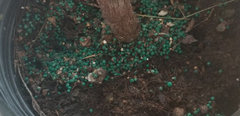
    The plant has some green vitamins grains on the top surface of the soil but the Plant Shop employee told me that it would help the plant acclimate to its new environment.

    I have several other plants (big and small) and they are doing fine with the tap water so I am not sure if there are lots of salts in my water.


    Do you think the dammaged leaves can be saved ? And how long till I get new leaves ? 😢😢😢

  • 6 years ago

    Those green round pellets are controlled release fertilizer. They are probably from florikan and they have many versions some that are rated to release the fertilizer over 3 month to 9 month periods. Very popular in nursery business. I had one plant that had way too much of that stuff.

    These depend on temperature and moisture to release fertilizer slowly over a period of time. Usually they will provide data on how fast or slow they are depending on temperature - usually from 60-80F soil temperature range. 70F being their median temperature for rating their fertilizer.

    Having said all that it is quite possible that they are still viable and releasing quite a bit of fertilizer into your soil. Assuming your home temperature is around 70F. The higher it is the faster it releases fertilizer. In winter, with indoor conditions, the plant does not need that much of fertilizer. I am guessing there is excess fertilizer in soil and stressing the plant. Browning edges of leaves is one indication of presence of excess salts/fertilizer in the soil. I suggest you remove those green balls and flush the soil well first. Then start using a liquid fertilizer like Foliage Pro (9-3-6) at low strengths (eg 1/4 strength) when you water the plant.

    Also all those little green balls are very much concentrated in a small area. That cannot be good. They should have been more uniformly distributed. Looks like someone at the nursery just tossed a bunch at the plant at some point. It should be more uniformly distributed and scratched into the soil a bit so that they do not move around when watering.

    I get a feeling that the soil is not uniformly wet. Once it is too dry it often becomes difficult to re-wet the soil more uniformly. I suggest dunk the plant in a tub of warm water and leave it there for 30-60 minutes. Then flush it with warm water again a couple of times. Flushing means apply enough water that a good amount like 25-50% flows out of the bottom. This will take away excess salts in the soil and freshen it up. Makes it much easier for the roots to absorb water.

  • 6 years ago

    While I was merrily taking my sweet time to compose my thoughts Al managed to sneak in a more detailed and informative post - :))) At least we seem to be in agreement about the two issues I touched upon. I agree ficus is quite tolerant of dry conditions. Although I have to admit recently one of my little micro-carpa (I think) suddenly shed all of its leaves. It is growing new ones now but I suspect the root zone became too dry.

    Al: whenever I see your ficus pic I tend to turn my head sideways and see a camel with a hump or may be a duck. :) Looks really good.

  • 6 years ago

    Lol - timing is everything ....... especially if you're throwing hand grenades.

    Al

  • 6 years ago

    Shower time...

    All joking aside, showering my large Peace Lily is the only way I can water it properly, meaning moving large amounts of water through the soil to clean it, including the mineral deposits from last watering's tap water, and residues of fertilizer. Once it is watered well, I fertilize with half strength but that's just because the watering can I have on hand is 2 gallons. I do this every 5 weeks currently. May need twice as often once I put it outside during my outside season. In between waterings, not a drop of water goes into the pot.

    You may want to water that way while the plant needs a boost, but even more, since yours apparently really needs a boost as its leaves are telling you so, let the water penetrate the hard and dry areas of the soil and loosen the soil, by doing something like tropicofcancer said. If, after you have done this, water flows more abundantly through the pot and out of the drain hole, you can consider it a small victory in your efforts to care about this plant. The next step would be to figure out how long to wait until the plant needs to be watered again, and that is the hard part in my opinion.

  • 6 years ago
    last modified: 6 years ago

    This is great guys ! Thank you.

    1) this sunday (watering day) I will soak the pot into room temperature water. Then I will shower it again and make sure the excess drains out of the pot.

    2) About the liquid fertilizer, do you have a brand to recommend ? Something that goes well with Ficus Fiddle Leaf type of tree ? I will order it on amazon asap. How do I fertilize the plant (what quantity and how often) ?

    3) After the soaking and showering, how long should I wait before watering it ? Until the soils becomes dry ? And should I go back to regular weekly watering after that ?

    This is great ! I have several medium to large indoor plants at home and I always manage to not let them die in winter. Now I know where to go for questions ! :) :)

  • 6 years ago

    CD: All the questions you have been answered above earlier in the replies. Al recommended Dyna-Gro's Foliage Pro 9-3-6 for fertilizer and many of us use it with success. Do not water on a schedule - water when the plant needs it. Use a "tell" as Al described earlier to get into the habit of detecting when the mix is dry enough and needs watering. Treat flushing of the soil as watering the plant and wait till it is dry. You can fertilize every time you water at lower strength (1/4-1/2 strength of the recommended dosage of the product). In summer when growth starts again you can bump it to full strength. Please do go over the replies given earlier and come back with questions and clarifications.

  • 6 years ago

    I agree with what ToC said. All the questions you most recently asked were answered with reasons why the information was provided, which is as/more important than simple answers. I really don't mind if someone isn't taking my advice seriously, because someone else might benefit from it at some point in time; however, when my advice is overlooked, the desire to help the person asking the questions morphs to something more like simply supporting what I said in the face of any other conflicting advice. IOW, when something conflicts with something I said, about a topic important to any grower's betterment, I'll explain why I offered the advice. Best luck, CD.


    You'll find much more info here.


    Al

  • 5 years ago

    Hi all ! Just to give you guys an update on my Ficus Lyrata after a year:

    - I have moved the plant closer to my window (during the week I pull the plant from the wall/corner and only push it back when I have people over.

    - I removed the brown spots around the leaves on damaged ones (with scisors)

    - I have been watering it every 14 days with approx 8 cups of water and throwing excess of water after 30 min.

    - Canadian winter care: I have been using a grow light during winter - placed behind the plant. And I also turning the plant 90 degre every 2 weeks. I also use a humifier 4x times a week for 4-6 hrs each time

    - Summer care: liquid fertilizer in water (x2 a month)

    The plant is recovered. I got 7 news leaves in a year and this week I got a new leaf (it is Winter now so I am super impressed). So far, none of the new leaves got damaged The brown spots on already damaged leaves stopped growing.

    Thank you everyone for your advices. I can't say that I followed everyone's advices but I picked a few from each and adjusted to what seemed to make sense for me.