

Hillside garden design help
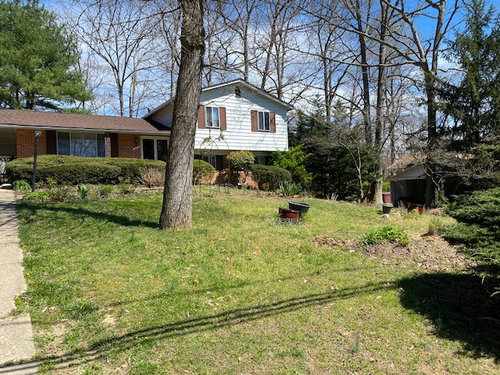
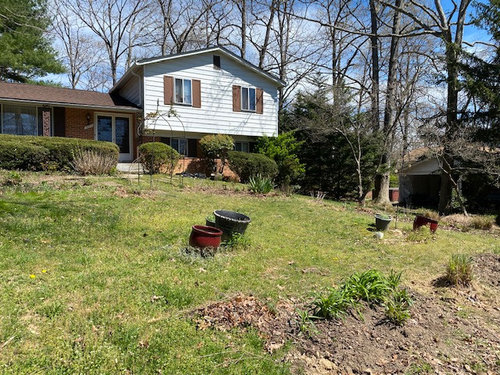
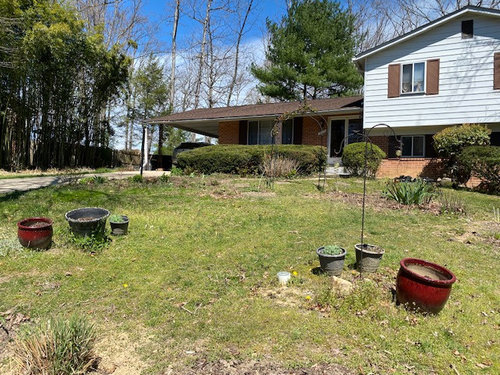
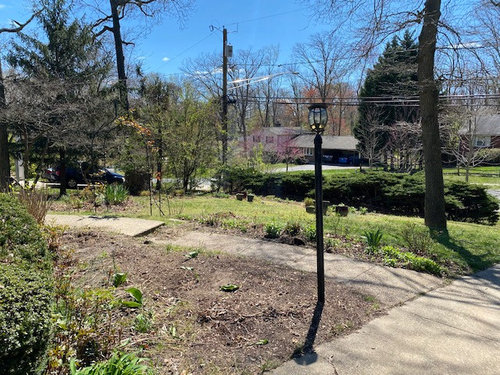
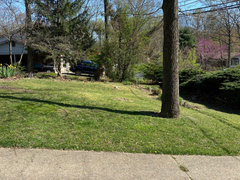
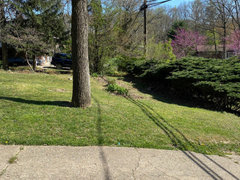
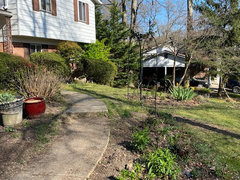
Hi, below is my garden today. I'm thinking I'd like to plant the whole slope, remove the arches and relocate the roses on it.
But I need help deciding how to place my plants. The ones in the top beds are all perennials, not very tall, as I was going for appeal as you follow the path to the door. But I was reading hillsides should have larger plants placed at the top.
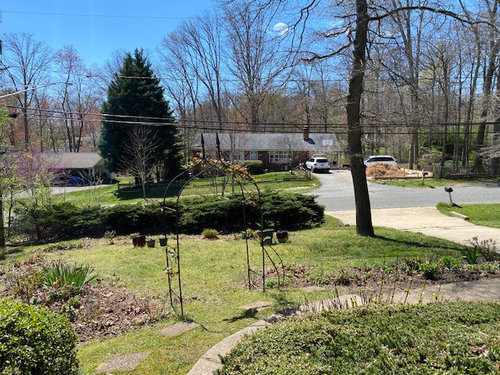
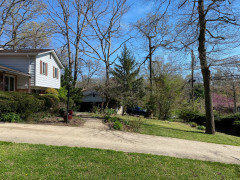
Note that there are several view points: coming up the driveway, looking out the window/front door, and following the path to the door.
So again, my questions:
How to place large/small plants best in this setting? Most of my largest plants are at the bottom of the slope now.
Would you change the perennial bed at the top of the slope for large shrubs/grasses, or just start below it? What would you start with if starting below?
Am I right in thinking the arch is a bit pretentious? Would you remove it completely or put it elsewhere in the setting?
And no, I'm not going to terrace this, but would like to place stepping stones as a path down, since the slope is not so steep. Where would you place them?
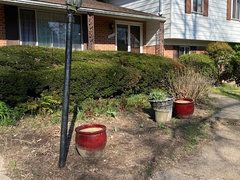
Oh, and would you group the pots together or scatter them among plantings?
Comments (30)
 PRO6 years agolast modified: 6 years ago
The only goal I can detect so far is to 'fill a place with plants.' That is vague. It doesn't explain what benefits your are expecting to receive after you've paid all the money and done all the work. It sounds like a gardening project that doesn't know or care if the house is there. You need to elaborate some on your vision.
The arch makes sense if it is an entrance to somewhere, like if it were placed over a path (even if you never use the path.) Be careful of placing it over a path you do use because, depending on what grows on it, it could be a tight, uncomfortable squeeze. A lot of the ready-made garden decor is more for looks and is not sized well for actual use.
As far as pots and things around the yard, I'd remove them all. They make the yard look junky. Find a place to put pots on a hard surface. But not too many of them.
If you want your house to look welcoming at all, you have to remove the hedge that is directly in front of it. It looks like a big, foreboding barricade.
"I was reading hillsides should have larger plants placed at the top." Find another gardening book to read that says that this is not necessary. This is not a "rule" that's going to help you.
 6 years ago
That is a large project and I hope you are an experienced gardener or interested enough to become one. Also, it's a project best started in fall with dealing with the grass and spending the winter researching plants and drawing up a plan. Then you plant in spring.
Related Professionals
Forrest City Landscape Architects & Landscape Designers · Frisco Landscape Architects & Landscape Designers · Olympia Landscape Architects & Landscape Designers · Hilo Landscape Architects & Landscape Designers · Vidalia Landscape Contractors · Moline Landscape Contractors · San Marcos Decks, Patios & Outdoor Enclosures · Ithaca Decks, Patios & Outdoor Enclosures · Middlesboro Interior Designers & Decorators · Hilo Interior Designers & Decorators · Natchitoches Architects & Building Designers · Charlotte Kitchen & Bathroom Designers · Jackson Kitchen & Bathroom Designers · Sioux City Kitchen & Bathroom Designers · Jackson Kitchen & Bathroom Designers- 6 years agolast modified: 6 years ago
I agree about the pots too. Get rid of all of them from the open garden. Then pick the largest few and group them together in a place that makes sense, as Yard suggests. I'd also lose the bird feeder and put it somewhere in a bed amongst shrubs when you've redone the design.
- PRO6 years agolast modified: 6 years ago
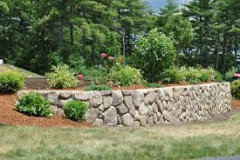
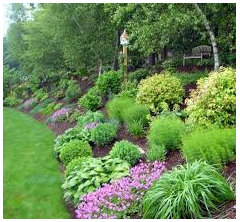
Pots are not landscaping material and are best on decks or patios where it is impossible to do in ground plantings and you want a splash of color.First take out all those hedges that are hiding the house , remove all the pots and that arch thing. Now you will have a better idea of what is needed. Talk to a landscape designer and make a plan for the next couple of years unless you have a ton of money in which case do it all now. Gardens are best done with a lot of thought put into them. I think terracing gives a garden a different feel. My first question would be how much time are you prepared to give to looking after the garden? Are you what I would call a green thumb? I always have to restrain myself in the garden because everything grows for me. Get a plan and work toward it and be honest with yourself about the hours you need to spend on a perfect garden.These are a couple of pics of what you can do with that slope.
lovesblooms
Original Author6 years agoThank you, Yardvaark, for helping me think a little more (just a little) about what I want.
Thank you, laceyveil for reminding me to be patient, I know this will take some time.
Thank you floral_uk for the advice to strip things down.
Thank you Patricia for asking the questions that will help clarify what can be done.
I'd like a better view looking up the hill, and I like the natural cottage garden look. I just am not sure where to plant what I have, or where to concentrate first. I also don't have the budget for a landscape designer.
I have a lot of plants and time to dedicate to caring for the garden, I'm growing and acquiring new plants all the time.
I don't have the wherewithal to terrace, and I don't need to plant the slope top to bottom with flowers to be satisfied. I think what I want is to bring together the plantings I have, whether that means moving things around, or just connecting them with new plantings somehow so it's more cohesive and nicer to look at as a whole picture.
I'm not moving the hedges in front of the porch anytime soon, although I've considered it a few times. I usually plant tall things in the bed in front of it anyway like cannas, elephant ears, and dahlias. Might be able to get rid of the troll-like "hedge" thing at the bottom of the hill in fall.
The grass/weed/grass-replacement mix in the "lawn" doesn't really want to be there. I easily peel it in mats off the surface of my red clay along with most other weeds, and usually am left with onion grass and a few dandelions (they don't really want to be there either). I'm used to dealing with those, and spending time weeding out whatever sneaks up/in, etc. I tend to plant very close, so there isn't much room for weeds, and mulch.
Come to think of it, maybe one my issues is with the "lawn," and replacing more of it with some other groundcover, to better accent plantings, whatever/wherever they are. I've been looking at trailing and creeping shrubs.
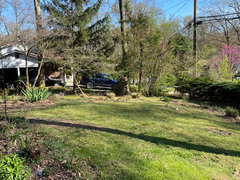
As you see, I used to have that center bed that you see in midground. One of the tree's roots wouldn't allow anything to thrive in that vicinity (midway up the hill), so I let grass grow back in. But this is the best pic I have looking down on it.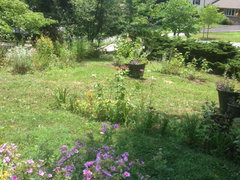
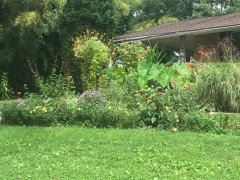
And I think I'm thinking too "small" in terms of planting. As you can see, I like messy beds, but I feel like that sabotaged this large space, and I can't sustain that many plants per square foot for such a large area if I want to bring it all together.
Look at the area as a whole, where should I start with dividing it up, and where best to put taller shrubs, grasses, and perennials in the plan?lovesblooms
Original Author6 years agolast modified: 6 years agoThank you. This is exactly the discussion I want to have. What organization, placement, forms, etc. would be useful if I need to work around the unsightly hedge in my yard? Is there nothing for it but to remove it?
I went out and removed the things that can be removed and mowed and it looks better than it did already.- PRO6 years ago
When something is identified as being not good but the homeowner says "But we're keeping it," then it's enormously helpful if they justify why, so we can agree that it's in the best interest. Otherwise, some of us have to ask ourselves, "Why bother?" if this is going to end up being good money after bad. If your only child has been kidnapped and the FBI has set up a concealed hiding spot behind that hedge for listening in on telephone calls from the kidnapper, and none of you all want that fact to be known, then we'd understand why you must keep it. But without a good explanation, it doesn't make sense ... which is a hard starting point for a front yard landscape.
lovesblooms
Original Author6 years agoRight. I had a feeling you'd say "why bother." I don't own this property (long-term renter), but we have permission to do as we wish with the garden/lawn in terms of "improvements." Harder to get permission to remove longstanding plantings that the owners planted a while back likely thinking they would add curb appeal. We've been here over a decade.
Why bother, eh?
What would you replace the hedge with? Anything? Might be more appealing to offer if I have some ideas in mind.- PRO6 years ago
OK, that's understandable. It wouldn't be possible to say what could replace them without seeing what's behind them. But I'm sure it would be LESS. Of course, I don't know the landlord's personality, but I don't think it would be too hard to make a case that the shrubs are overgrown and either need to be replaced, OR rejuvenated -- cut to the ground and regrown from scratch -- and shaped and controlled better on their way back. For the time being they can be on the back burner.
lovesblooms thanked Yardvaark lovesblooms
Original Author6 years agoThere's nothing behind them but that raised front walk thing that passes for porches on ranch-type houses. Very common here. We don't have a gorgeous bay window or pretty paving on the walk to show off, there's literally nothing there but what you see.
Maybe an openwork gate kind of thing across the front...? It recently lost one of its two decorative brown openwork pillar things (you see the missing one in the more recent summer pic). We're trying to get that back up, then maybe I could attach a low screen...
But either way, I'm sure I could get away with reducing the hedge's size. What about the rest of the picture?
Currently the slope can only be viewed from the side or the top, but I do hope to be able to get rid of the big hedges at the bottom this fall, so it would then be viewable from the bottom, too.- 6 years ago
I'm a homeowner who loves to garden, not a professional gardener.
Keeping that in mind, here's what I'd do. I would move the pots and arches to the back, take pictures and go to my local plant nursery to get a plan. Not a big box store but a local plant nursery. I'd go during the week, not the weekend, at a time when they aren't busy. I'd ask for a simple, easy to maintain plan. I'd expect to clean up the beds, put out grass seed, plant a few things. When I say get a plan, I don't mean a drawn out plan. I just mean suggestions. I'd draw a plan myself. I'd keep my fun garden in the back. I would probably plant some perennials in that area of the front by the sidewalk and shrubs. That looks like a sunny area so I'd probably plant shasta daisies, black eyed susans, maybe some swamp iris, definitely some day lilies. You can move your roses here if you like and they'd be easy to spray. Also they would be easy to weed.
However, if you really want your fun garden in the front. I can certainly understand that, since a really good garden depends on the sun and not the siting of the house. I would take an area and focus on that. I would drop my question of what to plant, or at least reframe it. The best question for some people is what to plant, but if you are dependent on finances then your best question to yourself is what do you have access to. Can you get a beautiful pink dogwood or japanese maple from a relative? Do you have a neighbor with some beautiful variegated solomon's seal? I personally would plant hosta, variegated solomon's seal, lenten rose, heucherella, maybe some black miniature mondo grass in the shady parts because that's what I have a lot of. Your mileage may vary. In the sunny parts I'd plant daylilies, roses if I liked them, shasta daisies, rudbeckia, the possibilities are endless. I'd just work on one area at a time. I'd forget the messy garden love, although I do understand and embrace it. Go for a neater look. Expect to change your mind, move things, add shrubs, move shrubs, etc. I love shrubs and you get such an explosion of color with the right ones. I'd keep my eyes open for some hydrangeas, which would be lovely in your yard I think.
But right now I do think you should focus on a plan instead of the exact type of plant you have or can find. Putting something like 'a 3 foot tall perennial' on your plan is perfectly fine. I would put the pathways on my plan, too. You can fill that in during your gardening, that is fine. I mean you can fill it in for real, not on your plan, during your gardening. I would start the gardening in one corner or section and leave the rest for another time of year.
The one thing I've never regretted is putting some benches and chairs in my garden areas. They are great for dreaming. I sit after some digging or weeding and think. Only really put what I need or will use. You might enjoy some sitting and dreaming about your plan.
Good luck whatever you decide.
lovesblooms thanked DaisyinGA - PRO6 years ago
"There's nothing behind them but that raised front walk thing that passes for porches on ranch-type houses." It would make a difference how high it is and where its ends are. If it's a walk and window, it's not something that you'd want to pen in. There could possibly be a SMALL (12'-ish height) tree from at the left end and groundcover in most of the rest of the bed, to correlate with the stoop height. Again, it's on the back burner.
The big hedge at the bottom is something I don't personally care for but some people want to screen off their property and keep their view to themselves. It's not my thing but I can respect it ... sort of. More so, if the house is set back from the street. That you want that hedge gone is a plus.
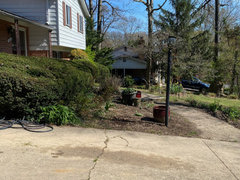
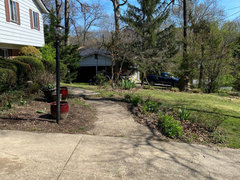
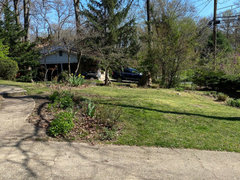
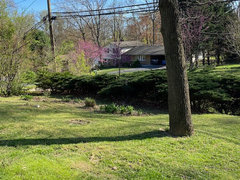
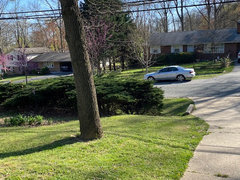
I see your next objectives as laying out the beds. To do that requires a base plan, which you can easily make by measuring elements of the site and transferring them to paper. But in theory, the concept I see working best for you is to NOT place the bed at the drive, but opposite it, as the view ... not something that's under your nose or seems to pen in the driveway. Can you take of pictures while standing where indicated below? Pan 180* from left to right where the driveway length shows in the first and last picture, and all the pictures are slightly overlapping. That way, we could a complete view of your front yard from that viewpoint. (Looking at foundation planting is a part of this but not in detail, as that would be a separate thing.)
lovesblooms thanked Yardvaark - 6 years ago
Sorry, I just realized that I didn't describe what a landscaping plan looks like. A thousand apologies if that's something you've already seen. It's on graph paper or possibly paper with no lines, and it's to scale. And shrubs and trees are usually round circles with a plus in the middle and possibly a description or name or both written in a list to the side or on the circles. The groups of flowers are not on a circle individually but in a circle as a group, probably an oblong circle. But can be any shape, the important thing is they are drawn as a group. Trees are drawn as a circle with a plus in the center. The plus marks the center of the plant. The plant should be planted a certain width and length away from the adjoining plants and that is denoted on the plan by the plus marks and circles.
Save your plant markers, your plant notes, your plan, etc. in a notebook.
That's what I've seen and had, at least. Good luck and I hope you have lots of fun. Grimy, dirty fun that lasts for years.
lovesblooms thanked DaisyinGA - PRO6 years ago
So that pretty well describes a landscape plan. But what's needed here, if we can get it, is a BASE PLAN, which would be much simpler. because it's not interested in any small plants. (I'm speaking about here on the forum. Many pros may put all kind of things on their own base plans.) But here, the objective is to keep it simple. Typically, people draw way to many details, use color, draw squiggly plants everywhere, draw bricks on paving, add all kinds of notes, add shading and fluffy circles around tree trunks. All these details make a base plan very hard, sometimes impossible to read. Far better to keep it simple and if in doubt, leave it out. Anything missing can be added later. We just need house footprint, drive edge, walk, tree trunks. If the hedge at the street was going to remain, I'd draw it. If it's going to be removed, I wouldn't.
lovesblooms thanked Yardvaark lovesblooms
Original Author6 years agolast modified: 6 years agoThank you so much, Daisy, I do hope to continue to have fun here! I'll keep your suggestions about the fun garden in mind, cause yeah, us gardeners need to play with plants, not just plant 'em!
- PRO6 years ago
You don't understand the picture taking process. First, you should be on the red mark, at the edge of the driveway, where when looking toward the opposite side of the yard, you would see no driveway in the viewfinder. You'd only see driveway as you pan to the far left and far right, which is why it would show only in the first and last pictures. Panning means that you stand in one place and pivot to take the pictures. If you move locations, the pictures cannot be put together into a panorama. Also, you cannot use a camera panorama feature because it shrinks the pictures to a small percentage of what they would otherwise be. Sorry if I didn't originally explain very well.
lovesblooms thanked Yardvaark - PRO6 years agolast modified: 6 years ago
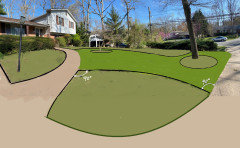
Those work better. I've marked off some proposed beds in black outline, trying to keep a central area open to lawn. But more or less, the yard is surrounded by bed. It's up to you how much of that you want, as it could certainly be cut down. (It's a lot of bed.) You can put groundcover where there are tree roots and anything anywhere else. For subdividing the areas in heights, you need to work in plan view. If there is a path to the back yard, the arbor could possibly go at its entrance.
 lovesblooms thanked Yardvaark
lovesblooms
Original Author6 years agoThank you so much for your time and help with thinking this through. These beds offer a lot more space to work in. It looks like I'd be connecting the beds in the back in an arc, and placing a specimen tree in the center of the curve. I kind of started trying to do that already last month.
I really like the arch placement idea, and the idea of making the garden face this way. A lot of this has been swirling in my head, but I had no way to visualize it except via sketch, which is hard to make to scale (and messy). So thank you again!
I'm actually starting to consider keeping the hedge at the bottom, just so we could keep it private. But would this work as well if we removed the hedge?
Also considered adding a stepping-stone path from the bottom of the hill, up behind the tree to meet the walkway or continue around to the backyard, so people can walk through if they'd like.
Is plan view overhead view? What would you suggest for heights? The sun moves pretty much left to right from this view point.- PRO6 years ago
Plan view is overhead view.
If that seems like more space than you want, by all means shrink it. Islands could get smaller except the one left of walk to front door, since it's defined by walk, hedge and rive. The long island at far side the sweeps to street hedge could become shorter, or it could become skinnier. Don't make too skinny or will not look good. Better to make shorter. The front street hedge could stay or go as you wish. Islands around trees shouldn't shrink much or they will look dorky. (I was putting them around trees you already had. Not adding new trees.) I would not add any random path (the lawn itself is a path.) It would need to have a specific destination. It needs to look purposeful ... not like a stroll through Candyland.
In general tall plants toward back of bed and short to front. Better to use large blocks of same plant than one of this and one of that all over the place. Avoid lines of plants and opt for blocks.
lovesblooms thanked Yardvaark - 6 years ago
Nice house. Do keep your privacy hedge by the road but cut back the bu(es) closest to the driveway as may be needed for safety reason -- to not block you view of the road in both directions..
Keep a dozen or so healthy feet of lawn only behind it.
Budget and energy permitting, of course, consider creating a terrace several feet below your sidewalk -- or at least part of it -- and put short plants between terrace wall and sidewalk and taller plants below the wall.
Then, scattered around your yard where what specific plants that you want to plant can get the sun it needs, create several slightly curved short walls to create terraces with a level planting area above the wall -- preferably with all about the same width. Depending upon how tall the wall is, you could put taller plants on the slope that remains below the wall and shorter plants in the level planting area. If in some places, your terrace wall isn't that tall, you may need to put the shorter plants on the slope at the base of the wall and put the taller plants in the level place above the terrace. Keep the rest of the yard as lawn, adding moss or ground cover in any shady place(s) where the grass doesn't grow well.
If Lliriope will grow where you live, consider that for outlining your driveway.
Would remove the arch from the front yard but, as long as it is tall enough to walk under it, you could put in on a side yard ... a gateway from front yard to back with a green fence (hedge of rose bushes or other flowering bushes or shrubs that keep their leaves and look good all year round) on each side of the arch.
Would reserve the flower pots for your back yard patio. When you start on that, let us know.lovesblooms thanked suezbell - PRO6 years ago
Lining/edging anything (beds, walks, drive) with liriope is a look I came to detest. I think it works totally against all goals of good landscaping.
lovesblooms thanked Yardvaark  6 years ago
I just read your frontyard 'challenge'.
My proposal is to start big (birdview) and then downsize to plantscheme's.To have a frontyard on a slope work for you, make big (different sized and movement!) waves (like in the ocean) of plants, the waves going alongside the slope and somewhat directing to the frontdoor.
Then think of in which wave you want smaller 'shrubs', perennials, grasses or groundcovers.
Then decide what plants to use as a river (rhythm, smoothness, harmony) and which plants to combine (eyecatchers, direction, season) in other waves.
Waves can repeat themselves, so not every wave has to be different.
This way it'll get obvious as to leave the hedges or remove them.
Do you want to reuse the pots? make a statement and put them all under the lamppost; it directions the entrance path. Even a bigger statement, put the same plants in every one of them.
Good lucklovesblooms thanked signatuur 6 years ago
I think once you plant up Yaardvark's plan, you'll want that lower hedge removed so those passing by can enjoy the full effect of your effort. Removing the top hedges will allow you to admire it from the house as well. So, REMOVAL of the hedges would be my first step after a drenching rain makes it easier to get them out of the ground.
lovesblooms thanked decoenthusiaste- 6 years agolast modified: 6 years ago
If, over time this spring and summer, you can create several shorter and smaller walls (than in the pic posted by Patricia Colwell Consulting) -- be they made of block or stone or brick walls -- for terraces in order to have small flat areas above them and even below them for planting your flowers -- specifically placing them where each will get the amount of sun they need -- then you will be less likely to get burned out with the task than if you try to do the entire front yard all at once/. What's more, acquiring the brick or block or stone or pavers for the project will be less likely to bust your budget.
There is no reason why you cannot leave the decision as to whether to keep all or part of the hedge along the front of your yard by the road until last.
lovesblooms thanked suezbell lovesblooms
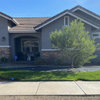
Original Author6 years agolast modified: 6 years agoSo we went ahead and "reduced" the size of the hedge:
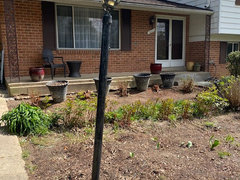
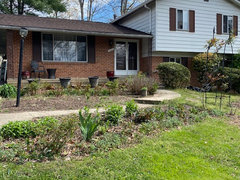
So, there's the house in all its utilitarian glory. We immediately had the urge to cover it back up, but have thus far decided not to panic, add some hanging baskets and a bench, and let the garden grow in.The shrubs remaining between the stumps are the azaleas that were struggling to survive and bloom among the yews. They're very excited to grow now, and I want to relocate them and put hydrangeas across the front instead. But now this bed is twice as deep as it was. I'm wondering whether I should think more in clumps than rows.
How would you arrange things?- PRO6 years ago
I'm thinking that it now shows promise and hope and then I read your line about deciding not to panic! :-) Goodness. everyone can have wildly diverging thoughts ... reminding me of our crazy political climate. Never seen anything like what is happening this year.
It would be good to get the azaleas out of there as they were smothered. If you are letting Yews grow back, keep them no more than 2' height ... at least for a while and see if it doesn't feel better. Let them grow together, though ... not as balls.
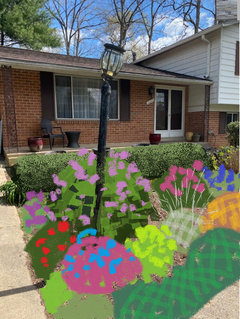
I would not put any hedge in front of another hedge. Instaead of thinking hydrangeaS, think hydrangeA. Many of them can occupy a 6' circle. Then, fill the rest of the space there with your cottage garden plants. Don't have anything very tall near the walk. Use tall things in front of backdrops, which is part of the house (not the entrance part) and the far side lot line. If you keep the hedge at the street, it will provide some backdrop, too. If you allow shrubs more room, I think this space will be eaten up without too many. You can come back any time and fill in any bares spots with perennials, groundcover & annual.
 lovesblooms thanked Yardvaark
lovesblooms
Original Author6 years agoGlad you see promise! It doesn't look horrible, and we're glad the hedge is gone, but we do miss the privacy it offered.
Your sketch makes the facade a lot easier to look at, so that's something to keep in mind about how things will look eventually, thank you.
I don't know if the yews will come back as a hedge any time soon, honestly. There were only two, separated by azaleas and quite a few feet of space. They'd already grown together with the azaleas over 10 years ago. Now they're just stumps, as flat to ground as I could get them. I'm hoping to try and get them out of there altogether. The azaleas would be a better-behaved hedge replacement, I think.

Yardvaark