Software
Houzz Logo Print
mtnrdredux_gw

Ventilators, not so much ...

6 years ago

This was in the news today (excerpted from BN). Bolding mine.


The study, published in the Journal of the American Medical Association, is one of the largest reviews published to date of Covid-19 patients hospitalized in the U.S. The researchers examined outcomes for coronavirus patients who were admitted between March 1 and April 4 to 12 hospitals in New York City and Long Island that are part of the Northwell Health system.

Overall, the researchers reported that 553 patients died, or 21%. But among the 12% of very sick patients that needed ventilators to breathe, the death rate rose to 88%. The rate was particularly awful for patients over 65 who were placed on a machine, with just 3% of those patients surviving, according to the results. Men had a higher mortality rate than women.


Comments (31)

  • 6 years ago

    It's a small study, but it was published in JAMA.


    The 21% fatality rate is high, but it just means the system was so overwhelmed that only the very ill got admitted.


    Interesting that even among those in hospital, only 12% required (or at least got) a ventilator.


    But these much-vaunted ventilators? 88% of the time patient died anyway. Sounds to me like ventilators are not effective treatment. And for the over 65 population, 97% chance of death once you are at the ventilator stage.


    Were they deploying ventilators too late since they were short?


    IDK

  • 6 years ago

    I'd read these statistics regarding ventilator survival before. It's very frightening. I think it's akin to CPR-it's the last thing you want to have to do, because the survival rate is so low. I've also read that men are affected more than women by this virus. Again, wonder if it's got anything to do with coronary disease? Men do tend to have greater rates of heart disease than women.


    It's just flat our frightening how vicious this virus is. Word coming out that it causes blood clots in a number of patients. Long term health complications that may occur. A nightmare that I just want to wake up from already.

  • 6 years ago

    Yes, I saw that about blood clots too. I know the public (myself included) oversimplifies, but I had thought we knew what to do, but just didn't have enough eqp.


    I now think they really don't know how to treat COVID and the virus effects a lot more than the lungs. Sigh.

  • 6 years ago

    It's interesting how some people become gravely ill, while others are completely asymptomatic. Why that is is the question that I want answered.

  • 6 years ago
    last modified: 6 years ago

    The summary I read today mentioned that most of the people in NYC who were hospitalized due to coronavirus had one or more underlying health issues. It also said that most of those that died on the ventilators had diabetes. Not sure if it was this same study. Just checked, it was the same study.

  • 6 years ago

    Regarding the differential outcomes for men and women, women have different immune function than men. It shows up in women being more likely to suffer from auto-immune disorders. Immune differences also come into play in pregnancy, as women's immune systems need to tolerate a literal foreign body inside them during gestation. So while differences in underlying conditions is one possible explanation, there are a lot of other factors that could be at play.

  • 6 years ago

    I've seen some articles that talk about how they have learned that not everyone actually needs a ventilator, that supplemental oxygen and turning people on their sides or abdomen, like adult 'tummy time" has actually helped and reduced the need for ventilators.


    The riskiest patients are those with heart disease, diabetes, hypertension, and obesity. All the more reason to be active and lose the extra weight.

  • 6 years ago

    Yes ventilators are not without side effects even without covid.

    Some docs are thinking the breathing issue is not so much the inability to take in air, but the ability for the lungs to oxygenate the blood. The pressure from the ventilator may be too much and may actually be damaging the lungs themselves.

  • 6 years ago

    Elunia - thanks for sharing that, depressing as it is.

  • 6 years ago

    FTA: And the truth, no matter how painful, eases fear.


  • 6 years ago

    i too recall reading an article a few weeks ago about ventilators not really being helpful in many, or maybe even most, situations. I discussed with DD who agreed. The more I read about the structure of the virus, it seemed to be a virus that attached to the red blood cells, thus prohibiting (or inhibiting might be the better word) the transference of oxygen within the body via the bloodstream. I decided I only wanted a ventilator if my situation was dire. We have living wills so our families know what to do.

    Thanks, Mtn, and others for posting the info.

  • 6 years ago
    last modified: 6 years ago

    I am in contact with a lot of my friends in the medical field, and they have been telling me this for some time now. It's all so sad. There is still so much to learn. Wish we had all the answers.

  • 6 years ago

    That's a nice story, HHireno.

  • 6 years ago

    Wow, this is really good information. DH, who has COPD, regularly sees a pulmonologist. He checked in with him immediately when this all started, and the doctor recommended he purchase an oxygen concentrator to have on hand. I've been on him and on him about doing this, but of course he hasn't yet. This morning, Gayle King did a segment on how great these are and how helpful they could be -so now DH probably won't be able to find one. Anyway, I thought I'd mention it here as something that might be helpful.

  • 6 years ago

    HH that post deserves a thread of its own. So uplifting ❤️.

  • 6 years ago

    If I'm remembering correctly, the husband of a British couple who tested positive fairly early on (cruising at the time), was knowledgeable about ventilators and said he was working hard to stay off of one (he had symptoms, she didn't); that he did breathing exercises and walked, it was difficult & painful but he wanted to avoid a ventilator at all costs...that once you get on them, it can be difficult to get off and/or there can be residual problems. He recovered. (Sorry for the poorly written comment....in a hurry. ;) )

  • 6 years ago

    It sounds a lot like non-Covid related Adult Respiratory Distress Syndrome (ARDS), which seems very much like what I am hearing about the respiratory failure from Covid,. When I first became a nurse its mortality rate was 75-90%, but with more sophisticated ventilators and treatments, that has come down to 35-50%. I see the lung complication from Covid often reported as pneumonia, but the progression, CT scans, and autopsy findings seem more like ARDS to me. ARDS can be a complication of many things - pneumonia, flu, sepsis from any cause, even traumatic injuries. It also often leaves survivors with permanently damaged lungs. ARDS interferes with both moving air in & out, and oxygen transport across the lung into the capillaries.

    Turning pts onto their stomachs ("pronation") is not a new technique; it is frequently used to manage ARDS along with extreme ventilator support. Another way in which they are similar. There are other positioning and movement techniques that could be helping also but not being written about.


    I am puzzled by the thought that using the ventilator is making things worse; since typically patients would be intubated and eventually treated with the type of ventilator settings that can in themselves cause injury (also not a new finding) only when absolutely necessary. Lower levels of pressure, "permissive" lower levels of blood oxygen, different modes of delivering breaths are all techniques to minimize secondary lung injury when between that rock and hard place.

    Perhaps there are physicians who are intubating before it is really needed - I think that I recall a trend early on toward thinking that early aggressive mechanical ventilation was the way to go, especially with the lack of PPE that would be even more needed in caring for patients on certain kinds of non-invasive breathing support.

    Or perhaps with this virus, the lungs tissue is made more prone to being damaged beyond that which is typical of ARDS.


  • 6 years ago

    In August, my 76 year old mom had emergency surgery for a suspected intestinal blockage (which it turned out she didn’t have) and was put on a vent after the surgery. The respiratory therapists began almost immediately trying to get her off it. Two days later, they successfully removed it. Mom was very foggy mentally after. About three days later, they were performing a routine, basic procedure (something to do with her central line, can’t remember if they were putting it in or taking it out) and all of a sudden she crashed. Earlier in the week, the woman from palliative care (I always referred to her as the Grim Reaper when talking to my brother, even though she was perfectly nice, lol) had been by several times trying to figure out what my mom would want regarding her life saving measures. Mom had a living will, plus I KNEW how she was regarding stuff like that, but dad just couldn’t sign the DNR at that time. The fear and shock was too much.


    When mom crashed, my dad was there, but I had gone home to walk the dogs. The room was filled with about 10 people and they re-intubated her. After the second time, even though they once again weaned her off, she was never the same. She suffered a type of dementia from the anesthesia, she was too weak to participate in the necessary therapy at the rehab center she was discharged to...and basically after 6 weeks she was re-admitted to the hospital suffering from acute infections that her body just couldn’t fight. Her organs began shutting down and she passed away in the hospital (in a Hospice room bc dad finally signed the DNR after she was readmitted.)

    Even though it turned out the reason she had surgery was bc her scan looked off due to an undiagnosed case of adenosarcoma...that cancer is highly treatable and she would have had a good prognosis with chemotherapy. She basically passed away bc of the trauma of the surgery and more importantly...being intubated twice. It is a HARSH intervention. My heart hurts thinking of all the pain she went through for basically 5 weeks following the 2nd intubation. Discussing what interventions you would want with your family is very important.

  • 6 years ago
    last modified: 6 years ago

    This may sound simplistic but it's important to remember too that to date there is no effective medical treatment for Covid-19. Usually a patient on a ventilator is also receiving treatment for an underlying cause......and that cause is known - a brain injury, drug overdose, stroke, surgery etc.


  • 6 years ago
    last modified: 6 years ago

    I have read that only the most critically ill patients are put on ventilators as a last resort to try to save them. Hence, the high fatality rate. It has also been reported that Covid causes heart damage and organ failure in some patients. Very frightening indeed.


    nini-I am so very sorry about your mom. That sounds like a nightmare. I also heard recently about ventilators causing some sort of dementia in some patients.

  • 6 years ago

    I saw my hematologist last month and he mentioned that in studies on community spread pneumonia people on warfarin, or DOAC blood thinners, have much lower over all mortality rates because sepsis causes clotting.

    Ihave a clotting disease, Antiphospholipid syndrome that if I catch a virus I have a very high chance of clotting within my microcirculation. When I had shingles last, I had two major strokes within a week and in the ICU my IV lines kept clotting. I also had signs of kidney ischemia.

    Catastrophic APS is very rare but it seems to be very much like what is happening in severeCOVID. The treatments are also similar. HQC ( now proven non effective in latter disease) is frequently used preventively in APS, heparin is now recommended for most ICU COVID patients, plasma exchange and complement suppressant drugs. Many reports see beta2glycoprotien antibodies, high D-dimer levels( indictitive of a DVT) and high ferritin all present in Catastropic APS. The virus seems to be activating a servere attack against the bodies glycoproteins and starting a clotting cascade in some patients. TPA and blood thinners are the next set of treatment trials.

  • 6 years ago

    Another op-ed from the NYT made me think of this discussion:

    https://www.nytimes.com/2020/04/20/opinion/coronavirus-testing-pneumonia.html

    "...By the time patients have noticeable trouble breathing and present to the hospital with dangerously low oxygen levels, many will ultimately require a ventilator.

    Silent hypoxia progressing rapidly to respiratory failure explains cases of Covid-19 patients dying suddenly after not feeling short of breath. (It appears that most Covid-19 patients experience relatively mild symptoms and get over the illness in a week or two without treatment.)

    A major reason this pandemic is straining our health system is the alarming severity of lung injury patients have when they arrive in emergency rooms. Covid-19 overwhelmingly kills through the lungs. And because so many patients are not going to the hospital until their pneumonia is already well advanced, many wind up on ventilators, causing shortages of the machines. And once on ventilators, many die.

    Avoiding the use of a ventilator is a huge win for both patient and the health care system. The resources needed for patients on ventilators are staggering. Vented patients require multiple sedatives so that they don’t buck the vent or accidentally remove their breathing tubes; they need intravenous and arterial lines, IV medicines and IV pumps. In addition to a tube in the trachea, they have tubes in their stomach and bladder. Teams of people are required to move each patient, turning them on their stomach and then their back, twice a day to improve lung function...."

  • 6 years ago

    Stay well, Roarah. : )


    I do understand that only the seriously ill go on a ventilator, and I understand it's a small study and impacted by many factors.


    Even so, I had the impression that ventilators were the holy grail, and our problem was not having them. So an 88% mortality rate, for people lucky enough to find a ventilator, is not what I expected.


    To me it reframes the story thusly --- we have a very contagious disease that threatens to overwhelm the healthcare system capacity and for which we have no highly effective treatment at this time.


    That's a little different.


  • 6 years ago

    Yes, anyone familiar with the typical ventilator situation knows that the ventilator is used only in the hope that the patients own immune system will be able to fend off the virus, which if it hasn't by that point, is very unlikely to after. Not impossible, but not likely. That's how most people die from "just the flu." Their immune system can't win the battle. If that's all we have against covid-19, then yes, not very likely that we are going to be of much help to people. Which is a FACT known by epidemiologists and virologists, which is WHY they are urging social distancing, protective gear, and testing followed up by quarantine and contact tracing. Once you get covid-19, it is a crap shoot with many likely to die, which makes the best available option currently, to try like heck to not get it!!

  • 6 years ago

    There’s always more to the studies as well as more studies.

    “


    IF YOUR TIME IS SHORT

    • A recent study was widely reported to have found an 88% death rate for coronavirus patients who were put on a ventilator, leaving the impression that patients should do everything they can to stay off ventilators. But medical experts say that’s a misinterpretation.

    • The 88% death rate was among patients who either died or recovered. It did not account for the roughly three-quarters of patients involved in the study who were still on a ventilator at the end of the study, leaving in doubt what the eventual mortality rate will be.

    • A subsequent study finds much lower mortality rates for ventilator patients. ”


    “ A new study, which hasn’t gone through peer review yet, has been posted by researchers at Emory University. It looked at 217 critically ill coronavirus patients at facilities in Georgia, which hasn’t been hit as hard as New York City. It found a far lower mortality rate for patients on ventilators: 29.7%.”


    Politifact

  • 6 years ago

    Thanks, maddielee. That is the report I heard recently referred to. Also, underscored that people with any short ESS of breath or Covid19 symptoms not wait before getting diagnosed, treated. However, I believe many metro hospitals are so overwhelmed that they are sending very sick people home. Perhaps it is better to hydrate and give O2 earlier on.


    Rae — yes, I’ve read that it is ARDS.


    nini — I am so sorry about your mother. Heartbreaking.


    roarah — wishing the best for you and glad that you have a good doctor. Stay safe — everybody.


  • 6 years ago
    last modified: 6 years ago

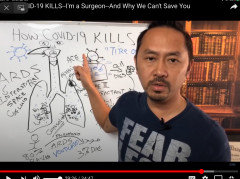
    How Covid-19 Kills

    This (bariatric) surgeon seems a tad self promoting, but ignore that and watch his very good video.

    There is another one or two, but I think this doctor does a very good job at explaining. Note: he uses a few salty words.

    https://www.youtube.com/watch?v=4J0d59dd-qM


    He explains ARDS


  • 6 years ago

    A ventilator saved my sister's life. It was due to a car accident though. A young man ran into the back of her car while she was turning into the oncoming traffic of a semi-truck which drove her over her legs.

    Not that there wasn't a cost. She had infections for years in her chest and lost some of her tissue across her chest due to death of her tissue. She also has polyps from the invasiveness of the ventilator and at times loses her voice for weeks on end. She has migraines and cluster headaches which are probably more likely attributable to the actual accident.

    She tells me pain wise she's at 4 out of 10 most of the time and the pain is hard to manage without a very addictive drug..

    She has regained 80% of her former health. I wish they found a way to alleviate all that.

    Still she is here. We are so very lucky to have her with us and she's glad to be here.

    I am relieved that the above evidence appears to show that intubation works often for those worst cases. Thank you for that Maddielee.

  • 6 years ago

    ((((((Nini)))))

    I am also so sorry about your mother.