Software
Houzz Logo Print
kingcobbtx7b

David austin fertilizer experience

6 years ago
last modified: 6 years ago

My 50 plus roses have struggled the past 3 years living in the rolling plains. My first 10 years as a rose gardener they lived on the Gulf coast and did great being fertilized with Mills magic, HRS fertilizer, and John's recipe. They did well the 1st 2 years here down in a river bottom, but after we moved to the top of this hill we now live on they have really struggled.When my reliable fertilizers weren't working I tried others. Rose tone, local ferts from local nurseries, etc. My roses are largely David Austin's, with a few old roses mixed in and some Earthkind roses. My Belindas dreams and Olivia rose Austin grew well with a nice blooms but not the explosion I have been used to.So on the advice of a rosarian I know, I tried DAs ferts this spring.The results have been astounding. My graham Thomas's that have set there and not grown or put up basal breaks for 3 years have tripled in size. My gertrude Jekyll which had been a 1 or 2 bloom plant currently has 18 blooms and has put on 4 new canes, my munstead wood has doubled its blooms. The spring flush has been astounding.When we first moved here the soil sample with the extension service said it was low in nitrogen, high in phosphorus, and low in organic matter. After 3 years I am still adding N, still high in P, but good to go in organic matter.Weather between this year and last are comparably mild winters with wet springs.We will see if this continues but so far I am thrilled. I have always felt that there was more to ferts than simple NPK a lot of people rely on. To me there is a bit of voodoo as to what ferts roses respond to in certain conditions but who knows.Anyway, thought I would share.

Comments (21)

  • 6 years ago

    That Rotarian know a thing or 2 about roses.

    I believe gardengal posts here from time to time.

  • 6 years ago

    Sorry meant rotarian. I am familiar with garden gal but this wouldn't be her. Can't get photos to upload.

  • 6 years ago

    We both may be victims of “ auto- correct”.

    I swear I typed “rotarian knows”.

    To be clear: I await gardengal’s views on the voodoo.


  • 6 years ago

    I never know what makes a difference in my roses' bloom quality and quantity because I throw everything at them, starting in late November through April. There is a break in "throwing" because of weather in December and January, but basically high quality compost ($) that contains some chicken manure comes first; then comes granular Lilly Miller fertilizer for acid loving plants (organic and stinks); then Plant Tone (stinks, too). Which makes the difference? I haven't the faintest, but my system works. I also use a lot of manure on the flower beds in general. That said, I'm all for trying the David Austin fertilizer. Of course, it's expensive because part of the cost is paying for the "name". My regimen is costly, too. I spend more for amendments and fertilizer than anything else. I'm thrilled for your success, kingcobb, and I'm always for trying new products. Diane

  • 6 years ago

    I have composted in the past but now I just let my mulch break down to compost each year.

  • 6 years ago

    I use the compost as mulch--I wish I had room for a big compost pile. I buy the stuff, and I swear by its quality--Nu Life compost, only available regionally, unfortunately. Diane

  • 5 years ago

    I know this is an old post but I’m just starting out with David Austin’s this spring. I’ve watched several videos and one of Paul’s videos says to only use organic gentle matter as fertilizer for the first year. Because it will make the rose grow too strongly too quickly. But then I see on David Austin’s site they recommend their fertilizer for new roses. I just want to give my rose the best fighting chance they can get. What would you guys suggest when it comes to this fertilizer and baby roses? Thank you!
    Sarena

  • 5 years ago

    David Austin's fertilizer isn't a chemical fert which is what Paul is advocating against. It isn't organic, but it isn't a heavy chemical fert either.

  • 5 years ago

    Oh thank you I just assumed it was chemical since it didn’t advertise as organic. Would you suggest using it in the first year?

  • 5 years ago

    Yeah it's fine. I think it has a rate for newly planted roses on the bag.

  • 5 years ago
    last modified: 5 years ago

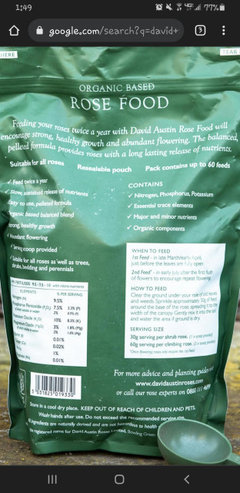
    What does "It isn't organic, but it isn't a heavy chemical fert either." mean? What are the ingredients? Chemical is not the opposite of organic, synthetic is. No matter what fert you use, the purpose is to add certain chemical elements to the plant. If it is not marketed as organic, it's very likely synthetic chemical feed.

  • 5 years ago

    It is organic based slow release fertilizer. It isn't technically organic but it isn't a heavy quick release nitrogen fert that will burn plants.


    There are a ton or fer that can't be called organic that aren't a heavy synthetic chemical fert either.


    Ingredients, don't know, but from the smell it has a lot of alfalfa and fish emulsion in it.

  • 5 years ago

    Could someone take a pic of the nutritional analysis of David Austin fertilizer on the package? I’d like to know the composition and sources used for it. Thanks

  • 5 years ago

    This isn't mine, just from the internet. It has percentages and claims "organic components" but doesn't list what any of them are, or how much of it is actually derived from these unlisted organic sources.


  • 5 years ago

    Austin's fertilizer has got NPK just like the so called "chemical" fertilizers. Plants take up the "chemicals" they need and anything extra just sits there. Furthermore, "organic" fertilizers must be broken down into NPK, too. It just takes more time for them to be broken down and absorbed as NPK by the plant. Diane

  • 5 years ago

    Magpie, your explanation farther up is spot on. Diane

  • 5 years ago

    Again for the purpose of the question Paul is saying to use organi ferns because they are slow release and won't burn the roots. David austin is slow release just like mills magic. Neither of which is organic. But both are slow release and won't burn roots of young roses.

  • 5 years ago

    Okay thank you this was really helpful. I’ve learned all about burning poor roots from all my house plants. I’d hate to do it to my roses. I think I’ll use it then! I’ve heard lots of good things. And I want my baby alnwick and spirit of freedoms to thrive!

  • 5 years ago
    last modified: 5 years ago

    This year summer 2021, I contacted Austin website and the lady wrote to me that their fertilizer is rotted chicken manure.

  • 5 years ago

    Oh well that sounds better to me then fish emulsion. I wish I could use the natural fish emulsion but we have issues with raccoons and coyotes and I don’t want to attract them!

Sponsored
Haus Studio
Average rating: 4.8 out of 5 stars28 Reviews
Franklin County's Preferred Custom Cabinetry & Design Studio