Software
Houzz Logo Print
samantha_schneider33

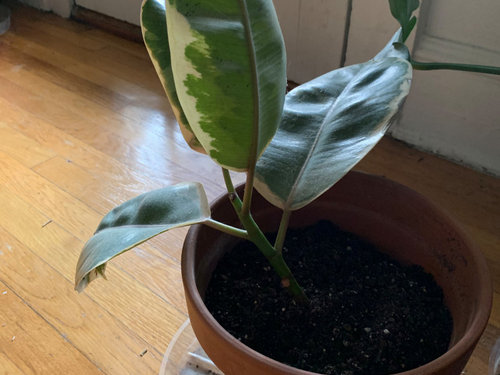
My Ficus has never grown!

Any ideas on what to do to get this to grow? I was using regular potting soil mixed with a sandy cactus soil & likely put some rocks on the bottom (but don’t remember). I water 1x a week as necessary during the warmer months. I used to water every 4th or 5th watering with some dissolved Miracle gro food.


@tapla (mid-Michigan, USDA z5b-6a) here’s a pic. I just added some recycled potting mix to the pot that has worm casings & new nutrient rich soil. I didn’t want to cover the bottom node. Would cutting above that node help? maybe it needs a smaller pot?? I thought it’d grow fast so I put it in a bigger one to start out. I’m so confused! 🤷‍♀️🤷‍♀️ Thanks for any tips!

Comments (2)

  • 6 years ago

    Where do you live? Has the apex been pinched out? By that, I mean, is the growing tip of the trunk been removed? It looks like there is a wound there.

    Whenever trees make more energy/food (during photosynthesis) than they need to keep their systems orderly they create new cells in which the food/energy can be stored. These new cells are visually conspicuous in the lengthening and thickening of branches (additive growth) and in the number of leaves and branches (multiplicative growth). If your plant is not growing, it is making barely enough energy to keep itself afloat - not a good position for a tree to be in. What's limiting growth are cultural conditions the tree doesn't like. The main culprits are usually A) a combination of a poor soil and a heavy hand on the watering can, B) lack of sufficient light, C) poor nutrition.

    I would move the plant outdoors in open or dappled shade as soon as night temps are reliably above 50-55*, flush the soil and fertilize (Foliage-Pro 9-3-6 is excellent) the plant when it next needs watering, and repot at the first appropriate opportunity. "Appropriate" will depend in large part on where you live. I would also use a "tell" to "tell" you when it's time to water. Some things I wrote and saved that should help will follow below. Also, I wrote a thread about Good Growing Practices that will help you avoid all the pitfalls every container gardener confronts at one time or another on the journey toward green thumb status.

    Flushing Soils

    When you water, you should be able to flush planting's soil to eliminate the potentiality of salts from fertilizers and tapwater accumulating in the soil, thereby limiting the plant's ability to take up water and the nutrients dissolved in the water. If you think you shouldn't flush the soil during your regular water applications for fear the soil will remain saturated for a lengthy period, limiting root function or worse, you should consider a different soil or take steps to reduce the amount of excess water your soil can hold. By whatever means necessary, getting to the point you can water correctly is going to make a very big difference in the opportunity to realize as much of it's genetic potential as possible. Once you can water correctly, you no longer have to do battle with a water-retentive medium over control of your plant's vitality. There are several methods of limiting how much water your planting can hold, all but 1 or 2 are completely passive, requiring no effort on your part other than set-up, which is monkey easy. I can help if you have interest in that, I'm continually improving my proficiency at monkey easy tasks.

    To flush the soil of a planting: Water with room temperature water until the soil is completely saturated. Allow the planting to rest for 15 minutes to an hour to allow as much of the salt accumulation as possible to go into solution, then pour a volume of room temp water equal to at least 10X the volume of the pot the plant is in slowly through the soil. This will remove most of any accumulation of offending salts and resolve any skewing of nutrient ratios.

    It's a good idea, no matter what time of year, to fertilize most plants immediately after flushing the soil. Try to be sure you're using a fertilizer that has a ratio as close as possible to the ratio at which the plant uses nutrients. The NPK % listed on fertilizer packaging is not its ratio. 7-7-7 and 14-14-14 are 1:1:1 ratios. 9-3-6, 12-4-8, and 24-8-16, are all 3:1:3 ratios. Container growers should try very hard to avoid use of fertilizers advertised as 'bloom-boosters', or any number with a middle number (Phosphorous) higher than either the first or third numbers (Nitrogen or Potassium). These fertilizers can badly skew nutrient ratios with even the first application). On average, plants use about 6x as much N as P, so there is NO potential for a positive outcome when supplying many times as much P as the plant requires. I, and a large number of other members, use Dyna-Gro's Foliage Pro 9-3-6. It's designed to closely mimic the uptake ratio of the average plant, and has many other attributes not commonly found in other fertilizers. It also has ALL of the nutrients essential to normal growth. Summarized, it makes fertilizing as easy as it can be, and from 1 container.

    Using a 'tell'

    Over-watering saps vitality and is one of the most common plant assassins, so learning to avoid it is worth the small effort. Plants make and store their own energy source – photosynthate - (sugar/glucose). Functioning roots need energy to drive their metabolic processes, and in order to get it, they use oxygen to burn (oxidize) their food. From this, we can see that terrestrial plants need air (oxygen) in the soil to drive root function. Many off-the-shelf soils hold too much water and not enough air to support good root health, which is a prerequisite to a healthy plant. Watering in small sips leads to a build-up of dissolved solids (salts) in the soil, which limits a plant's ability to absorb water – so watering in sips simply moves us to the other horn of a dilemma. It creates another problem that requires resolution. Better, would be to simply adopt a soil that drains well enough to allow watering to beyond the saturation point, so we're flushing the soil of accumulating dissolved solids whenever we water; this, w/o the plant being forced to pay a tax in the form of reduced vitality, due to prolong periods of soil saturation. Sometimes, though, that's not a course we can immediately steer, which makes controlling how often we water a very important factor.

    In many cases, we can judge whether or not a planting needs watering by hefting the pot. This is especially true if the pot is made from light material, like plastic, but doesn't work (as) well when the pot is made from heavier material, like clay, or when the size/weight of the pot precludes grabbing it with one hand to judge its weight and gauge the need for water.

    Fingers stuck an inch or two into the soil work ok for shallow pots, but not for deep pots. Deep pots might have 3 or more inches of soil that feels totally dry, while the lower several inches of the soil is 100% saturated. Obviously, the lack of oxygen in the root zone situation can wreak havoc with root health and cause the loss of a very notable measure of your plant's potential. Inexpensive watering meters don't even measure moisture levels, they measure electrical conductivity. Clean the tip and insert it into a cup of distilled water and witness the fact it reads 'DRY'.

    One of the most reliable methods of checking a planting's need for water is using a 'tell'. You can use a bamboo skewer in a pinch, but a wooden dowel rod of about 5/16” (75-85mm) would work better. They usually come 48” (120cm) long and can usually be cut in half and serve as a pair. Sharpen all 4 ends in a pencil sharpener and slightly blunt the tip so it's about the diameter of the head on a straight pin. Push the wooden tell deep into the soil. Don't worry, it won't harm the root system. If the plant is quite root-bound, you might need to try several places until you find one where you can push it all the way to the pot's bottom. Leave it a few seconds, then withdraw it and inspect the tip for moisture. For most plantings, withhold water until the tell comes out dry or nearly so. If you see signs of wilting, adjust the interval between waterings so drought stress isn't a recurring issue.

    Al