

What’s wrong with my whale fin Sansevieria?
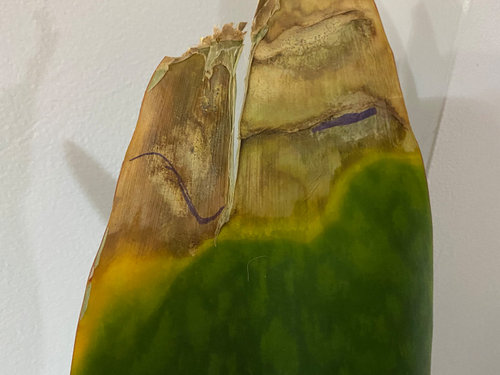
^^^This is the tallest leaf on the whaLe fin
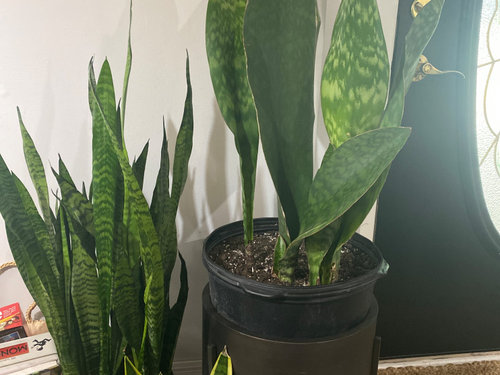
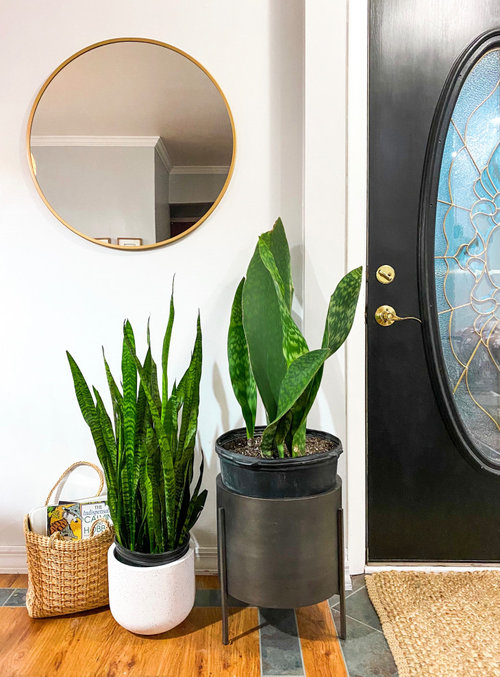
^^ here you can see the whole whale fin plant when you click on it you will see the affected area
So I finally got my dream plant. This guy is amazing. But I’m nervous about the big leaf. 3 days ago I drew the purple line on it to track the brown drying leaf. And today it looked like this. Any ideas on what’s up? And what I should do?
this photo is from when I brought the plant home in March or so. the leaf that I am concerned about came jagged but was still green >>>>
Comments (13)
 6 years ago
Sorry, I'm unclear what you're showing us. Is the damaged leaf in the first pic part of either of the plants in the 2nd pic?
Alyse Cole thanked User- 6 years ago
Like Karen, I am not sure what you are showing. Your Sans masoniana, which is what I think you have on the right, appears to me to be in good shape. Does your first photo show the tippy-top of the leaf that is mostly solid green? If so -- I wouldn't worry a whole lot, based on the appearance of the other leaves. I have 3 masoniana plants myself, and I do get a crusty leaf here and there. Mine are slow growers, but many Sans are. If that dried leaf were mine, I might trim it and treat the plant with a little TLC for a week or so....and then just go back to realizing that Sansevierias are STURDY plants that SURVIVE and -- treat it normally: decent light but not hot sun, a non-peaty mix with good drainage, and water when it's thirsty but only then. PRETTY plants.
Alyse Cole thanked robinswfl Related Professionals
Brainerd Landscape Architects & Landscape Designers · Morgan City Landscape Contractors · Fayetteville Landscape Contractors · Burlington Landscape Contractors · Sheboygan Landscape Contractors · Lebanon Architects & Building Designers · Knoxville Landscape Architects & Landscape Designers · Owensboro Landscape Contractors · Hannibal Landscape Contractors · Watertown Landscape Contractors · Rutland Landscape Contractors · Lagrange Landscape Contractors · Mankato Interior Designers & Decorators · Mansfield Interior Designers & Decorators · Yuba City Interior Designers & DecoratorsAlyse Cole
Original Author6 years agoSo the picture of the whole plant is from when I got it. just to show what it looked like 3 months ago when I got it. And the close up is of the tallest leaf as of yesterday.
 6 years ago
FYI, that wouldn't make me want to change anything I said.
Al
Alyse Cole
Original Author6 years agoI updated my original post. Added new pics Sorry, I was not very clear the first time, which is not helpful when asking for help :)
Alyse Cole
Original Author6 years agoSo Al, you mentioned that sips of water are not the ideal way to water. I like that verbage. I usually water most of my plants ether by running water through them untill fully saturated Or place them in a bowl of water and let them drink from below. But i Have always been nervous to do this with all of my sans. so I do just give them sips of water every other week or so. How do you transition from sips to full saturation while knowing the soil will not stay that way and dry out in the appropriate time?
also I’m very confident that the damage is mechanica. Do I need to remove the leaf? Or will it stop? 6 years ago
There is some really, really good information above, Alyse.
Those 'tells' can really help you to learn your plant's needs and your medium. I have used skewers and chopsticks, but the dowel rods really do better. I use the tells especially in Winter for my Sansevieria, and always for plants that seem more sensitive to water and chill or those who have had health problems.
- 6 years ago
So Al, you mentioned that sips of water are not the ideal way to water. As noted in the piece about watering with a 'tell', watering in sips ensures there is no way for the dissolved solids in tapwater and fertilizer solutions to be removed from the soil. Eventually, the concentration of dissolved solids can get so high, water is actually pulled OUT of cells instead of entering cells during the essential osmotic process. This results in the tearing of plasma from cell walls, which is why the technical name for the issue is 'plasmolysis'. We commonly know it as fertilizer burn. I usually water most of my plants ether by running water through them untill fully saturated, or place them in a bowl of water and let them drink from below. The former is a better choice than the later. It's far more effective at removing accumulating dissolved solids from the soil. But i Have always been nervous to do this with all of my sans. so I do just give them sips of water every other week or so. How do you transition from sips to full saturation while knowing the soil will not stay that way and dry out in the appropriate time? The best way is to use a medium that drains thoroughly without any extra effort or special considerations. That's what I do. There are four other ways which immediately come to mind. After flushing the soil thoroughly, you can:
1) Hold small containers over the sink and move the container downward before reversing direction sharply to upward. You'll immediately see Newton's First Law of Motion in effect as water in the pot continues moving downward after the reversal in direction. You can remove ALL perched/excess water from manageable pots using this bit of science.
2) Tipping the pot and allow it to drain thoroughly. This is most effective when there are drain holes through the bottom of the pot AT the sidewall and the drain hole is at it's lowest point (after tipping the pot. Compare image B to A below.
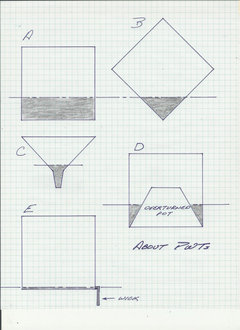
3) Use a wick, which is best positioned through a drain hole in the pot's bottom at the sidewall. Let the wick dangle over the edge of a sink with the pot tipped as in B, until the pot completely stops draining before returning it to a collection saucer. For large pots, you might need to lift them above the collection saucer so water can drain. The wick should never be allowed to dangle in the effluent that exits the drain hole.
4) Efficient utilization of ballast, set in place when the planting is established, can eliminate 95% or more of a planting's ability to hold perched/excess water. Once it's become a part of the planting, it works passively to displace almost all soil capable of holding perched water, which is enemy #1 when it comes to root health.
I’m very confident that the damage is mechanical. Me too. Do I need to remove the leaf? Or will it stop? It's not necessary to remove the leaf. Plants create walls or barriers to decay and injuries to protect viable parts of the organism. Dr. Alex Shigo wrote extensively about trees' ability to protect themselves this way, and came up with the acronym C.O.D.I.T., for compartmentalization of decay in trees, though the process is not limited to trees alone. So, if you remove the leaf, base your decision on whether or not you think the appearance of that particular leaf is tolerable. The plant would prefer that you keep it, and can chemically recognize when it's time to shed the leaf if/when it changes from an asset to a liability.
Al
- 6 years ago
I agree with what others have said, here, Alyse - your plants are lovely, you've got some excellent advice, and, yes, masoniana (whale fin) is a survivor. In my experience, that kind of browning of the leaves on masoniana results from a combination of mechanical damage and some sort of abrupt change in watering or temperature. Since your home is no doubt different than wherever the plant was growing before you got it, that would be my best guess. I don't know if it will continue. As long as it's dry and crispy, not mushy or soft, I think you can wait and see. After it's stopped, you could trim the brown parts off if they bother you, or cut off the leaf, but - again, as long was it's crispy and not mushy - I don't think you *need* to.
What kind of soil are you using? It looks like you have plastic pots inside of cache pots. Are the cache pots water-tight? Ideally, you'd find or make a potting medium and air-flow situation that would allow you to water thoroughly until water lines out the drainage hole and then dry out relatively quickly. How quickly depends on how often you like to water, how warm your growing environment is, whether the plants are in active growth...there are many good discussions about this on these forums but you jambe a great start here.
Amanda - 6 years ago
Alyse, I also use skewers and even dowels with my masioniana. Al pointed out -- no Sans enjoy wet feet, so water ONLY when they need to be watered. With a small plant, the kind of skinny wooden skewer you can buy in the grocery store will tell you what the soil is like at the bottom. But I buy a few packs of wooden dowels at Walmart (craft dept) for my large Sans in 12 or 14-inch pots. I poke 2 or 3 deep into the soil to see how wet the mix at the bottom is -- or hopefully, it's dry and time to water. I live in Florida. Even in the hot hot hot summer, I water my large Sans no more than once ever 12 or 14 days. But -- I water thoroughly. I see water draining from the bottom, and that's when I stop.
I have never lost a Sans to neglect, or "thirst." But I HAVE lost Sans (multiple) to over-watering. My large ones are in plastic pots with drainage holes at the bottom. The mix is 50% cactus soil (I buy Black Gold, that's what my local garden center sells -- but they are pretty much all alike) and 50% either pumice or 50% perlite (or sometimes 25% pumice, AND 25% perlite). But again, the key as pointed out by Al is -- don't over-water. MANY of us have killed succulents with "too much love."  4 years agolast modified: 4 years ago
It's because if it's I a cold spot moisture is sitting on the so it's dying so put it in a kitchen or high light bedroom then it will be a happy strong plant water one time every 2 weeks
- 4 years ago
amialoneinthinkingitwouldbebettertoshowalittleconsiderationrespectforthepoorpeoplewhoaretaskedwithtryingtoreadmessageswithnocapsorpunctuationcapsandpunctuationareessentialtounderstandingthewrittenwordisoftenhardenoughtointerpretwobeingfurtherhandicappedbywriterswhodontcarewhetherornotyouhavetotakethetimeandmaketheefforttofigureoutwhattheyaretryingtosayifanyoneconsidersnocapsorpunctuationtobetheirsignaturemoitaintworkingjustsayinImigktaswellskipthinkingaboutstartinganewparagraphtoojusttosaythepartsicouldreadorunderstandarentgoodadvice
Just making a point, feel free to ignore me. I just think it's disrespectful of the people we're writing FOR, to forego using caps and punctuation appropriately. Case in point, which of the 3 paragraphs stands out as most difficult to read?
Plants should be watered on an 'as needed' basis as opposed to relying on an entirely arbitrary schedule based on the calendar (".... water one time every 2 weeks"). For conventional container culture, only when using a medium that holds very little to no perched (excess) water between soil particles is it appropriate to water on a schedule. The problem then becomes, soils that hold the healthiest ratio of air:water can usually not tolerate 2-week watering intervals unless the plant being grown is one known to be drought tolerant.
Al


tapla (mid-Michigan, USDA z5b-6a)