Software
Houzz Logo Print
webuser_172983353

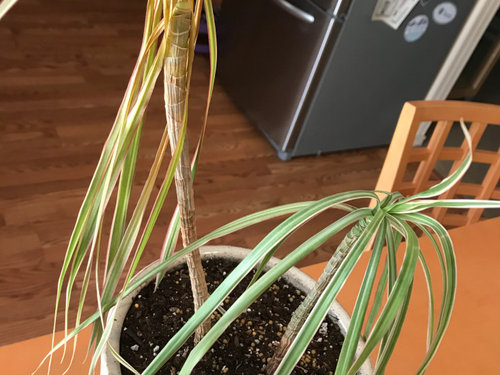
Why is one stalk dying?

6 years ago
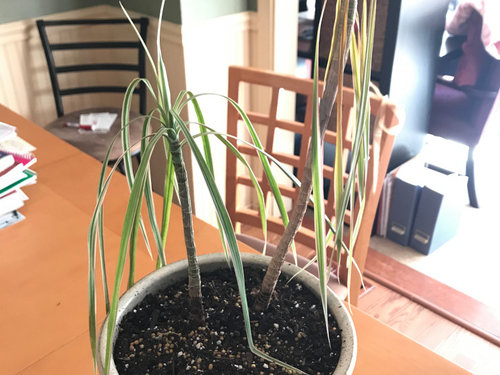


Hello I have a dracena marginata one stalk is doing fine but the other looks as if it is dying. How can I bring it back to life?


Also, they used to have pink around the edges of the leaves but that has gone away. How can I get that back?


thank you for any help

Comments (5)

  • 6 years ago

    I'm thinking the one you're thinking is doing fine will soon follow the one you can see is not doing fine. The longitudinal wrinkles at the base of the side with more green leaves is a decidedly bad sign of an advancing fungal infection.


    Al

  • 6 years ago

    Oh no, is there a way to stop it?

  • 6 years ago

    I'm really sorry, but it's irreversible. Plants don't 'heal' like animals do. Once the disease destroys the vascular structure in the area where the roots transition to the stem, the plant's fate is sealed.


    Maybe you can take something away from the hard lesson. Most plant issues growers bring to the forums is related to a compromised root system with the common thread being an overly water-retentive medium and a grower's heavy hand on the watering can. Plants want their soil to be moist or damp - about as moist/damp as a sponge that's just been wrung out thoroughly. When part of the soil is saturated, the saturation deprives roots of the air needed to function normally. It also sets the stage for fungal infections like you're witnessing in your dracaena.

    If you're growing in a pot taller than 5", avoid the advice to "water when the top inch or so of soil is dry" or the direction to "stick a finger into the soil up to the second knuckle. If it feels dry it's time to water." This advice virtually insures you'll be over-watering.

    This should be helpful.

    Also, using a 'tell' to 'tell' you when it's actually time to water would be VERY helpful. Read more below.


    Using a 'tell'

    Over-watering saps vitality and is one of the most common plant assassins, so learning to avoid it is worth the small effort. Plants make and store their own energy source – photosynthate - (sugar/glucose). Functioning roots need energy to drive their metabolic processes, and in order to get it, they use oxygen to burn (oxidize) their food. From this, we can see that terrestrial plants need plenty of air (oxygen) in the soil to drive root function. Many off-the-shelf soils hold too much water and not enough air to support the kind of root health most growers would like to see; and, a healthy root system is a prerequisite to a healthy plant.

    Watering in small sips leads to avoid over-watering leads to a residual build-up of dissolved solids (salts) in the soil from tapwater and fertilizer solutions, which limits a plant's ability to absorb water – so watering in sips simply moves us to the other horn of a dilemma. It creates another problem that requires resolution. Better, would be to simply adopt a soil that drains well enough to allow watering to beyond the saturation point, so we're flushing the soil of accumulating dissolved solids whenever we water; this, w/o the plant being forced to pay a tax in the form of reduced vitality, due to prolong periods of soil saturation. Sometimes, though, that's not a course we can immediately steer, which makes controlling how often we water a very important factor.

    In many cases, we can judge whether or not a planting needs watering by hefting the pot. This is especially true if the pot is made from light material, like plastic, but doesn't work (as) well when the pot is made from heavier material, like clay, or when the size/weight of the pot precludes grabbing it with one hand to judge its weight and gauge the need for water.

    Fingers stuck an inch or two into the soil work ok for shallow pots, but not for deep pots. Deep pots might have 3 or more inches of soil that feels totally dry, while the lower several inches of the soil is 100% saturated. Obviously, the lack of oxygen in the root zone situation can wreak havoc with root health and cause the loss of a very notable measure of your plant's potential. Inexpensive watering meters don't even measure moisture levels, they measure electrical conductivity. Clean the tip and insert it into a cup of distilled water and witness the fact it reads 'DRY'.

    One of the most reliable methods of checking a planting's need for water is using a 'tell'. You can use a bamboo skewer in a pinch, but a wooden dowel rod of about 5/16” (75-85mm) would work better. They usually come 48” (120cm) long and can usually be cut in half and serve as a pair. Sharpen all 4 ends in a pencil sharpener and slightly blunt the tip so it's about the diameter of the head on a straight pin. Push the wooden tell deep into the soil. Don't worry, it won't harm the root system. If the plant is quite root-bound, you might need to try several places until you find one where you can push it all the way to the pot's bottom. Leave it a few seconds, then withdraw it and inspect the tip for moisture. For most plantings, withhold water until the tell comes out dry or nearly so. If you see signs of wilting, adjust the interval between waterings so drought stress isn't a recurring issue.


    Al

  • 6 years ago

    :( Okay thank you for the help. I only watered it once a week and would let the top soil be dry but I guess the bottom soil was wet and I didnt know.

  • 6 years ago

    You might find some value in this "Overview of Good Growing Practices".


    Al

Sponsored
Hope Restoration & General Contracting
Average rating: 4.7 out of 5 stars35 Reviews
Columbus Design-Build, Kitchen & Bath Remodeling, Historic Renovations