Software
Houzz Logo Print
webuser_744518830

Need advice on Money Tree

6 years ago
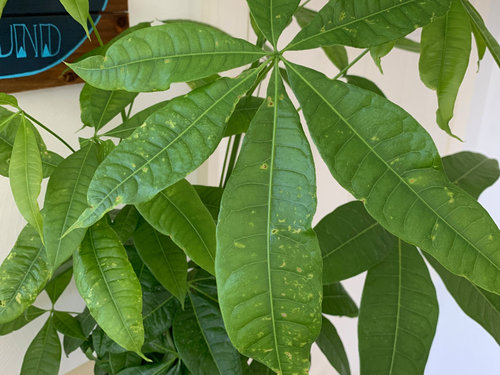

I’ve had this tree for about a month, and these spots are progressing and getting bigger then turn into a hole in the leaf. New growth is starting to die. I’ve tried tweaking the amount I water and direct sun, indirect sun. Nothing seems to make it perk up or improve. Does it look diseased? There are no pests on it. I’ve checked for that. TIA.

Comments (5)

  • 6 years ago

    These are riparian trees from central/ South America (Growing near rivers) They need lots of water (but only IF planted in a rich yet fast draining soil), lots of humidity & bright filtered light. What kind of soil is it planted in, what type of light & how often do you water & fertilize? Is it indoors or out? Flip the leaves over & check for little white cottony fluffs or check plant for any other pests. When did you last repot? If it’s not a pest but a nutrient deficiency, Al (Tapla) is really good at diagnosing that.

  • 6 years ago

    Thank you for all your input. I repotted it the day I got it, so about a month ago, give or take. It’s planted in well drained succulent/cactus soil. I read that was ok for them. It was in direct sun in a window for a Couple hours a day in the afternoon. I moved It to indirect because I thought maybe it was too much sunlight. I water it once a week until I see water drain from the bottom. I’m going to try watering it more. I checked everywhere and don’t see mealy bugs or pests of any kind, so I must be doing something wrong. I’m thinking its the water situation. Thanks again!

  • 6 years ago

    Thanks for the kind words, Rebecca!

    In all likelihood you're over-watering; and, if you're following the advice to water when the top inch or two of soil is dry (or something similar), that pretty much certifies over-watering as the cause of the spots. Check the inferior side of the leaves (bottom) to see if the marks are more prevalent/conspicuous there. If so, it's almost certainly oedema, which brings us back full circle to over-watering.

    There's no need to even care if the top inch or two of soil is dry unless your pot is 5" deep or less. There will be very few fine (almost microscopic) roots that do the plant's heavy lifting in that part of the pot. What IS important is what moisture levels are deep in the pot. If the top 2" of a 10" deep soil column are dry, the bottom 6" can still be 100% saturated. Ask yourself if that's really when you want to water.

    Use a "tell" to "tell" you when it's time to water:

    Using a 'tell'

    Over-watering saps vitality
    and is one of the most common plant assassins, so learning to avoid
    it is worth the small effort. Plants make and store their own energy
    source – photosynthate - (sugar/glucose). Functioning roots need
    energy to drive their metabolic processes, and in order to get it,
    they use oxygen to burn (oxidize) their food. From this, we can see
    that terrestrial plants need plenty of air (oxygen) in the soil to
    drive root function. Many off-the-shelf soils hold too much water and
    not enough air to support the kind of root health most growers would
    like to see; and, a healthy root system is a prerequisite to a
    healthy plant.

    Watering in small sips leads
    to avoid over-watering leads to a residual build-up of dissolved
    solids (salts) in the soil from tapwater and fertilizer solutions,
    which limits a plant's ability to absorb water – so watering in
    sips simply moves us to the other horn of a dilemma. It creates
    another problem that requires resolution. Better, would be to simply
    adopt a soil that drains well enough to allow watering to beyond the
    saturation point, so we're flushing the soil of accumulating
    dissolved solids whenever we water; this, w/o the plant being forced
    to pay a tax in the form of reduced vitality, due to prolong periods
    of soil saturation. Sometimes, though, that's not a course we can
    immediately steer, which makes controlling how often we water a very
    important factor.

    In many cases, we can judge
    whether or not a planting needs watering by hefting the pot. This is
    especially true if the pot is made from light material, like plastic,
    but doesn't work (as) well when the pot is made from heavier
    material, like clay, or when the size/weight of the pot precludes
    grabbing it with one hand to judge its weight and gauge the need for
    water.

    Fingers stuck an inch or two
    into the soil work ok for shallow pots, but not for deep pots. Deep
    pots might have 3 or more inches of soil that feels totally dry,
    while the lower several inches of the soil is 100% saturated.
    Obviously, the lack of oxygen in the root zone situation can wreak
    havoc with root health and cause the loss of a very notable measure
    of your plant's potential. Inexpensive watering meters don't even
    measure moisture levels, they measure electrical conductivity. Clean
    the tip and insert it into a cup of distilled water and witness the
    fact it reads 'DRY'.

    One of the most reliable
    methods of checking a planting's need for water is using a 'tell'.
    You can use a bamboo skewer in a pinch, but a wooden dowel rod of
    about 5/16” (75-85mm) would work better. They usually come 48”
    (120cm) long and can usually be cut in half and serve as a pair.
    Sharpen all 4 ends in a pencil sharpener and slightly blunt the tip
    so it's about the diameter of the head on a straight pin. Push the
    wooden tell deep into the soil. Don't worry, it won't harm the root
    system. If the plant is quite root-bound, you might need to try
    several places until you find one where you can push it all the way
    to the pot's bottom. Leave it a few seconds, then withdraw it and
    inspect the tip for moisture. For most plantings, withhold water
    until the tell comes out dry or nearly so. If you see signs of
    wilting, adjust the interval between waterings so drought stress
    isn't a recurring issue.


    Al

  • 6 years ago

    Wow thank you for the morning in depth response. That was very helpful. I will get some of those dowels, and test the soil. It’s in cactus/succulent soil, so it’s more of the fast draining variety. I could try to add some other materials to help it drain faster. thanks again!

  • 6 years ago

    Imaging half of a quart jar of water-retentive medium and half of a quart jar of marbles. In your mind's eye, you can see the large air spaces between the marbles, and no matter how how much you water the marbles, the spaces between them are never full of water after draining is done. Now, if you mix them together, aeration of the water-retentive medium should be improved considerably because of the air space added by the marbles - right? Not so fast. What ACTUALLY occurs is, the water-retentive medium fills all the pores between the marbles, leaving the roots to grow in only the water-retentive medium between the marbles.


    If you add one marble to a pint of a water-retentive medium the volume o/a volume of soil goes up by the volume of the marble. Let's say it's 10, or 100 marbles. The volume of the medium is increased by the volume of the 100 marbles, but 0 aeration has been added. When you increase volume while the physical air porosity stays the same, as it does in the example, the o/a percentage of air porosity actually goes down.


    If we keep adding marbles, the o/a air porosity keeps going down and down and down; UNTIL, the threshold proportion is reached. The threshold proportion occurs when the volume of fine material is exactly enough to fill all the air spaces between the coarse soil particles. IF we keep adding coarse materials beyond threshold proportion, air porosity begins to rise dramatically. From this example you should take away the idea that adding relatively small fractions of coarse material to a water-retentive medium does very little in the way of improving aeration or drainage. In order to take advantage of the superior aeration and drainage coarse materials offer, they must be a very large fraction of the medium, as in 75-100%.


    Too, that a product says "cactus/succulent soil" on the beg says nothing about what's actually IN the bag. Soil particle size is the primary driver of water retention. If you open the bag and it looks like other media you've used, maybe with a bit more perlite, there's high potential for disappointment. If you learn to make your own, it will be far less expensive and you'll end up with far more plant-friendly products.


    Al

Sponsored
Hope Restoration & General Contracting
Average rating: 4.7 out of 5 stars35 Reviews
Columbus Design-Build, Kitchen & Bath Remodeling, Historic Renovations