Software
Houzz Logo Print
webuser_475249518

How to prune young container tree for future shape?

6 years ago

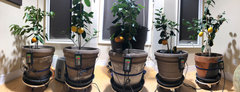
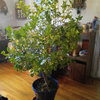
I got a Meyer lemon tree this week (photo below). It doesn't seem to have a central leader, and all of its new growth is on the circled cluster of branches. These branches point inward or straight up, and they're angled very close together. From the research I've done, my inclination is to remove all of the circled branches. I want a compact, symmetrical tree with a classic central leader or vase form several years down the line. I have a couple of questions about how to start.

  1. Should I remove these branches or tie the main right branch to train it to become the new leader (or both)?
  2. Should I prune now or wait until late June next year?

I understand basic principles such as pruning to remove leggy winter growth, crossing branches, and narrow angles. However, any tips on how to prune going forward are welcome :)


(FYI I'm planning to transfer from its nursery container to a larger pot with Al's 5:1:1 mix very soon)


Comments (29)

  • 6 years ago
    last modified: 6 years ago

    Probably ready for a new pot. I'd stake it and train that whole right side and top to the stake. Gradually tighten the ties over time for a more vertical trunk. Can you get that plant outdoors for summer at all? Really nice view, by the way!

    Kim L thanked Dave in NoVA • N. Virginia • zone 7A
  • 6 years ago
    1. You still have the tree in the original nursery pot. When a tree's root system becomes root bound a tree's growth pattern becomes in a straight up mode. As Dave wrote the tree needs to be re-potted into a wider container.
    Kim L thanked Silica
  • 6 years ago

    I agree it might be getting rootbound

    Kim L thanked HOWARD Martin
  • 6 years ago

    Thanks for the insight! It's reassuring to know that the tree's growth pattern may change once it's potted up. I'll be living in an apartment for the foreseeable future so probably no outdoor time. It's in front of big, south-facing windows though! We enjoy the view of Lake Michigan as well :)

  • 6 years ago
    last modified: 6 years ago

    Alvin, about the straight up growth mode of a root bound plant in a too small container, you can read about this in one of YOUR favorite books. Plant Production In Containers II by Dr. Carl E. Whitcomb Ph.D.

  • 6 years ago
    last modified: 6 years ago

    I would prefer a much shorter tree, more like a bushy tree so it only screen the parking lot below. Got an excellent view of the lake, why would you cover it with a tree?

    Al, how about some of your bonzay principals but a little bigger.

  • 6 years ago

    Thanks for your input Al! I really appreciate how willing you are to offer personal advice to those of us just beginning our plant journeys :) I feel confident going ahead and pruning off those branches now before potting up.

  • 6 years ago

    Bob - A side note: It's interesting to think about how handily techniques usually limited to bonsai apply to everything else we grow, horticulturally and aesthetically. I can honestly say I never had an artistic bone in my body until I had done a lot of studying of bonsai's underlying artistic principles. Many of the books read and lectures listened to communicated the message there is usually more beauty to be had in asymmetrical things, but perhaps more importantly the artistic aspects of bonsai are based on a few geometric principles and proportions. Personally, the artistic side of bonsai was something of a mighty struggle, much more so than the horticultural side, but after the art was translated into math, it got easier. It's particularly enjoyable to introduce others to information not yet in common use beyond the bonsai community, to the betterment of their plants and their growing experience.


    Kim - you're welcome. Thanks for the kind words. I hope everything works to your and the lemon tree's favor.


    Al


  • 6 years ago

    Last spring l pruned one of my tree’s going the wrong way.


  • 6 years ago

    I guess u need to adjust that some how

  • 6 years ago

    I would leave it alone to do its thing. It still needs to be repotted.


    steve

    Kim L thanked poncirusguy6b452xx
  • 6 years ago

    You're just not going to get a full, compact tree when it's growing indoors under lower light conditions -- no matter how much you prune it.

    Kim L thanked Dave in NoVA • N. Virginia • zone 7A
  • 6 years ago

    You don’t know how much sun it gets, besides it’s 300 feet closer to the sun. You don’t know till you try it.

  • 6 years ago

    Growing citrus in a window is like swimming in Florida in March. The water is a bit of a shock but the sunshine sure feels nice. The mechanical heating and ventilation systems in your home will play a big impact on your watering habits. Comparing 5-1-1 and plastic pots vs Clay and PROMIX indoors is like comparing a standard transmission to an automatic. Most homes are designed to have a 40-60% RH. This works really well in your favor and is the ideal moisture content of citrus soil. Indoors if you use a clay pot and PROMIX potting mix it would be almost impossible to overwater your citrus. Watering is as easy or as complicated as you want to make it by your choice of pots and soil. If you have excess water in a clay pot the mechanical cooling or heating systems will evaporate it. Using 5-1-1 you will probably run into a lot of underwatering conditions which will lead to WLD and fruit drop. Remember your indoor weather forecast is air conditioning and heating with zero chance of thundershowers indoors. Your barking up the wrong tree with 5-1-1 growing 12 months a year indoors. You will be further ahead growing indoors buying a good quality clay pot from Italy or Germany and buying an infrared thermometer. Move the plant away from the windows when the leaves get too hot or if the VPD is to large. If you want to grow indoors year round you need to understand how to control the VPD around the plant. Growth indoors has to be controlled otherwise you will run into issues with insufficient light.


    Citrus, Cacti, Succulents, Photography · More Info


    Kim L thanked Lemon Lime Orange Zone 6a
  • 6 years ago

    One of the cardinal rules of growing citrus in containers is to not use too large a pot. I theorize this is very true and size matters if you are using a plastic pot. If you have adequate light and are using a clay pot I don't think it makes much difference. Clay pots act like sponges and excess moisture evaporates through the clay or soil. With plastic size matters because if you overwater you get a pile of muck in the lower portion of a plastic pot because plastic can't breath. To grow sweet oranges indoors I had to throw a lot of conventional ideas out the window and rethink outdoor growing ideas.

    Kim L thanked Lemon Lime Orange Zone 6a
  • 6 years ago

    @Lemon Lime Orange Zone 6a Thank you for sharing your expertise! You’ve given me a lot of concepts to research and think about. I’ve always been hesitant to use bagged potting mixes due to their rate of decomposition / collapse of macropores. Much easier to fix dehydration than root rot. How often do you replace your soil? My understanding of WLD is insufficient water uptake to support active leaf area, especially if root temperature is too low. What’s the difference between growing in a more water retentive medium + clay pot and growing in a less water retentive medium + plastic pot? My understanding of @tapla (mid-Michigan, USDA z5b-6a)'s mix is that you can’t really have too large a pot if there’s no PWT. (I would never grow in a bagged mix + plastic pot.) I get that PROMIX + clay may allow me to water less frequently, but theoretically if I'm willing to water daily, can I achieve comparable results in 5:1:1 + plastic? I'll definitely invest in an infrared thermometer to calculate VPD if I notice any signs of declining vitality. Thanks for the suggestion!

  • 6 years ago
    last modified: 6 years ago

    Almost any commonly used medium will be just OK for the first year +-. 5-1-1 is surely the safest medium for growing container citrus. Personally I refer 5-2-1. `VPD infrared thermometers are OK if one wants to spend the money, however 99.9999+ growers grow excellent container citrus without VPD thermometers..

    Kim L thanked Silica
  • 6 years ago
    last modified: 6 years ago

    Hi Kim, if the root ball is heavier than what you can easily lift than decomposition would be a real issue. For example if you lived in Arizona and were planting a 24" crated citrus in a 200 gallon clay pot that weighed 250 lbs. the rate of decomposition of potting soil would be a serious practical concern. In that example you might add sand in the bottom of the container as it would not decompose. In an indoor pot decomposition is something that would not even cross my radar. Decomposition is a great opportunity! it means the plant is consuming nutrients and you have a wonderful opportunity to top dress with new nutrients. If growing citrus was a University degree you could break each of the following 9 parameters into a course. Most people fail indoors because they perseverate on topics like 5-1-1, bark, oxygen and decomposition. Light is like the gas peddle on a race car. The more light the more water, the more nutrients, the more everything the plant needs and everything has to be scaled accordingly or scaled back accordingly and if any one of those things is out of balance problems will arise very quickly. Based on these 9 parameters the potting soil is about 11% of the success equation. If you studied for an exam and spent 90% of your time studying 11 percent of the course how well would you know the subject?

    Light drives the optimal levels of the other 8 parameters.

    Four parameters are in the foliar environment:

    Temperature
    Humidity
    Wind
    CO2

    Four are in the root zone environment:

    Root zone temperature
    Water
    Nutrients
    Oxygen
    root temperature

    A typical citrus tree is composed of approximately 60% water and 40% dry matter. Specifically the roots contain 70% water and the fruit contain 85% water. The woody portions of the tree contain about 50% water. Indoors citrus that are growing need to be consistently moist day in and day out and not moist one day and dry the next. Indoors HVAC can cycle your potting mix moisture and can have a significant impact on everything. Too much cooling leaves drop, too much heating leaves drop, too high a temperature leaves drop, too low a humidity leaves drop. Flooding effects and drought stress can have similar responses. In a flooded citrus grove citrus roots will begin to die after 72 hours. If you choose a professional potting mix with a 60% maximum moisture content and you choose a reasonable sized clay pot it would be impossible for the roots to be 100% saturated in 72 hours. The pot soil will drain excess quickly and your HVAC will evaporate any excess within 24 hours. I suppose in theory you could water multiple times a day to recreate root rot. Personally have never seen it before. You want the moisture content of soil to cycle around 40-60% moisture content. If you are using bark in a do it yourself mix you have no control over the maximum moisture content of the wood because bark bought here is not the same as bark bought there. One bark might hold 40% and another 65% and this is where people run into problems. The right pot and the right professional potting mix holds the right amount of moisture for the right amount of time indoors period. WLD is caused when any of the 9 parameters are not in balance. If you don't have enough light the WLD will be slow and steady. If you have too much fertilizer the WLD will be fast and furious. WLD is also caused by too high a VPD which is caused by very low indoor humidity and very high leaf temperature. Indoors in a window leaf temperature will be unusually high due to the low indoor humidity which is well below where it should be and there is no wind indoors. Fans indoors in a low humidity environment seem to dry the leaves out rather than cool them down. Each growing environment is unique and different. Growing citrus and fishing have a lot in common. Fish like natural bait better than artificial plastic, wood, and steel. Some lures work better than others and many claims are to catch the fisherman not the fish. A lot ideas on how to grow citrus indoors sound good but they don't work or don't work well.

    Kim L thanked Lemon Lime Orange Zone 6a
  • 6 years ago
    last modified: 6 years ago

    Have any of you know something about Rootmaker plastic containers? You can throw a lot of b out the window. I use them exclusively for the first few years. My tree’s spend 5 months indoors. My system is only used by me. Different growers do their own way of doing. I don’t have experience with 12 months indoor, I am out.


  • 6 years ago

    For container trees, I use most only RootMaker containers. They are great containers.

  • 6 years ago
    last modified: 6 years ago

    Silica, I wish they make bigger than the 5gl ones, than they make the ones you got to ty together with wire ties, To any size you want. The ones I use now, the 15gl, has wide grips for easy sliding.

    once, you spend a few years on good forums you start making wise decisions. If you want satisfaction out of your tree’s, you think twice going the cheapest route, not going that route.

    Know what to buy, how much I am willing to spend, don’t need no input from nobody.

  • 6 years ago

    @Monyet and @Silica, thanks for the suggestion about RootMaker containers! Do you know if I can place a RootMaker container/liner inside a decorative cachepot? Is it advisable to drill a drainage hole in the bottom, or is the drainage from the root openings sufficient?

  • 6 years ago
    last modified: 6 years ago

    Not needed. It’s nearly impossible to overwater. Yes if you live in a expensive place like yours. You have to buy a fancy container. My nephew live in Marina Tower. When I was in the stained glass business, I did a show at Navy Pier. I don’t even know what it look like there now.

    Good memories from Chitown.

    Kim L thanked Monyet
  • 6 years ago

    Kim, the purpose of the side wall openings in a RootMaker container is that the air out side of the container kills the root tip, causing the tip to produce two new root ends. If you put the RM container inside a decorative container be sure that there is plenty room for good air circulation.

    Kim L thanked Silica
  • 6 years ago

    The comments about under-watering issues when using the 5:1:1 are unfounded and misleading. Undoubtedly, plants in a 5:1:1 mix with pine bark as the primary fraction are going to meed watering more often, but that is a very good thing. Since we all know the 5:1:1 mix is very productive, and, the grower is 100% responsible for seeing the plant's water needs are met, any under-watering issues would rightly be considered grower error. It's not reasonable to think one can grow in a highly aerated, fast-draining medium without comparatively shorter watering intervals, and no matter what medium is being used, if the grower isn't watering appropriately by way of stretching watering intervals out too far, there is going to be an issue.


    If we give it some thought and really identify the reason growers have so much better luck with highly aerated and fast-draining media, we'll see the purpose is to rid our growing experience of the limitations imposed by perched water. As long as there is perched water in any medium, it is a limiting factor; so, from the plant's perspective it's always a good thing to eliminate as much excess water as possible. In the extreme and all else equal, media that actually NEED watering twice per day will offer much better opportunity for plants to realize a much greater of their genetic potential than even a well-made 5-1-1 mix, and far more opportunity than other media based on large fractions of fine materials.


    The growing experience often involves compromise. Assuming, arguendo, we agree plants that need watering twice daily have much better opportunity to realize more of their potential than plants that need watering only every 2 weeks, we'd almost all agree we're not willing to water twice daily, even if it does serve the plant better. Somewhere between twice daily and every 2 weeks is a compromise watering interval that suits our priorities. What's important isn't whether or not everyone goes all in and waters every hour on the hour, what's important is understanding there is a compromise to be made and how to make it.


    It's not uncommon, even within the span of 2 consecutive posts, for grower A to pooh pooh a name brand medium known to be very water-retentive and hard on plants, and grower B to pooh pooh the 5:1:1 or gritty mix because it doesn't provide at least a 2 week watering interval. No one can tell grower A or B what is better for them because we don't order their priorities, but we can say with a great deal of certainty, if all else is equal, that the grower who has to water and the medium that supports the least amount of perched water is capable of providing much better opportunity for the plant to realize more of its potential. What the grower actually decides shouldn't matter to us, no matter how much it matters to the plant.


    That's the view from here.


    Al

    Kim L thanked tapla (mid-Michigan, USDA z5b-6a)
  • 6 years ago
    last modified: 6 years ago

    Currently building a raised indoor conservatory/greenhouse on wheels with 💯 artificial light moving on a LightRail LightMover for kicks and giggles.


  • 6 years ago

    Mondi air pots. Don't use them anymore.

  • 6 years ago

    I just bought another 24" rootmaker, I like them. My biggest beef is the dark color....so I spray painted it white along with a reused nursery pot...Voila a cooler pot...had I known sooner. Someone on here suggested spray paint and its held up all right.