Software
Houzz Logo Print
raquel_g27

rubber plant drooping

6 years ago
last modified: 6 years ago

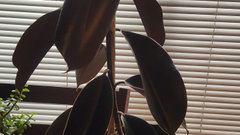
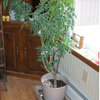
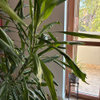
My rubber plant leaves are drooping. I just got it delivered from the store, but it needed to be sprayed with a disinfectant upon arrival to my complex and also kept in a room for 3 days. When I got it, it was super dry. I put it in the shower and gave it a soak for a few seconds, and wiped down the leaves with a little mayonnaise. The next day it started drooping even more. Not sure what it needs.I put the picture on the next post. I couldn't attach it to this post.

Comments (7)

  • 6 years ago
    last modified: 6 years ago


  • 6 years ago

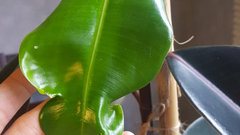
    The plant has been chronically over-watered for at least a month or more. The malformed leaf you're holding is resultant of a culturally induced (or actual) calcium (Ca) deficiency, evidenced by the hook-shaped leaves.

    Ca must be in the nutrient stream at all times if cells/tissues are to form normally. It should be noted there might be an adequate measure of Ca in the soil, but root inundation (waterlogged soil) limits the plant's ability to absorb it. If there is an insufficient supply of Ca in the nutrient stream, the newly forming walls of cells form imperfectly and become more permeable, allowing their liquid content to spill into inter-cellular spaces. Any concentrated absence of normal cells can cause voids (holes)/cracks in the leaves when they unfurl, pits/holes/odd shapes in fruits, and misshapen leaves – especially malformed leaf tips. Anything that slows movement of the nutrients stream, and over-watering certainly does that, would exacerbate the malady.

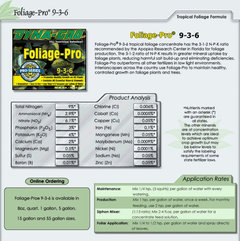
    The best way to fix it would be to start using a growing medium which is highly aerated and difficult to over-water, and make sure your fertilizer includes both Ca and Mg. Short of that, there are other 'tricks' that allow you to alleviate the potential for waterlogging - ask if you have interest.


    Al

    Raquel V thanked tapla (mid-Michigan, USDA z5b-6a)
  • 6 years ago

    thank you SO much Al! that would explain why it looked worse after I watered it. I would definetly be interested in hearing any other tricks that would help alleviate the potential for water logging. I live in Mexico so I'll try to look around for the fertilizer that includes the nutrients you mentioned.

  • 6 years ago

    should I wait a while before watering again?

  • 6 years ago
    last modified: 6 years ago

    Why did you put mayonnaise on the leaves? Leaves have stomata (pores) that are necessary for gas exchange. There should never be anything put on them that will block the stomata and I think mayonnaise would probably do that.

    As far as watering goes, water when the plant feels lightweight. Water until liquid comes out of the holes in the bottom of the pot. Don't let the plant sit in water for an extended period of time (like inside a decorative pot with no holes). Don't water again until the plant feels lightweight again.

    Deanna

    Raquel V thanked gardenfanatic2003
  • 6 years ago

    That would explain why it looked worse after I watered it. I would definetly be interested in hearing any other tricks that would help alleviate the potential for water logging. These tips/ techniques should be helpful. Excess water in the pot is a plant's mortal enemy, yet only a few growers understand how much sway your soil choice has over how much opportunity you'll be able to offer your plants in terms of their ability to realize as much of their genetic potential as possible. Pay particular attention to anything that has to do with media (soil) or reducing water retention. I live in Mexico so I'll try to look around for the fertilizer that includes the nutrients you mentioned.

    Should I wait a while before watering again? Yes - use this as a guide:

    Using a 'tell'

    Over-watering saps vitality and is one of the most common plant assassins, so learning to avoid it is worth the small effort. Plants make and store their own energy source – photosynthate - (sugar/glucose). Functioning roots need energy to drive their metabolic processes, and in order to get it, they use oxygen to burn (oxidize) their food. From this, we can see that terrestrial plants need plenty of air (oxygen) in the soil to drive root function. Many off-the-shelf soils hold too much water and not enough air to support the kind of root health most growers would like to see; and, a healthy root system is a prerequisite to a healthy plant.

    Watering in small sips leads to avoid over-watering leads to a residual build-up of dissolved solids (salts) in the soil from tapwater and fertilizer solutions, which limits a plant's ability to absorb water – so watering in sips simply moves us to the other horn of a dilemma. It creates another problem that requires resolution. Better, would be to simply adopt a soil that drains well enough to allow watering to beyond the saturation point, so we're flushing the soil of accumulating dissolved solids whenever we water; this, w/o the plant being forced to pay a tax in the form of reduced vitality, due to prolong periods of soil saturation. Sometimes, though, that's not a course we can immediately steer, which makes controlling how often we water a very important factor.

    In many cases, we can judge whether or not a planting needs watering by hefting the pot. This is especially true if the pot is made from light material, like plastic, but doesn't work (as) well when the pot is made from heavier material, like clay, or when the size/weight of the pot precludes grabbing it with one hand to judge its weight and gauge the need for water.

    Fingers stuck an inch or two into the soil work ok for shallow pots, but not for deep pots. Deep pots might have 3 or more inches of soil that feels totally dry, while the lower several inches of the soil is 100% saturated. Obviously, the lack of oxygen in the root zone situation can wreak havoc with root health and cause the loss of a very notable measure of your plant's potential. Inexpensive watering meters don't even measure moisture levels, they measure electrical conductivity. Clean the tip and insert it into a cup of distilled water and witness the fact it reads 'DRY'.

    One of the most reliable methods of checking a planting's need for water is using a 'tell'. You can use a bamboo skewer in a pinch, but a wooden dowel rod of about 5/16” (75-85mm) would work better. They usually come 48” (120cm) long and can usually be cut in half and serve as a pair. Sharpen all 4 ends in a pencil sharpener and slightly blunt the tip so it's about the diameter of the head on a straight pin. Push the wooden tell deep into the soil. Don't worry, it won't harm the root system. If the plant is quite root-bound, you might need to try several places until you find one where you can push it all the way to the pot's bottom. Leave it a few seconds, then withdraw it and inspect the tip for moisture. For most plantings, withhold water until the tell comes out dry or nearly so. If you see signs of wilting, adjust the interval between waterings so drought stress isn't a recurring issue.

    ***************************************************************************************

    Don't be bashful about asking questions ............


    Al

Sponsored
Peabody Landscape Group
Average rating: 3.5 out of 5 stars8 Reviews
Franklin County's Reliable Landscape Design & Contracting