Software
Houzz Logo Print
anna_reindlova

Rose Seeds Question

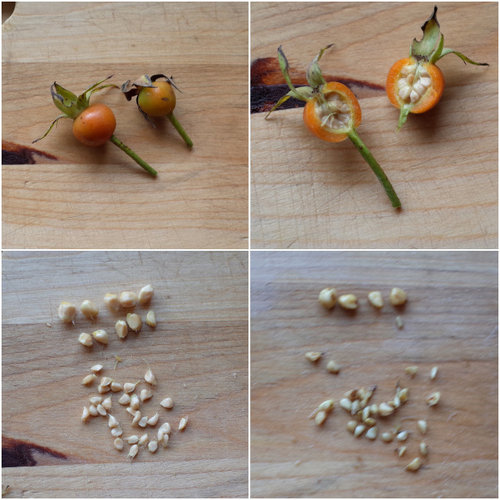
Hi, I am doing my first experiments with rose breeding. I opened these two hips today, from a mother I have high hopes for. The bigger one is OP, the smaller one is my cross.

As you can see, I got:

The 1st hip - 5 big seeds, 5 medium seeds, a ton of tiny seeds

The 2nd hip - 4 big seeds, many tiny seeds

Are only the big/medium seeds viable? Are the small ones undeveloped? Or are they potentially viable too?

Thank you.

Comments (36)

  • 5 years ago

    If they are completely flat, they likely don't contain embryos. If they aren't, and you are really interested in seeing what's possible from the cross, they're worth planting. Some do a "float test", placing them in a glass or bowl of water and then perhaps stirring it to make sure the ones which float haven't trapped an air bubble on their surface. The belief is, if there is no embryo, only air space inside the seed coat, it floats. If there is an embryo, it sinks. Sometimes, that's the case. Always? It doesn't appear so. Are they all worth planting? How important are they to you? If you collected them on a lark and aren't vested in seeing what the may create, plant them or not. If you created the cross and are really interested in seeing what may result, plant all of them. For crosses I am really interested in, I plant them all. If you feel there is little potential for germination from the smaller ones, then plant them close together, perhaps just in the space you might have reserved for two or three of the larger ones. If they germinate, great! You've discovered something. If they don't, what's the harm? You've added a bit of organic material to the soil. Congratulations and good luck!

    Edhelka (North Wales, UK) thanked roseseek
  • 5 years ago

    Thank you! That was my thinking, to sow them all in one tray, there's nothing to lose and I have space. I lost two other crosses (either to bad pairing or bad weather), so this is my only one to play with this year. I plan to do much more next year :)

  • 5 years ago

    Good luck! You'll have to post "baby pictures"!

  • 5 years ago

    What roseseek said! Personally I try them all. I don't do a ton of them so I have room to try and start all of the seeds I get.

    Edhelka (North Wales, UK) thanked seil zone 6b MI
  • 5 years ago

    Good luck with them!! Make sure you keep us in the loop as to how it goes! :)


    I'm desperately trying to get my Stainless Steel X John Davis hip to ripen...it's mostly orange, but still hard. It has all of tomorrow to be outside, and then that's all the outside time it should get.

    Does anyone think I should take it off and give it a try or should I leave it on the bush until spring?

  • 5 years ago

    @rosecanadian Thank you, I will, if there is something to share next year.

    My hips were also mostly orange and still hard but the seeds inside looked ready, I can only hope for germination.

  • 5 years ago

    Your rose hips sound just like mine. I was thinking of cutting the cane off (about 6 inches) and planting it in soil and putting it under my grow lights to see if that will help further ripen the hip.

  • 5 years ago

    There is a Canadian member of the Rose Hybridizers Association who also posts to Face Book, who experiences your short season ripening issues. He reports success in planting the stem carrying the hips he wishes to ripen in damp sand under grow lights. He even sometimes observes the stem rooting in the sand. I don't know how he deals with the potential for bringing spider mites, aphids, etc. into the house.

  • 5 years ago

    Thanks, Kim! I just finished doing that...although not in sand. I washed the canes, leaves and hip ... hopefully that got rid of any insects. I would be really annoyed if I brought those in. Good to know that this may help ripen the hip!

  • 5 years ago

    You're welcome! My fingers are crossed for you! It's nice knowing others experience similar concerns and have found work-arounds, isn't it?

  • 5 years ago

    So true!!! And thanks for the information connection! :) :) I'll keep you posted.

  • 5 years ago

    You're welcome! You should definitely browse the RHA forum. There are folks all over experiencing all the same issues people here are and there is a wealth of information there to enjoy. Not to mention some very nice people, too. https://rosebreeders.org/forum/viewforum.php?f=2

  • 5 years ago

    Kim - I bookmarked that link...thanks!! I'm going to give it a look soon. :)

  • 5 years ago

    You're welcome! There is a lot of information there, not just on the forum, but in the articles. https://rosebreeders.org/ Pretty much any question you can think of about raising rose seeds (and creating them) has already been discussed there. Enjoy!

  • 5 years ago

    Dang....I opened the hip up today...inside was grey. Lots of seeds...but they weren't the usual milky white. They were darker. But, I threw them in some dampened potting soil and put them in the fridge. If only one works out...then that would be great. Have you ever experienced this?

  • 5 years ago

    Yes ma'am. Sometimes it happens and it isn't necessarily a bad thing. The seed coat has to break down to allow water and air entry into the embryo to stimulate germination. I guess some of the molds that form might help?

  • 5 years ago

    Oh really? I was thinking of throwing them out. It was a close thing...last second, I thought...doesn't hurt anything to try. Thank you!! Now I have to hang out on the Rose Hybridization forum to see what I should do. :)

  • 5 years ago

    Think about it...what does Nature use to prevent seeds from molding? What does Nature use to trigger germination? Hips fall on the ground and they weather and deteriorate. They are eaten by birds, rodents and other critters, passing through their digestive tracts and are eliminated, encapsulated in guano. All of those things help break down the seed coat and permit germination. What harm can a bit of mold cause once they're under ground? There are plenty of other molds, fungi, bacteria and other actors there. I just plant them and begin worrying where I'm going to hold too many to evaluate! Good luck!


  • 5 years ago

    LOL!!! Thank you!!!

  • 5 years ago

    You're welcome!


  • 5 years ago

    I've planted 3 year old seeds that were covered in a gooey mess of slimy mold and they germinated! I never say die when it comes to planting seeds. Plant them. You have nothing to lose by trying!

  • 5 years ago

    Seil - really?? I would have thrown them in the garbage...live and learn!! Thank you!

  • 5 years ago
    last modified: 5 years ago

    So based on reading from the link you posted, Kim, I'm going to do this:

    1. put the seeds in sterilized sand in a ziploc bag

    2. keep the seeds in room temperature for 60 days.

    3. plant seeds that have germinated (if any)

    4. Keep in fridge for 90 day (checking for germinated seeds to plant)

    5. Plant everything after 90 days.

    6. use red light for germination....on for 24 hrs/day??

    7. After they have germinated...use full spectrum lighting for 24 hours/day.

    8. use a fan to promote strong stems (my thoughts)

    Does that sound reasonable?? And do you scarify the seeds at all? Or clean them with chemicals?

    Thanks!

  • 5 years ago

    I am a lurker on the rose breeders forum but most advice there is either too advanced for me or from a different climate. I guess we all have to find our ways how to do things and learn through trial and error. My approach is to try the easiest option possible (which is to plant everything right after extracting the seeds and forgetting about them over the winter) and if it doesn't work or if the germination rates are very low, then I can try something else.

  • 5 years ago

    Wow! Thank goodness I don't have to go through all of that! Seriously, Seil and quite a few of the folks on the RHA can advise you better on those questions. It only takes a moment to register on the RHA forum and it costs nothing. The people there are very nice and helpful and many of them endure harsh, long, cold winters, with several of them fellow Canadians! Here, I do none of that because this climate and the roses I play with don't require it. The most I ever did was to place cleaned seeds on damp paper toweling with Captan on it, in Ziploc bags in the refrigerator...UNTIL I learned I didn't have to do that here. I only used refrigeration to delay germination until November-ish when the rains were supposed to begin and the temps SHOULD have started falling below 80 F where germination could begin. Now, I shell the seeds into small ziploc bags with tags or open baby food jars with tags and place them on the table in the dining room (which we never use for eating) until I have emptied the seed tables and am ready to plant. That SHOULD be any time now, but there are still other things getting in the way of that, so it may take a while longer. Once planted, they either get rained on or hose watered to keep them appropriately moist and, of course, I hover over them until enough of them germinate to have it become satisfying.

  • 5 years ago
    last modified: 5 years ago

    Edhelka, that is what the British and other European breeders recommended for many years. LeGrice wrote fifty-plus years ago to plant them out in screen covered trays and allow the weather to encourage germination. He stressed using zinc screen covers to prevent rodents from gnawing into the trays and eating the seeds as they are rich in vitamins. Thankfully, I don't have the rodent issue here, but I do have birds and they adore rose seeds as much as mice, rats and squirrels do. If you're interested in what I plant the seeds in, this post on my blog will show you what I created to hold them. http://pushingtheroseenvelope.blogspot.com/2015/03/seedling-tables.html Originally, I stapled plastic screen over the tops directly to the board sides, but that didn't allow enough room for the seedlings to grow, so currently, there are 1" X 1" frames attached over the tables, to which plastic hardware cloth is stapled, leaving the front side able to be opened for access. Hopefully, that gives others some ideas of what can easily and inexpensively be created elsewhere to make this easy and fun. Oh, and if what has been discussed on the RHA is more advanced or otherwise complicated, ask questions as someone who isn't quite to that stage yet. Believe me, there are people there of all interest and experience levels and someone is sure to explain themselves at the level you are more comfortable. Good luck!

  • 5 years ago

    I love your seed system, Kim. I think I will do something similar next year.

    At the moment, the planted seeds are in my unheated greenhouse. We are having mild weather right now but the temperatures already were in forties and will be soon again, with night temperatures in thirties. We rarely go lower than that. From what I've read, these temperatures should work quite well.

    BTW I already have one volunteer seedling which germinated on its own last winter. Nothing special and I should get rid of it but at least I know that roses can germinate and grow here without any special help.

  • 5 years ago

    Thank you. I'm glad it gave you some ideas. Yes, your temperatures sound perfect for germination! With those available in the greenhouse, who needs a refrigerator? Isn't it surprising how easily rose seeds germinate on their own?

  • 5 years ago

    I really appreciate the wonderful discussion!! I'm going to return to this soon...just not really soon. LOL I've got to think...and then I'll reply....but I REALLY appreciate this!

  • 5 years ago

    Hey Carol! A responder just posted this on the RHA. I thought you might find it interesting. "I made my best experiences with putting stems (about 6 inch) with upper leaflets and hips in a pot with light humid flower soil without fertilizer in a little plastic or indoor greenhouse under LED daylight (6500 K), 10-12h per day, with one or two tomatoes and apples put around. The mixture of both fruits is important. Apples and tomatoes develop a maturity gas of called ethylene which have some positive effects on ripening hips in this case. By the way, in the kitchen it is quite useful not to store other fruits and vegetables near apples and tomatoes, because they could spoil quickly. Another noteworthy point in this recipe is that the relative humidity should be about 75%. A glass with water within the greenhouse is able to manage this very easily. If you use a pot with plastic bag plus tomato and apple (lying on the soil) under light, the slightly humid soil has the same effect on the relative humidity, because the volume is smaller. Of course, one cannot expect miracles but my green hips at least got a light orange tinge within about two weeks."

  • 5 years ago

    That is very interesting, Kim, thanks. I'm lucky that my season is long enough that if I use my first spring flush for breeding I do have a long enough time for them to ripen on the bush but with this I might be able to do a few later crosses. The roses you want to use don't always bloom when you want them too, lol!

  • 5 years ago

    Great! I'm glad it might help! I am so blessed I don't have to worry about that. I COULD still be pollinating IF I wanted to deal with the tags molding worse with the increased humidity and approaching rain. I already have to soak some of them in Clorox to be able to read them.


  • 5 years ago

    Kim - I would never have thought of doing that...what a clever person!!! Using the off-gasses of tomatoes and apples...clever!!! Thanks for sharing that! :)

  • 5 years ago

    Isn't it? I wish I could claim credit! LOL! I'm glad you benefited from it!

  • 5 years ago

    :)