Software
Houzz Logo Print
socalnolympia

rare cold hardy citrus collection

5 years ago
last modified: 5 years ago

I'll share with you some of my plants.


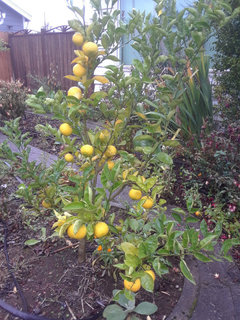
This is in Olympia, WA. (climate zone 8a)


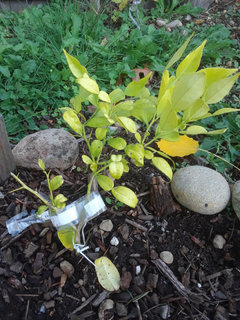
This is what is called a "Bloomsweet grapefruit"


It's not a real grapefruit. The fruits supposedly could best be described as somewhere in-between a grapefruit and orange, but seedy and a little watery and insipid. From what I've researched, this is believed to be an old obscure variety in Japan known as "Kinkoji", and originated as a cross between another variety known as "Kunenbo" and "buntan". "Buntan" is simply a Japanese pomelo. Kunenbo was simply a large sized very aromatic mandarin, almost similar to a tangor, but very seedy. Along with Kishu mandarin, Kunenbo was one of the original two parents of "unshiu-mikan", what we know as "Satsuma mandarin". So that would make Bloomsweet a close sibling related to Satsuma mandarin. However, Bloomsweet is even slightly more cold hardy than Satsuma.

It is planted in the ground, in a warm sunny spot, with a brick wall only two and half feet behind it. It was not protected this winter.


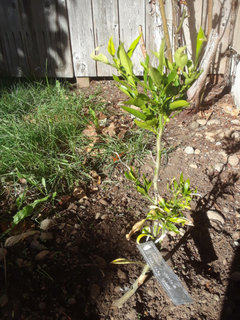
This is my new Keraji mandarin


Keraji mandarin is very difficult to find these days. It is similar to Satsuma mandarin, but smaller fruit size and somewhat more sour, and has seeds. But it is said that Keraji can survive down to maybe 12 or 14 degrees F, making it significantly more cold hardy than Satsuma mandarin. A Japanese genetic marker study found that Keraji started from Shikuwasa that was then backcrossed with Kunenbo three separate times (to make a long story short).

The plant you see has not gone through a winter yet (in all fairness).

Jim in Vancouver, WA grafted it for me.

As an experiment, I also planted a very small Keraji seedling (growing on its own roots), and it has survived through two winters so far, but has really not done well or grown very much. The first winter it was covered, but it was an unusually cold winter that year and buried under more than a foot of snow. It died back almost entirely to the ground, but by June it started to regrow. Eventually it grew some leaves. It's currently only about 2 inches tall. But it survived the last winter without a cover. The leaves do not look like a very healthy color, but it did grow three small leaves this year.


All pictures taken today, November 2, 2020

Comments (17)

  • 5 years ago

    Here is my Ichang papeda in ground


    I originally rooted it from a cutting. (it seems to root very easily, but this was done inside a special warm enclosure under artificial light indoors)

    I suppose Ichang papeda isn't that rare, but to my knowledge there are currently not any mail order nurseries listing it for sale.

    This is the second-most cold hardy original citrus species (if we are counting Poncirus trifoliata). Maybe somewhere in the South it could survive the warmer part of zone 7b, but I think further north it can only tolerate zone 8a. The leaves have a very distinctive symmetrical shape.

    While this plant has not produced fruit yet, I have gotten the opportunity to taste the fruits. The flavor is very close to lemon (or to be more specific, citron), but more sour, and with a deeper pungent quality, and also just a little bit woody in a resinous sort of way. The fruits didn't have many seeds. Now obviously the quality of the fruits is much inferior to lemon, but they are edible. And, like citrons, the peel of the fruit is a little bit softer and moderately edible, with only a moderate level of bitterness. I would say almost as edible as a mandarinquat or calamondin. Or at least I thought so. I mean, you can eat the peel of the fruit, but maybe it's not the most enjoyable experience.

    To be honest, probably the reason this is so rare is the fruit quality isn't that great, and if someone wants to plant a novelty very cold hardy citrus just for the look of it, they are probably more likely to buy Poncirus trifoliata. But Ichang papeda doesn't have the terrible unpalatable flavor of Poncirus trifoliata and its hybrids.


    Ichang papeda originated from China, around the upper gorge of the Yangtze River.


    This one is even rarer.

    It's a hybrid between Ichang papeda and Poncirus trifoliata


    To be more specific, it was actually grown from a seedling from a fruit of an Ichang papeda and poncirus trifoliata cross, making it a second generation hybrid.

    It hasn't produced fruits yet, but the fruits of the parent are said to have surprisingly little of the bad poncirus taste, considering that it is was a direct hybrid. So much so, some speculated it might have actually been a hybrid with citrumelo rather than poncirus. However, the parent also apparently doesn't have the level of cold hardiness one might expect for being a direct poncirus hybrid; it did not appear to be much more cold tolerant than Ichang papeda itself.

    I would guess it could probably only survive zone 7b.


  • 5 years ago

    This is another really rare and unusual one. I believe it is a cross between Ichangquat and Citrumelo.

    That would make it a (kumquat x Ichang papeda) x (grapefruit x trifoliata) hybrid


    It was grown from a seed that came from an Ichangquat, but while I was growing one of the seeds, I noticed one of the leaves that was clearly "bifoliate" (split into two, in contrast to Poncirus which is trifoliate). This was an indicator that this Ichangquat had clearly cross pollinated with some other Poncirus hybrid, and so what grew from the seed was not a pure Ichangquat.


    This is a crazy combination, and I have no idea what the fruits might be like. It's planted in the ground outside, and what you see is after it recovered from being planted outside in the ground in January (this year) and dying back a little bit.

  • 5 years ago

    That was very interesting. Thank you.

    Steve

  • 5 years ago

    I think I saw that exact Bloomsweet tree at McKenzie when I was there.. Curious for a report when you get fruit.

  • 5 years ago
    last modified: 5 years ago
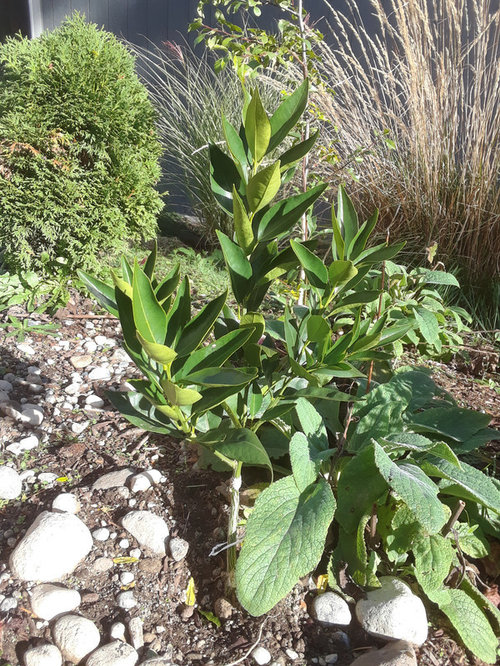
    I do have an Ichang Lemon. It's in a 5-gallon container on the deck near the house. It survived through the last winter well, and didn't even lose most of its leaves. But this winter was relatively mild.

    What I have found is that keeping the hardy citrus growing indoors and then bringing it outside early in the year does not work too well. Even if the plant never experiences freezing temperatures, the plants do not adapt well to the sudden change between warm growing conditions to the cold outside. Can cause die-back and even bark damage, and yellowing and fall-off of leaves.

  • 5 years ago
    last modified: 5 years ago

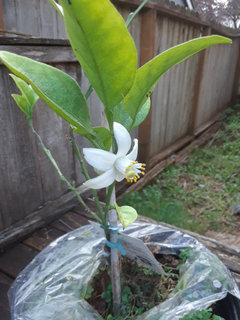
    I have not had the opportunity to taste the fruits, but one time the Bloomsweet did produce blossoms inside the grow enclosure. The blossoms smell like the blossoms of sour orange, or maybe a little bit of bergamot, which still smells wonderful, but does not smell anything like the flowers of grapefruit.

    Bloomsweet is probably is the least hardy of the hardy varieties I am growing, which is why I saved the most optimal warmest spot up against the wall on the south-facing side to plant it. I think it probably would not be able to survive planted completely out in the open with no wind-break. For this type of climate, so far north, I think it's really more of a zone 8b variety. It did suffer some pretty severe bark damage at the base the previous very cold winter.


    I have a picture of it from early April 2019

    As you can see, the flower was quite big.

  • 5 years ago

    Not every trial has gone so well.

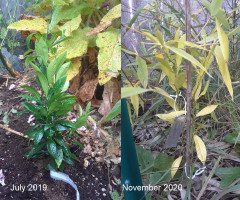
    This one was another seedling grown from an Ichangquat. The first picture was taken July 2019 only a few weeks after it was planted in the ground, and "after" picture was taken today, November 2020.


    Because it was grown from a seed, maybe this one simply didn't inherit the cold hardy genes from its parent.

    It still appears to be alive, but is far from a healthy color. I don't think it grew a single leaf this year. All those pale yellowish leaves you see on it are the ones from before the winter.

  • 5 years ago

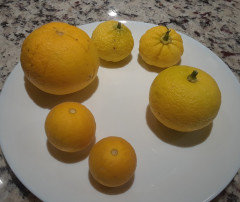
    I know you all want to see some fruits.


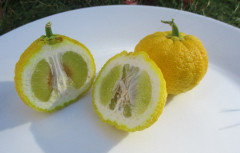
    These fruits all came from Portland


    The largest one, more orange and to the left, is a citrumelo (probable variety 'Swingle').
    The two smaller ones in the front are Poncirus trifoliata, but apparently a special variety that can be eaten and does not have the bad poncirus taste inside.
    The two smaller yellow ones in the back are Ichang papeda.
    The medium sized one on the right is a Kabosu.

    These were all picked today (November 3) from trees growing outside and unprotected.

    The poncirus fruits are surprisingly fragrant. The smell is very hard to accurately describe, but I am really going to try and be precise. It smells like raw fresh quince fruit, maybe almost something like peach and ripe apricot, definitely just a little bit of guava, cheap laundry fragrance or something like mock orange (Pittosporum tobira), a little bit of the rubbery smell of tulips and floral lily, alcohol baby wipes (phenethyl alcohol), and somewhat skunky lemon.
    Something about them almost reminds me of orris butter or an old fashioned perfume satchet.

    The Ichang papeda fruits are moderately fragrant, in the wet air. They smell resinous woody (in the best way possible), mixed with fresh lemon. Also there is something very slightly deep and pungent to them, but that part is not very noticeable without cutting into it.

    The surface of the Kabosu smells like Satsuma mandarin, the strong deep smell of a very aromatic Satsuma mandarin, mixed with a little Yuzu, and some aromatic Valencia orange. It smells wonderful. (I think this might even contend for my favorite variety of citrus smell)

    The Citrumelo is nothing remarkable.

    Note the descriptions of all these fruits are before cutting them or tasting them.

    It's an eclectic little assortment of cold hardy citrus fruits.

  • 5 years ago
    last modified: 5 years ago

    Here's the tree where the Kabosu was picked from, in Vancouver, WA (right across the bridge from Portland)


    This is a pretty rare variety, virtually impossible to find outside of Japan.

    It is a hybrid between Yuzu and Kunenbo, in case anyone was very curious.

    This tree is not covered, and they had a freeze there a week ago, temperatures went down to 26 F in Vancouver. Even severely killed back the tip leaves of fig trees. But there was no freeze 2 hours north in Olympia, or Seattle. (It's because the Columbia river gorge can funnel in cold air sometimes)

  • 5 years ago

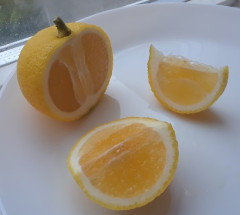
    I can give a review of the Kabosu


    Cutting into it, this smells like the best very high quality Meyer lemon (and I'm not much of a fan of Meyer lemons) mixed with some very aromatic Satsuma smell. There might also be a tiny hint of Yuzu aroma, barely perceptible.
    The inside is a little bit more fragrant than a lemon, has a little bit of Yuzu smell.

    Eating it, it tastes like a lemon. Not bad at all, but it doesn't have the most flavor, and it's just a little dry, like Yuzu. But it is still fairly juicy.
    The flavor is like lemon, maybe not the best quality lemon but not that bad, kind of watery, mixed with a little bit of tangerine and Satsuma flavor.

    I do not see any seeds inside.

    I think Kabosu is supposed to be picked green in Japan, so these may have been considered too over-ripe. Although they tasted like they might be underripe to me. In this cool climate (Pacific Northwest), they probably wouldn't be the most sweet.

    The peel was about as edible as a normal lemon, maybe just a little bit more. One probably could use the peel in cooking, although it might not be the most ideal.
    The peel reminds me a lot of the flavor of Satsuma peels, although maybe just a little bit softer like Yuzu.
    The white pith appears to be edible, only the tiniest bit of bitterness, not that much inferior to the pith of citron.

    The fruit quality inside is better than Yuzu, but I suspect the peel is still very important for the flavor, if you were making a sauce.

    One last thing, I do want to emphasize that this review may not be representative of what Kabosu is really like, but rather a single account of Kabosu grown in the far north in the Pacific Northwest climate.


    I think the peel is where most of the flavor of Kabosu is.
    The peel is less edible than that of Yuzu, somewhere between Yuzu and Satsuma mandarin, but I guess it cannot be too bad since I am finding myself eating the peels. The flavor of the peels is mostly like somewhere in between the peels of Satsuma mandarin and lime. Maybe just a little bit of Ichang papeda / Yuzu flavor, but the orange part of the flavor of Yuzu is not really there.
    I think the peels of Kabosu could definitely be candied to be made into a snack.

  • 5 years ago

    Ended up in this topic as well. Where do ya find all of these? Does not seem like normal citrus grocery market stuff

  • 5 years ago

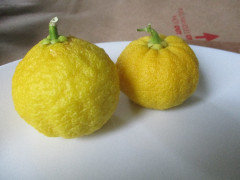
    Ichang papeda fruits, picked from the tree around November 5


    The taste is halfway between lemon and Kaffir lime.

    The outer peels are very soft and surprisingly halfway edible, only a little bit of bitterness, maybe just a little bit skunky in flavor.

    The fruits are not really the best quality, and taste a little bit unripe, but there is nothing really bad about them. They'd probably go well with gin.

  • 5 years ago

    Hello, I have family on the west side of the state and myself have relocated to eastern WA. I am growing Shangjuan lemons and Poncirus Trifoliata here, going to give them another winter or two inside before putting them in the ground. The poncirus trifoliata is supposed to be hardy to zone 5 and anything grafted onto it is supposed to gain 10 degrees Fahrenheit in cold tolerance. I'm in zone 6 but some people in the area say they are in a pocket of 5, I've had a rosemary growing well for a few years and they say it can't be done in zone 6 so we might be in a mini microclimate of zone 7ish. I would like to grow Yuzu, ichang papeda, 10 degree mandarin, and any and all of the most cold-hardy citrus. If the wine industry is any indication I'd say WA is going into a warming period which could last a few centuries before a cooling period. I would love to buy some seeds, saplings, or cuttings from you. I've had luck with chip bud grafting citrus but not other methods. Fresh seeds grow easily and I know they wouldn't be true to the parent but if they proved to be cold hardy rootstock other things could be grafted on if the fruit wasn't stellar. I know you can get fresh yuzu @ uwajimaya so I was planning to do that when in the area but I'd love to buy from you the most cold-hardy of what you grow or that could become a little more cold hardy by grafting onto shangjuan, yuzu, ichang papeda, Poncirus Trifoliata, etc. and I'm willing to try growing from seed to see if there are any with maybe a slight mutation or just luck that can handle winter here. The sunny summers they are sure to love and there's an underground water table that all the trees, bushes, & vines love once they get their roots down deep enough they are quite happy.

    marlajns@yahoo.com

  • 5 years ago
    last modified: 5 years ago

    My "10 degree tangerine" did not end up surviving here, in zone 8a, Pacific Northwest.

    Shangjuan (Ichang lemon) is definitely not as cold tolerant as Yuzu. I can confirm that through personal observations. It's not even as cold tolerant as Changsha mandarin.

    Yuzu seems to be pretty hardy, but I have my doubts about whether it could survive zone 7 in the Pacific Northwest. I think you would at the very least definitely want to plant it in a protected spot up against the house. The Ichang papeda is supposed to be hardier than Yuzu, but what I've personally seen here, strangely it doesn't seem to behave that way. Some of the hybrids like US 852 (Changsha x trifoliate) could probably survive for you but don't taste the best. What I mean is that these hardy citrus are generally a little bit lower fruit quality than regular varieties, but the trifoliate hybrids are in a completely separate category of being worse and having bad trifoliate aftertaste. Of course all that is too complicated to fully explain in this short post.

    If you're willing to put some burlap insulation over your Yuzu with some mulch or dried leaves in there during the winter, I think that would help where you are.

  • 5 years ago

    I will definitely try some yuzu then :D

    I won't expect great taste out of the trifoliates, but if they are useful as a cold hardy rootstock I could graft other things into them. Suggestions as to what to graft on?

Sponsored
Peabody Landscape Group
Average rating: 3.5 out of 5 stars8 Reviews
Columbus' Reliable Landscape Design & Contracting