Software
Houzz Logo Print
ryan_castle36

St. Augustine Damage - South Florida

5 years ago
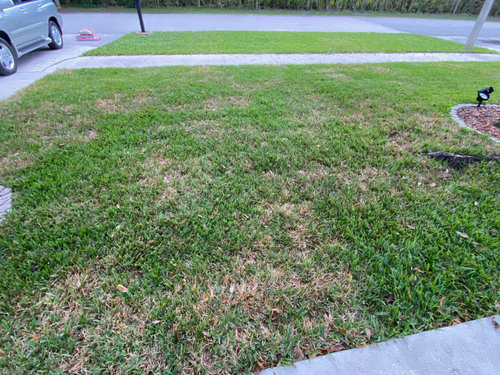
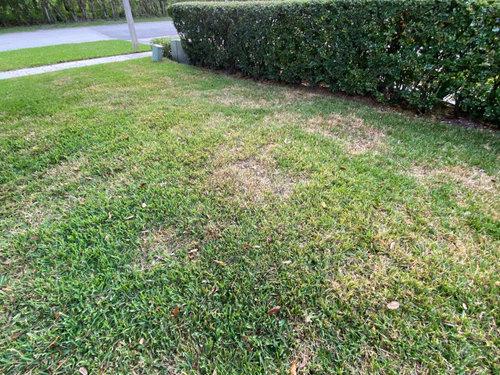
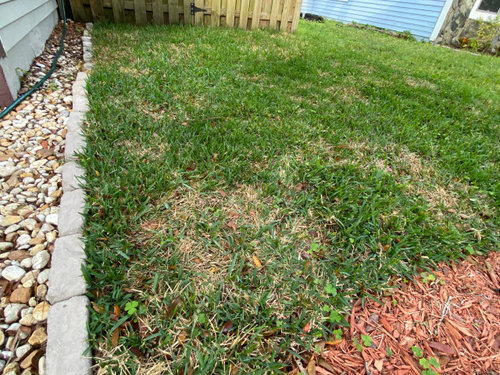
I installed St. Augustine sod in my front yard late November and things started off very well... used RGS to promote root growth and watered constantly. Roots took ground in no time and were strong to the pull.

About a month later in mid-December, I started noticing brown/yellow patches forming which I assumed to be large patch due to the sudden drop in temperatures and a little overwatering for the sake of establishing the sod.

I hit the lawn with the "bullet-proof" strategy of azoxystrobin and, a few days later, propiconazole to try and remedy the fungus problem. Now we're in January (temperatures still falling to the mid 40s-50s some nights) and the lawn is looking worse than ever.

I'm out of ideas at this point, I've been bagging my mower clippings and have gone light on watering as not to further spread the disease. I've attached some photos of the lawn this morning... horrible! I would really appreciate any insight you guys could offer. Is this just damage from new sod being hit by such stark weather fluctuations? Did I not kill the disease? Is this insect/chinch bug damage?


Comments (3)

  • 5 years ago

    Please describe what you mean by "gone light on watering." I put some St Aug sod down in late Oct, watered it about every other day for a couple weeks, went to weekly watering in mid November, and stopped watering it in early Dec. It's doing fine.

    Your sod looks good in that it seems to be knit down. At this point you should be watering about 1/2 inch, all at one time, no more than twice a month. When the grass starts to leap out of the ground in March, then you should drop back to watering 1 inch, all at one time, once every 3 weeks. As the spring heats up you can increase the frequency to twice a month and then weekly, but in your area you should never need to water more than once a week. Measure 1 inch by placing several cat food or tuna cans around the yard and time how long it takes to fill all the cans. If some cans fill fast and others take forever, then you have sprinkler issues.

    Would you describe your soil as fast draining sand, or something else?

    Also, stop throwing stuff at your lawn. I'm not sure what "bullet proof" means, but you are destroying your soil by using so many different fungicides. You do have a fungus, but the chemicals clearly are not working. Chemical fungicides are immediate death to the soil microbiome, of which fungus is the majority of the beneficial microbes. What I would do now is apply an organic fertilizer. In particular I would apply ordinary corn meal from your local feed store. It should cost under $10 for a 50-pound bag. If the price is $20 or $30, then they are selling you something besides "ordinary" corn meal. Then apply the corn meal to the entire yard at a rate of 20 pounds per 1,000 square feet. I would apply now, Valentine's Day, and St Patrick's Day. Besides being an organic fertilizer, corn meal has anti fungal properties when used on St Augustine turf. I've been using it against disease in St Augustine successfully for 19 years.

    So how have you been watering it since the sod went down? We need to know so we know what to tell people about how not to do it.

  • 5 years ago
    last modified: 5 years ago

    @dchall_san_antonio Hi, thank you so much for the response. When I first laid the sod, I was watering twice every day for about 15 minutes each. Around early December, it was raining heavily during the evenings and may have caused the sod to become over saturated with water (hence the disease).

    Since then, I have watered lightly once every two weeks for a little under ten minutes (time is approximate because I don't have an irrigation system so I hand water). I consider my soil to be slow-draining as it stays wet for quite some time, though the area seen in my second picture used to be a gravel driveway, so it's rather rocky there.

    Beyond the fungicide, I have tried to put back as much micro-nutrients as possible through milorganite, ironite, and root growth stimulant.

    Please let me know if this helps and I'm happy to provide anything else to further clarify my situation.

    Thanks!

    (Also: the products I've used, including the term "bullet proof", comes from advise from "The Lawn Care Nut" on YouTube. I'm still relatively new to lawn care so I've used his videos as a reference getting started.)

  • 5 years ago

    If you want to spend every waking minute monitoring, measuring, buying, and applying products for your lawn, watch the Lawn Care Nut. His approach might work, but at what cost and how much hassle? He might not admit it but he's also anti soil health. As I mentioned above, the use of fungicides is just bad for the soil, but really, it's horrible. He uses them for no reason at all.

    In the last 12 months I've bought 2 bags of corn meal, 1 bag of alfalfa pellets, and a bottle of herbicide for my St Augustine. I watered 8 times starting in June. It rained 4 times which extends the time between irrigation. The grass gets mulch mowed at the mower's highest setting every 2, and sometimes, 3 weeks.

    Corn meal seems to work as a biological control against fungal diseases. In the process of decomposing corn, the natural population of the trichoderma (try koh DER muh) fungus skyrockets. Trichoderma is a predatory fungus which "feeds" on other fungi. Once it has wiped out the fungi feeding on the corn, it proceeds to feed on other fungi in the soil. But for corn meal to work, you have to have trichoderma in the soil. After 2 doses of fungicide, you will have a much reduced population of it. So stop using chemicals now and give it time (and food) to recover. I had spots where fungal disease wiped out the grass. After 2 years, all there was was soil and a few runners - no grass blades at all. Three weeks after applying the corn meal, the grass came back and remained grassy for the rest of the time at that house. After that I learned to recognize the disease before killing large areas of grass and I could get some corn meal down. It seems to work better in the spring, so that's why I'm encouraging you to start now and repeat a few times. Here is a picture of a very common disease in St Augustine.


    And here's what it should look like after 3 weeks.


    Well, there are a few yellow blades in this second shot. This lawn was in full shade and is much less dense than a full sun lawn. I think the yellowing was from too much rain.

Sponsored
Industry Leading Landscape Contractors in Franklin County, Ohio