Software
Houzz Logo Print
m0nini873

My ficus elastica needs a diagnosis!

5 years ago
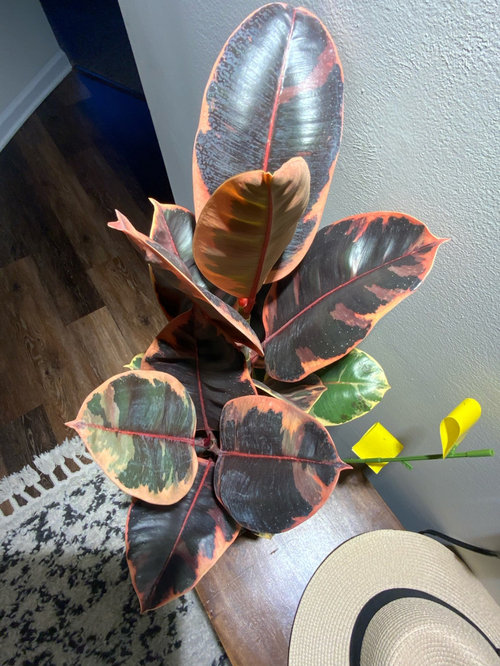
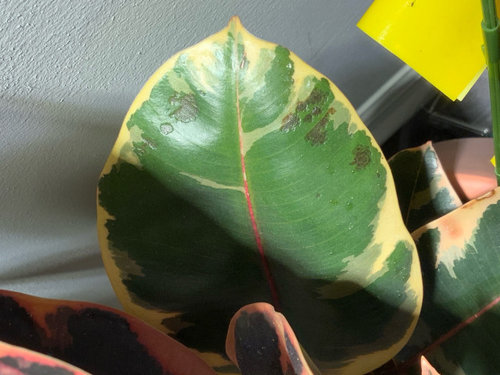
I have had this ruby ficus elastica growing happily for the last several months. Two days ago, I noticed these black marks appearing on one of the leaves. No other leaves seem to be affected. At least, not yet (fingers crossed).

My assumption is that they appeared quickly, as I often walk by this plant and believe they were not there about a week ago. Having said that, I don’t believe they are getting worse on the affected leaf, nor do other leaves seem to be affected, but I want to know what’s going on to prevent any further marks on my beautiful leaves! I am worried it is something systemic.

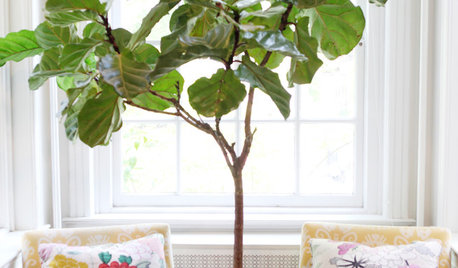
I have attached a close up image of the leaf/marks, and an image of the whole plant so you can see it’s otherwise a healthy plant. Hope it stays this way! Do I need to remove the affected leaf? Does this look like something that will spread?

Thank you in advance for help with my plant child! It’s my favorite out of all my green children.

Comments (3)

  • 5 years ago

    It's oedema/edema, a very physiological disorder. I wrote the following, which describes the disorder and how to avoid it in the future.

    Oedema

    Oedema is a physiological disorder that can affect all plants. It occurs when the plant takes up more water than it can rid itself of via the process of transpiration. The word itself means 'swelling', which is usually the first symptom, and comes in the form of pale blisters or water-filled bumps on foliage. Under a variety of circumstances/cultural conditions, a plant's internal water pressure (turgidity) can become so high that some leaf cells rupture and leak their contents into inter-cellular spaces in leaf tissue, creating wet or weepy areas. Symptoms vary by plant, but as the malady progresses, areas of the leaf turn yellow, brown, brown with reddish overtones or even black, with older damage appearing as corky/ scaly/ ridged patches, or wart/gall-like bumpy growth. Symptoms are seen more frequently in plants that are fleshy, are usually more pronounced on the underside of leaves, and older/lower leaves are more likely to be affected than younger/upper leaves.

    Oedema is most common in houseplants during the winter/early spring months, is driven primarily by excessive water retention in the soil, and can be intensified via several additional cultural influences. Cool temperatures, high humidity levels, low light conditions, or partial defoliation can individually or collectively act to intensify the problem, as can anything else that slows transpiration. Nutritional deficiencies of Ca and Mg are also known contributors to the malady.

    Some things that can help you prevent oedema:

    * Increase light levels and temperature

    * Monitor water needs carefully – avoid over-watering. I'd heartily recommend a soil with drainage so sharp (fast) that when you to water to beyond the saturation point you needn't worry about prolonged periods of soil saturation wrecking root health/function. Your soil choice should be a key that unlocks the solutions to many potential problems.

    * Avoid misting or getting water on foliage. It slows transpiration and increases turgidity.

    * Water as soon as you get up in the AM. When stomata close in preparation for the dark cycle, turgidity builds. If you water early in the day, it gives the plant an opportunity to remove (for its own needs) some of the excess water in the soil.

    * Put a fan in the room or otherwise increase air flow/circulation. Avoid over-crowding your plants.

    Al

  • 5 years ago

    Thank you AI! I did read your paragraphs about edema on another post, but wasn’t sure that’s what this was.

    In a human, an edematous tissue can slowly return to its healthy state if you control the cause to prevent further accumulation of fluid. Will this leaf return to healthy, or is it forever marked?

    Additionally, having faithfully read many of your other posts, I do have a quick draining soil with holes in the pot, the plant is not kept near others, and as for light- well it has been putting out leaves all winter in quick succession so I assume light is more than adequate.

    The only thing that changed was that I allowed a longer period to go between watering (very seriously doubt I overwater it) and it’s been a few weeks since my last fertilizing.

    Given that info, and the evidence of good conditions which I infer also from wonderful growth, what could be wrong? This is also the first time in months that I can tell it’s not pumping out a new leaf on either branch. Usually the next one is already elongating and I can tell a new leaf is coming. If it has been growing vigorously all winter, does it “need a break” or some downtime? What could be happening suddenly with no changes from my end?

    Thanks!! Appreciate your quick reply!
    -Monica

  • 5 years ago

    Unfortunately, the blemishes are a forever thing. Animals/people are different from plants in that animals are regenerating organisms, and as such are able to heal by repairing/replacing cells in their formal spatial position. As generating organisms only, plants are unable to 'heal' the same way animals do.

    The plant starts life in the understory and spends the early part of that life struggling to reach the upper canopy where it can finally come into it's own. Though some precautions should be taken (in some circumstances) when increasing the photo load significantly, it's good to remember the plant would love summer outdoors in a full sun site when temperatures allow. I have about 30 ficus more than 10 years old and many more which are younger, and all are sited in full sun all summer.

    As the blemishes are not pathogenic, they won't spread; however, if the cultural cause remains in play, there's a high probability it will continue to happen. While I can't say with specificity why the blemishes appeared, I'm not in doubt it's oedema. It might be worth making a hole through the sidewall of the pot where the wall meets the bottom, and pushing a wick into the hole. Then, after a thorough watering, tip the pot to a 45* angle so the hole with the wick is the lowest point on the pot. Then just let it drain until it stops. That will remove significantly more water after a thorough watering, such that at least 15-25% of the total volume of water applied exits the drain hole.

    Plants grow by laying down files of cells in the vascular cambium. They do this only when they are producing more food (during photosynthesis) than required to maintain the plant's respiring mass - it's living parts, which is genetically obligatory. It's very common for plants grown indoors to 'stall' when the combination of light, temperature, and/or other cultural conditions, limit the plant's food-making ability during the slow winter months, even to the degree the plant sort of switches temporarily to battery power (stored energy reserves) when ambient photo load is inadequate. If your plant was circling the drain, it would be a concern, but given the condition your plant appears to be in, I wouldn't let it bother me too much.

    Your plant grows in sort of a hopscotch manner. Root growth always precedes top growth. Only when the volume of roots is large enough to support new top growth will you see new top growth. As soon as roots are taxed by the volume of the top, top growth stops or slows markedly to allow roots to get out in front of top growth. If anything occurs to limit the volume or efficiency of the root system, we can expect the limitations of top growth to be immediate, even if not always immediately conspicuous.

    Al