Software
Houzz Logo Print
m_bagnas

Shady evergreen needed

5 years ago

Hello, I have a fantasy of having a private, backyard escape when I reach 65 in ten years. Toward that goal, I’d like to plant some evergreens to screen out the view of my neighbors yard and house. I’m looking for a shrub that will work in this difficult spot. I’d like it to grow to at least 12 feet, but there is room for more height. Narrow is better, but negotiable. I don’t want to prune it into a hedge, but I can give it room to grow.

Some details: Shade and root competition from two large Maples. Some morning sun does reach the area. Soil is hard clay, although I do leave the leaves to decompose. Plants that grow there: lots of little volunteer Maples, Solomon Seal, Hellebores, Phloxes, Japanese Maples, Mayapples and one Witch-Hazel (if watered religiously). Plants that haven’t worked: Viburnum, Hemlock, Goatsbeard, Oakleaf hydrangea...just hanging on - the Annabelles grow, but don’t flower much.

Reading discussions here and elsewhere indicates that Hicks Yew is the best choice, but I read mixed reports of size. I’d love something faster growing if possible. If Hicks Yew is the best option is there a way to encourage good growth in this environment? They are expensive shrubs in this area I don’t want to send them to a slow death or stunted life.

I’ve also considered cold hardy clumping bamboo-another non-native in an area I was trying to push toward native plants, but I’m at a loss. Would it look out of place in my Michigan garden? Thoughts?

Any other ideas for this area are welcome!

Thanks so much in advance!

Comments (29)

  • 5 years ago

    A picture would be good.

  • 5 years ago

    The problem is that list is not going to be very suitable for a lot of colder winter climates. Only a couple will survive a MI winter....with the yews leading a very small pack :-) A cold hardy clumping bamboo like Fargesia is a decent possibility as well.

    btw, arborvitae are not well suited for a shaded location, so I'd eliminate those right off.

  • 5 years ago

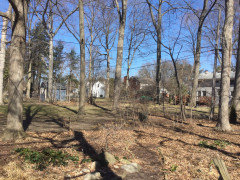
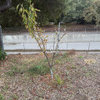
    Here is an attempt at a photo. I was having trouble posting it this morning. It may not be useful since it’s a winter photo. The area I’m looking to plant is between these two trees.

  • 5 years ago

    The closest two trees, that is.

  • 5 years ago

    Whatever you plant there will need special attention to watering for a few years to compete with the maple roots. Yews would be the first choice but I must say my brother has the Techny arbs mentioned in the link above growing in the same conditions as you have and they’re doing very well but they are not narrow. Just how much morning sun does that area get?

    tj

  • 5 years ago
    last modified: 5 years ago

    In my area 'Hicksii' can often be found in smaller pot sizes. With it being typical for nursery plants in general to increase markedly in price with every jump in pot size. So that if you have only looked at 5 gallon pot size or larger yews you haven't seen how much less these can be when you buy small ones.


    Regarding the planting site environment here's another pertinent aspect: do you ever see deer there?

  • 5 years ago

    Callirhoe123 - Thanks so much for the article. Some good tips there!

    Gardengal48 - Yes, It seems like my options are very limited. I did read a Michigan State Extension (I think) Article that suggested that cedars and some others will tolerate an understory planting if they are raised in shade...but of course I can’t find the article again.

    Tsugajunkie - Thanks, I will consider the techny if I come across a reasonable priced one.

    Embrothrium- you are right. Yesterday afternoon, I just saw some gallon size hicks at Home Depot for an okay price. Maybe They sell out fast, I haven’t seen them in smaller pots at HD or Lowe’s in the past.

    All- I’m thinking I might try an experimental mixed hedge with hicks, maybe bamboo if I can find it, and a few other part shade shrubs/trees. Water them well this summer and see what does best this year/next, then move out the struggling ones and replace with the survivor type.

    As an aside, I had a dream last night that I planted corn there and it grew up tall and screened the neighbors all winter. I woke up thinking “that would never work”. :D

    Thanks all for your thoughts!

  • 5 years ago

    Also Embrothruim- Deer and their damage is exceedingly rare. I’ve had one tree chomped 10 years ago. So I don’t worry about deer.

  • 5 years ago
    last modified: 5 years ago

    You can buy the bamboo online. I'm growing the Fargesia rufa and the taller F. nitida in a zone 6, 4000ft elevation that tests its cold tolerance.

    My experience is that it takes a season or two for Oregon grown bamboo to adjust to a colder climate. Early on after planting, in a no snow, polar vortex, high wind event it defoliated and had some dieback. The canes leafed back out in the spring, but the dieback slowed the height development. It also took a few years for the new spring growth to delay itself long enough to avoid spring freeze damage to tender new shoots.

    The most recent F. nitida I planted had the leaves frozen in normal winter weather. I expect it to leaf out and be just fine this spring.

    With your setting, the taller F. nitida might be preferred.

    Fargesia nitida "Blue Fountain" (bamboogarden.com)

    And the deer don't eat the bamboo. They really like all selections of Hydrangea arborescens though.

  • 5 years ago

    Christopher C Nc- you read my mind I was just looking at f. nitida and murielae at bamboo garden this morning. Thanks for sharing your experience!

  • 5 years ago

    My experience with Fargesia rufa is that it starts to winterkill at subzero temperatures. When the canes are killed, it takes about a year to get back to size.

  • 5 years ago

    I would stick to natives for your area. Of course, I am exceedingly anti-bamboo.

  • 5 years ago

    I bought my Fargesias from those Oregonians 15 years ago when I was in Michigan.


    F. murielae is very pretty and looks nice with everything.

  • 5 years ago

    Mad-Gallica - Thanks - sounds like rufa would not be a good fit for me.

    cyn427 - My preference would definitely be natives. But shade evergreens natives seem to be limited. Hemlocks have the concerns of woolly adelgid, I have a ton of hollies and I love them, but they are very slow growing and then there’s some cedar/thuja/arborvitae which are said to need more light.

    Fori - thanks! That is definitely under consideration then.

  • 5 years ago

    There is no reason to be "anti-bamboo" if dealing with any of the clumping species. They are NOT invasive and are not even very aggressive spreaders, often slow to establish and form a decent stand. In fact, they behave just as properly as most ornamental grasses, slowly increasing in clump size. And better than some since they do not reseed (flowering of bamboo is rare and extremely cyclical - every 60-130 years, depending on type).

    IMO, bamboo paranoia is overdone and is usually the result of being uninformed. btw, there ARE bamboos native to the US, Arundanaria species. But not going to be cold hardy enough to survive a MI winter and they are a running type as well, so would need confinement methods when planting.

  • 5 years ago
    last modified: 5 years ago

    gardengal, yes, the arundanaria bamboo is a running bamboo and containment is far from easy or successful. The Fargesia will spread a number of feet per year. You are certainly entitled to think the paranoia is overdone , but I have been dealing with it for more than 25 years and even if I rid my yard of it, it comes back from the neighbor's property and the woods where it chokes out native growth, so yes, I am paranoid. It is also taking over woods throughout the DC area which is problematic.


  • 5 years ago

    Fargesia doesn't spread any number of feet per year in places like Michigan--even in the warm part of MI where I lived.


    It's actually kind of frustrating!

  • 5 years ago

    "Fargesia doesn't spread any number of feet per year in places like Michigan--even in the warm part of MI where I lived."

    It doesn't even spread like that here in the PNW!! And this is bamboo heaven!! It is one of the reasons clumping bamboos carry a higher price tag than most similarly sized containers of running bamboo. It just takes so much longer for them to bulk up, let alone start eating real estate. Which they don't. Whatever is taking over the woods in the DC area, it is highly doubtful it is any kind of Fargesia! Pachymorphic bamboos - the clumpers - expand only a few inches a year. Leptomorphic bamboo - the runners - can produce rhizomes that extend many feet away from the mother plant, expanding at the rate of 3-15 feet per year, sometimes more.

    But FWIW, even running bamboo can be very successfully contained if you put the effort into it initially.

    It is perfectly reasonable to be dubious about the containment or invasive properties of running bamboos. But to be equally paranoid about the clumpers indicates a lack of awareness about their properties.

  • 5 years ago

    Was having trouble getting on this discussion with my iPad. But it works today? Thanks all, I will make sure to get clumping bamboo if I decide on bamboo.

    I did find some reasonable priced gallon hicks yews that are about 2’ high. I’m beginning to think I’ll just go with those...although they may take longer to grow high. The bamboo I was looking at sounds like it will need more water than the hicks. Also the hicks, while also not native, seems like it will be more of a backdrop, than a statement. Which is what I’d like.

    Thanks all for your help!

  • 4 years ago
    last modified: 4 years ago

    Mich-Bagn - Nice photo. I have yews I added. Hicksii I believe. I let them grow naturally without pruning much and they filled in great and are a wonderful screen in lots of shade. They are such a nice dark green background.

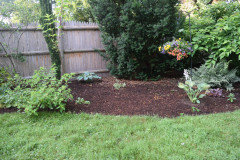
    I thought I'd add a photo of my mature Yew that is 10+ years old. I just cleared out a space there to add another shrub in front of it. I could have kept it trimmed to a conical shape, but this is what I was looking for, screening without the maintenance of a clipped shrub.


  • 4 years ago

    Pretty! I have always been fond of yews, especially in their natural form.


    A clipped plant in my yard is a plant that needs clipping. :)

  • 4 years ago

    Prairie moon- thanks for posting your yew photo. I would be thrilled if mine look as good as yours in ten years! I plan on letting my yews grow naturally too.

  • 4 years ago

    Fori - yes, I’m not into shrub trimming either, particularly in the back yard.

  • 4 years ago

    If you let them go free, nobody will know what kind of shrub they are! Okay, gardening types will recognize them, but many people will have no idea that it's the same plant as the square ones. :)

  • 4 years ago

    Mine were pruned once. I had someone helping in the yard one summer, and I have two that size and they both were looking a little messy, and this person, who worked for me, pruned them for me. I was so impressed at how talented she was with pruning tools. She didn't even realize it. She had only taken one course at a local Botanical Garden and was not doing it for a living at that point. I prune adequately but she just had to look at it and know exactly what to remove to create a great outcome. She didn't take that much off but it looked so much better. And quickly. And that trim she gave them matured with the shrub and I haven't really had to touch them since.


    Mich-Bagn - I would say that it did have some time in the beginning where I was asking myself if I did the right thing. It wasn't nice and dense but was gangly. But I was busy with other things and ignored them and every year they got better and better. Now I'm very happy with them. Good luck with yours!

  • 4 years ago

    Thanks guys!

  • 3 years ago

    Schip laurel?

Sponsored
Peabody Landscape Group
Average rating: 3.5 out of 5 stars8 Reviews
Franklin County's Reliable Landscape Design & Contracting