Software
Houzz Logo Print
bestany

Florida Dogwood in Chicagoland?

5 years ago

Hello,


I live in zone 5b. I love flowering dogwood trees and am considering transplanting a somewhat large-caliper tree (5"). The landscaper I am working with has sourced some from TN, though I don't know exactly which zone. My planting space receives full-to partial sun.


I've researched the different varieties-- florida, kousa, and the hybrids--enough to know that kousa is more hardy in my area, but I still love the florida dogwoods so much. At the moment my options for the somewhat mature transplants are Cherokee Chief and Cherokee Brave (I would prefer a white bloom, but this is what he found). From what I've read Brave has somewhat better disease resistance of the two. I could get a smaller Stellar Pink from Wisconsin, but again, my heart is with the non-hybrid!


My question is, basically: How stupid would it be to go ahead with a florida dogwood in Chicagoland? Would you do it? If I go ahead, what are your suggestions for giving it the best chance?


Thanks!

Comments (19)

  • 5 years ago
    last modified: 5 years ago

    @gardengal48 (PNW Z8/9) Thank you for the reply. It makes me feel better that you say it isn't stupid; I put it that way because I'm worried about investing growth years into a tree to have it die in winter (and of course the cost!). I know that's always a risk but I just don't know how big of a risk.

    If 5" caliper is too big for transplanting, how big can I go before the getting-established problem? Also, can you say more about what it would mean for a tree to be slower to establish? Would it take a number of years to catch up and end up almost the same as planting a younger tree?

  • 5 years ago

    i am due east of you just south of ann arbor ... i consider our climes the same ....


    i quit spending money on dogwoods long ago ... just too many losses .. usually just as the tree got established and was performing.. we would have one of those every ten year winters.. and they would die ...


    yet i see them randomly around the area at bloom time ... perhaps natives .. i dont know.. i just know i hate dogwood with a white hot passion for all that money i lost ...


    they are exotic to you ..; most likely because they are so uncommon in your area.. and they are uncommon.. because zone-wise.. you are borderline within their scope ..


    if you cant talk you out of it.. then i suggest you spend no more than $100 bucks on the biggest you can get at that price point ... and just give it time to get established [2 to 5 years].. and another 3 to 5 years to mature to full flowering capacity ...


    and btw.. the huge transplant will also take 3 to 5 years.. to get re established after 90% of its roots are cut off from moving to your garden ... you can not 'buy' time investing in root growth .....


    we do not live in the PNW where it will have near year around growth .. and if you live in ground freeze.. thats another few months either side of winter.. as the soil thaws or freezes ...


    in my BIASED opinion.. its just not worth it .. unless you are spending completely un needed money ... and all the power to you... if you got it ...


    ken


    bestany thanked ken_adrian Adrian MI cold Z5
  • 5 years ago

    "Also, can you say more about what it would mean for a tree to be slower to establish? Would it take a number of years to catch up and end up almost the same as planting a younger tree?"

    Exactly! In fact, in trials growing mature specimens alongside younger trees, the younger ones catch up to larger, more mature ones in just a few seasons. Unless I am required by HOA or municipal planting requirements, I never spec a tree larger than 3" caliper. And rarely any that big!

    btw, the native range of Cornus florida extends into southern IL (as well as most of MI, ken) so not so out of context for your locale. But you are on the cusp, so yet another excellent reason NOT to go with a pricey mature specimen. Locate something smaller and locally grown. And If it were mine, I'd locate where it does not receive all day sun and out of any strong winter winds.

    bestany thanked gardengal48 (PNW Z8/9)
  • 5 years ago

    Cornus florida grows wild here, so temperature isn't the real problem. Named selection chosen for disease resistance, not hardiness, may not be suited for the upper regions of the native range. I don't know enough about dogwoods to say.

  • 5 years ago

    The problem with jumbo transplants of any kind of tree is typically a smaller proportion of the root system is retained at digging time than with a smaller specimen.

  • 5 years ago

    Dogwood anthracnose disease is a problem these days....another reason not to spend too much on a tree.

    bestany thanked callirhoe123
  • 5 years ago
    last modified: 5 years ago

    Kousa dogwood might be better 'cause it is more resistant than flowering dogwood to dogwood anthracnose (which is in my area but don't know about Chicago).

    bestany thanked bengz6westmd
  • 5 years ago
    last modified: 5 years ago

    Why don't you call your cooperative extension agent and have a conversation- they are COUNTY specific and can tell you how C.florida does in your county with regard to both temps and anthracnose.

    Find them by googling "your state+county+cooperative extension."

    bestany thanked cearbhaill (zone 6b Eastern Kentucky)
  • 5 years ago

    @ken_adrian Adrian MI cold Z5 Thanks for the brutally honest take. That's why I posted the question, because I want to know! If dogwoods broke your heart or wallet repeatedly I can see why you'd hate them. What (if any) flowering trees have you planted in place of the lost dogwoods? I'm basically familiar with the options, I'm just curious what *you* chose.

    @gardengal48 (PNW Z8/9), @Embothrium I think you all are talking me out of the large tree, at least. I had another mature tree removed for various reasons, then after it was gone I was a little in shock, hence the large-tree longing. But I certainly don't have money to dump into a lost cause or no actual benefit. It has to be worth it.

    I appreciate all the responses and suggestions. And I'm still interested if anyone else want to share personal experience.

  • 5 years ago
    last modified: 5 years ago

    Agree with a lot of what has been said above, especially regarding proper siting as gardengal noted. Hardiness at your location could be an issue on more exposed sites (per the Morton Arboretum C. florida is "Considered borderline hardy in the Chicago area", and the Chicago Botanic Garden says "Alas, it struggles to maintain bud hardiness in northeastern Illinois"). I have Cherokee Chief in my yard and it was slow to leaf out with minor dieback after the polar vortex winters. It's too bad there aren't any (that I'm aware of) northern provenance disease resistant cultivars of C. florida (although Dirr notes that at least one major grower is working on it). The commonly grown cultivars of C. florida have all been selected from more southerly seed sources. I suppose it's possible you may be able to find a grower in your region with northern provenance (seed grown) trees. I'm not aware of any here.

    I'm guessing that anthracnose may not be too much of an issue at your location since native wild trees are uncommon there (C. florida is technically native to the Chicago area, but absent from the rest of northern IL). See this map of Dogwood Anthracnose. I subscribe to the Morton Arboretum's Plant Healthcare Report, and I can't remember seeing dogwood anthracnose mentioned.

  • 5 years ago

    Years ago it was noticed the level of anthracnose severity on flowering dogwood is apparently determined by how bad the ozone pollution is. With mapping of the two occurrences lining up like a hand in a glove.

    Out here the western analog Pacific dogwood is typically riddled with disease problems including anthracnose in built up areas and clean in parts of the mountains where there aren't any cities for some distance.

  • 5 years ago

    Which general area are you? Have you looked at Kousa Dogwood instead?

  • 5 years ago

    arbordave (SE MI) I know it's been a while since I started this thread, but I haven't made a selection yet. You mentioned you have a Cherokee Chief in your yard and that it gets some dieback after the vortex winters. Is it growing in size? I looked up on google maps a house where I used to live (same general area) where I know there was a dogwood planted. I don't know what kind! It's been a good number of years and the tree is still puny. *Maybe* only six feet tall but also as wide. I never knew the variety, and it was probably only starting to flower well when I moved, so all I know is that it had pink flowers and it's not dead (points for that!).


    But for my new location I need something that will grow in stature.


    I have been talking to a grower in Indiana (zone 6) who has Cherokee Brave (which has resistance to spot anthracnose and mildew), but he said Cloud 9 is hardier in his experience (though it doesn't have innate disease resistance).


    I could just go a different direction entirely and try a flowering cherry. I came across the one called Pink Flair from JF Schmidt. It's supposed to be healthier than other cherries with a fairly upright habit. Anyone with experience with this one? Also, are the roots of cherry trees usually big? The spot is about 8 ft from my house. https://www.jfschmidt.com/introductions/pinkflair/index.html


  • 5 years ago

    My Cherokee Chief has been in the ground about 8 years, and the back-to-back polar vortex years hit before it was well established. Dieback was relatively minor, and it has recovered well (it was a spindly 5-6' when planted, it's now 10' and well branched). I'd guess that Cherokee Brave has comparable hardiness to CC. I believe Cloud 9 was selected in the south, but it is supposed to have good hardiness and might be worth a try.

    Pink Flair is a sargentii selection so it will be quite hardy. Per Schmidt it should grow 25' x 15', so probably needs to be planted more than 8' from the house. The flowers are supposed to appear "a week or two later than is typical of the species" and are therefore less susceptible to frost/freeze damage. The Pink Flairs that I've seen so far (we've planted a few over the last couple years) seem to have a tendency to sucker from the rootstock.

  • 4 years ago

    I just saw this thread and thought I'd put in my 2 cents worth in case anyone is interested in dogwoods in the Chicago area. Bestany, did you finally decide on a tree? It would be nice to know what you planted.


    My favorite ornamental tree is the dogwood. Mainly Cornus florida but also the Kousa's and the many hybrids. I'm in the west/southwest suburbs of Chicago and between my house and my parents house I have planted many (over 30, unfortunately not all have survived).


    First, addressing your inquiry regarding planting a 5" caliper dogwood. DON'T! This is way too big for a dogwood transplant in our area. I'm even surprised that you found one that big. This is even larger than your typical shade tree transplant! 1.5"-2.5" would be ideal. For me I am generally planting potted dogwoods that only have .25"-1" calipers. The reason for this is because I generally look for unusual cultivars that only come in pots that I can fit in my car when I travel. The Chicago area is not usually stocked with dogwoods due to us being at the northern zone of it's hardiness. That being said I have found a number of named varieties over the years at the big box stores, including your Cherokee Brave. HD and Lowe's will always carry an unnamed generic white dogwood every year in a 5 gallon container.


    So regarding cultivars...Cherokee Chief is not reliable (my experience) here in the Chicago area. It's just a well known old variety that people know the name of. Cherokee Brave is superior and more hardy. For white I would choose Cherokee Princess. I have a Cloud Nine but it does get quite a bit of mildew every year. I also have an unknown variety that was sold to me as a Cloud Nine but has a different tree habit and flower shape. This one has not failed to bloom in the perhaps 20 years since planting. Regarding the anthracnose disease you are direly warned about... you really don't need to be worried about that here in northern Illinois. There's not many people growing Cornus florida for there to be any spread. And we don't have any wild populations in the forest for any infections from that route.


    A mention about Kousa dogwoods for those interested. Generally these are more disease resistant (true) and are touted as being more cold tolerant (not necessarily). Here's some observations from a few years back. During our polar vortex of late January 2019 (remember that?!), we experienced temps down to -23F with wind chills in the -50F range. All of my Cornus florida came through fine. (Although many flower buds were affected). No dead branches. Cornus kousa on the other hand were either killed completely or had severe branch damage. I think the wind chill coupled with the cold had a huge part to play. We also lost many weeping Japanese Maples in areas northwest of the city. These are known to not like the desiccating winter winds.


    For those not tired of my ramblings yet, here are my thoughts about a few of the hybrids out there. I've had fairly good luck with the Rutger Stellar hybrids. These are a cross between our native dogwood and the Kousa dogwood. Very cold winters have limited their floral displays although the trees themselves are fine. These were produced to be anthracnose resistant due to the problems on the East coast. My one word of advice. Stay away from Stellar Pink. If the temperatures become warm when it's opening (which many times they are since they flower after the native dogwoods), the color will be a washed out "dirty" pink. This includes any of the straight Kousas like Satomi. Enough for me to cut down extremely healthy and robust trees. The new variety out of Rutgers that is not supposed to fade is Scarlet Fire. I'm testing that one out now and so far the color is beautiful. The other hybrid that needs a mention is Venus. This is a cross between the native west coast dogwood Cornus nuttalii, and the Kousa dogwwod. The flowers (or should I say bracts) are ginourmous, 5-6" across and a bright white. It's a showstopper. Mine is still small but did survive the polar vortex on the east side of the house.


    One last note about growing them here in the Chicago area. Normally dogwoods are considered understory trees so many people will plant them in the shade. In our area it's best to give them either full sun or at least half day sun. They will flower much better. The flower buds need a certain amount of maturity before going into winter. I've noticed the hotter and sunnier the summers are the earlier the buds mature. That's why I think they do better on the East coast where the summers are warmer and longer (just a thought). A small underdeveloped bud will usually not bloom the next year. Usually if they reach a quarter inch then they are fine. Except of course when we have an extremely cold winter which then even a mature bud may not bloom or just 2 of the 4 bracts may open.


    Well done for now. I will attempt to add some photos so you can see that dogwoods do grow here in the Chicago area.


  • 4 years ago

    Oh another thing Bestany. You were mentioning about choosing a cherry over the dogwood. That would be fine since the Pink Flair cultivar is hardier than the dogwoods. However I should point out that cherry blossoms are very fleeting. Usually a short week of bloom. The dogwood bloom is effective for a longer period due to the bracts being the showy part (think poinsettia), so the floral display is about twice as long.

  • 4 years ago


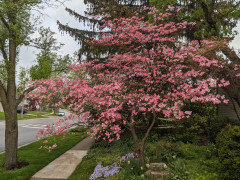
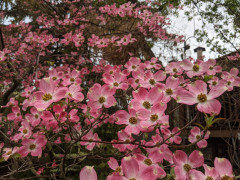
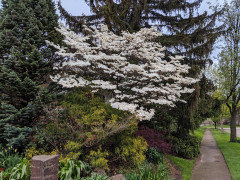
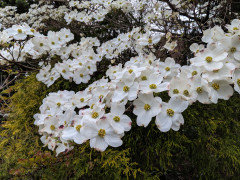
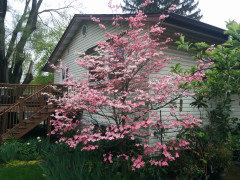
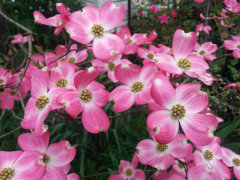
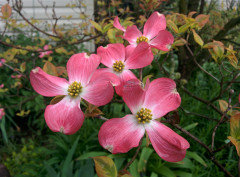
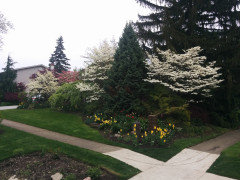
    Here's some pictures over the years.


    Photo 1 & 2 are Cherokee Brave

    Photo 3 & 4 are unnamed cultivar (sold as Cloud 9)

    Photo 5, 6 & 7 are Cherokee Sunset (notice the variegated leaves emerging in last slide)

    Photo 8 General house view


    Hope you enjoyed!

Sponsored
Peabody Landscape Group
Average rating: 3.5 out of 5 stars8 Reviews
Franklin County's Reliable Landscape Design & Contracting