Software
Houzz Logo Print
sd2102

Daphne getting too much sun?

5 years ago
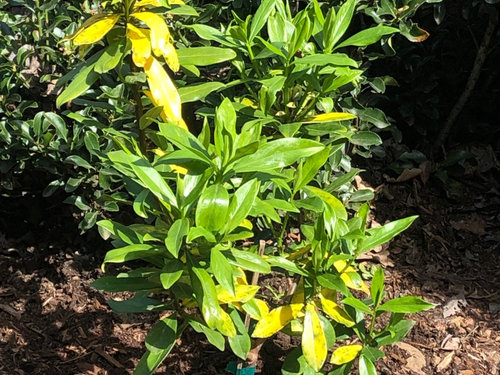
I planted Daphne odora 'Zuiko Nishiki' earlier this spring. We had some extremely hot/dry weather over the past few weeks and now I'm thinking the plant may be in a spot where it will get too much sun. It's a weird part of our yard (north side of the house) that is fairly shaded in part where I have Hellebores growing but transitions to a full sun area where I have lavender and rosemary. And the yard is not a big space- less than 10 feet wide I think, so it's a quick transition from part shade to full sun.

The Daphne did alright until a few weeks ago when I noticed damaged leaves. I thought this was due to the ice storm we had back in mid-February, but the leaves keep turning yellow. But since the plant has been getting so much sunlight the past few weeks, I'm beginning to think it may be too sunny there.

I'm thinking of transplanting it, and I have an area that might work great, but I recently learned that I have an invasive flower growing there that will need substantial digging to try to get out.

So I guess my question is, how late is too late in the season to transplant this Daphne? I only got it in the ground in early February.

I have another area I could move it to on the side of the house, but we'd never really see it or smell it in that location. But I guess that would be better than losing the bush entirely.

Here's a picture of the plant.


Any thoughts?

Thanks!


Comments (5)

  • 5 years ago

    Check soil moisture.

  • 5 years ago

    you planted it no more than a few months ago .. and within a month of that.. you have yellow leaves ...


    that is stress from shipping from grower.. to seller to you.. and how you planted it ... why dont you tell us about that ...


    do not stress it more by moving it again ... perfect watering.. if you want.. shade it ...


    and in fall when it over all those stresses.. move it if you want ...


    most alleged shade plants are only tolerant of shade .. and they can do very well in sun .. even full sun sometimes .. if you can provide the water necessary for them to grow there .. in other words.. its not simply a sun issue.. its the amount of water they need in full sun ...


    and in the PNW on the north side of the house.. im thinking you arent dealing with intense sun .. nor extreme dry ...


    take a trowel or tablespoon.. and dig a few 3 to 6 inch holes.. AND FIND OUT ABOUT MOISTURE AT DEPTH.. and then water accordingly ...


    and be patient ... other than stress .. nothing happens that fast in the garden.. a couple weeks .... or a month or two.. isnt that long .. especially with shrubs and trees .. and this is a shrub .. not a perennial .. meaning only.. things dont happen all that fast ...


    try not to kill it with too much love ... and no.. its stressed.. fert wont help .. and i hope you didnt throw any in the planting hole .. but if you did.. nvm ...


    ken


  • 5 years ago

    I'm admittedly new to outdoor gardening, but from the many plants I've put in our yard over the past two years I've never seen this continuous yellowing/leaf drop, including a Daphne I planted last year that does get some dappled shade.

    But I will pay closer attention to the moisture (which I am definitely not as careful about as I am with my indoor plants) and see how it does by the fall.

    I prefer plants that don't need a lot of fussing and if this Daphne can't survive where it is with minimal care then I may need to pick something else anyway.

  • 5 years ago

    Daphne are prone to root rot, which they can be infected with before purchase anytime they have been displayed in or near dirty puddles or other sources of infection with water molds.


    Otherwise any plant placed in the ground with its roots growing in potting soil may be subject to the natural soil around it having a greater attraction for water than the coarser textured potting soil. So even during generally moist climate conditions the recently planted specimen can be needing to be watered. This situation remains until it has rooted out well into the natural soil around it.


    The still widely advocated and practiced amending of planting hole backfill with bark, compost, peat etc. only creates a third area of differing soil texture for the plant to have to survive in order to become established. Rather than doing anything to assist and promote establishment.

  • 5 years ago
    last modified: 5 years ago

    Yes, I've seen all the heartbreak on this forum with Daphne. It is really common where I live, however, so we'll see how the two I planted do.

    Worst case, it dies and I have to replace it. I've already gone down a rabbit hole on my local nursery's website to figure out what I might replace it with next spring.

    And then I'll plant another Daphne in the backyard in the part shade area which will hopefully be free of invasives by then:)