Software
Houzz Logo Print
webuser_774792562

Fiddle Leaf Fig - New leaf is oddly shaped / bottom leaves yellowing

5 years ago
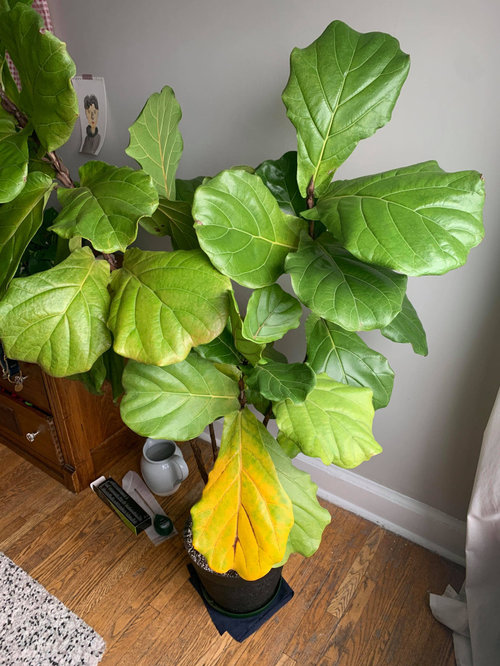
Hello,


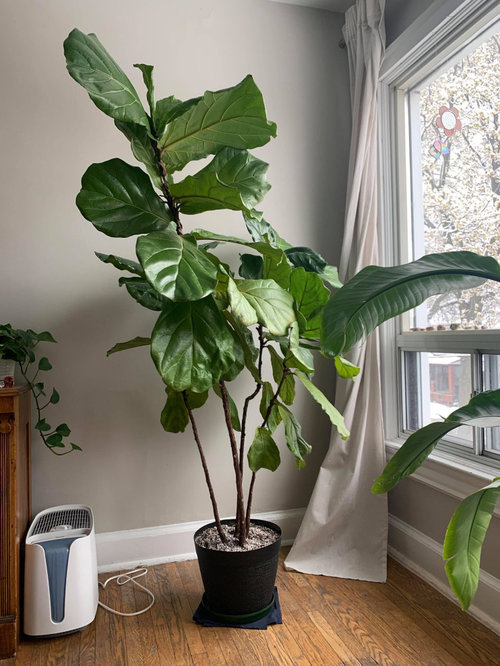
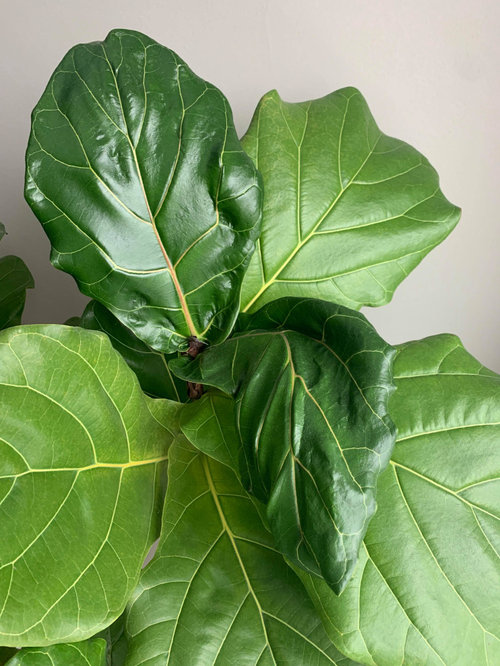
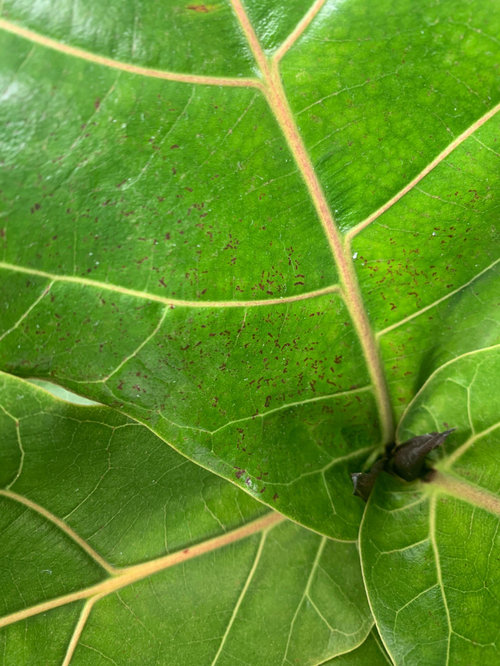
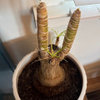
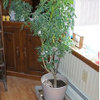
I have had this Fiddle Leaf Fig plant in the same spot (east facing window) since 2018. September 2021 bottom leaves start yellowing but new growth was still coming in. Realized the plant was incredible root bound since it had never been repotted from its 10" nursery planter that it was purchased in. Potted it up to a planter that is 12" in February. After repotting some bottom leaves are still continuing to yellow and a new leaf has come in misshapen and some with brown spots.


Any advice or recommendations is greatly appreciated thank you!


Comments (9)

  • 5 years ago
    last modified: 5 years ago

    When you potted up, you didn't negate the effects of the root congestion (rootbound) in the main root mass. The 2 most conspicuous symptoms of root congestion are a loss of older/interior foliage and a decrease in extension growth (branches.stems elongating); although in summer the effects might not be as conspicuous. As the congestion in the root mass increases, you can expect the symptoms to increase. Even though potting up can cause what most growers perceive as a 'growth spurt', it really isn't. Potting up temporarily eases a bit of the stress associated with root congestion, but until congestion in the main mass of roots is corrected by the grower, most of the limiting effects will still be robbing the plant of the lion's share of its potential.

    Calcium is essential to the normal formation of cells/tissue. For this reason, it must be in the nutrient stream at all times. If not, you get misshaped NEW leaves, often with hooked tips or holes. There might be an actual scarcity of Ca in the soil, but more often a cultural influence limits the plant's ability to take up the soil's already plentiful supply, the main cultural offenders being over-watering and soil compaction. Do you fertilize regularly?

    Loss of lower leaves can be light-related (new foliage shading out the old or a change in locations that reduces light load), a drought response due to over-or under-watering, a nutritional deficiency of one of the nutrients considered to be mobile in the plant, usually N, but deficiencies of P, K, and Mg are known to cause shedding of older leaves; this, because the plant robs mobile nutrients from old foliage in order to provide nutrients for new growth, after which the leaves are shed.

    Now, think about the potential causes I mentioned (if you like) and see which ones you think are not affecting your tree.

    Undoubtedly it needs a full repot, and the best time to do that, if you live in the Northern Hemisphere, is in the first half of June. I have a large number of Ficus I've been tending for many years, all in very good health, as the images I've shared here show, so I'm very familiar with their wants, needs, and idiosyncrasies.

    Al

  • 5 years ago
    last modified: 5 years ago

    Hello Al,


    Thank you so so much for your very detailed response! This is incredible helpful and your knowledge and time spent replying is greatly appreciated.


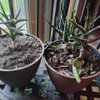
    When it was repotted the dirt was almost all shaken out, before being potted up. I attached an image of the root ball before the dirt was shaken out.


    Do you feel as though maybe it should still be repotted? What steps should I do differently? And should I wait until June or repot immediately so the plant doesn’t suffer any further?

    As per your fertilizer question, this plant was fertilized for the first time since purchased about 2.5 weeks ago with 'Fiddle Leaf Fig Plant Food' image attached as reference.


    Thank you in advance for all your help!


  • 5 years ago

    "When it was repotted the dirt was almost all shaken out, before being potted up. I attached an image of the root ball before the dirt was shaken out." ..... good that you removed all or almost all soil. We can talk more about your next repotting session if you like, but I'll provide some images of a Ficus repot so you have a better understanding of how tolerant they are of rootwork.

    Ficus benjamina "Too Little"


    Some soil and perimeter roots removed:


    Soil has been entirely removed:


    Rootwork finished - ready to be potted. Notice the size of some of the roots removed. All roots remaining are fine/small diameter.


    Repotted and top rough-pruned.

    "Do you feel as though maybe it should still be repotted? What steps should I do differently? And should I wait until June or repot immediately so the plant doesn’t suffer any further?" I apologize. I assumed that you would have up-potted only - not realizing you removed all the soil. The only reason I would suggest you repot it again is if I thought the grow medium it is currently in is going to be too water-retentive. There is a world of difference when you're using a grow medium that works FOR you, instead of at cross-purposes to your efforts.

    If you didn't cut back all roots circling the pot, I'd repot June '22. If you did - June '23. Every other year is normally best for the plant's health and development, but I'll leave you to decide what you want to do. I'm usually always around here trying to help, so it's not like this has to be our last exchange of ideas.

    Did you notice, when you repotted, that most of the roots were crowded into the space between the soil mass and the pot wall? That is because the medium the plant WAS in did not supply enough oxygen to the roots; so, the only place in the pot that provided an adequate oxygen supply is in the void formed when the soil mass started to shrink away from the pot walls as the grow medium dried down. Roots can't "grow in search of" an adequate oxygen supply, but when they find water, air, and nutrients, they grow there. Notice how roots of the plants colonize the entire soil mass when they are in a highly aerated, fast-draining grow medium:


    When you consider that fine roots do the lion's share of the heavy lifting for the plant, you can see how essential (a prerequisite, actually) a healthy root system is to a healthy plant.

    "As per your fertilizer question, this plant was fertilized for the first time since purchased about 2.5 weeks ago with 'Fiddle Leaf Fig Plant Food' image attached as reference." I'm really sorry, but by way of my calculations, the product you bought is hyped to the max. The owner or co-owner of the company was here 3 years ago trying to hype the product. We had a back and forth conversation that essentially focused on whether people were being scammed. This is how it eventually played out, her offerings begin paragraphs (3) in bold.

    **************************************************************************

    Our NPK percentage is 3-1-2. That's NOT what your advertising says. From amazon: "Fiddle Leaf Fig Tree Plant Food for Ficus Lyrata – Calcium Fortified, Urea-Free and with NPKRATIO of 3-1-2 [my emphasis - your words] for Healthy Roots, Stems and Leaves (8 Ounces)."

    When you tout a 3:1:2 RATIO, the actual NPK % could be minuscule, which in your product they most certainly are. There is a very big difference between a fertilizer's RATIO and its NPK %s.

    I'm not sure where you are getting your information from. This doesn't take a rocket scientist to figure out. Witness that 1 teaspoon of your product makes 2 cups of maintenance strength solution (use every time you water). 1 teaspoon of Foliage-Pro 9-3-6, a legit 3:1:2 RATIO fertilizer, makes 4 gallons of maintenance strength solution at a tiny, tiny fraction of the price you charge for your product.

    If you'd like to develop your own fertilizer for ficus lyrata, you are welcome to use whichever formula you'd like. There is no need for anyone to formulate their own fertilizer. They can buy better than you offer at a tiny fraction of the price. In fact, I'd bet large you don't "formulate" or manufacture your own product unless you consider buying a product like Foliage-Pro 9-3-6, then diluting it to minuscule NPK %s and selling it as a fertilizer "created specifically for Ficus lyrata" (which is prima facie absurdity in itself).

    Folks - a 3:1:2 NPK ratio fertilizer (like Foliage-Pro 9-3-6) is indeed great for almost any commonly grown houseplant and all Ficus species, but please beware of what you buy. It's almost always wise to be wary of products that make absurd claims, but don't even tell you what's in the product.

    ************************************************************************************

    8 oz of the product you have makes 384 oz of maintenance dose solution. The same volume of Foliage-Pro 9-3-6 costs less than 1/3 the amount of what you have, and makes 24,576 ounces of solution with the same NPK %s (3:1:2); so, it makes 64X as much at 1/3 the cost, which means (at that time) they were asking people to pay 192X as much for their fertilizer; this, w/o revealing what's in it, the source from which it derives it's nitrogen, and whether it contains any nutrients other than simply nitrogen, phosphorous, and potassium. I estimate the actual NPK % of the product you have to be about 0.28 : 0.09 : 0.06, almost nothing, less than 1/2 of 1% (.043%) of nutrients, the rest water. I feel bad for telling you, but I'd feel worse if I didn't.

    Foliage-Pro 9-3-6 makes an excellent 'go to' fertilizer for all your potted plants except perhaps for hibiscus and tomato, a couple of rogues.


    Al


  • 5 years ago
    last modified: 5 years ago

    @tapla (mid-Michigan, USDA z5b-6a) thank you for sharing!! I keep seeing it suggested in facebook and it was very suspicious given the price and percentages. definitely good marketing on their part and pushing innocent people who dont know a better alternative is available .

    If I may - what encourages bigger leaves on a ficus lyrata? From my very little reading on bonsai I understood that a higher photo load would result in smaller leaves. Is this correct? Am I over simplifying?

    Also how much root flare is recommended to expose when repotting?


    many thanks!!!

  • 5 years ago

    What I think that outfit did is, bought a barrel of FP 9-3-6 and diluted it to a ridiculously low NPK percentages, which still ALLOWED them to say it was a 3:1:2 RATIO. How else could you mix a full teaspoon of a soluble synthetic fertilizer into only 2 cups of water? That fact alone is enough to give pause and wonder whassup? They PACKAGE similar products that are equally suspect. I think that spreading the word would be a great service to the growing community.

    "If I may - what encourages bigger leaves on a ficus lyrata? From my very little reading on bonsai I understood that a higher photo load would result in smaller leaves. Is this correct? Am I over simplifying? All species of the mulberry family (Moraceae) are genetically programmed such that each successive leaf on any given branch will be larger than the leaf which emerged immediately previous.

    Low light does indeed encourage large leaves (a mechanism that increases the o/a area of plants' photosynthesizing surface). It also increases internode length (distance between leaves/nodes).

    Young trees have larger leaves than older trees because the o/a energy supply must be divided between a larger number of growing points. Bonsai practitioners direct much focus toward increasing their trees ramification (branch and leaf density), taking advantage of the fact that building ramification decreases leaf size, which makes the leaves appear more in proportion to the rest of the tree.

    Also how much root flare is recommended to expose when repotting?" All of it. you should see the tops of the large roots radiating from the trunk. That should be standard for the average tree growing enthusiast. Bonsai practitioners very often purposely produce exposed root compositions. Back to the root flare ..... often, there will be lots of small adventitious roots above what the hobby grower should consider to be the beginning (from top down) of the plant's roots. These small should be severed near the trunk and rubbed off after they dry. Planting too deep was what caused them in the first place. The habit of planting too deep (common nursery practice) limits gas exchange in the lower trunk; and something even more serious, the moist soil can rot through the bark and cambium, which slowly kills the root system and the tree.

    The tree below was layered off the roots it had as a seedling. The tap root was long and very large and wouldn't look good on a bonsai. You can still see the wire I used as a tourniquet to do the layer.


    I actually chose where the roots should grow above the tourniquet using this trick I discovered on my own many years ago. See below.

    I used a 3/16" brad-point drill which I spun with my fingers until I had removed the pith beneath the cambium (holes above the tourniquet only). Then, I dabbed a generous amount of Dyna-Gro's waterproof Rooting Gel into the wounds left by the drill. This produced many roots from each wound that soon fused together. I use this trick very regularly, but have since gotten away from using the zip ties and went back to the wire tourniquet.

    This is an image of one of my scheffleras, from a cutting, with exposed roots grown over a rock.

    You can tell it's old and has been on the rock for a long time because of how completely the roots are mated to the rock.

    Al

  • 5 years ago

    Al thank you for the really detailed answer! Its very much appreciated ☺️ i love this forum for this exact reason and ive learnt so much

  • 5 years ago

    Thank you for the kind words! Love your enthusiasm.

    Al

  • 5 years ago

    Thank you so so much Al!


    This is all so so helpful. I got some Foliage-Pro 9-3-6 and will start planning my next steps. Thanks again for taking the time to help me out and providing such helpful information and pictures.


    Lisa


  • 5 years ago

    My pleasure. Good luck!

    Al

Sponsored
Kuhns Contracting, Inc.
Average rating: 5 out of 5 stars26 Reviews
Central Ohio's Trusted Home Remodeler Specializing in Kitchens & Baths