Software
Houzz Logo Print
jhoff86

Help! Newly installed tile floor is cracking

5 years ago

Just replaced old floor tile that had multiple hairline cracks. We used an installer that has been doing tile for 25 years and came highly recommended by multiple people. He poured concrete to even out the subfloor and put in the new tile about a month ago. I was just cleaning the bathroom floor after my contractors finished painting and saw a giant hairline crack spanning multiple tiles. How can I fix this? I can easily grab a box of tiles to replace the cracked ones but I’m worried this will happen again.


Comments (14)

  • 5 years ago

    Oh that’s so unfortunate! Yes, this kind of crack is indicative of flexing in your joists, not just isolated to the tiles, so if you replace the tiles it will likely happen again. Experienced tradesmen are great, but they often (sorry guys) use the same methods they always have and are sometimes resistant to adopting new industry techniques and materials. Using an uncoupling mat might have avoided this. It is a layer between your floor and tile that allows the tile and floor to make those micro movements independently. While uncoupling mats aren’t brand new exactly, if all he did was put cement down, that wouldn’t have fixed the cracking issues. I don’t know what your options are other than taking it all out and redoing it with better prep. Hopefully pros here will have good advice.

  • PRO
    5 years ago

    It will crack again. Lack of uncoupling membrane and/or expansion joints and/or the floor wasn't stiff enough to start.

  • 5 years ago

    thanks guys, would it be possible to just take out that row of tiles and put down a membrane in that area? Or does everything need to come out?

  • 5 years ago

    @Joseph Corlett, LLC i just spoke to the installer and he said that he would pull up the broken tiles and some of the surrounding ones, install a flex membrane underneath land then reinstall new tile. Does that sound like a decent solution?


    Also, i have another bathroom next to this one thats separated by a wall. if the issue is with the joist, wouldn’t I see cracking in that bathroom as well? I’ve just double checked the floor in there and there’s nothing, it looks solid and sturdy.

  • 5 years ago

    What you have is a subfloor that is not stiff enough to handle tile (assuming this is a wood-joist/plywood structure). OR...you have concrete slat that was never dealt with properly between floor #1 and floor #2.


    As we all know, "The definition of insanity is doing the same thing over and over again and expecting different results."


    The fix = BEFORE #2 tile floor was installed (and after the old tiles were removed) you paid $2-$4/sf to 'stiffen' the subfloor. The added SLC = more weight...but NO ADDED stiffness. The deflection rating of the wood-joist subfloor was not dealt with. Or...if this is on concrete then the SLC was not properly ground down/filled in to get the correct 'flatness' rating.


    Now that the problem is there, the Tile setter is responsible for 'fixing' his error for the damaged tile (remove and replace). BUT....here's the BIG BUT...you as the homeowner are responsible for PAYING FOR the correct subfloor work in the first place. If you did not pay for the subfloor to be 'stiffened' (no...cement backer board is NOT a product that adds stiffness) then you (very sadly) 'got what you paid for' = nothing.


    Example: Homeowner (HO) pays $12/sf for labour + materials for tile installation. No contractual mention of decoupling membrane is mentioned. Tile Setter (TS) does not mention it. The item is therefor not paid for and not installed...as per contract. The HO then pays $2/sf for tile removal. And then pays an additional $1/sf for subfloor preparation (light sanding...a little bit of SLC...nothing major). The home has already shown it will cause tiles to crack. All work is done to contractual obligations discussed/agreed upon at time HO hires TS.


    One month later tiles are cracking along a ridge in the subfloor (see photo in post). Who is responsible? Sadly, a bit of both. The TS is responsible for the replacement of cracked tile in the house. The HO is responsible for paying for (and then getting) the subfloor to the point where it can and will successfully accept new tile.


    So is the TS suggestion 'a good one'? It is from his/her point of view. Is it going to fix the home's situation? Nope. Not one iota. Not one jot. Hmmmm. Now what? The cost of the matter is the ONE THING that would STOP the 'fix' from happening. As HO, you will be responsible for paying for the full replacement cost of the tile floor (TS will probably offer the labour to remove the tile and then a discount on the 'new job' labour) and the real cost of subfloor deflection upgrade (again...this is assuming there is plywood underneath).


    I'm sorry but there is no happy ending or quick fix for this. The issue lies beneath (literally) all the tile you just paid for and all the labour costs you just paid for to install them. The fix is to remove, remedy and then install new tile.

  • 5 years ago
    last modified: 5 years ago

    @SJ McCarthy this bathroom is on the second floor of the house. There is another bathroom (divided by a wall) next to this one. Are the subfloors different in each bathroom? Why would one bathroom experience cracking and not the other? If it makes a difference, the bathroom having no issues with the tile in it is much bigger.

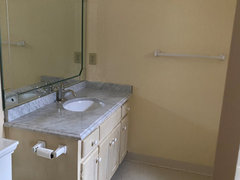
    How does one go about figuring out deflection rating and all the other stuff you’ve talked about? Its a small kids bathroom, we literally just paid the guy to demo and put in new tile because the old tile was gross (from 1982) and looked like this (notice that giant horizontal crack). I assumed someone dropped something heavy on it and cracked it.


    The new crack is vertical and completely straight. After the demo, our tiler did mention the subfloor was uneven so he evened it with concrete and let it set for a few days before starting to tile. What do we even need to add to the subfloor? I’m not knowledge at all about this stuff. Could our new solid wood vanity also be stressing the floor?

  • 5 years ago
    last modified: 5 years ago

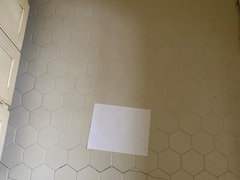
    @SJ McCarthy if it makes a difference, this is the before. The crack ran vertically in an uneven way across the floor:


    The new crack runs parallel right where the new vanity is (hard to see in this photo but it basically runs the length of the vanity that I marked in red). And as you can see the new one is completely straight, almost like someone took a knife to it. The old one was crooked:


  • 5 years ago

    @SJ McCarthy if it makes a difference, this is the before. The crack ran vertically in an uneven way across the floor right where the toilet was:


    The new crack runs parallel right where the new vanity is (hard to see in this photo but it basically runs the length of the vanity):


  • PRO
    5 years ago

    "@Joseph Corlett, LLC i just spoke to the installer and he said that he would pull up the broken tiles and some of the surrounding ones, install a flex membrane underneath land then reinstall new tile. Does that sound like a decent solution?"


    I will be amazed if that works permanently.

  • 5 years ago
    last modified: 5 years ago

    Deflection ratings have to do with joist spacing (find and measure) AND the total thickness of the subfloor. The wood stuff makes the floor STIFFER. The heavy stuff, like levelling compound, tiles, vanity, mortar, tub, counters, etc. ALL cause the wood to sag.

    Now imagine the support joist(s) are under the BIG bathroom, whereas the SAG is in the small bath. It can be as simple as that.

    The way to stop the cracking? Add MORE plywood before you do this for the 3rd time (with the same results).

  • PRO
    5 years ago

    Agree with the above - you need to figure out what caused the problem before you fix, otherwise you're just hoping instead of fixing.


    Deflection may be the problem, make sure either you or your installer check your framing (there's a decent calculator here: https://www.johnbridge.com/vbulletin/deflecto.pl


    Could also be an issue with mortar coverage - I recently did a repair where the original installer left an entire 2" line down the middle of the bathroom without any mortar :(


    Could be a thick self-leveling underlayment without needed lathe to reinforce.


    As an aside, I would hesitate to use a uncoupling membrane for a repair - they run 1/8" thick, and you'll have a hard time getting the tiles to be at the same level.

  • 5 years ago

    @Ripped Jeans Construction so I just popped over to the store to grab some of the hex tile (I didn’t buy it before, my husband did), and I think I’ve actually realized the issue. The tile we have is rated as a wall tile, NOT a floor tile. 🤦‍♀️ The smaller version of it is rated as a floor tile. Could this be why it cracked?

  • PRO
    5 years ago
    last modified: 5 years ago

    @jhoff86 Like millworkman said, it's a contributing factor (wall tiles usually aren't as strong) but unlikely to be the only issue. Like mentioned above, could be deflection or an installation error. :(

Sponsored
AIS Renovations
Average rating: 4.5 out of 5 stars15 Reviews
Custom Craftsmanship & Construction Solutions in Franklin County, Ohio