Software
Houzz Logo Print
webuser_59995391

bathroom tile mishap!

5 years ago
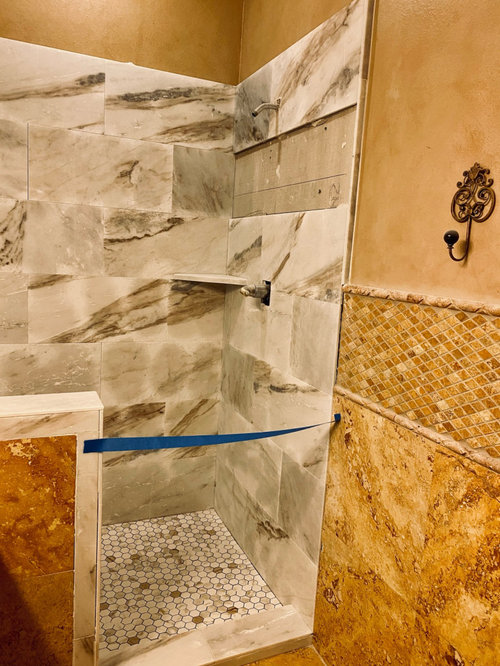
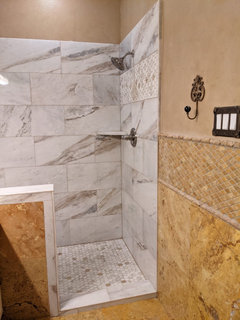
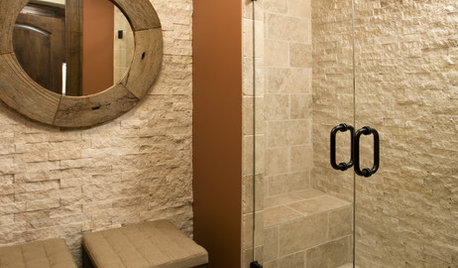
Just bought a house and there is this orangy guest bathroom that we are not crazy about. The whole bathroom wall is orange and grey travertine tile ( mostly orange/peach) as you can tell.

We changed the shower tile hoping to match the grey parts of the wall tile wall and tone down the orange vibe feel it looks disconnected now.

Any suggestions?? Should we paint the walls grey to tie it all in? The vanity is white.

Comments (16)

  • 5 years ago

    I can see how the original features would feel difficult to work with. I think to salvage this, you're going to need to remove the old tile. There is a lot of clashing here between the scale of the patterns, styles, and (most importantly) undertones of the new versus the old tiles. The older stuff looks like an early 2000s faux Tuscan style, while your newer tiles lean modern.


    I'm all for eclecticism in design, but I'm not seeing anything here that relates between the old and new stuff. It might be the photo (or just water, or the tiles were just set), but it also looks like there's some sort of staining on the new tiles. I see large ovals showing through on some of them.

  • 5 years ago

    Hi Anna I’m no pro but I agree with kpkowski. I think the styles are too different to work. I cannot speak to the spits on the tiles mentioned above, but I’d investigate that. I hope some pros will jump in an offer suggestions. Best to you!

  • 5 years ago

    Unless you have proper waterproofing, you’ll have a whole ‘nother problem shortly. Your exposed piece of cement backer board hints at that lack of proper waterproofing.

  • 5 years ago

    Not sure if the budget will allow for complete tile replacing 😩

    The tiles have just been set and not yet grouted.

    Ok thanks for your help!!

  • 5 years ago

    Anna, you do know that grout is not part of the waterproofing system, right? Grout does not contribute to waterproofing. Not a shower expert to the point I'd build one DIY but that cement board does not look to code to me...

  • 5 years ago

    Your shower is not waterproofed properly and it will create more problems down the road.

  • 5 years ago

    Aww Anna... I feel your pain. And nicely said, kpkowski.

  • 5 years ago

    Providing your new tile is properly waterproofed and you hate the colors, you can always paint walls as well as tiles. DIY easy too and helps with frustration. Pull light color out of new tile and and paint away.

  • 5 years ago

    Thank you everyone ! Took care of the waterproofing issue with the tiling guy. That exposed peice was for an accent tile and he did put waterproofing.
    Thanks for looking out!@kpkowski thanks for some solid advice!
    I’ve never posted here and so glad I did!

    After the grout was done it looks a little better I think.

  • 5 years ago

    Here it is

  • 5 years ago

    "That exposed piece was for an accent tile and he did put waterproofing."


    You cannot waterproof this piece meal. The entire shower needs one waterproofing system before any tile in laid. Thee joints need to be taped with non-alkaline tape and covered in thinset. he is feeding you a line of bs I am afraid.

  • 5 years ago

    Anna - I know that it can be extremely upsetting to read comments on here about waterproofing issues when you only posted about a design question - BUT - please do not ignore these comments. If you’ve hired someone to complete this shower, he/she was required to perform the work correctly.


    Even if you’ve failed to enter into a written contract, most (if not all) states require that the work is completed in a good and workmanlike manner, and in compliance with applicable laws. Also, unlike what some people might tell you here on Houzz, even if the bid you accepted was lower than it should have been for the amount of work, that doesn’t give the contractor a “free ride” to do a crappy job/not comply with applicable laws.


    Statutes have been enacted to protect homeowners - in my state, there are specific statutes applicable to home renovation services, plus our consumer protection statute has also been used by the appellate courts to protect homeowners in situations similar to what you have going on in your bathroom.


    PLEASE discuss this with your contractor. Your accent border SHOULD NOT be waterproofed separately if that’s what you’ve been told. That simply is not how it works. There could be waterproofing that was done behind the cement board - but that’s seems to be less typical.


    Ask him/her to explain the process used to waterproof the shower. Once you have that information, please come back here and post exactly what you’ve been told. While I’m not an expert re: waterproofing showers, I am going through a bathroom renovation currently - and had to stop work on my shower because I caught something wrong (and confirmed my suspicion with pros here on Houzz and on the John Bridge Tile Forum). It’s an uncomfortable conversation - but this HAS to be done correctly.


    If he/she failed to waterproof your shower, it can cause THOUSANDS AND THOUSANDS OF DOLLARS WORTH OF DAMAGE TO YOUR HOME!


    I also am happy to help point you in the right direction from a legal standpoint once the pros are able to access your situation. If you have any questions, please do not hesitate to ask.

  • 5 years ago

    @dani_m08 I’m about to start bathroom remodels - where do I find step by step of how waterproofing is supposed to be done? I want to stay on my GC after reading this, especially since my daughter‘s health cannot handle more mold exposure!

  • PRO
    5 years ago

    elizabeth_eclectic Your attention should be on the qualifications of the tile installer BEFORE work is started. Here is what you want to know:

    LOOKING FOR A QUALIFIED TILE INSTALLER?

    14 QUESTIONS YOU SHOULD ASK TO FIND A GOOD MATCH FOR YOUR PROJECT.

    1. Do they have liability insurance and if they have employees, are they covered with Worker’s Compensation Insurance?

    · Make sure you can verify appropriate insurance coverage.

    2. Are they licensed (if required in your area)?

    · Verify. Some states do not require tile contractor’s to be licensed.

    3. How many years have they been working exclusively as tile installers?

    · It takes many years to become proficient as a dedicated, qualified tile professional. Five years or more would be an expected minimum.

    4. How was the installer trained? Do they participate in on-going professional industry training from organizations and or manufactures, and specifically what?

    · Installers who have completed an apprenticeship under a Qualified Tile Installer and participate in industry training are generally more likely to follow standards and recommendations and stay current with products, materials, and industry updates.

    5. Are they familiar with the TCNA Handbook and ANSI Standards and do they follow these industry recommendations?

    · The TCNA Handbook coupled with ANSI Standards are the industry recognized guidelines for the installation of tile for a wide range of applications. A qualified tile professional will be familiar with and know how to specify and use these reference tools.

    6. If wet areas (showers/baths) are to be included in the work performed, what approved system/methods will they use to assure a long-lasting installation?

    · Tile installations in wet areas require some very important preparation to avoid leaks and unwanted moisture problems. Hybrid or unapproved methods, and the use of materials inappropriate for this application can contribute to a very costly and unwanted result that too often requires complete removal and replacement by a qualified professional. A quality installation should last decades or longer.

    7. What manufacturer’s products do they use and do they comply with manufacturer’s instructions?

    · There are many manufacturers of quality tile setting materials. Most perform well with use of approved methods and adherence to manufacturer specifications. Qualified tile installers will be well-versed on the materials and systems they prefer and should be able to answer your questions about the process and materials and their associated warranties.

    8. Do they have a company website or social media page with photos of their work?

    · Professionals will have a public presence that is available to consumers so you can review their work and customer reviews. Lack of a traceable, legitimate, and committed business should be a deterrent to hiring.

    9. Can you speak with recent customers and see photos of those projects?

    · Qualified, experienced tile contractors will have a loyal client base that is happy to recommend them and share their experience.

    10. Do they have experience working with the type of tile you plan to use?

    · There are different methods, materials and considerations when installing various tile products… ceramic, porcelain, large format tile, handmade tile, natural stone, glass. Verify their experience and training with the tile product you have chosen.

    11. Talk to them about positives and challenges of past projects

    · Get to know the tile professional as part of your project team. Do they take pride in their work? If your General Contractor is hiring the tile installer, it may make sense to request meeting with the GC and tile installer in advance of the installation.

    12. What has been their greatest challenge as a tile installer?

    · Listen carefully to understand the installer’s limitations and ability to meet your expectations.

    13. Do they or their team belong to a professional organization like NTCA (National Tile Contractor’s Association)?

    · Industry involvement is one indication of a tile installation company’s commitment to their craft. It gives them access to education, technical information, and other resources to assist them in professionally serving you.

    14. Are they, or do they have Certified Tile Installer’s (Certified Tile Education Foundation, CTI) on their team?

    · The certification of tile installers is an important step forward for the consumer. The industry has established a process to certify tile installers. Certification identifies an installer as being a dedicated and knowledgeable professional whose competence in installing tile has been verified to meet specific tile industry standards.

  • 5 years ago

    @elizabeth_eclectic - I didn’t see your comment until now. DragonflyTile & Stone Works provided a very detailed answer for you.


    John Bridge Tile Forum is where I received a lot of information re: correct waterproofing for my shower. I posted photos as my contractor did work because I thought something was wrong - and I received detailed feedback from the pros on there. They were very nice and helpful.


    I also had to be extremely careful because I have serious heath issues - including systemic mastocytosis. Mold is a huge trigger for that disease - so I understand how you want to make sure that this is addressed correctly for your daughter.


    The biggest problem I’ve learned is that there are MANY experienced contractors/tile setters who think that because they’ve “never had an issue in 20 years” that they don’t have to follow code. One of the pros over at John Bridge works as an inspector (he shared this with me privately because he didn’t want it to be common knowledge) - he told me that at least 70% of showers that are installed in the U.S are NOT done correctly! That’s crazy. I was also told by another very well respected pro over there that many inspectors don’t know what they are doing - and pass showers all the time that are built incorrectly.


    If I was you, in addition to following Dragonfly’s advice, I’d register over there - and let them know why you’re asking. Also, they may be able to recommend someone in your area to complete your shower.