Software
Houzz Logo Print
webuser_923058824

What is wrong with my crispy fern?

5 years ago
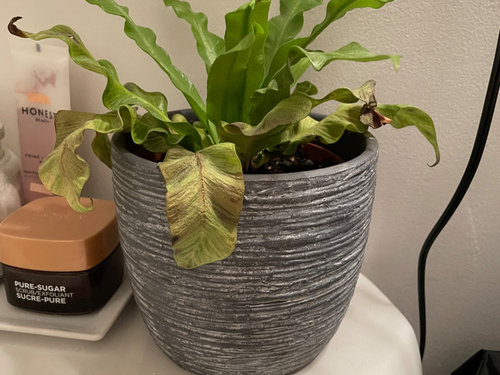


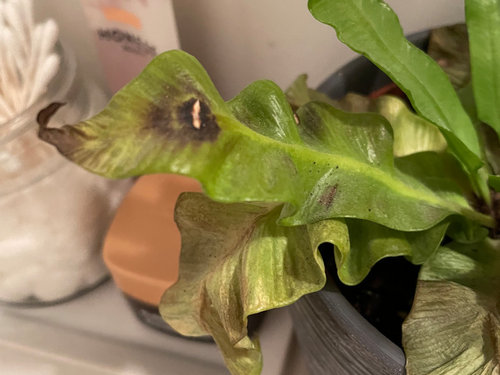
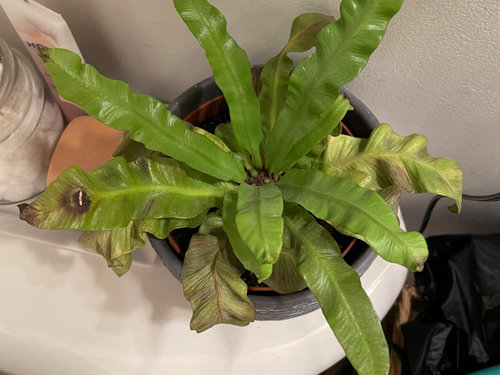
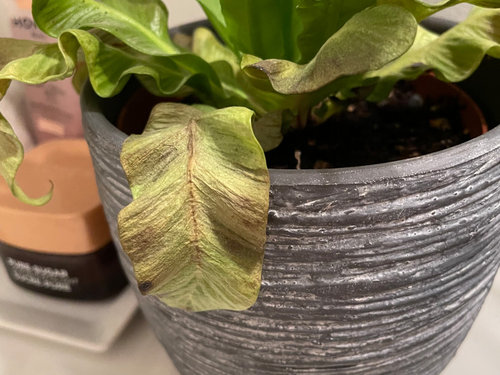
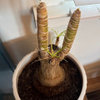
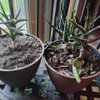
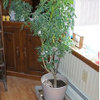
I’ve had this plant for about a year. I previously had it in the windowsill of a NW facing window where it got a decent amount of sunlight. it seemed mostly content there (the leaves were always perky and green) except it would get little holes sometimes that looked like burn holes. i thought it might be getting too much direct sunlight (hence the burned look on the leaves) so i moved it into a dimmer corner of the same room (which gets very bright during the day). The newest leaves in the center of the plant look super happy and healthy (nice green, standing up tall, growing kind of flatter than the other leaves) but the older leaves on the outside have become very droopy, dry, and brownish gray. I haven’t really changed watering habits, just have been experimenting with moving it around a bit with different levels of sunlight. My most recent theory is that maybe it doesn’t like my bedroom anymore because it’s been a hot summer and I’ve been running the AC a lot which has made the air quite dry. Can anyone tell from the photos what the issue might be?

Comments (8)

  • 5 years ago

    good on the pot in pot.. do you insure no water accumulates in the outer pot ...


    so it seemed to like its former location.. but you over thought it all and moved it.. and some time later.. its not happy .... and you just keep moving it ...


    so why not put it back.. and stop moving it around???


    i doubt the a/c is an issue.. unless you place it directly in the breeze ...


    i would probably just snip out the 3 ugliest... and move on...lets try not to love it to death ... its a fern... it will never be an exciting plant.. lol ... this is a plant that thrives on near benign neglect ...


    ken


  • 5 years ago

    Yeah, i think i need to just move it back and stop overthinking it. i originally moved it because of those burnhole-looking spots it was getting but it seems to not be working out. to answer your question, yes I always ensure all the water drains when I water… thanks thanks!

  • 5 years ago

    If you've fertilized recently, the leaf symptoms are consistent with over-fertilizing, but they are also consistent with over-watering. Let us know about the fertilizing - the 'fix' would be to slowly flush the grow medium with a volume of room temp water equal to at least 10x the volume of the pot the plant is in. If you're over-watering, there are 2 potential fixes. 1) Start checking the moisture level of the medium deep in the pot, at the bottom, with a wooden tell. More on that below. 2) If the plant is of manageable size, water over the sink, allow it to drain, then put Newton's First Law of Motion to work, draining excess water from the pot. See below.

    Using a 'tell'

    Over-watering saps vitality and is one of the most common plant assassins, so learning to avoid it is worth the small effort. Plants make and store their own energy source – photosynthate - (sugar/glucose). Functioning roots need energy to drive their metabolic processes, and in order to get it, they use oxygen to burn (oxidize) their food. From this, we can see that terrestrial plants need plenty of air (oxygen) in the soil to drive root function. Many off-the-shelf soils hold too much water and not enough air to support the kind of root health most growers would like to see; and, a healthy root system is a prerequisite to a healthy plant.

    Watering in small sips leads to avoid over-watering leads to a residual build-up of dissolved solids (salts) in the soil from tapwater and fertilizer solutions, which limits a plant's ability to absorb water – so watering in sips simply moves us to the other horn of a dilemma. It creates another problem that requires resolution. Better, would be to simply adopt a soil that drains well enough to allow watering to beyond the saturation point, so we're flushing the soil of accumulating dissolved solids whenever we water; this, w/o the plant being forced to pay a tax in the form of reduced vitality, due to prolong periods of soil saturation. Sometimes, though, that's not a course we can immediately steer, which makes controlling how often we water a very important factor.

    In many cases, we can judge whether or not a planting needs watering by hefting the pot. This is especially true if the pot is made from light material, like plastic, but doesn't work (as) well when the pot is made from heavier material, like clay, or when the size/weight of the pot precludes grabbing it with one hand to judge its weight and gauge the need for water.

    Fingers stuck an inch or two into the soil work ok for shallow pots, but not for deep pots. Deep pots might have 3 or more inches of soil that feels totally dry, while the lower several inches of the soil is 100% saturated. Obviously, the lack of oxygen in the root zone situation can wreak havoc with root health and cause the loss of a very notable measure of your plant's potential. Inexpensive watering meters don't even measure moisture levels, they measure electrical conductivity. Clean the tip and insert it into a cup of distilled water and witness the fact it reads 'DRY'.

    One of the most reliable methods of checking a planting's need for water is using a 'tell'. You can use a bamboo skewer in a pinch, but a wooden dowel rod of about 5/16” (75-85mm) would work better. They usually come 48” (120cm) long and can usually be cut in half and serve as a pair. Sharpen all 4 ends in a pencil sharpener and slightly blunt the tip so it's about the diameter of the head on a straight pin. Push the wooden tell deep into the soil. Don't worry, it won't harm the root system. If the plant is quite root-bound, you might need to try several places until you find one where you can push it all the way to the pot's bottom. Leave it a few seconds, then withdraw it and inspect the tip for moisture. For most plantings, withhold water until the tell comes out dry or nearly so. If you see signs of wilting, adjust the interval between waterings so drought stress isn't a recurring issue.

    Newton's First Law

    For conventional container culture, it's a given that saturated/partially saturated media rob roots of the oxygen they need to function normally and efficiently. At best, soil saturation robs your plants of immense measure of potential in areas like growth, appearance, yields, ….. At worst, plants unable to cope with the strain of drought stress caused by saturated media will succumb to it. This isn't a 'scare tactic, it's a very simple and straightforward observation that will be difficult to disagree with a straight face.

    Newton's First Law of Motion states that an object will remain either at rest, or in motion at a uniform rate and in a straight line unless acted upon by an external offsetting force. In this case, we will designate the 'object' as excess water in your potting medium. At risk of my being redundant, the 'law' can be seen as a simple statement about inertia, that objects will remain in motion and in a straight line unless a force acts to change the motion. To put the law to work for you/your plantings, you should water to beyond the point of total soil saturation - so the medium has been completely saturated and at least 15-20% of the water you have applied has exited the pot. Unless your soil is purposefully constructed to eliminate all/nearly all excess water, it's extremely probable, when the pot has stopped draining, there will be too much water in the potting medium for the plants' liking.

    To eliminate this excess water: immediately after a thorough watering, hold the pot in one hand over the sink, lawn, or over-sleeping significant other and move it downward, then sharply reverse the direction to upward. You'll immediately note that a good measure of 'excess' water will “continue downward in a straight line” and exit the drain hole. The sharper the reversal of direction, the more water exits the drain hole. When you have repeated the exercise until water no longer exits the drain hole on the reversal of direction, you will have eliminated all excess water and your plants will regard you with a newfound sense of awe.

    Al

  • 5 years ago

    Thanks!! I did just start adding an indoor liquid plant food mix to my houseplants about a month ago, I used the recommended amount but perhaps it didn’t like it. I’m usually vigilant about overwatering (I only water when the soil is dry and I always water over the sink for full drainage.)

  • 5 years ago

    Watering over the sink doesn't ensure full drainage, but it is still good practice because the salts dissolved in the water exiting the drain hole have no pathway by which they can make their way back into the soil solution (water in the pot).

    Most commercially prepared potting media are based on all fine particles (peat, coir, compost, composted forest products, sand, ground soil amendments, ....) and support a 3-6" (or more) layer of 100% saturated medium at the bottom of the pot. This is water that wrecks root health and limits root function to the degree it can sap nearly all the plant's growth potential. It doesn't leave the pot after watering when acted upon by gravity alone, so it needs a measure of help to convince it to leave. That's what is described in the part headed 'Newton's First Law'. It can remove all excess water and make a very big difference in how much return, in the form of personal satisfaction, you can get in return for your growing efforts.

    Al

  • 5 years ago

    Hey Al, will putting the container at a 45 degree angle to one side, straighten ,and then putting container at a 45 degree angle on other side have the same effect?

  • 5 years ago

    If the drain hole is in the middle of the bottom it will.

    The best place for a drain hole to ensure the maximum amount of excess water drains from the pot passively is either through the sidewall of the pot where the sidewall meets the bottom, or through the bottom where it meets the sidewall. If you make the hole through the sidewall, the bottom of the hole should be flush with the bottom of the pot. Even 1/8 of an inch above the bottom is a problem waiting to happen. When you tip the pot, the side hole should be the lowest point on the pot.

    A wick sticking out of the drain hole will help even more water to drain. See 'E' above.

    Al

  • 5 years ago

    Thanks!