

Roses not getting enough water
This year I've paid a bit more attention to my soil and trying to build it up. I noticed that when I water it does not penetrate down the soil. This will explain why grass has moved into my flower beds. I've recently loosen up the soil around each rose in hopes of more water getting down to the roots.
Has anyone else experienced this? If so what did you do to improve the soil loosening up to allow the water to get down to the roses roots.
Comments (30)
 5 years agolast modified: 5 years ago
Do you have clay, loamy, or sandy soil? My soil is sticky & heavy & dense clay and water always float over, rather than sinking in. So I used a pitchfork to pry out the top dense layer (clumps together in large chunks). Then I put those clumps of hardened clay aside and work in gypsum & organic matter until it's fluffy, then I top dress roses with this fluffy soil.
Gypsum is calcium sulfate, the calcium element coats each particle of soil and prevents clay from clumping like concrete. The sulfate element is acidic and it helps to break up rock-hard clay. Nearby rose park (alkaline clay) also spread gypsum in early spring. Soil Acidifier also contains gypsum, but the elemental sulfur (yellow dust) needs time to be converted to sulfate, vesus gypsum provides instant sulfate and calcium.
Here's an excerpt from below link: " Sulfur is taken up by plants as the sulfate ion (SO4 -2) and may be retained in this form in plant tissues and cell sap. Much of the sulfate is reduced and used in the formation of amino acids, proteins, and oils; in nitrogen fixation (root nodules). Chlorophyll formation also is dependent on proper sulfur nutrition. The amount of sulfur in plants is similar to phosphorus in many cases, thus removal by crops can be sizeable especially when the entire aboveground portion of the crop is harvested. Sulfur removal by various crops is summarized in Table 1.
Sulfur deficiency on growing crops is often mistaken for nitrogen deficiency. With sulfur deficiency, many crops become uniformly chlorotic. The pale yellow symptom of sulfur deficiency often appears first on the younger or uppermost leaves, while nitrogen deficiency initially appears on the older lower leaves."
haku84_zone9 thanked strawchicago z5haku84_zone9
Original Author5 years agoIm in So California, I believe I have clay soil. I did buy some Gypsum the other day but have not used it yet. I have been trying to work in organic matter but does not seem to be working since I only add it once a season.
Straw - Gypsum has to be worked in and not just sprinkled on top? How often should I add the Gypsum? Should I work in some Kelloggs Garden soil too?Related Professionals
Hot Springs Landscape Architects & Landscape Designers · Rocky Mount Landscape Architects & Landscape Designers · Longview Landscape Architects & Landscape Designers · Danville Landscape Architects & Landscape Designers · Washington Landscape Contractors · Effingham Landscape Contractors · Bowling Green Landscape Contractors · DeRidder Landscape Contractors · Frederick Landscape Contractors · Poplar Bluff Landscape Contractors · Green Bay Landscape Contractors · Jonesboro Home Builders · Effingham Home Builders · Willmar Home Builders · Hackettstown Home Builders 5 years ago
I really share your pain. I try to build up my soil my 7 years here but am still seeing drought effects. I have irrigation going daily during the hottest June, July and August and so far September. I have had trees explode in growth, from my irrigation no doubt, which have impacted my roses. I also fight gophers and voles. I have one watering zone that lost pressure half way down the line probably from a gopher hole chewing that I haven't found yet.
Where are you again, Haku? I know Ingrid described drought conditions affecting her garden poignantly in Southern California. Some hydrophobic soil solutions have been discussed.
I think Deborah brought up getting her hose out to supplement areas under trees. After the fact, I realized I need to do that. I am also having some junk trees removed like Leyland Cypress.
haku84_zone9 thanked Sheila z8a Rogue Valley OR- 5 years agolast modified: 5 years ago
Haku: My sister is in Mission Viejo, southern CA. Her soil and water is salty, and gypsum helps to de-salt saline soil. The calcium part binds with chloride and flushes out the salt. The sulfate part of gypsum helps to soften soil and green up pale leaves.
Per your question: "Gypsum has to be worked in rather than sprinkled on top?"
IT DOES NOT WORK WELL ON TOP since the acid (sulfur) moves down fast, and the calcium got stuck above. That's how rose park's Pink Traviata (likes it alkaline) got RRD when rose park doused it with gypsum. That's how my 3 roses got rust when I doused it with gypsum powder back in 2012. First time ever that I got rust in 3 decades of growing roses !! Zero rust after that failed experiment plus stopping throwing gypsum on top.
You want calcium to mix in to coat each particle of clay to make clay fluffy TO PREVENT clumping together and hardening into rocks. Clay is sticky and clump together due to high magnesium (my clay was tested exceedingly high in magnesium). Calcium is the opposing force of magnesium, it separates soil particles versus magnesium glues soil particles into chunks.
Yes to topping with: Ingredients in Kellogg Garden soil for flowers: "Processed Forest Products, Recycled Forest Products, Arbor Fines, Peat Humus or Compost), Composted Poultry Manure, Rice Hulls, Gypsum, Worm Castings, Bat Guano, Kelp Meal and Organic Fertilizer. In Georgia, this product contains: 85-95% processed forest products, composted poultry manure, rice hulls, gypsum, worm castings, bat guano, kelp meal, and organic fertilizer."
https://www.kellogggarden.com/products/kellogg/kellogg-garden-natural-garden-soil/
Note the above product has gypsum to keep the particles fluffy. Without gypsum, my clay glues up with wood-chips above into concrete blocks which water floats over, rather than soak in.
What's on top will eventually become what's below. Woodchips on top are hard and it makes soil hard below once that glue up with clay. Topping with fluffy soil like Kellogg Garden soil is better than HARD woodchips. The best weapon against hardened clay is a pitch fork. It's fun to pry out the "concrete chunks" above, put it aside, then break up the hardened clay using gypsum as a "separating agent".
haku84_zone9 thanked strawchicago z5  5 years ago
Here is another approach to your problem, haku84: see dchall’s ”Featured Answer” in this discussion
https://www.houzz.com/discussions/6169903/is-my-lawn-too-wet#n=6
This is a discussion nominally about lawns, though applicable to anything growing in hydrophobic soil.
haku84_zone9 thanked rifis (zone 6b-7a NJ)haku84_zone9
Original Author5 years agoSheila - I am in the San Gabriel Valley next to the Foothills. We have hot and dry summers. Everyday at 2:30-7pm we get gusts of winds. Not much rain fall, and now we are in another drought. I dug up 2 roses today that were failing and the root ball was bone dry even tho I have been watering them. Im gonna cut everything low this winter and try to add lots of organics to the soil.
Thanks Straw and Rifis!- 5 years ago
Haku, I add alfalfa hay and wood chips around the roses and am building soil but in our conditions they need even more water. Mulching is a start but flooding your roses with a hose would really help too. If they aren't blooming overhead watering would be great too.
Your conditions sound like ours here. This year we had 41 days 100 F or over this summer. Previously over 7 years here we had 14 -21 days that hot. This has been one hellacious summer.
- 5 years ago
This is a constant problem for me, too. Even using a mixture of compost, manure and vermiculite as a planting medium, getting water to penetrate is an exercise in patience. When water pools in the well around the plant, I poke holes with a narrow stake, and that helps, but I feel like I'm compacting the soil. The mystery is, where does that water go? When it looks as thought the area is completely saturated, if you disturb the soil, it's only wet on top. I think hydrophobia is the reason roses fail when we think we have watered deeply.
Rifis, I'm glad you posted that link. I remembered reading about adding baby shampoo to a hose sprayer for lawns, but couldn't think of the word 'surfactant'. I'm not a numbers person, but wouldn't a few drops of shampoo to a gal of water be sufficient? Reapplied as much as necessary. Apparently, you can't over do it. Gypsum would be the better choice, but in a pinch, we all have shampoo on hand
- 5 years agolast modified: 5 years ago
Baby shampoo is "sticky" and that would help with sandy & loamy soil as a surfactant (slows down water movement). However, for my clay which is already "sticky" or high-in magnesium, my soil test advised using gypsum. My clay is rock-hard when dried, and sticky like mud when wet. The black clay sticks tight to my shoes, I have to use a knife to scrape it off. The black "mud" also sticks tight to my skin, I have to use rubbing alcohol to clean my skin (soap and water can't wash the dirt off).
Decades ago I hired "core-aeration" service for my lawn with compacted clay, that DID NOT HELP. I poked holes around my roses with a stick, and that DID NOT help water to go down faster. My method of watering is dumping buckets of water (from my 6 rain-barrels), rather than using a hose, so fast-drainage or water-basin (around the rose) helps.
"Adding gypsum (CaSO4) allows the Ca++ to release and replace the soil-bound Na+. The released Na+ is leached out as Na2SO4, and the soil tends to granulate ...This granulated condition improves soil structure, and soil is then less prone to compaction."
"Gypsum improves water infiltration rates into soils and also the hydraulic conductivity of the soil (Shainberg et al. 1989). It is protection against excess water runoff from especially large storms that are accompanied with erosion."
The reason why I have to use a pitch-fork to pry off "cement blocks" of clay stuck on top each year is:
1) calcium leaches down (mobility of 5 compared to nitrogen mobility of 10), what's left on top is STICKY MAGNESIUM which makes soil above rock-hard. Calcium leaches down more than magnesium and potassium.
2) Wood-chips & alfalfa meal above glue up with magnesium in clay.
3) What's on top eventually becomes what's at bottom. Hard wood-chips eventually make the soil below hard. Wood-chips and leaves decompose to alkaline, and that glue up with clay. The worse offender is topping with red-lava-rock (high in magnesium) and pea-gravel (also high in magnesium). Topping with hard & alkaline medium will make the soil below rock hard.
In contrast, topping with acidic & fluffy green like grass-clippings soften the soil below. Gypsum is calcium sulfate (the 18% sulfur provides acid to soften the soil). There's a guy in Garden forum who reported that each time he mowed the lawn, he piled up grass-clippings around a rose, then watered that rose with his tap-water. Years later he dug up that rose and the soil below was soft & fluffy, compared to elsewhere in his garden with compact & large cement-blocks of clay.
Yesterday I pried off large chunks of clay above 2 roses with a pitch-fork, then put these huge clumps into wheel-barrel, then broke up these chunks with gypsum, then mixed in grass clippings and left in a brick-pit to decompose. Then I topped these roses with pre-fixed soil (aged for 2 months), and it's fluffy & very moist soil high in organic matter.
Alfalfa meal has 31% fiber and forms a hard crust on top. I once topped a white pine tree with alfalfa meal and after 6 months of high-rain, it formed a hard crust on top which choked off air .. the poor pine tree turned yellowish and I had to scrape off the "alfalfa glue" on top.
I once researched on ways to aerate clay, and the tip is to use LARGE CHUNKY ORGANIC MATTER (like grass clippings), rather than fine particles like peat moss or alfalfa meal which glue up with clay into concrete. Even then, clay glues right back if there's not enough grass-clippings, and gypsum (calcium sufate) is a fast way to break up large chunks of glued-up clay which block water from going down.
- 5 years agolast modified: 5 years ago
Info. from Michigan State University "Baby shampoo could serve as a type of surfactant that could reduce water repellency in the soil – if that’s a problem for your soil."
Another problem is the salt build-up with 3 types of salt in baby shampoo: "Sodium Cocoyl Isethionate, Sodium Benzoate, Sodium Methyl Cocoyl Taurate"
Here's the result of using baby shampoo reported in lawn forum:
https://thelawnforum.com/viewtopic.php?t=3727
"Between August -October last year I used 2 bottles of Baby Shampoo (Walmart brand) for my 7K sqft yard per month By Nov-Feb'18 - lawn was really soft to walk on.
Really too soft. So certainly - it help water penetrated. Some anomalies that occurred post application are: Grass seem to go to Winter dormancy quicker. Grass was slow to wake up this past SpringI can relate to those! I used the baby shampoo last year and had a late spring awakening and my overseeding last fall didn't produce results as I had hoped.
I have used my version of the BLSC for the last 2 years but i have not seen any real difference. I was hoping that my lawn would stay a little greener than the neighbors during the hot weeks but it was not. "
- 5 years ago
Would that translate to roses having a late start in the spring and the season ending sooner than usual? My season is short to begin with. I wonder if it would interfere with rose food, fertilizer, etc. I'm going with gypsum for the roses. But, I do have a patch of lawn that just won't green up. I might try the shampoo on a small area and see how it goes.
- 5 years agolast modified: 5 years ago
For my lawn high nitrogen plus potassium (fall-fertilizer) make grass deep & shiny & vibrant green. One spring I used fall-fertilizer (high nitrogen plus potassium) instead of regular spring fertilizer (high nitrogen only) and husband loves the deep & lush green. From that time on we stock up on fall-lawn-fertilizer to use for spring.
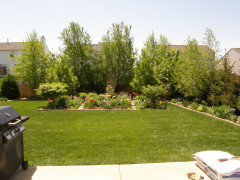
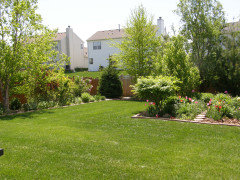
Potassium regulates water osmosis and helps with water uptake. Below is my lawn. Note the bags of Ace Hardware top soil on the patio. I tested the pH (using red-cabbage juice) and it registered a pH between 8 and 9, much more alkaline than Scott's top soil (with peatmoss, at neutral pH). But the Ace Hardware VERY ALKALINE top soil was fantastic for bare spots in my lawn, the grass there grew twice taller and deeper green than the rest. I told husband that it's the wrong grass seed, but he argued that it's the bagged soil. He's right, after 1 year of nutrients leaching out, the fixed spots look the same as the rest of the lawn.
My neighbor topped her lawn with gypsum and it was too acidic and burnt her grass. In below pics. I don't plant roses in my center garden, it's like a mini-swimming pool since I enclosed it with plastic edging dug down to 6 inch. to prevent grass from going in. Grass was very aggressive when we first moved here with soil pH near 8.
haku84_zone9
Original Author5 years agoStraw - How did you tackle the grass in your flower bed? Grass has taken over my flower bed along with nutsedge. I got a little lazy this year and the grass has taken over, Im not having to pull grass as I see it. I spray the nutsedge it dies then another one pops up in another spot.
What plastic edging did you use?- 5 years agolast modified: 5 years ago
Home Depot has the best Lifetime Guaranteed BLACK plastic edging that lasts well for the past 20 years in my garden. Lowe's has those green plastic edging that you hammer into the soil, and these are worthless (they pop up). Took some work to dig down into clay and insert the plastic edging at 4" to 6" level, but it lasts forever to keep out weeds.
My neighbor had those giant bricks put along his flower bed, and grass crawled between the cracks to invade his bed. Same with stopping trees' root, I dug down to one foot to put huge cement blocks, but trees' root crawled between the adjacent blocks, so I have to do a 2nd layer of cement blocks.
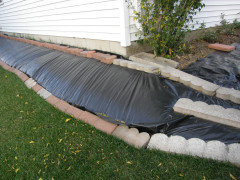
To stop grass or trees' roots, it has to be a continuous strip, no gaps in between. Grass is very aggressive in alkaline clay, my hands used to be in pain when I cut out clumps of sods. There's an easier way of using THICK black plastic (Mulch-film) to solarize or kill grass. After covering the grass with black plastic, it's decomposed within a few months. Fast way to expand or make a flower bed. Below was when I made a rose bed next to the house back in 2011, using "Mulch-film" long string of black plastic sold at Menards for $5:
 haku84_zone9 thanked strawchicago z5
- 5 years ago
Straw, your yard is so neat and tidy with perfect lawn. It looks well tended. What are the small, multi trunk trees punctuating the corners of your rose bed? I love everything about them. How big will they get?
- 5 years agolast modified: 5 years ago
Flowers (Andrea): The 2 chunky shrubs at the front corners of my center bed are Burning bushes, they turned bright red in the fall. But they died 2 years ago due to flash flood in the middle of winter. I was happy to chop them down: more sunshine to the center garden. The roots of Burning bush is a dense mat and invade any flowers around it. Burning Bush is very drought tolerant, but can't plant any roses nearby.
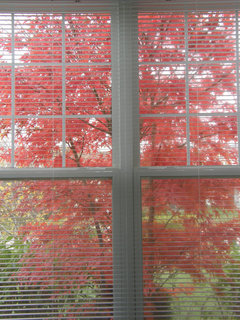
The only tree I would recommend is Japanese Maple trees which is slow-growing and NEVER INVADE roses if planted 20 feet away. Japanese red maple trees roots are within their capony with slender growth. Below is Japanese maple tree seen from inside my living room in the fall:
Below is the burning bush at corner of my center garden, in late fall: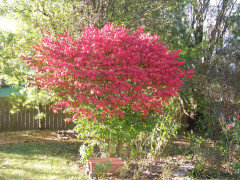
- 5 years ago
I never would have guess Burning Bushes. I like the way you limbed them up so the trunks show. I like low growing, spreading trees.
- 5 years agolast modified: 5 years ago
Flowers, you should look up Forestiera neomexicana. Google images of it. I got a male and two females from High Country Gardens. They are z 4-9 and drought tolerant. They develop great character with age and you can let the trunks show.
- 5 years ago
Sheila, I really like that a lot. I saved it in my tree and shrub file. New to me. Thanks!
- 5 years agolast modified: 5 years ago
I need to read this thread a few more times. I have that problem of preferential channeling so the water just runs through the ”soil” instead of saturating it. Adding organics makes it worse when it dries out and becomes water repellant.
I agree with Sheila that Forestiera neomexicana is a pretty tree. Forestiera neomexicana is native here (hence the ”neomexicana”) and is commonly planted. I have two trees. It makes a small multi-trunked tree (to 15 feet but usually smaller), roughly the same size and shape of a large lilac. The yellow fall color is luminous. Something to think about is that there are male and female trees. The female trees produce black fruit, the common name for the tree is Desert Olive, and the species is a relative of the olive. The birds love the fruit and leave black droppings that stain and make a mess if that is an issue for you. High Country Gardens sells a male variety and a female variety. I’m not sure if this plant is insect pollinated or wind pollinated if you are pollen sensitive.
- 5 years agolast modified: 5 years ago
Flowers: I dug out only 2 weeds along the edge of my driveway, and the soil HAS BECOME VERY SOFT thanks to 2 applications of pelletized lime (100% calcium). Calcium on top does move down to "granulate" or soften hard clay high in magnesium. No need to water with baby shampoo (high in salt) to "granulate" and soften clay. Calcium does wonder to get rid my lawn of weeds, esp. dandelions.
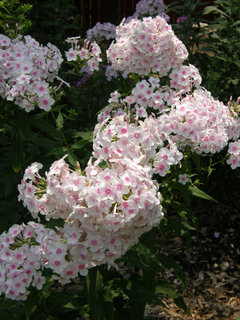
My best clump of garden phlox now is where I fixed the soil with gypsum, making it fluffy and helps water to soak in. Below is wild garden phlox in my garden, pic. taken in late August. It's in 3 hrs of sun. Each bloom is larger thanks to more water absorption:
Here's another phlox next to the tree which I mulched with layers of grass clippings, then topped with wood chips. Pic. taken this August. Soft mulch above helps soil below to be softer. I get better result with soft & acidic topping first, then hard & alkaline wood-chips above. Acidic peat moss can be used if one doesn't have acidic grass clippings, that helps to neutralize high pH & alkaline tap water plus retain moisture.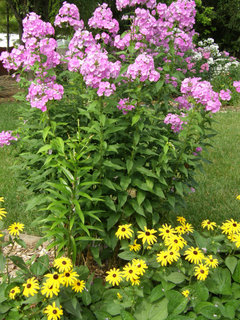
- 5 years agolast modified: 5 years ago
Thanks, Noseometer. I've always loved olive trees. I wonder if the common olive tree I was used to seeing in CA is hardy here. I never see them. I was surprised Forestiera neomexicana is so hardy, having ....mexican.... in the name. And, thanks for mentioning the pollen. I don't have any allergies except once in a while, not every year, I am a little sensitive to pine pollen. Too bad for me. I live in a pine grove!
Straw, I learn something every time I log on here. Lime and calcium - same. Had no idea. There are a couple spots in our lawn that just won't green up. In addition to the sprinkler system, we hand water and use a small sprinkler on those spots. I will definitely try lime or calcium, not baby shampoo. Getting rid of dandelions would be a nice bonus. I grow a massive crop of them every year.
I LOVE phlox. I don't have any that look like your wild one. It's gorgeous! Mine are the usual, Laura, Bright Eyes, Blue Paradise, etc. They do very well here with almost no care, except lots of water, and sounds like gypsum can help with that. Your's obviously stay moist because you don't have any dead foliage toward the bottom. I'd love to get away from that. Many thanks!
- 5 years ago
No Flowers, I do not think regular Olive trees are hardy up your way. Here, mine are bushes so far in z 8. I did plant an Italian Stone Pine (umbrella pine) and it is doing well so far. I read they can fall over in wind, and some pathogen is attacking them in Italy. It's always something.
- 5 years ago
Ha! Isn't that the truth. We get lots of wind, rather, gales, that do damage, so I'd better stay away from the Stone Pine. Must be shallow rooted. I can see it in your setting. You have a Tuscan setting without the pathogen. I hope it doesn't make it's way to the US.
- 5 years ago
Straw, agricultural lime isn't 100% calcium, since it's either calcium carbonate, calcium oxide, or (at the extreme) calcium hydroxide. Sometimes it also has magnesium in it as well. Not disagreeing with your results, but as a chemistry teacher I have to throw this in :-D
- 5 years agolast modified: 5 years ago
Agree, I wrote extensively on different types of calcium in Organic rose forum back in 2014 . My B.S. is in computer science & minor in chemistry. Calcium carbonate doesn't dissolve well in water, but calcium citrate dissolves fast to pro-long cut-blooms in the vase.
From wikipedia: "quicklime specifically applies to the single chemical compound calcium oxide. Calcium oxide that survives processing without reacting in building products such as cement is called free lime."
Calcium oxide is extremely alkaline at pH over 12. Calcium hydroxide (also extremely alkaline) is hydrated lime which municipals add to deodorize water, this makes cement out of clay. Gypsum dissolves best in alkaline tap water since it has 18% acidic sulfur.
Pelletized lime (86% calcium carbonate) is best for high-magnesium clay like mine.
Local stores sell Garden lime powder (dolomitic lime) with 22% calcium and 12% magnesium which I use for pots to neutralize acidic rain.
Gypsum has mostly calcium plus 14% to 18% acidic sulfur which would be best for low-rain region. I don't use gypsum on top since I have tons of acidic rain in certain months.
Below is a link which I posted in Organic rose forum 8 years ago: "Types of calcium for best bloom formation.:
https://www.houzz.com/discussions/2133798/types-of-calcium-for-best-bloom-formation
Re-post the info. I complied in above link:
U of CA Extension chart in the below link listed 1 ton of gypsum as equivalent to 5.38 ton of sulfur. It also listed 1.09 ton of Ferric Sulfate as equivalent to 5.85 ton of sulfur. See link below:
http://vric.ucdavis.edu/pdf/Soil/ChangingpHinSoil.pdf
If your soil is acidic, hold off the gypsum. That stuff is great in California, where the soil & water is alkaline ... but there are better sources of Calcium for acidic soil:
Gypsum provides 22% calcium, 17% sulfur, with salt index of 8.1, used to de-salt sodic soil, also to neutralize bicarbonates in alkaline tap water.
Dolomitic Limestone provides 25% calcium and 10% magnesium, salt index 0.8, sandy soil lacks magnesium
Calcitic limestone provides 36% calcium when the rain water (pH 5.6) breaks it down, low salt index 4.7
Colloidal rock phosphate provides 19% calcium and 18% phosphate. Best for acidic soil, cannot be utilized at pH over 7.
Hard rock phosphate provides 48% calcium and 30% phosphate, cannot be utilized at pH over 7.
Bone meal has 11% phosphorus and 24% calcium. Bone meal cannot be utilized if the pH is over 7.
Superphosphate provides 20% calcium, 12% sulfur, and 20% phosphorus, low salt index 7.8
Wood ashes provides 20% calcium, 2% phosphorus, 7% potassium, magnesium, and all trace elements. CAUTION: Wood ash is very alkaline, pH over 13, will burn roots if applied directly to plants.
Wood ash is great for acidic clay, where my Mom in MI put wood ash on top of a thick layer of leaves. Snow and rain (pH 5.6) counteracts the alkalinity of wood ash. Below is a bouquet picked recently in 90 degrees humid weather. I use both gypsum and sulfate of potash for best blooms with my alkaline tap water at pH 9:

More info. which I posted 8 years ago:http://waltsorganic.com/ag-lime-dolomite-gypsum-oyster-shellwhat-kind-of-calcium-do-you-need/
"Agricultural Lime: Calcium carbonate – CaC03 Pure calcium carbonate is used to help prevent the spread of various diseases, such as powdery mildew, black spot, and blossom end rot ... Adding Ag. Lime to your soil will also raise your PH making it more alkaline.
Dolomite: Dolomitic Lime contains calcium carbonate, bringing benefits similar to Ag Lime, while also providing magnesium which is important for plants’ utilization of nitrogen, phosphorus and sulfur. Having an excess of magnesium in your soil can cause a break down in soil structure, resulting in hard compact soils.
Gypsum:Calcium sulfate, or Sulfate of Lime – CaS042H20, due to its sulfur content Gypsum does not raise the soil PH like lime. Gypsum helps liberate potash for plant use. Gypsum can also help break up compact and clay filled soils by correcting excess amounts of magnesium in your soil.
Oyster Shell Flour: in addition to a large percentage of calcium carbonate, Oyster shell flour contains about 1-% phosphoric acid, which makes oyster shell flour a source of both lime (calcium) and phosphorus. Oyster shell will also slightly raise your soils PH over time."
*** From Straw: I did buy Oyster shell pellets from Amazon and it could not dissolve after soaking in acidic rain water for a week. Oyster shell flour is best.
Agricultural lime (pelletized) listed 86% calcium carbonate worked great for my 12 tomatoes this year .. zero blossom end rots like previous years of using gypsum in planting holes.
- 5 years ago
I am trying to absorb all this information, but I can't get past that absolutely divine bouquet just above. I'm trying to memorize the colors. I may not have those roses, but I might be able to mimic the colors.
Susan, Straw and a handful of others here can appreciate all the finer points of chemistry, but thankfully, sometimes she makes things a little less complicated for people like me whose eyes gloss over at the intricacies of scientific info.
- 5 years agolast modified: 5 years ago
Flowers: Fast tips: if your soil is compact clay with less rain, use gypsum.
If your soil is loamy & fluffy plus less rain then it has enough calcium.
If your soil is compact clay but high rain like mine, use agricultural lime (pelletized lime) with 100% calcium with 86% slow-released calcium carbonate & NO MAGNESIUM. Compact clay is already high in magnesium which glues soil together into clumps.
If your soil is loamy & fluffy but with high-rain, then use Garden lime/dolomite lime (has 12% magnesium and 22% calcium), the magnesium is to "glue" soil together, and the calcium is to raise the pH to offset acidic rain. Rain leaches out calcium.
- 5 years ago
THANK YOU, Straw, for breaking that down for us right brain types. I have the first option - compact clay, less rain. Although we have had rain for 24 hours the soil is dry as dust. Our rain is not the kind you can see or hear. It's light and misty. You know it rained because the concrete is wet. It's rare when we can see or hear it rain. So, gypsum is what I should use.





JoJo (Nevada 9A)