Software
Houzz Logo Print
olga2694

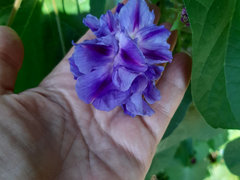
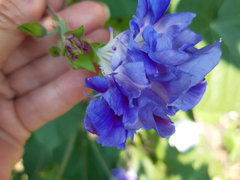
Double Ruffled Morning Glory, looking for a variety

4 years ago
last modified: 4 years ago

Double Ruffled Morning Glory, my own pollination, second generation. How can I know if such a variety already exists? Can't find information ... Million thanks for any help

Comments (18)

  • 4 years ago


  • 4 years ago
    last modified: 4 years ago

    Hello Olga,

    That looks like a unique new variety of morning glory. There are commercially available double morning glory seeds, but yours look different, and better than any that I have seen. There are hobbyists who breed morning glories. You could search this website for messages that deal with morning glories (that is a clickable link for a Houzz search that has a lot of false positives).

    ZM

    Olga Коциевский thanked zen_man
  • 4 years ago
    last modified: 4 years ago

    Hello again, Olga,

    One commercial source of double morning glory seed is Split Second Morning Glory seeds from Park Seed (another clickable link)

    ZM (not associated with any product or vendor mentioned or linked)

    Olga Коциевский thanked zen_man
  • 4 years ago
    last modified: 4 years ago

    Hello again, Olga

    The following is a link to images for double morning glory seed. Those images themselves are clickable links. (The Internet is a big place.)

    Double Morning Glory Seed (images)

    ZM (not associated with any product or vendor mentioned or linked)

    Olga Коциевский thanked zen_man
  • 4 years ago

    zen_man, really -you haven’t met anyone like that either? Thank you very much, I will study everything carefully!
    American seeds are not available in my country (I live in southern Ukraine, this is Eastern Europe, zone 7b) and I use European commercial and local seeds.

  • 4 years ago

    Hi zen_man

    thanks for the link, this is a very cool MG! Maybe I'll try to buy. I used seeds from the Dutch company Hem Zaden, a few seeds from the bag grew appropriate, a few - ordinary. The same thing happened with the seeds I received from my plants. Now I know that this is normal and even with manual pollination with all the precautions you will get a surprise in each seed pod))) The next season will be very interesting, as I pollinated my Nile morning glories

  • 4 years ago

    Hello again zen_man

    I wanted to ask you many more questions, but, fortunately, I found a thread about zinnia, where you share your knowledge. Of course, morning glories are not zinnias, but the principle is the same, right? My morning glories are the second generation from my pollinated seeds, therefore, I need to work as a bee for at least four more years in order to stabilize the new qualities ... Now I am worried whether the seeds will have time to ripen before the frost))

    Many thanks!!!

  • 4 years ago
    last modified: 4 years ago

    Hi Olga,

    I agree, the principles are the same for pretty much all flowers. And while you are stabilizing a hybrid, you may have the opportunity to make minor improvements. Incidentally, some people who grow morning glories grow them indoors. And if you did grow them indoors under artificial light, you might have the opportunity to grow them year-round. I have some zinnias that are coming into bloom right now indoors, safe from the threat of frost outdoors later this month.

    About those morning glory seed and the threat of impending frost, you might be able to save the seed before they are fully ripened and dry. I deliberately save some of my zinnia seeds while they are still green, but reasonably plumped out. You do want the embryo inside the seed to be reasonably developed, but the more mature green seeds can have well-developed embryos. You do need to dry the green seeds before you store them. If you stored them with a high moisture content, they might germinate in storage.

    ZM

    Olga Коциевский thanked zen_man
  • 4 years ago

    hello again zen_man
    you have no idea how grateful I am for your help :)
    I thought about digging up the plants and taking them home, but I doubted, and you said the right words and I will try to save the uterine vines. And of course, I will have to buy phytolamps - if I can use them to check the flowering of seedlings in winter, this greatly expands my horizons.

    Will you let me ask you questions sometimes? I am taking my first steps and I really appreciate your experience

  • 4 years ago
    last modified: 4 years ago

    Hello Olga,

    " Will you let me ask you questions sometimes? "

    Of course, you can and may ask questions at any time. I can't guarantee that I can always provide a good answer, but I can always try. Unfortunately, I don't even know the identity of your native language in the southern Ukraine. So we will continue to have language-based problems from time to time.

    As an example, in your last message, you said, "and I will try to save the uterine vines" and I am not sure of the meaning of that sentence because of the word "uterine". My small pocket English dictionary associates "uterine" with "uterus", the organ in female mammals in which the fertilized egg develops. So that sentence needs to be re-worded, to something different from "uterine vines".

    I am wondering if there is some translation software that we could make use of. I must confess that I do not know what language you use in southern Ukraine. Just out of curiosity, are you already using such a language translation software? And what is your native language?

    ZM

    Olga Коциевский thanked zen_man
  • 4 years ago

    Hello again zen_man

    oh, we won't mention inches and ounces yet! I measure in centimeters and liters)

    My family's native languages are Ukrainian, Polish and Russian. In Ukraine, we speak different languages, but Ukrainian and Russian are common to all.
    I use google translate and quite often it is effective, but .... In Slavic languages, the name of the donor plant (for seeds or cuttings) comes from the word "uterus", just in the sense that you mean. How am I supposed to say it correctly in English?
    thanks for the help
    O.

  • 4 years ago
    last modified: 4 years ago

    Hello Olga,

    " In Slavic languages, the name of the donor plant (for seeds or cuttings) comes from the word "uterus", just in the sense that you mean. How am I supposed to say it correctly in English? "

    I don't think you need a special word. For cuttings or grafts, you could just say "scion plant" or "rootstock plant" for the donor and receiver. (incidentally, I think you could graft morning glories -- it is fairly easy to graft zinnias and almost any plant can be propagated by grafts).

    For seeds, you could say the seed-producing plant or the mother plant. I refer to zinnia plants that I am using as pollen sources or pollen receivers as breeder plants. If you choose to propagate your morning glories by tissue culture (another excellent option), you could refer to your plant as an explant donor.

    On a slightly different subject, the National Gardening Association has a forum devoted to Ipomea that might be of interest to you. (that is a clickable link) As I am sure you are aware, Morning Glories are Ipomea and that forum has a lot of discussion about Morning Glories. There may be fellow Morning Glory Breeders on that forum, if none respond on this forum. Also, here on Houzz, there is the Hybridizing forum

    (another clickable link).

    It is impressive that you are so multi-lingual. And by whatever means you use to achieve it, your messages here have remarkably good English. We all have trouble finding just the right word from time to time. So don't worry about that.

    ZM

  • 4 years ago
    last modified: 4 years ago

    Hello again Olga,

    You might be interested in this unusual morning glory (that is a clickable link).

    I believe they said that is Ipomoea albivenia.

    ZM

  • 4 years ago
    last modified: 4 years ago

    Hello Zen_man
    I had little internet problems due to hurricane))
    The link you gave is awesome. I have never seen such morning glories and did not know that they exist. It looks like I'm on the verge of a new stage in my life :)

  • 4 years ago

    Thanks for the clarification, it is important for me to use the correct words. You are writing: "it is fairly easy to graft zinnias"
    I'm not sure I got it right. Are you transferring a bud or branch of one plant to another? My husband grafts fruit trees, for example, we have a sweet cherry with branches of different varieties. But we've never tried this on annuals.

  • 4 years ago

    and a few words about multilingualism, you may just be interested - my country was part of the Soviet Union. There was a policy of pressure - Russian and everything Russian is the main one. We all just tried to keep our identity)))

  • 4 years ago
    last modified: 4 years ago

    Hello Olga,

    My sympathies about your Internet hurricane problem. On the subject of grafting and zinnias, in the past I have grafted a zinnia top onto a zinnia rootstock, just to see if it can be done, and it can. Grafting is not limited to trees. Tomatoes are grafted onto special hybrid rootstocks commercially. Some people also graft other vegetables, and sometimes the scion and rootstock can be different species and yet work successfully.

    With respect to your morning glory hobby, I don't know specifically of any grafting that has gone on within Ipomea, but I would be very surprised if you couldn't graft one morning glory onto a different morning glory, and I think some experimentation on grafting a scion of one Ipomea species onto a different Ipomea species would be worth doing.

    Your husband might be able to show you enough to get you started grafting your morning glories. The technique is probably a little different from grafting trees. Maybe a lot different. You might need to use some tape to hold the graft together until it can "take".

    If I were grafting morning glories, I would be very curious about grafting morning glories onto sweet potato rootstock. Sweet potatoes are Ipomea. There could be some significant advantages to having morning glories with sweet potato root systems. Perhaps you could convert annual morning glories into perennial morning glories by doing that. In any case, a sweet potato root system could be very powerful. That is something to think about.

    ZM