Software
Houzz Logo Print
webuser_353955525

Request for orchid plants

5 years ago
My association with orchids began soon after my wife, Pat, and I were married. I was almost half way through what wound up being a 20 yr. career in the U. S. Navy Submarine Service. The sub I was stationed on had two complete crews, and an unusually dependable operating schedule which meant one crew would travel to a specified port to meet the sub when it returned from the at sea portion of its schedule. We would do a complete turnover and the on coming crew would take control of the boat for about 3 months, while the off going crew returned home for a rather light schedule of rest and relaxation and two months of a heavier schedule of school and study. At the end of that three month period the two crews would swap jobs and repeat the process.

At the first opportunity, I planned a trip to Florida to introduce my new wife to a favorite Aunt and Uncle who had not been able to attend the wedding. It was this visit that introduced me to orchids for the first time. My aunt had a number of strange looking plants in pots hanging on a large Oak tree in her yard. Orchids, she called them, and we had several conversations about them. On departure, I was presented with one of her plants, and the adventure began.

During my next “at sea” cycle on the boat, our orchid bloomed, but of course I knew nothing about that until I returned home, but by then the bloom was long gone, and I only had a few photos that Pat had taken as proof of the event.

During these early months I was reading everything I could get my hands on about orchids, and had learned that there were orchids that grew in South Carolina. That was interesting, because I had grown up in SC, and I had never heard of orchids before our trip to Florida. My literature did say that most of the orchids in SC were terrestrial, meaning they grew in the soil like most other plants, and were very difficult to transplant. There was one, though that was an epiphyte, or an “air plant” like the orchid I had, and they grew in the river swamps in the southern part of SC, and were usually found growing in association with Resurrection Fern. I had spent a great deal of my life in these river swamps, and was very familiar with Resurrection Fern, but had never heard of orchids growing there, and certainly not Epidendrum conopseum, as it was called at the time.

The search was on. During my in port periods I did quite a bit of fishing, some with my new in-laws, and some with my new wife, and one day we found it!

Jump into the future about 10 years, I’m retired from the Navy and working at my new job with a large orchid nursery in SC, and a member of the SC Orchid Society. Native orchids would occasionally come up, and the fact that I had seen Epidendrum conopseum growing in the wild always created interest.

My employer had a block of seedlings that had conopseum as one parent, and when I left that job, I purchased one of these plants, and still have three pots of it. (one in full bloom as I write). I always had questions about whether or not conopseum would breed cold hardiness into any of its seedlings, or in general just what traits it might impart to its offspring.

I never got a chance to do any of this discovery, but have not lost the curiosity, Thus this request for assistance. My one copy of Sander’s List of Orchid Hybrids (1961-70 addendum) lists 13 crosses with conopseum as a parent, and I would be interested in obtaining divisions of any of these plants that I can find.

Point of interest, at some point after 1970 The taxonomists re-discovered conopseum and decided it was not first published under that name, instead was first published as Epi. magnoliae, so any crosses with magnoliae would also be desirable. The one cross that I have is (BL richard mueller ‘Newberry’HCC/AOS X Epi. conopseum.

If anyone has information that might assist a curious old man in this search, please contact me either through this forum, or email at ehney(at)yahoo.com. Thanks for any assistance.

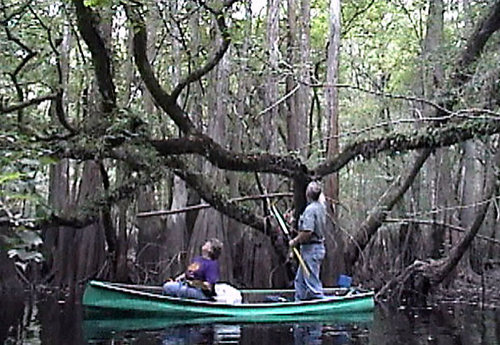
Looking for "wild orchids" in the swamps of South Carolina

The search is over. Success!

Photo of my only Epi. conopseum cross. The Epi. conopseum parent is now more properly

known as Epi. magnoliae. The other parent of this cross is BL Richard Mueller

Comments (6)

  • 5 years ago

    What a wonderful story. Love hearing of your orchid hunt and finding the jewel!

    Wish I could help but only living 10 yrs in Florida has not led me to hunting swamps to find orchids.


    What are the lowest temps in S.C? Somehow I thought it was pretty temperate. I would love to help but not even sure where to ask. I think the best way to get info would be to speak to growers/breeders who visit your Orchid Society. If they don't grow for your climate, they might give you leads.


    I know, in the past, I've gotten good leads from commercial orchid growers. Heard an interesting lecture tonight from a grower in California. He pointed out, by slide show, the orchids which can't be grown well in California vs. S. Florida due to rainfall, winter temperatures and humidity.


    If your OS has speakers, or growers in your area, it would be my suggestion to ask them about the natives and see what information they could provide.


    You are such a good guy, Bill and hope you post back to let us know what you can learn.


    Jane

    Billsc thanked jane__ny
  • 5 years ago

    Hi Jane, Great to hear from you. You asked about temps in SC, and that is a tough one to answer. Along the coast, temps are pretty moderate, dropping into the low 30’s to high 20’s occasionally, but as you go inland towards the mountains, the temps can, and do get much colder. The northwest section of the sate around the NC/GA boundaries snow is seen frequently, and temps can get down around 0 deg. F. for brief periods. Where I live, in Newberry, we see single digit temps fairly often for brief periods of time.

    If you are asking the question in regards to the E. magnoliae, that plant is limited to a fairly narrow band across the state nearly 100 miles from me. I have never seen it growing around water that has any salt content, which eliminates the coastal tidal waters, but its entire habitat includes sections of the state that do get freezing temps every winter, and some of those are brief periods into the low double digits. The northern boundary of its habitat is reasonably easy to find, but one does have to have a good understanding of the state’s swamps and an interest in associating the swamps with what epiphytic orchids grow there to find that boundary, (and I am convinced that E. magnoliae is the only epiphytic orchid growing wild in SC), and I am probably the only nut in the state with that interest.

    The trick E. magnoliae has learned is to always grow on host trees that are growing in, or very near open moving water. This would moderate the air temperature around the plants considerably. This still means that E. magnoliae is one of the most cold tolerant epiphytes that I know of. Only a few of the cane type dendrobiums can come close to doing this to my knowledge.

    When I worked in the industry, I always had it in the back of my mind that it would be interesting to make some crosses with magnoliae and leave some of them outside one winter to see if they had inherited any cold resistance from the magnoliae parent. I never got to do that, but never the less, I know there are a number of hybrids that have been made with magnoliae, (I have one) and I would love to have a few more, just for sentimental reasons.

    And yes, about the only place I am going to find those crosses will be breeders and/or collectors. That’s why I did the post here, hoping there might be a few of those folks hanging around on this forum.

    Thanks for the response and a chance to chat.

    Bill

  • 5 years ago

    Billsc,

    Have you looked on OrchidRoots or the RHS orchid register web sites to find the names of some more recent registered crosses? They will have the name of the greenhouse that registered the cross. That might give you a lead as to where to look for some plants.

    Meg


    Billsc thanked meg_w (9b) Bradenton
  • 5 years ago

    Bill, I had no idea it got so cold in S. Carolina. We have vacationed there for many years during the summer and loved the State. But we never ventured far from the coast.


    You must have local societies. Have you tried researching on AOS. org?

    I did a brief search and this list came up. Take a look at the list and see if any of them could be related. https://www.aos.org/search-results.aspx?searchtext=E.+magnoliae&searchmode=anyword


    Jane

    Billsc thanked jane__ny
  • 4 years ago

    What a great story, Bill. Thank you.

Sponsored
Franklin County's Heavy Timber Specialists | Best of Houzz 2020!