Software
Houzz Logo Print
jason_carlton26

Ground cover recommendation for zone 7A

I'm in 7A, western North Carolina... in the foothills, not quite in the mountains.


I have 9 flower gardens that I mulch every year, which costs a little over $1,000 and takes a good 2 weeks to finish :-O Someone on here suggested that I do a ground cover instead, and at first I balked at the idea! But the more I think about it? I dunno, maybe. At least for the parts away from the walkways.


Can you recommend a groundcover that:


1. is evergreen


2. is dark in color (dark brown, black, etc), OR bright and vibrant (white or blue)


3. can handle light traffic (me walked occasionally to get to sections, or the 25lb dog trying to find a place to pee)


4. deer / rabbit tolerant


5. doesn't attract pests (specifically voles and ants)


6. does well in full sun to part shade


7. does well with both sprinklers and sections with only rain for water


8. loose enough that other flowers can grow through it


I currently have areas of Anne Marie ivy and Creeping Jenny, but they're way too light in color and the green tones just blend in with the adjoining grass and defeats the purpose. I want something that at least kind of looks like dark mulch, or failing that then something that's super bold and stands out.


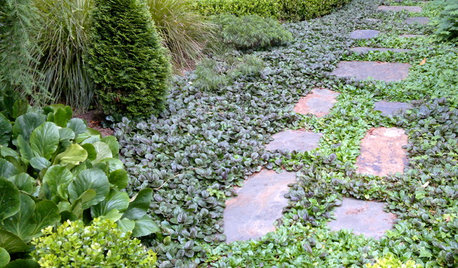
I also have a little Chocolate Chip ajuga (bugleweed), and I'm kind of thinking about something like that (Black Scallop ajuga, maybe). But I would rather have something that, if it flowers at all, then it doesn't have bold flowers like this does. I much prefer the ground cover to fade in to the background and let the other flowers be the show, not take away from them.

Comments (8)

  • 4 years ago

    Creeping Raspberry, fka Rubus calycinoides.

  • 4 years ago

    This?


    https://cdn.shopify.com/s/files/1/1038/5352/products/creeping-raspberry-2_2000x.jpeg?v=1571618446


    That looks super green, not much different from the Creeping Jenny and Anne Marie ivy that I already have :-(

  • 4 years ago
    last modified: 4 years ago

    I don't believe any ground covering plant exist that can possibly meet all your criteria, seriously?! If we can see photos of the beds, we could have a clearer picture. If you have a lot of space in between plants with a lot of mulch, which looks like an unnatural construct, that so many here deem attractive. If there is a lot of space in between plants, then the mulch would be more useful, with so much area to be protected from germinating weeds. The other problem with groundcovers is they can grow into your other perennials and create a hard to fix mess. Lysimachia nummularia is great for stitching itself into prized perennials. I prefer planting things closer together and not mulching at all. Weeds will appear, but nothing a good yank or scuffle can't fix. Why are ants bad? They play a big role in the natural world. They disperse many wildflower seeds. You don't make mulch tree volcanos I hope.

  • 4 years ago

    If you plant your ’flowers’ more densely so each just touches the next they will form their own groundcover. It’ll make your beds much lower maintenance. If you still have some empty spaces how about mulching with your own compost or autumn leaves rather than buying material in?

  • 4 years ago

    "I don't believe any ground covering plant exists that can possibly meet all your criteria,"

    So I suggested a mulch like, deep green, dense groundcover that should grow well for you and takes on deep red and maroon coloring in the winter and meets a great many of your wants. If you should discover that perfect groundcover that meets every single one of your wants, patent it fast.


  • 4 years ago
    last modified: 4 years ago

    Is the $1k for just the mulch? You're paying way too much.

    Is your mulch breaking down in a year? you're using the wrong mulch.

    Or are you piling on mulch annually and successfully avoiding weeding?

    Do you have landscape fabric on a hill and the mulch washes off?

    At some point, garden take work and money.

    Ajuga is a horrendous weed that will become a groundcover if you let it.


    You could border your gardens with something distinct in color, like silver artemisia or stachys and then use a green ground cover in your gardens.

  • 4 years ago

    As others have mentioned, you are not going to find one single groundcover to answer all your needs. But you could combine a selection of different ones that can be used in different situations. For blacks, I'd consider black mondo grass or Leptinella squalida 'Platt's Back'. Or the dark leaved ajugas (neither of which I would consider a "weed" - they both grow far too slowly).

    White (or slivery gray) could be Cerastium tomentosum, Helianthemum nummularia or Lamium maculatum.

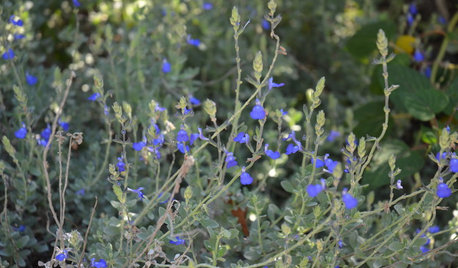
    Other possibilities include Saxifraga x urbium 'Variegata' (variegated London Pride), Sedum 'Angelina', Sedum 'Blue Spruce' and Veronica pedunculata 'Georgia Blue'.

    Unless you have acres to cover, I agree that $1000 for mulch is excessive. I trust you are buying in bulk and not by the bag? Bagged soil products like mulch are priced 3-5 times (or more) than that of a similar product sold in bulk. Here, $1000 of bulk mulch would result in 27 cubic yards of product or enough to cover 2700 square feet to a depth of 3 inches.

    A good organic mulch is one of the best things you can do for both your soil and your garden, so I would not dismiss mulching out of hand. Maybe some sort of mulch-groundcover combo would work best.

  • 4 years ago

    $1000+ for enough mulch for a large garden is not at all unusual and that does not include the labor cost to spread it or in some cases blow it into the beds. Bagged mulch is certainly more expensive by volume than bulk, but as I tell my clients, a machine can bagged it faster and more economically for places no wheel barrow is ever going to go. The savings in labor can make bagged mulch on par with bulk in some scenarios.

Sponsored
Custom Home Works
Average rating: 4.6 out of 5 stars10 Reviews
Franklin County's Award-Winning Design, Build and Remodeling Expert