Software
Houzz Logo Print
jacqueline9ca

OT - two months after the firestorm...

4 years ago
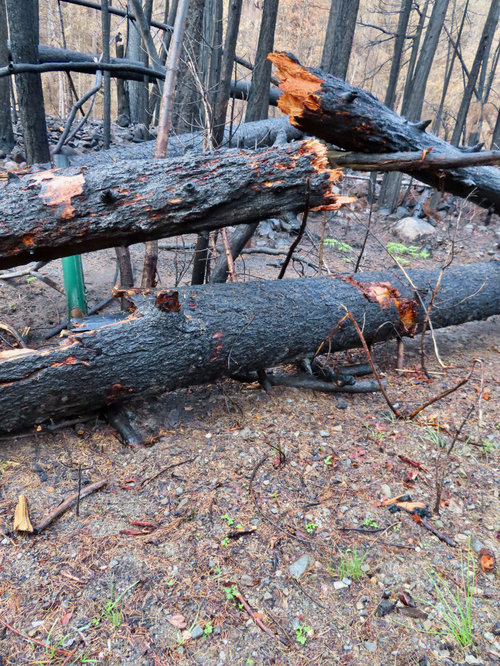
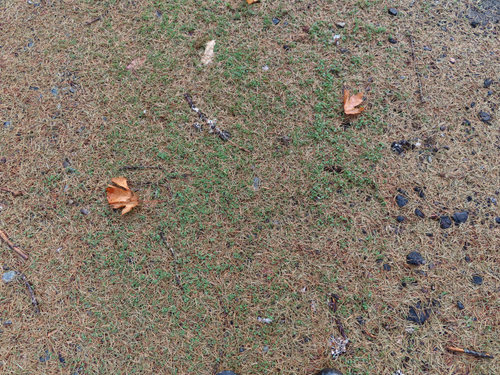
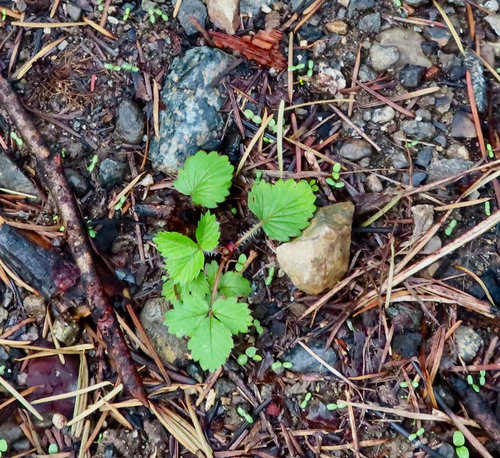
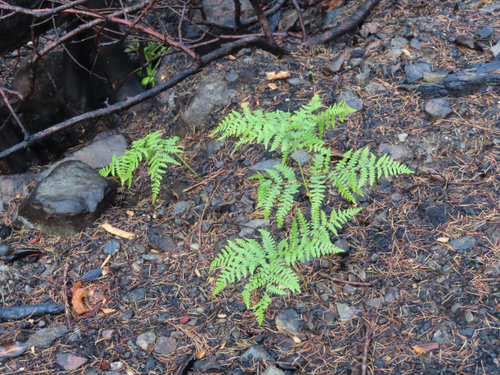
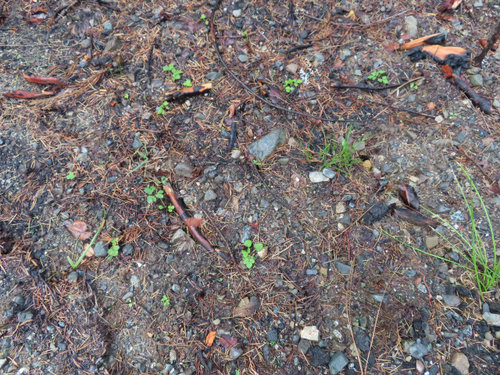
My DH and I went up to our property last week, for our second trip after it was reduced to dead trees and ashes after the firestorm on the night of Sept 8 which was part of the "River Complex 2021" fire in Northern CA. We had been told that the actual soil/dirt was dead down 5-6 inches, burned and sterile and so hard it was not even absorbing water. Well, here are some pictures of new plants happily sprouting up on that soil - lots of pretty ferns, now 8-10 inches tall, as well as grass of course, and what I first thought might be wild roses sprouts, but concluded were blackberry sprouts. It cheered me up to see the new green haze over the dirt -


Jackie


some context for the rest of the pics:


Comments (26)

  • 4 years ago

    What terrible destruction! I am glad something is beginning to grow. I should think that any growth at all would help restore the soil. Nature is more resilient than many realize. How many roses did you lose? What about buildings?


    Lindsey

  • 4 years ago

    Oh my gosh!! I am so sorry to see so much damage. Looks like there is still life, of course it would be blackberrys.

  • 4 years ago

    I hope the wild roses come back.

  • 4 years ago

    I think they will, Sheila - they were sprouting THROUGH the blacktop of the road before the fire, so they are definitely "vigorous"!


    Jackie

  • 4 years ago

    Wow. It is truly terrible the destruction occurring on the west coast.

    I'm relieved to hear this was a cabin and not your beautiful home!

  • 4 years ago

    Nature will always heal itself and find a way. We can only cope.
    Thank you for sharing the pics showing that the green healing of the Earth is relentless.

    Steven

  • 4 years ago

    Do the madrones have visible lignotubers?

  • 4 years ago

    Rifis - what is a "lignotuber"?


    Jackie

  • 4 years ago

    I only learned about them yesterday when I searched on ” madrone tree” and found this Wikipedia entry https://en.wikipedia.org/wiki/Arbutus_menziesii


    The first photo in the ” distribution and habitat” section of the article

    showed a madrone with a prominent lignotuber. The accompanying description included “…provides fire resistant storage of energy and sprouting buds if fire damage …” That got my attention. The link to the wikipedia lignotuber entry is here https://en.wikipedia.org/wiki/Lignotuber


    Coincidently, I found a 4 foot high stalked weed in the back of the yard a few days ago, in the same location where I removed one last fall. When I went to dig it up, i was suprised to find it arose from a giant, partially buried tuber, like a giant potato. Almost football sized. It was harder than a potato but not quite woody. So probably not qualifying for lignotuber status.


  • 4 years ago

    Madrones are in the same family as the closely-related manzanitas, some of which also have lignotubers that allow them to resprout after fires. It's a classic fire-ecology type of adaptation.


    As for weeds, various 4-o'clock species (genus Mirabilis) have giant tuber-like structures underground, including Mirabilis jalapa and Mirabilis longiflora (humungous - about football-sized and only partially buried!) that grow in my yard. Pokeweeds (genus Phytolacca) can develop fairly large, tuber-like roots, too -- I remember trying to dig up a rather large one when we lived back east, which was at least several years old, and being amazed at the size of the root -- bigger job than I thought it was going to be. Don't get me started on yuccas....

  • 4 years ago

    do ”they” go in and attempt to replant native vegetation?

  • 4 years ago
    last modified: 4 years ago

    L Clark (zone 4 WY), I'm a restoration ecologist and, when it comes to public lands in California at least, no. The current philosophy is that fires are natural, intrinsic, and necessary factors affecting landscapes and that the most effective recoveries are those that happen by themselves. Many experiments, natural and otherwise, have been done around this very question since the catastrophic eruption of Mt. St. Helens in Washington state more than 40 years ago, with results there still being examined and analyzed -- there's a conference every 5 years. Even the old show of "doing something" by seeding grasses to prevent erosion on denuded slopes has come to regarded as, basically, a kabuki act that doesn't accomplish much.

  • 4 years ago

    Jackie, I am so happy that your soil was not more seriously damaged by the fire. You will be able to recover from this, I am sure. The madrones and ferns are such a good sign.

  • 4 years ago
    last modified: 4 years ago

    I live just below the Deukmejian Wilderness Park which severely burned in 2009 in the Station Fire. After the fire, volunteer crews began going up once a month to remove invasive weeds. They also planted some trees in the areas near the barn (soon to be an interpretive center) and parking lot but those have struggled to take hold. It is one of the least invaded areas of the local ‘forest’ by broom and tobacco tree due to these efforts. The first to sprout back after the fire were the native sumac, Malosma laurina.

  • 4 years ago
    last modified: 4 years ago

    We had a huge fire two years ago west of me. The experts said it would be generations before the forest returns, but there's already a plethora of species returning, including pines and aspen in most places. Fire is tragic, but something that needs to happen from time to time in a fores.t

    The reason I asked about re-vegetation, is there were crews sent in to control cheat grass that had already started to grow back. I was thinking sow native grasses before the cheat grass can get a foothold.

  • 4 years ago
    last modified: 4 years ago

    L Clark (zone 4 WY) If there's cheat grass around, sowing native grasses to take up germination niche space could likely be a great strategy -- I worked on the same strategy myself, as part of my thesis, to counter re-infestaion of medusahead after controlled burns in grasslands in the northern half of the Central Valley here. It does work initially, and persists for at least several years, but I have no info about longer term.

    There are far fewer invasive plant species in the higher-elevation plant communities of California than plague the lower elevations, so controlling invasives after fires in those elevations aren't so much of a concern and, if invasives did pop up after a fire, they could be dealt with fairly well. With the lower elevations, they are what they are. Piecemeal rehab can be done, but generally the areas are too vast and, with lower-elevation grasslands at least, 95%+ of the biomass is consistently introduced exotic annual grasses anyway, and has been for several centuries ( these grass species are wryly referred to as "honorary natives"), so it's relatively hopeless to restore these areas entirely to true natives.

  • 4 years ago

    The area where our cabin was is at 3,500 ft in the "Trinity Alps" , a very mountainous part of Northern CA. It snows there most winters, even at that lower elevation. The nearby mountain peaks are 7,000 high. It was an area which was part of the 1849 gold rush, and the area had a population in the second half of the 19th century which was MUCH larger than it is now. So, all over you can see garden plants like vinca, peas, etc. which have naturalized. Also a plant which looks related to carnations, and smells just like carnations, which I have been told was used as gentle washing stuff for delicate laundry.


    I have not heard of any sort of program to try and re-plant natives - it was a pine forest basically. Rifis - thanks for the info about the madrone trees - I will tell the debris removal folks not to mess with them.


    Right now the county and the state are spending a lot of effort trying to figure out how to save the one road (which runs along next to the creek for 10+ miles) from being undercut by the creek, as there was a massive landslide about a month after the fire when the first rain since April happened - a huge storm which put about 5-6 inches of rain on that area in 24 hours. That created an enormous landslide in one area. The landslide dumped tons and tons of rocks and huge trees right into the middle of the creek bed. So, the creek did what they do, and moved over about 30 feet, washed away all of the land which had been there, and created itself a new bed just a few feet away from the road. Never a dull moment...


    Jackie

  • 4 years ago

    Very interesting about the carnation like species that naturalized there.

  • 4 years ago

    Jackie, the introduced plant used for washing is actually called soapwort, Saponaria officinalis. See a map of its distribution here: https://www.calflora.org/app/taxon?crn=7344


    Elevation 3,500' is still basically "lower elevation", vegetation-wise, and yes, lots of horticultural introductions from the earlier settlers -- exotics tend to fall off once you get above 5000 - 6,000' or so. You can often tell where old towns, now entirely disappeared, once were just from their horticultural artifacts.


    My Aunt Dot lived in a cabin roughly 10 miles north of Platina, which is 40 miles west of Redding and/or Red Bluff, probably not that close to your cabin, but similar situation (last summer's fires got to Platina, but not much north of it, from what I can tell). She lived there for over 50 years, a couple of decades of that by herself after her last husband died, without electricity and only barely with phone service. The snow would sometimes pile up over the eaves of her cabin. She was a wonderfully gentle, amazing woman who loved wildlife and quiet.


    The 1964 floods actually cut the road to my grandmother's ranch outside of Laytonville in a similar manner -- the alternate route, coming in from the other side, was like 100 miles over very poor roads. They ended up leaving a truck on the town side of the cut and using the jeep to travel to the other side from the ranch, then hiking over the cut to use the truck to drive into town. It took some months for them to rebuild that road...

  • 4 years ago

    Thank you catspa! Yes, the plant I was talking about is soapwort - I wonder how old it is? The name would imply that it has been used as a type of soap for a long time.


    Platina is about the same distance SW of Redding that our property is NW of Redding. All of the properties along several miles of road where our property is are "off grid". In recent years people have been installing solar panels to produce electricity, or those new little generators which can be put into fast running streams. The older source, which we used, was just a huge propane tank & generator. The propane delivery truck comes around routinely.


    The 1964 floods were all over a huge area of way Northern CA. I have a book about them in Trinity county. The pictures are amazing. Every single bridge in the county (which is very large - about 3200 sq miles, and very underpopulated - about 12,000 tot in 2019) washed out, including the state highway bridges. Evidently after a winter of heavy snowfall, there was what they called a "Pineapple Express" weather system in the early Spring - very warm weather, which melted the snow pack all at once. In those days Trinity was still a big logging county, and the logging companies jumped into action and re-built all of the main roads and bridges quite promptly - using logs and their huge equipment. Local people are still talking about it.


    Jackie

  • 4 years ago

    Just heard on the radio that the U.S. Forest Service is planning to scatter tree seeds via drones in some post-fire areas in California, and to plant seedlings in others, due to what they deem the catastrophic nature of these fires and nature thus needing "help" in regeneration. How these fires could have been as, or more, catastrophic as the pyroclastic flows on Mt. St. Helens is difficult to conceive. The urge to "do something", rather than wait and see if action is really needed, is very strong.

  • 4 years ago

    Thanks for this interesting discussion. I am glad the plants are able to grow again. If you rebuild your little house, I hope it's just what you want it to be.

  • 4 years ago

    Jackie -- thank you so much for the update, and I'm so sorry for your loss. My mom used to live in Weaverville (and even Hayfork for a few years), and I have family in Redding. What a horrific fire to endure.

    The green shoots are so inspiring. After the Tea Fire that burned 18 of my neighbors' homes (and damaged but didn't destroy my own home), I really mourned the loss of almost all of my garden. Then one day I saw a bright green shoot coming up out of the blackness. It was Advent Season, and that night at a Christmas concert the choir sang about the shoot of Jesse...a verse that had been largely meaningless to me before that moment: "A shoot will come up from the stump of Jesse; from his roots a Branch will bear fruit." Gave a whole new layer of meaning to "hope" and "advent" that year.

    Blessings on you as you rebuild and recover.

  • 4 years ago

    Thank you all for your lovely kind thoughts.


    Good news so far - the State run (and free) "Debris Removal" program is working very fast, to my amazement (we figured it would not start for months). I finally figured out that that might be because the county has turned the entire issue of the landslide and preserving the road over to the State, as the county does not have the equipment or the resources needed. The State Debris Removal program is for dangerous trees, burned remnants of houses, contaminated soil, etc. However, they had to send in contractors on a priority basis to deal with the mess which is blocking the creek, and threatening the road. Those are of course contractors they normally deal with, and what evidently has happened is that those contractors are also starting the Debris Removal process on nearby properties like ours while they are there. Our property went from "we got your paperwork", to "your property has been assessed", to "waiting for lab report back about possible asbestos", to "asbestos removal is needed" in one week. The next message in the list (which we have not gotten yet) is "asbestos removal completed", after which it moves to various types of debris removal. So, our property and other nearby properties may be getting more attention faster because of the huge landslide. Silver linings always are good...


    Jackie

  • 4 years ago

    State-program debris removal also commenced quickly after the LNU Complex fires last year, in and around Napa County, though it apparently took some time to work through all the homes needing it from that vast fire. You are fortunate to have it resolved so quickly, Jackie. The non-profit 501(c)(3) nature preserve whose board I've served on suffered loss of an outbuilding in that fire (much of the rest saved, thanks to amazing effort by CalFire) and, due to what was stored in the shed, it needed hazmats cleanup. Unfortunately, being a corporation and not a private homeowner, the preserve didn't qualify for the state program and was required to privately contract and pay for the evaluation, cleanup, and hazardous tree removal, on its own, even though considered a public charity.