Software
Houzz Logo Print
ivana_b79

Schefflera problem

4 years ago

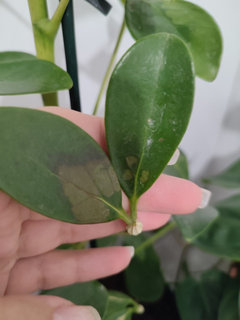
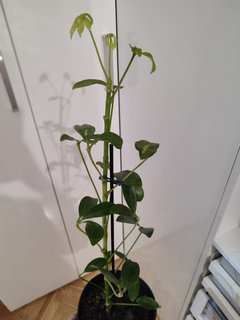
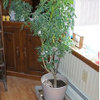
Hi everyone. I bought my schefflera about month and a half ago and it drops leaves ever since. They are not crispy but do turn somewhat brown before they drop. However, it also has new growth. Can it be due to temperature change (it was in a quite low temperature place where I bought it, while it is quite warm in my apartment since my apartment has central heating). Thank you for your answers.

Comments (12)

  • 4 years ago

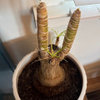
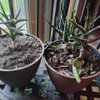
    Please find them below.

  • 4 years ago

    Definitely. The exposure to cold temps could be a factor too. When I leave mine outside in almost-frosty temps, the leaves turn yellow & fall off. If it gets too dry, the leaves fall off while still green.

  • 4 years ago

    What is the solution? Should I water it more (I water once a week) or should I just wait and see if it adapts to warmer environment?

  • 4 years ago

    Just seeing the pics. You'll want to water often enough so that the soil is never literally all the way dry.


    This looks like a cutting that may not have finished adjusting to being cut & taking root before being sold but looks perfectly healthy. Keep it in a warm, sunny spot and it should do wonderful things.


    The leaves on this kind of plant are called compound. Each leaf has a little stem (petiole) and several leaflets. It looks like all of the lower leaves have lost most of their leaflets, so the rest of each leaf will probably fall off soon. Then side branches should start to form so it will soon look more like a little tree than a stick with leaves.

  • 4 years ago

    Thank you, will definitely follow your advices. Hope it will get better soon.

  • 4 years ago

    Happy to suggest. It does not look like there is anything wrong with it to me. It's normal for plants to manifest adjustments to various changes in conditions, especially if it was just cut & propagated, &/or exposed to temps near frost.

  • 4 years ago

    It was about 10 celsius, now in my apartment is around 22-24 (cannot be any less during winter since my apartment is surrounded by other apartments and getting most of the heat from them). Maybe the temperature is not too low itself, but I thought that maybe such transition was a shock for the plant. The window is on the southeast side (the orientation of my apartment) and been kept near the window ever since. Air is quite dry but I try to sprinkle leaves few times a week.

  • 4 years ago

    That sounds fine.

  • 4 years ago
    last modified: 4 years ago

    Scheffs, like most plants, are susceptible to shedding of leaves/ leaflets after a significant reduction in the light load from the light load experienced by the plant as the leaves first matured. Plants can adapt to some degree to changes in light loads, but when the change is beyond the plant's ability to adapt, the leaves are destined to be shed. Many trees experience the heaviest shedding of leaves during the entire growth cycle in fall, 4-6 weeks after the plant has been moved indoors.

    Low fertility, especially low N levels, often causes shedding of older leaves as the plant will scavenge N and other mobile nutrients from older foliage to fuel the new growth, so withholding fertilizer is probably not a good idea. While the advice to 'never feed sick plants' is commonly repeated, you'll find no scientific support for it. Plants need a full compliment of all nutrients in the soil solution at all times if the plant is to grow normally and keep its systems orderly. What have you been doing for nutritional supplementation?

    I think the other possible causes have pretty much been covered, but I'll list the main potentialities so you have them all in one place. Over-watering, under-watering, chill - particularly sudden chill, being rootbound, low fertility, a reduction or significant increase in light levels, and soil compaction can all cause shedding of leaves. I should also mention a high level of salts in the soil solution as a potential cause. The plant does look like it might have been over-watered in the past if not currently, so paying particular attention to getting the watering intervals right could be a game changer.

    Try watering small, easy-to-manage plantings like this:

    Newton's First Law

    For conventional container culture, it's a given that saturated/partially saturated media rob roots of the oxygen they need to function normally and efficiently. At best, soil saturation robs your plants of immense measure of potential in areas like growth, appearance, yields, ….. At worst, plants unable to cope with the strain of drought stress caused by saturated media will succumb to it. This isn't a 'scare tactic, it's a very simple and straightforward observation that will be difficult to disagree with a straight face.

    Newton's First Law of Motion states that an object will remain either at rest, or in motion at a uniform rate and in a straight line unless acted upon by an external offsetting force. In this case, we will designate the 'object' as excess water in your potting medium. At risk of my being redundant, the 'law' can be seen as a simple statement about inertia, that objects will remain in motion and in a straight line unless a force acts to change the motion. To put the law to work for you/your plantings, you should water to beyond the point of total soil saturation - so the medium has been completely saturated and at least 15-20% of the water you have applied has exited the pot. Unless your soil is purposefully constructed to eliminate all/nearly all excess water, it's extremely probable, when the pot has stopped draining, there will be too much water in the potting medium for the plants' liking.

    To eliminate this excess water: immediately after a thorough watering, hold the pot in one hand over the sink, lawn, or over-sleeping significant other and move it downward, then sharply reverse the direction to upward. You'll immediately note that a good measure of 'excess' water will “continue downward in a straight line” and exit the drain hole. The sharper the reversal of direction, the more water exits the drain hole. When you have repeated the exercise until water no longer exits the drain hole on the reversal of direction, you will have eliminated all excess water and your plants will regard you with a newfound sense of awe.

    Al

  • 4 years ago

    Anyone else think the plant is etiolated? Looks pretty pale and skinny to me at the top.

  • 4 years ago

    Absolutely - it wants much more light. That can be seen by looking closely at the length of the internodes toward the bottom of the plant and comparing them to the length of the internodes at the top of the plant, which are many times longer than those toward the bottom; although, we should at least consider the long internodes could also be explained by the cutting being taken from a rootbound plant (root congestion slows growth and particularly primary growth [branch extension] , which can dramatically limit the length of internodes). The cutting would naturally present longer internodes than the rootbound parent plant because roots would have room to run, but the length of the internodes shown in Ivana's plant are well beyond what might be explained by the later of the 2 potentialities in this post.

    Al