Software
Houzz Logo Print
moreplantsplz

Neon pothos turning yellow

4 years ago
last modified: 4 years ago
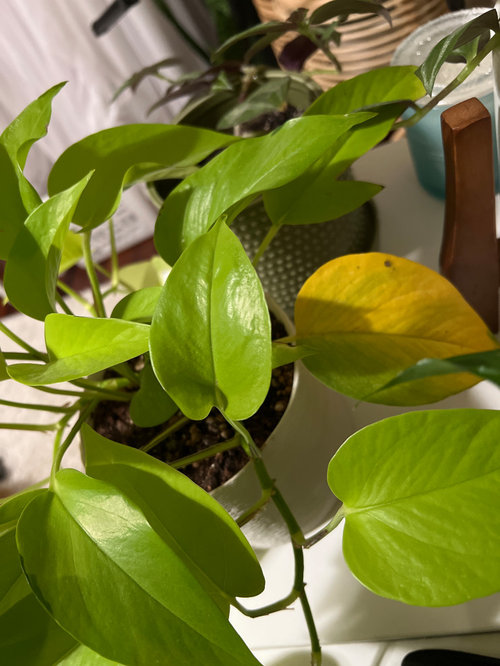


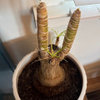
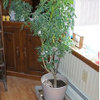
some leaves of my neon pothos turn yellow and im not sure why. I only water it when the soil is dry so it shouldnt be overwatering. i have some leaves that are thriving and starting to climb, then a random leaf here and there will randomly turn yellow. Should i repot it into a bigger pot?

Comments (8)

  • 4 years ago

    My pothos (not neon) occasionally loses leaves like that. Your pot should have a drainage hole. When you water, let it drain out thoroughly, in the sink or outside. . I think your pot size looks good, don’t pot to a bigger size. If you feel moisture down an inch or 2, hold off watering. I think your plant is fine.

    Kari thanked socks
  • 4 years ago

    it may be approaching the size where its too big for the pot ... perhaps in spring it might be time to repot ...


    but i wonder how old the media is ... media is a water management system.. retaining enough eater... and shedding excess .. when it wears out.. it doesnt do that properly ...


    so that would be a second reason to repot in spring ...


    also.. when i bring mine indoors for winter.. losing old leaves is usual ... are most of your lost leaves the oldest??? ... it appears that the one we see is right above the pot???


    lastly ... you need to make a plan ... in spring it might be time to propagate a few cuttings ... and start a new plant ... with new media.. and a clean pot ... and just be done with this old thing .... sometimes its just easier all around.. though i see nothing with yours that would make that suggestion requisite ...


    all that said.. this plant is rather forgiving.. if you want to repot it now.. it probably wouldnt matter ...


    ken

  • 4 years ago

    @socks theres no drainage hole, i bought it from the farmers market in this pot in the beginning if this year. about 8 months in it was SOO full and then started losing leaves, especislly from the middle of the plant from yellowing. ill probably repot in the spring with a pot that has a hole.

  • 4 years ago

    @ken_adrian Adrian MI cold Z5 i bought it the beginning of this year from the farmers market in that same pot - not sure how long the shop had been tryying to sell it, now im wondering if the soil is getting old…

  • 4 years ago

    Putting it in a pot with drain holes is more important than waiting for spring…I’d do it now.

    tj

    Kari thanked tsugajunkie z5 SE WI ♱
  • 4 years ago
    last modified: 4 years ago
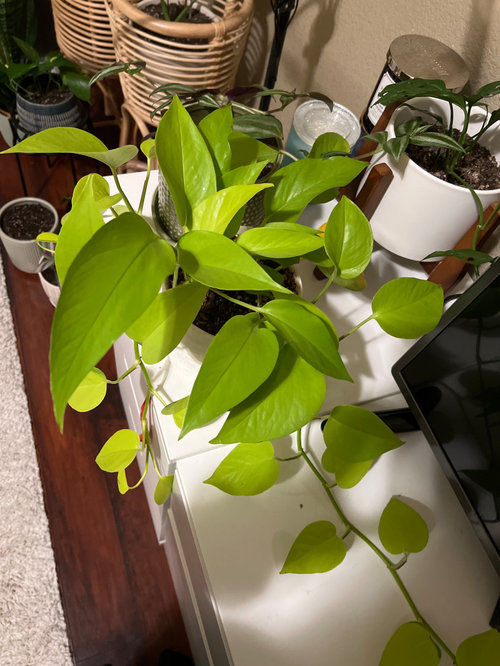
    Accompanying the fact the pot has no drain hole is the near certainty that over-watering will become an issue no matter how careful the grower is about watering or well the soil is constructed to promote aeration and drainage. Additionally, 'no drain hole' ensures that all dissolved solids (salts) in fertilizer solutions and tapwater will accumulate in the grow medium. As the level of dissolved solids increases, it limits water's ability to pass through cell membranes. Eventually, the level of salts becomes high enough that water stops moving into cells and starts moving out of cells; this, by exactly the same mechanism by which curing salts pulls water from the cells of pork for ham/ bacon, beef for beef jerky or summer sausage. The scientific name for the inhibition of water movement into cells is 'plasmolysis'; most likely because the disorder pulls plasma from cell walls, killing the cells.

    Most growers are unaware that the plant response to a high level of salts in the soil, under-watering, and over-watering, are all the same. Each of these imbalances causes a drought response which includes shedding of leaves. Over-watering robs the medium of oxygen essential to normal root function, so all three reasons limit a plants ability to take up and move water efficiently. If a plant could think, it would reason that since my water supply is dangerously limited, I'd better do something to conserve water loss. Since transpiration is by far where the most water is lost, shedding leaves is the best response to limiting water loss. BTW - if you haven't noticed any wilting of your plant, it's unlikely you've been under-watering, but not impossible. Symptoms of drought stress are first made manifest in roots.

    Since we know your plant is shedding leaves, the logical 'next step' is to determine why this is occurring (and those bases have been covered) or at least adopt cultural practices that prevent the plant from having to shed leaves to conserve water. Since a high level of dissolved solids (salts) AND over-watering are both fixable by changing to a pot with a drain hole and adopting the habit of flushing the soil regularly so salts cannot accumulate in the soil, it makes good sense to make those changes. Under-watering, if that's in play here, is easily fixed by monitoring the moisture level deep in the pot and watering at appropriate intervals. See "Using a Tell" below.

    When you switch to a pot with a drain hole, you should thoroughly flush the medium by slowly pouring a volume of room temp water equal to at least 10X the volume of the pot the plant is in evenly through the soil. This will reset the available nutrient level to near zero and should be followed by fertilizing with an appropriate fertilizer. Foliage-Pro 9-3-6 will serve you very well. It has an appropriate NPK ratio and contains all nutrients essential to normal growth.

    Using a 'tell'

    Over-watering saps vitality and is one of the most common plant assassins, so learning to avoid it is worth the small effort. Plants make and store their own energy source – photosynthate - (sugar/glucose). Functioning roots need energy to drive their metabolic processes, and in order to get it, they use oxygen to burn (oxidize) their food. From this, we can see that terrestrial plants need plenty of air (oxygen) in the soil to drive root function. Many off-the-shelf soils hold too much water and not enough air to support the kind of root health most growers would like to see; and, a healthy root system is a prerequisite to a healthy plant.

    Watering in small sips leads to avoid over-watering leads to a residual build-up of dissolved solids (salts) in the soil from tapwater and fertilizer solutions, which limits a plant's ability to absorb water – so watering in sips simply moves us to the other horn of a dilemma. It creates another problem that requires resolution. Better, would be to simply adopt a soil that drains well enough to allow watering to beyond the saturation point, so we're flushing the soil of accumulating dissolved solids whenever we water; this, w/o the plant being forced to pay a tax in the form of reduced vitality, due to prolong periods of soil saturation. Sometimes, though, that's not a course we can immediately steer, which makes controlling how often we water a very important factor.

    In many cases, we can judge whether or not a planting needs watering by hefting the pot. This is especially true if the pot is made from light material, like plastic, but doesn't work (as) well when the pot is made from heavier material, like clay, or when the size/weight of the pot precludes grabbing it with one hand to judge its weight and gauge the need for water.

    Fingers stuck an inch or two into the soil work ok for shallow pots, but not for deep pots. Deep pots might have 3 or more inches of soil that feels totally dry, while the lower several inches of the soil is 100% saturated. Obviously, the lack of oxygen in the root zone situation can wreak havoc with root health and cause the loss of a very notable measure of your plant's potential. Inexpensive watering meters don't even measure moisture levels, they measure electrical conductivity. Clean the tip and insert it into a cup of distilled water and witness the fact it reads 'DRY'.

    One of the most reliable methods of checking a planting's need for water is using a 'tell'. You can use a bamboo skewer in a pinch, but a wooden dowel rod of about 5/16” (75-85mm) would work better. They usually come 48” (120cm) long and can usually be cut in half and serve as a pair. Sharpen all 4 ends in a pencil sharpener and slightly blunt the tip so it's about the diameter of the head on a straight pin. Push the wooden tell deep into the soil. Don't worry, it won't harm the root system. If the plant is quite root-bound, you might need to try several places until you find one where you can push it all the way to the pot's bottom. Leave it a few seconds, then withdraw it and inspect the tip for moisture. For most plantings, withhold water until the tell comes out dry or nearly so. If you see signs of wilting, adjust the interval between waterings so drought stress isn't a recurring issue.

    BTW - early spring is the worst time to repot most houseplants, including pothos. Plants are normally at their lowest ebb in terms of energy reserves after a long dark winter of poor growing conditions, so an early spring repot most often means an unnecessarily long recovery period during which the plant is extra susceptible to insect herbivory and disease pathogens. Late spring, as in immediately before the summer solstice (21 June in the Northern Hemisphere) would be ideal. If you live within 20-25* of the equator, when you repot matters much less. Potting up, different and much less effective than a full repot, can be done anytime with impunity if you're careful about watering in the first months of aftercare.

    Al


    Kari thanked tapla (mid-Michigan, USDA z5b-6a)
  • 4 years ago
    last modified: 4 years ago
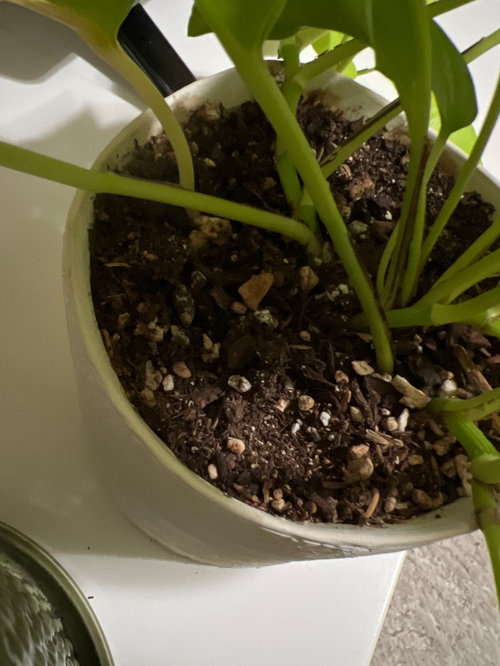
    Wow you went in. thank you!

  • 4 years ago

    Personally, I would repot now in a similar size plastic pot with holes. Use a high quality indoor potting mix from a nursery, not big box store mix. Don’t overwater. Don’t water on a schedule, water when dry. When you water, do it in the sink or outside and let the water drain through. (No sips.)