Software
Houzz Logo Print
carolyn_jenkins75

Which is the safer and more reliable rangetop?

4 years ago

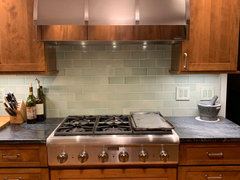
I am looking at 36 inch gas rangetops. I have heard that Bluestar’s RNB gas Rangetop’s griddle sometimes turns it self back on after you have turned if off. Sealed burner’s or open burners? Does anyone have any experience using Bluestar or Thermador gas rangetops?

Comments (31)

  • PRO
    4 years ago

    The most safe appliance is one that is installed per the manufacturer's installation instructions. Make sure your designer and builder haven't screwed this up please.

  • 4 years ago

    Induction is safer than gas, and offers the same level of control for cooking ;)

  • 4 years ago

    Induction. More rapid heating and response then gas. Simple to wipe clean.

  • 4 years ago

    I like the more obscure Fivestar, and they make rangetops too. They have a four burner plus grill/griddle and all the cast iron is made by Lodge.


    I prefer sealed burners.


    The range i installed back in 1998 is still going strong.

  • 4 years ago

    If you want reliable and easy to service yourself, nothing beats the open burners of a Bluestar. It’s old school simple. You can keep it going for decades and decades with just replacement of the igniters and cleaning. There’s nothing complicated about it enough to ever “fail”.


    Older induction units of the 70’s are also going strong. But the new crop that came on the scene circa 2000 have more shielding and need more ventilation in order for the electronics to keep cool. The jury is still out on long term fussiness and failure, even though its been 20 years. The technology and electronics has been constantly changing. Ones built 10 years ago have different components than ones built now. Induction is better as a cooking choice in many many ways, but it is also riskier to be ”once and done” in your choice, and not have to think about repair and replacement for 25 years.

  • 4 years ago

    "Induction is safer than gas, and offers the same level of control for cooking ;)"

    We don't know if induction is safer than gas or not. There is still much research needed and some issues will take time to know. And, FWIW, many radiologists and others with specialist knowledge in that area will not use induction.

    Second, the harmful effluent from cooking is the same regardless of heat source.

    Many cooking techniques are either impossible or more difficult with induction. OTOH, induction has benefits over gas in other ways.

    More: https://bamasotan.us/the-kitchen/


  • 4 years ago

    "I have heard that Bluestar’s RNB gas Rangetop’s griddle sometimes turns it self back on after you have turned if off."

    Where did you hear this?

  • 4 years ago

    • Heats faster; don’t wait for heating element to transfer to pan.

    Not really, it depends on the gas vs induction range. I don't believe there is a consumer induction that will heat faster than a 22k+ btu such as a Bluestar. No consumer induction that I'm aware of can properly do high heat high recovery such as sauté, wok or pan fry.


    And for that matter, consumer induction ranges can't have a proper thermstatic griddle/flat-top.


    • Maintains cool cooking surface; only pan gets hot, element never exposed, preventing risk of fire hazard/burns.

    Many induction tops do get hot from the pan and people on this forum have been burned.


    • Safer; does not emit gas. Won't catch objects on fire - only heats items with iron particles. Turns off when cookware removed.

    No. See my post above.


    Induction is a great option for many and probably most people but not all. Please do not post false statements and mislead people though.

  • 4 years ago
    last modified: 4 years ago

    "No consumer induction that I'm aware of can properly do high heat high recovery such as sauté, wok or pan fry."

    Then you're out of touch, because I pan fry or saute several times a month, at least. Last night, as a matter of fact, I saute-d onions and peppers for my pasta dish.

    "Many induction tops do get hot from the pan and people on this forum have been burned."

    They only get hot in the small area around the element - the heat does not spread more than an inch from the pot/pan. Very, very different than a gas stove top. I sometimes use part of my induction stove top for prepping while I am cooking with the elements on the other side, and can use the stove top for resting things like bowls and spoon rests.

    "• Safer; does not emit gas. Won't catch objects on fire - only heats items with iron particles. Turns off when cookware removed.

    No. See my post above."

    Yes. It does not emit gas, it does turn off when the cookware is removed (after a slight delay), and the elements become safe to touch within about 5 seconds after it is turned off. It won't itself catch objects on fire (but hot cookware can of course cause fires). To me, those four things alone make it safer in comparison to other cooking methods. One hundred percent safe? No. Safer? Yes.

  • 4 years ago
    last modified: 4 years ago

    The OP specifically asked about experiences with either Bluestar or Thermador gas rangetops. She was not inquiring about induction.

    I have a 36” Thermador rangetop, that’s now almost 6 years old. I didn’t want open burners, so for us the choice was between Wolf and Thermador.

    The surface of the Thermador rangetop (under the grates), is a thick black enamel, which is a breeze to clean. The grates, too, clean easily. And, while the cooking snobs here will scoff at closed burners, this rangetop does everything we need, including wok cooking.

    I don’t have a built in griddle, so I can’t speak to that. Instead, we use a portable griddle, which we can clean and put away. Hope that helps.


  • 4 years ago

    @mdln…yes, but the body of her post was more specific.

  • 4 years ago

    Thank you all for the comments. They gave me something to consider. I meet with our Contractor next week and have added the 36 RNS gas Bluestar range top with griddle as part of our Kitchen Remodel and the Bluestar refrigerator and the french door double wall oven. I just hope I am making the right decision. Still considering the BS Platinum series rangetop. We have never remodeled a kitchen before so I want to make the best selections for new appliances.

  • 4 years ago

    @darbuka made an appropriately good point. Difficult to imagine a thread going off-topic here though :-)


    "Then you're out of touch, because I pan fry or saute several times a month, at least. Last night, as a matter of fact, I saute-d onions and peppers for my pasta dish."

    No consumer products, gas or induction, have enough power to properly pan fry or sauté. You can do the technique but without a lot more heat than is available on any consumer ranges then in many cases you'll not get the results.

    There are a number of great restaurants like Per Se that are all electric which is very cool but some of their induction hobs are 3-phase electric (I believe 408v / 80a). That's more power than most entire houses.

    "To me, those four things alone make it safer in comparison to other cooking methods. One hundred percent safe? No. Safer? Yes."

    We know, or at least think we know, the risks of gas and can fairly succesfully remedy those. We do not know the risks of induction and can't remedy what we don't know. Something interesting that's come out of mRNA research is that over time induction may cause DNA lesions. This may prove totallly innocuous or may be a serious issue - we don't know.


  • 4 years ago
    last modified: 4 years ago

    "then in many cases you'll not get the results."

    Yawn.

    I know what saute is. I know what pan-frying is. I know what results are. People who think that a more powerful range will allow them to get chef-quality results don't understand that the important part of good results is the ingredients and the technique, not the equipment. A good chef can saute with good results on a consumer-level stove, and a mediocre chef will fry with mediocre results on a powerful "pro-level" stove.

    "We do not know the risks of induction"

    We know them as well as we know the risks of any decades-old technology, and that includes the new technology in our cars, our appliances, or our HVAC systems, etc. The technology in a gas stove now is not the technology that was there 10 years ago, so we don't know the risks of that either. Induction is not new, and the risks it has are many times fewer and lesser than the risks of a gas stove. If you don't like induction because it's new, then just say so, but don't make up dangers and "what if"s and "maybe"s.........You're not a new adopter, and/or someone who doesn't like change. So be it. That's fine. Admit that and move on, but don't make stuff up.

    Do you know the radiation risks of a vacuum cleaner? They're real, and the reason I choose never to vacuum, LOL, but most people use vacuum cleaners all the time in our homes.

  • 4 years ago

    "I know what saute is. I know what pan-frying is. I know what results are. People who think that a more powerful range will allow them to get chef-quality results don't understand that the important part of good results is the ingredients and the technique, not the equipment. A good chef can saute with good results on a consumer-level stove, and a mediocre chef will fry with mediocre results on a powerful "pro-level" stove."

    I wasn't going to take time to respond to this but a conversation with a couple of chef friends last night and not wanting anyone reading this thread to be misled...

    @Toronto Veterinarian's statement above is largely correct but not totally. I've stated numerous times that chef friends of mine, pro and amateur, can produce much better meals in a much lower-end kitchen with lessor appliances than I can in my fairly top-of-the-line for a residence kitchen. They have skills and knowledge that I do not.

    Part of that knowledge though is knowing what NOT to cook. As one stated, she'd never plan to sauté asparagus in any residence (gas or induction) including mine because the heat isn't there. Without the heat there is no way to have it come out right. She might do it on someone's grill though or possibly a wok burner if the heat is concentrated enough.

    According to these chef's, and this is what I've heard from numerous other chef's and what I was taught... It is impossible to properly sauté on less than about a 30k btu burner and even that may not be sufficient in some cases such as larger pans or some items that need higher heat. There are two issues. The first is the amount of heat needed for the food to properly carmelize and do so very quickly without otherwise affecting the food. The hotter the surface the faster this happens and the less the food is negatively affected. The second bit is recovery time - without enough heat below it, the pan will cool too quickly when food is added.

    No matter how good of a chef someone is, they cannot change physics.

    FWIW, I'll sauté asparagus on my RNB and be quite happy with the results. However, if I were served the same thing in Per Se (which I believe is all commercial induction btw) I'd not be happy because I would have expected better.

    One interesting thing to note is that chef's consider 30-40k btu cooking 'medium'. Saying 'high heat' is reserved for wok, plancha, open flame, etc.

    -----

    For probably 95% of people buying a range, none of this means much. For the 5% who really like to cook and who invest time in learning to cook better and learning to cook a variety of different things it might be the difference in a kitchen they love to cook in and one they don't. Some things simply cannot be done well without the proper heat.

  • 4 years ago

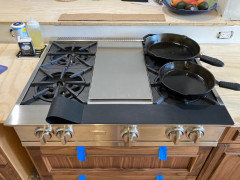
    I just bought a 36” BlueStar RNB rangetop with integrated griddle. I thought I read every review on the World Wide Web, but I don’t remember reading anything about the griddle turning itself on! We just installed it, but haven’t had a chance to cook with it yet. It seems really really awesome though.

  • 4 years ago

    Jaja06
    Please let me know how you like it after you have cooked on it. Thank you.

  • 4 years ago

    Stay far away from anything BlueStar makes. My range is only a few months old and I have had nothing but issues with it since I purchased it. I have had three repairmen out and not a single one of them would recommend BlueStar. No one wants to work on a BlueStar because they break frequently and their customer service is horrible Just check out their BBB rating.

  • 4 years ago
    last modified: 4 years ago

    @Michelle Ayer, can you provide more specifics. Model, specific problems you've had.

    What you're saying goes against what I've read and experienced.

    From a longevity/repair standpoint they are quite simple so have few things to go wrong, are easy to repair when things do go wrong, and many of the parts likely to fail like gas valves are standard commercial range parts and readily available.

    Bluestar's customer service does have a quite rough reputation. Our limited experience with them hasn't been bad though.

  • 4 years ago

    There is no mention of a hood exhaust. With such a powerful rangetop with griddle I hope you have a good exhaust hood, sized properly, with the correct ductwork.

  • 4 years ago

    Just stopping back in to say that I’m so glad we got this one! We haven’t cooked anything fancy yet, but it’s been great for all of our basic stuff. I love the griddle to cook for all the kids at once. We got a silicone mat and cut a piece to fit over the front/top because that stainless area seems very vulnerable with four kids.

  • 4 years ago

    jaj06, thank looks so nice! May I ask where you got that rubberized pad for the front of the range? I'd love one for my Wolf. They scratch so easily!

  • 4 years ago

    @telesaps I ordered this on Amazon (https://smile.amazon.com/gp/product/B09722TMDK/ref=ppx_yo_dt_b_asin_title_o01_s00?ie=UTF8&th=1) and cut a strip from one side. I put the rest into the bottom of the drawer below as a protective liner, figuring we can cut another strip when we need it. It's about 35.5" long, so there is just a bit exposed on either side, but I couldn't find any similar alternative that was actually the full 36".

  • 4 years ago

    Thank you so much!!

  • 4 years ago

    Here is a great article from Reviewed .Com about Gas verses Induction.

    Gas Vs Induction outputs

    I think you will be surprised by their findings

  • 4 years ago

    "Here is a great article from Reviewed .Com about Gas verses Induction.

    Gas Vs Induction outputs

    I think you will be surprised by their findings"

    I was surprised by the inaccuracies and slant. This appears to be a puff piece funded by mfr's.


  • 4 years ago

    Per induction, I'd encourage this read, and more on the topic not written by those who have a financial gain in the sale of this technology: https://pubmed.ncbi.nlm.nih.gov/22674188/ We were looking between rangetops and induction, doing a deep dive of the pros and cons. We are 100% back to rangetops. Anyway, please weigh. There's a lot of solid information on the matter.


  • 4 years ago

    To your original question, after many straight months of researching and looking at a wide array of rangetops online and in person, we are more than likely going with a BS 36" Platinum rangetop for its simplicity and functionality. Open burners are easier to maintain overall, and necessary replacements parts for maintenance are fairly easy to find. Here's one such resource: https://www.guaranteedparts.com/category/bluestar.html


  • 2 years ago

    My last 3 kitchen remodels, I have used BlueStar. I have a 36" RNB, have used it for 3 years, love it and have not had any issues. Prior to the last move, I had the a 36" RNB, again no issues. Home before that, had a blueStar cooktop. One caution I have is to make sure you get sufficient ventilation. The first 2 remodels, it was the last thing I chose, and I "cheaped" out on the hood selection. Made sure I did not make that mistake again!

  • 2 years ago

    I can't resist sticking my nose into the caramelization comments above.

    I think we can agree that Asian restaurants in the US with 100k BTU and up burners controlled by knee motion can caramelize serving sized quantities of food. By extrapolation, we might also agree that pre red Chinese hotels in Beijing using stoves with burners comprising a coal fire and a hole on the surface above the coal bed chamber would have been able to caramelize food. By reciprocal logic, do we believe that millions of Chinese families over centuries could not caramelize food unless they too had large coal burning stoves? I suggest that they could succeed with lesser equipment, probably with wood fires, and did so by scaling the quantity of food to the available heat density.

    Indeed, it is possible to caramelize food in my Cooktek wok on my 3500W Cooktek induction wok hob (~ 30k BTUh), IF I keep the quantity low and the power up. I suspect that if I aimed a MAPP gas torch at the bottom of a plumbing ladle with peanut oil in it I could caramelize a single piece of chicken.

    After all, the hottest the oil can get is its boiling point. Once there, the issue is whether the heat added to the cooking container equals or exceeds the rate that heat can conduct into the initially colder chicken piece such that the oil temperature is maintained (plus heat to account for the heat of vaporization of any moisture present).