Software
Houzz Logo Print
camelliaalan

Ponytail Palm in Trouble...

4 years ago
last modified: 4 years ago
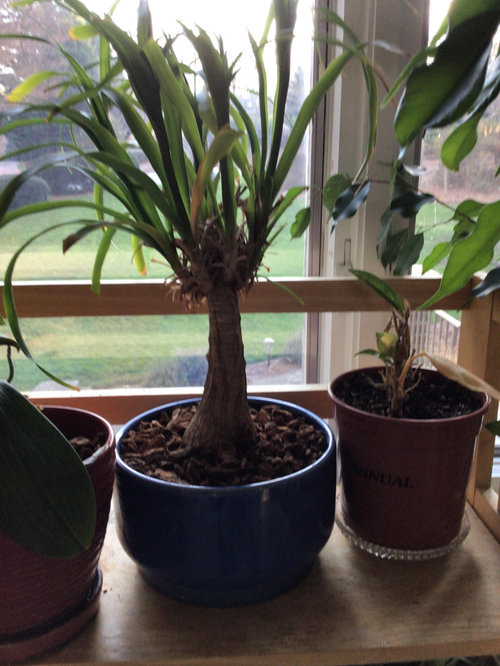
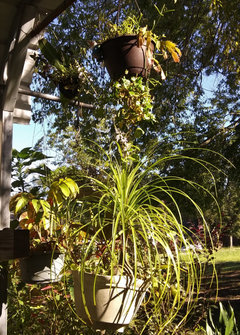
We've had a ponytail palm (see photo) for over a year.

The fronds regularly turn brown, starting at the tip, and then entirely.

This has been going on since we got the plant as a gift.

The soil is Miracle-Gro.

We only water when the soil is dry (we use a houseplant water meter to test). The soil is dry every 10 days or so (I know that is less than the recommended watering schedule).

I've tried watering less, but that only seems to increase the browning.

I'm wondering if I'm watering too little (despite the ponytail general recommendation)?

Sure would appreciate some advice...

Thanks,

Alan

P.S. - This picture shows the plant right after I removed the newest brown fronds.


Comments (17)

  • 4 years ago

    The soil is dry every 10 days or so (I know that is less than the recommended watering schedule).


    ==>>>


    water a plant when it needs it .. there really is no such thing as someone elses schedule.. since it all depends on your house ... and all the other plant variables inside your little slice of heaven .... etc ..


    does that pot have a drain hole?


    not many of us like MG media ... im wondering if it holds too much water for a palm ... even when you might think it is dry ....


    was it outside for summer.. and did you note an increase of said browning.. after bringing it in the house???


    do you heat with a forced air furnace .. how close is it to the window.. and does the window get really cold at night ... it sure doesnt look like you in a cold zone.. gazing out that window.. but we need facts about the plants cultural variables .... im repeating myself.. time to hit send ...


    ken

    camelliaalan thanked ken_adrian Adrian MI cold Z5
  • 4 years ago
    last modified: 4 years ago

    First off, it's not a palm at all!! The botanical name is Beaucarnea recurvata and it is a succulent. That big, fat trunk is a water storage organ. The Miracle Gro potting mix is not at all appropriate for this plant's needs - much too peaty and water retentive. It needs a mineral based cactus and succulent soil and most commercial ones need to be also heavily amended with additional grit or perlite to provide the very fast drainage these types of plants need.

    The plant is being over watered and is failing due to root rot. I would repot as soon as a better medium is available and also check thoroughly then for mushy, rotten roots and carefully remove. It will need minimal watering during the winter months and the soil should be quite dry (all the way through) before you water again.

    camelliaalan thanked gardengal48 (PNW Z8/9)
  • 4 years ago

    Thanks for responding, Ken!


    It's never been outside.


    It's about 2 feet from the window.


    Yes, forced air. Indoor temps always between 66 (night) and 71-75 (day).


    Humidity is low (no humidifier).


    We test soil dryness with a plant soil moisture tester. Top inch or two is almost always dry. We don't water till tester shows it's also dry beneath those top 2".


    Window is not cold (we're in NC).


    Container does not have a hole in bottom. Same container it came in.


    Definitely not root-bound.


    Thanks again,


    Alan

  • 4 years ago
    last modified: 4 years ago

    Thank you, GardenGal!

    Would this soil be okay? If yes, I will order and repot...Amazon soil

    Alan


  • 4 years ago

    Thanks, again! I will get a different pot. Should I order that Amazon soil?


    Alan

  • 4 years ago

    If you can, get this: https://www.bonsaijack.com/shop/premixed-bonsai-soil/succulent-soil/2-quarts-succulent-and-cactus-soil-mix/

    Probably the best commercial C&S potting mix available.

    camelliaalan thanked gardengal48 (PNW Z8/9)
  • 4 years ago

    Thank you (again)!!


    I ordered it (Amazon has it).


    I will repot in the new soiling in a new planter (with hole!).


    Alan

  • 4 years ago

    Just wanted to add an update (mainly for anyone who stumbles across this thread in the future)...


    I ordered the referenced soil, and I repotted the plant.


    I was then

    about to leave Feedback on Amazon when I came across the ponytail palm question (answered by Jack himself!).


    Just to be sure, I then called his company and he himself answered and spent 15 minutes on the phone with me discussing my palm.


    He was WONDERFUL!


    Bottom-line (from him): do not use that particular mix for any ponytail palm. He also said Miracle-Gro was "near perfect" for ponytails.


    After the call I repotted the palm back to Miracle-Gro (but in a new pot with a bottom hole).


    Hope the above helps someone someday.


    Thanks to all.


    Alan

  • 4 years ago

    He told you to restrict gritty mixes for succulents?


    Does he realize that Beaucarnea recurvata (Pony Tail) IS A SUCCULENT. Miracle Gro soils are mostly peat moss..., even the so-called, MG Cacti & Succulent soils. I buy MG soils but use it essential as an soil additive (in place of peat moss).

  • 4 years ago

    He said he's been growing ponytails for many years.


    We did not discuss any other plants. We only discussed the mixture suggested above for ponytails.


    (I am definitely not any sort of expert.)


    You may wish to reach out directly to Jack. Perhaps one of his other mixtures would be more appropriate?)

  • 4 years ago

    I'd respectfully suggest he doesn't know what he is talking about! Succulents - and that's precisely what the ponytail palm is - simply will not thrive (and possibly not even survive for long) in a water retentive potting mix like Miracle Gro. Even MG suggests using their cactus and succulent mix, although that would be pretty far down on my list of choices.

    But feel free to do whatever you think best. I just don't hold out much hope for long term success based on your current methodology.

  • 4 years ago

    I've never understood why people call these trees succulents. The leaves are not fleshy and if allowed to get too dry, the tips turn brown. Being able to survive a drought does not mean a plant won't look like it just had a near-death experience.


    Many plants called succulents are as thirsty as a Philodendron or Coleus, showing signs of distress and prematurely losing foliage if they get too dry.


    For ponytail, I like an un-stressed perky appearance, which requires preventing the soil from getting too dry.


  • 4 years ago

    Not all succulents have fleshy leaves. Caudiciform plants - like the beaucarnea - use their trunk or stems as waters storage features and typically ALL are considered succulents. Those water storage organs allow them to go for an extended period of time without water.

    Which is exactly what the beaucarnea wants: "Its habitat is low deciduous forest, with average temperatures of 20 °C and an annual rainfall of 800 mm, (that's only about 30 inches) and a well-marked dry season of between 7 and 8 months. They grow on rocky soils deficient in nutrients, cliffs and steep mountains. The plants are very slow growing and very tolerant to drought."

  • 4 years ago

    I too, question the suggestion that MG is about perfect for Beaucarnea recurvata, and find it hard to believe that anyone could find pluses enough to outweigh disadvantages like excess water retention, poor aeration, a perched water table of significant ht, fungus gnats, all reasons people arrive at these forums in numbers, seeking resolution for the ills caused by media better than MG products and for plants which are more tolerant of wet feet than ponytails. Excess water retention/ using inappropriate media is almost undoubtedly responsible for the largest fraction of issues we band together to help resolve on a daily basis. Whenever you're using a medium that demands you water in small sips to avoid over-watering, potential is left lying on the table.

    While we're discussing this plant, I'd like to address the common seen suggestion that the plant "thrives on neglect". Not only is that false on its face, it flies in the face of reason. For many growers, 'too much attention' means or leads to over-watering. Even if that were true, the fix for over-watering is not ignoring the plant and withholding water until it's conspicuously begging for salvation. The fix for a plant suffering from over-watering is the appropriate amount of water at appropriate intervals. With a nod to what Tiffany said above, just because the plant is able to tolerate long periods of bone-dry soil and low or skewed nutritional levels/ratios shouldn't be misconstrued to mean they need or appreciate such lax care.

    Al

  • 4 years ago

    Thanks, Al. (wave!)


    Although I've found myself with "survivor" plants over the years, I considered the compromise in appearance as a lesson learned. Try to not let that happen again unless it was done on behalf of being an experiment conducted to observe the results. When I see pics of many (not all) plants in their natural habitat, they don't exhibit the cultured, thriving appearance that most people prefer in a potted plant.


    Whether or not people agree which plants are succulents and which aren't, I reject the premise that succulent plants in particular can survive only the conditions of narrowly defined natural habitat. Some of them are just the last ones left standing in a harsh environment, and can be more ideal specimens with more (consistent) water, less sun, less temperature fluctuation - whatever the variations might be from the habitat. If they truly could not survive outside of their natural habitat, or exact replication thereof, we couldn't be collecting them into pots all over the globe and cultivating healthy specimens in a wider range of conditions.


    In peaty potting soil, I could just as easily "overwater" a Philodendron as a Crassula. It's not about how much water is applied or how often, but whether or not the roots are healthy and the other conditions within that plants' range of those which make it look great.


    I truly believe that sometimes people let a plant get so dry that it has died. Then when they water, it turns to mush, as dead organic matter does when wet, and then they think it was caused to rot by the water.


  • 4 years ago

    We're on the same page, and I'm prompted to add another thought by your saying, "Some of them [plants] are just the last ones left standing in a harsh environment, and can be more ideal specimens with more (consistent) water, less sun, less temperature fluctuation - whatever the variations might be from the habitat." Many growers reason 'it's best to try to replicate conditions the influences of which the plant grows under where it naturally occurs' (in situ), but plants do not commonly grow where they are capable of doing their very best (realizing as much of their genetic potential as possible). This, because other plants more genetically vigorous out-compete them for the most favored real estate. Often, plants growing in situ are just barely managing to hang on, unable to compete with others able to make better use of the resources. Some plants even resort to releasing allelopathic chemicals which are toxic their competitors. Most of us know of the allelopathic effects resultant of the chemical, jugulone, contained in the tree's organs, but many other common plants use chemicals to secure their right to rootage, among them are, marigold, fennel, some sunflowers, asparagus, bearberry, elderberry, garlic mustard, goldenrod, forsythia, and hundreds more.

    So, it's best to avoid trying to replicate the conditions under which the plant grows in situ, and first try a grow medium known to be appropriate for hundreds of species of other plants. The main reason is that water acts very differently in a soil/medium when in a container than it does in soils in the landscape. The other valid reason relates to what I said above, 'plants growing in situ might very likely not do best where the are fortunate (or unfortunate) enough to put down roots.

    Excluding most cacti and some succulents, there are precious few terrestrial plants that cannot be kept perfectly happy/healthy in a fast-draining, well-aerated medium.

    Al

Sponsored
Mary Shipley Interiors
Average rating: 4.8 out of 5 stars34 Reviews
Columbus OH Premier Interior Designer 10x Best of Houzz